
BuddhistCatholicContemplativeEvangelicalGeneral ChristianHinduJewishLatter-day SaintMuslimNew VisionsProgressive Christian
Beliefs
- Buddhist
- Catholic
- Contemplative
- Evangelical
- General Christian
- Hindu
- Jewish
- Latter-day Saint
- More Voices
- Muslim
- New Visions
- Pagan
- Progressive Christian
Topics
- Religion News
- Food and Religion
- Sports and Religion
- Religious Art
- Religious Music and Entertainment
- Religious Events
- History and Religion
- Style and Religion
- Politics and Religion
- Women in Religion
- Recreation Outdoors and Religion
- Business Finance and Religion
- Careers Workplace and Religion
- Education and Religion
- Family Parenting and Religion
- Health Fitness and Religion
- Home and Religion
- Relationships and Religion
- Technology and Religion
- Travel and Religion
Columnists
- Buddhist Columnists
- Business Finance and Religion Columnists
- Careers Workplace and Religion Columnists
- Catholic Columnists
- Contemplative Columnists
- Education and Religion Columnists
- Evangelists Columnists
- Family Parenting and Religion Columnists
- General Christian Columnists
- Health Fitness and Religion Columnists
- Hindu Columnists
- History and Religion Columnists
- Home and Religion Columnists
- Jewish Columnists
- More Voices Columnists
- Latter Day Columnists
- Muslim Columnists
- New Visions Columnists
- Nonreligious Columnists
- Pagan Columnists
- Politics and Religion Columnists
- Progressive Columnists
- Recreation Outdoors and Religion Columnists
- Relationships and Religion Columnists
- Religion News Columnists
- Religious Art Columnists
- Religious Events Columnists
- Religious Music and Entertainment Columnists
- Sports and Religion Columnists
- Style and Religion Columnists
- Technology and Religion Columnists
- Travel and Religion Columnists
- Women in Religion Columnists
Resource Library
- 2026 Calendar
- Library of World Religions
- The 100 Most Holy Places on Earth
- Patheos Answers
- Podcasts
- Videos
- Faith Leaders Database
- Anglican Episcopalian
- Bahai
- Baptist
- Buddhism
- Christianity
- Confucianism
- Eastern Orthodoxy
- Hinduism
- Holiness and Pentecostal
- ISKCON
- Islam
- Judaism
- Lutheran
- Methodist
- The Church of Jesus Christ of Latter-day Saints
- New Age
- Paganism
- Presbytarian and Reformed
- Protestantism
- Religion Behind the Scenes
- Roman Catholic
- Scientology
- Shia Islam
- Sikhism
- Sufism
- Sunni Islam
- Taoism
- Zen
- See all religions
Research Tools
 Ad-Free & Subscriber Log-In Subscription Support
Ad-Free & Subscriber Log-In Subscription Support
Follow Patheos 

- Trending:
- Forgiveness
- |
- Marriage
- |
- Consciousness
- |
- Death Penalty
- |
- Election
- |
- Halloween

- Home
- Religious Music & Entertainment
- Even the Faith Giants Didn’t Always Get it Right: Q&A With Frank Viola
Even the Faith Giants Didn’t Always Get it Right: Q&A With Frank Viola
Last updated on: February 26, 2019 at 1:06 pm by Lesli White
Even the Faith Giants Didn’t Always Get it Right: Q&A With Frank Viola 2019-02-26T13:06:57-07:00 Lesli White
Patheos Explore the world's faith through different perspectives on religion and spirituality! Patheos has the views of the prevalent religions and spiritualities of the world.
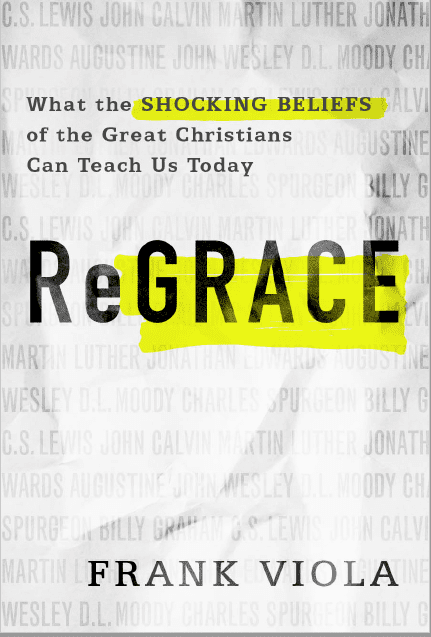 In November 2014, bestselling author Frank Viola was given a special task by Rick Warren. He asked him to write a series of articles called “Shocking Beliefs of [the Great Theologians]” on his blog. The one objective? To call for grace, civility and tolerance among Christians when they disagree with one another over doctrinal issues. This call couldn’t have come at a better time as we often see too many Christians act ungraciously toward one another when they disagree.
This series revealed that even faith giants like C.S. Lewis, Luther, Calvin, Moody, Spurgeon, Wesley, Graham and Augustine had flawed views on a number of issues. Since the “greats” didn’t always get everything right, we can be more patient with other believers when we feel they hold a flawed viewpoint.
Due to popular demand, Viola expanded the series into a short book ReGrace: What the Shocking Beliefs of the Great Christians Can Teach Us Today. Viola took the time to answer a few questions about his new book. These eye-opening responses may help soften the way you interact with others when you face theological disagreements:
1) Why did you write ReGrace?
Over the years, I’ve watched Christians destroy one another online over alleged doctrinal trespasses as well as over political disagreements.
And the vitriol has only worsened.
After watching the way countless Christians treat one another on social media when they disagree — even to the point of blocking one another — I’m convinced that if murder were legal, we’d see a lot of dead Christians who were slain at the hands of other Christians.
While I was considering a solution to this, Rick Warren read an article I wrote on my blog about Martin Luther. This provoked him to ask me to write a series of articles on Christian civility by looking at the shocking beliefs of the great Christians.
I immediately resonated with the idea and began working on the series.
The idea was that if we understood that every person who shaped the body of Christ throughout history held to some flawed views, this fact alone would give Christians pause before they raked one over the coals because of a theological disagreement.
Because the blog series was so well received, I decided to revise and expand it into a short book.
2) How will readers personally benefit from ReGrace. In other words, what’s in it for them?
I think four things.
First, they will laugh a lot. The entire book pokes fun at ourselves (including myself), and most of the chapters are peppered with humor. So it’s an entertaining read (so I’m told from those who read the manuscript).
Second, I think the historical facts will fascinate many. Discovering some of the surprising – and even shocking – beliefs that the “greats” in church history held is quite interesting.
Third, I believe that if I made my point successfully, readers will extend more grace to their fellow Christians the next time they encounter a theological or political disagreement.
Fourth, I give some practical tips on how to disagree agreeably and in a Christ-like way as well as how to identify a genuine disagreement opposed to a semantic one.
I trust the insights in the book will help readers better communicate with their fellow Christians (as well as with non believers) whenever they disagree.
3) What did you find to be the most fascinating facts in your research of the shapers of Christianity and their surprising beliefs?
Here are just a few of them (the book has many more):
- S. Lewis believed in praying for the dead, purgatory, and he believed the Bible contained errors.
- Jonathan Edwards believed it was okay to own slaves and that God hates sinners.
- Martin Luther believed that it was fine to despise Jewish people and that heretics should be put to death.
- John Calvin believed it was okay to call his opponents profane names and that some of the Old Testament capital offenses (=those requiring death) should be enforced today.
- John Wesley believed in ghosts and the perpetual virginity of Mary.
- Augustine held to some shocking beliefs about sex and marriage.
The book also treats some surprising beliefs held by Billy Graham, Charles Spurgeon, and some others.
Yet despite their shocking beliefs on certain issues, God still used each individual in remarkable ways.
In the book, I quote what George Whitefield (a Calvinist) said about John Wesley (an Arminian) when he was asked if he will see Wesley in heaven.
Here’s Whitefield’s amazing reply:
“I fear not, for he will be so near the eternal throne and we at such a distance, we shall hardly get sight of him.”
That’s perhaps the best example of “regracing” that I can point to.
4) Tell us about the word “heresy” and how Christians have misunderstood it.
In the New Testament, the words “heresy” and “heretic” don’t have to do with wrong beliefs. They have to do with creating division among a body of believers.
Heresy, then, is an action, not a belief.
Consequently, a person can be a heretic with the truth if they use that truth to create division among a body of believers.
We prove this biblically in one of the chapters.
Unfortunately, “heresy” and “heretic” have come to be degrading labels that some Christians put on those with whom they disagree. A la, “if you don’t agree with my doctrines and my theology, you’re a dirty rotten heretic!” Sigh.
5) What else do you want to say about the book?
Early readers of the book found it an eye-opening joy to read. I hope that’s the case with everyone else who picks up a copy.
People can check out free samples of the book here. That page includes ordering information as well. ReGrace.info
In ReGrace, Viola argues that the simple awareness that some of our favorite teachers in church history had blind spots and held to some false – and even shocking – views can soften Christians when they interact in the face of theological disagreements. Will you consider grace today?
The book is available for purchase March 5th.

Next Post
August 13, 2020 Rethinking Ritual for a Secular Age: An Interview with Casper ter Kuile
Browse Our Archives
Select a Category Author Q&A Book Review Christian Living Church Leadership Stump a Scholar Theology Uncategorized
Select a Month June 2022 March 2021 October 2020 August 2020 February 2019 November 2017 July 2017 June 2017 May 2017 March 2017 February 2017 January 2017 November 2016 October 2016 August 2016 July 2016 June 2016 May 2016 April 2016 March 2016 February 2016 January 2016 November 2015 October 2015 September 2015 August 2015 July 2015 June 2015 May 2015 April 2015 March 2015 February 2015 January 2015 December 2014 November 2014 October 2014 September 2014 August 2014 July 2014 June 2014 May 2014 April 2014 March 2014 February 2014 January 2014 December 2013 November 2013 October 2013 September 2013 August 2013 July 2013 June 2013 May 2013 April 2013 March 2013 February 2013 January 2013 December 2012 November 2012 October 2012 September 2012 August 2012 July 2012 June 2012 May 2012 April 2012 March 2012 February 2012 January 2012 December 2011 November 2011 October 2011 September 2011 August 2011 July 2011 June 2011 May 2011 April 2011 March 2011 February 2011 January 2011 December 2010 November 2010 October 2010 September 2010 August 2010 July 2010 June 2010
Follow Us!
TAKE THE
Religious Wisdom Quiz
What happened to Lot’s wife when she looked back at Sodom?
Select your answer to see how you score.
She turned into a pillar of salt She went blind She was swallowed by the earth She was struck by lightning
Related posts from Take and Read

Life is an Endless Invitation: Q&A With Rob...
Rethinking Ritual for a Secular Age: An Interview...

Author Lily Burana on Experiencing God's Grace and...

Learning About the Christian Faith: The Bible Is...
TRENDING AT PATHEOS Religious Music & Entertainment

"Les Diabolique" and Transgression
Alongside something like Arrival, Vertigo, or Charade, Les Diaboliques is a...

"The Plague Dogs" and Mortality
So, flashback to the late 70s, early 80s. Walt Disney Studios is...

With the recent and highly successful release of Christopher Nolan’s epic film,...

"L'avventura" and Human Weakness
Today's piece is going to be a little different for a few...

I first want to apologize for not posting or writing anything. I'm...

I've engaged in the multi-year project of reading through the Church Fathers,...
view all Religious Music & Entertainment blogs
Ad-Free & Subscriber Log-In Subscription Support
- About Us
- 2026 Calendar
- Videos
- Podcasts
- Library of World Religions
- Faith In Media Tracker
- Advertise With Us
- Write for Us
- Privacy Policy
- Terms of Service
- Do Not Sell My Data
- Contact Us
- Radiant Digital
- Manage Newsletter Subscriptions
- Unsubscribe From Notifications
- Sitemap
Copyright 2008-2026, Patheos. All rights reserved.
Subscription Support Ad-Free & Subscriber Log-In
Follow Patheos