
BuddhistCatholicContemplativeEvangelicalGeneral ChristianHinduJewishLatter-day SaintMuslimNew VisionsProgressive Christian
Beliefs
- Buddhist
- Catholic
- Contemplative
- Evangelical
- General Christian
- Hindu
- Jewish
- Latter-day Saint
- More Voices
- Muslim
- New Visions
- Pagan
- Progressive Christian
Topics
- Religion News
- Food and Religion
- Sports and Religion
- Religious Art
- Religious Music and Entertainment
- Religious Events
- History and Religion
- Style and Religion
- Politics and Religion
- Women in Religion
- Recreation Outdoors and Religion
- Business Finance and Religion
- Careers Workplace and Religion
- Education and Religion
- Family Parenting and Religion
- Health Fitness and Religion
- Home and Religion
- Relationships and Religion
- Technology and Religion
- Travel and Religion
Columnists
- Buddhist Columnists
- Business Finance and Religion Columnists
- Careers Workplace and Religion Columnists
- Catholic Columnists
- Contemplative Columnists
- Education and Religion Columnists
- Evangelists Columnists
- Family Parenting and Religion Columnists
- General Christian Columnists
- Health Fitness and Religion Columnists
- Hindu Columnists
- History and Religion Columnists
- Home and Religion Columnists
- Jewish Columnists
- More Voices Columnists
- Latter Day Columnists
- Muslim Columnists
- New Visions Columnists
- Nonreligious Columnists
- Pagan Columnists
- Politics and Religion Columnists
- Progressive Columnists
- Recreation Outdoors and Religion Columnists
- Relationships and Religion Columnists
- Religion News Columnists
- Religious Art Columnists
- Religious Events Columnists
- Religious Music and Entertainment Columnists
- Sports and Religion Columnists
- Style and Religion Columnists
- Technology and Religion Columnists
- Travel and Religion Columnists
- Women in Religion Columnists
Resource Library
- 2026 Calendar
- Library of World Religions
- The 100 Most Holy Places on Earth
- Patheos Answers
- Podcasts
- Videos
- Faith Leaders Database
- Anglican Episcopalian
- Bahai
- Baptist
- Buddhism
- Christianity
- Confucianism
- Eastern Orthodoxy
- Hinduism
- Holiness and Pentecostal
- ISKCON
- Islam
- Judaism
- Lutheran
- Methodist
- The Church of Jesus Christ of Latter-day Saints
- New Age
- Paganism
- Presbytarian and Reformed
- Protestantism
- Religion Behind the Scenes
- Roman Catholic
- Scientology
- Shia Islam
- Sikhism
- Sufism
- Sunni Islam
- Taoism
- Zen
- See all religions
Research Tools
 Ad-Free & Subscriber Log-In Subscription Support
Ad-Free & Subscriber Log-In Subscription Support
Follow Patheos 

- Trending:
- Forgiveness
- |
- Marriage
- |
- Consciousness
- |
- Death Penalty
- |
- Election
- |
- Halloween

- Home
- Religious Music & Entertainment
- 7 Billion Universes: An Interview With Deepak Chopra
7 Billion Universes: An Interview With Deepak Chopra
Last updated on: October 11, 2017 at 10:31 am by Megan Schmidt
7 Billion Universes: An Interview With Deepak Chopra 2017-10-11T10:31:49-06:00 Megan Schmidt
Patheos Explore the world's faith through different perspectives on religion and spirituality! Patheos has the views of the prevalent religions and spiritualities of the world.
by Megan Schmidt
If you pay attention to the work of astronomers, you might know that the universe was born from the Big Bang about 13.75 billion years ago, that it’s made of 70 percent dark energy, and that the universe is rapidly expanding and cooling as it ages.
What do all of these theories (or facts, depending on your worldview) have in common? It’s humans who have made these scientific discoveries—based on their knowledge, training, expertise, experiences, and the work of others in the profession before them.
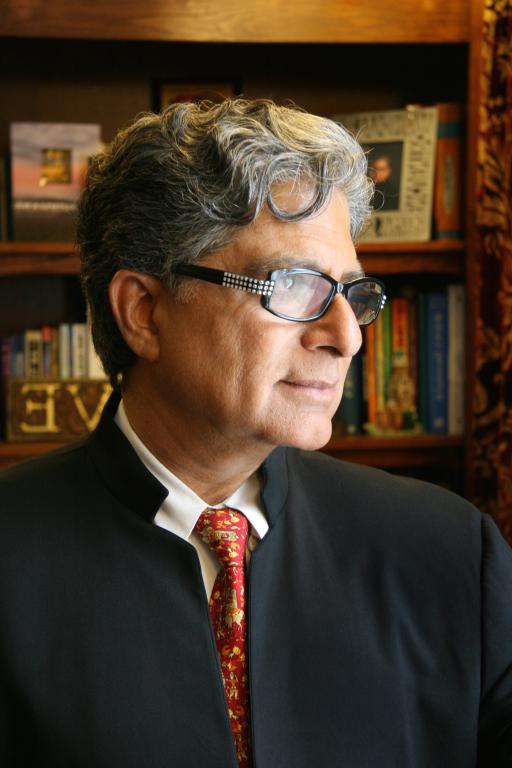
“If you go beyond the human constructs we’ve given the universe, the universe is actually our own self. We construct, govern, and become the universe, based on our senses, images, thoughts, and perceptions,” said Deepak Chopra, a New York Times bestselling author, renowned spiritual guru and medical advocate.
We are living in a golden age of science in which bodies of knowledge are growing by leaps and bounds all the time. Yet, some of the most basic questions about the universe have yet to be solved and Chopra believes it’s because we’re not looking for answers in the right places.
“There are open questions that we don’t have answers to because we don’t look at the consciousness which asks the questions and seeks the answers,” Chopra said. “Once we create a story around our experiences, we create the universe, which is our state of consciousness.”
Chopra teamed up with cosmologist Menas Kafatos to explore some of the biggest questions science can’t explain in a book that perhaps could revolutionize the way we think about ourselves, spirituality and the cosmos.
In “You Are the Universe: Discovering Your Cosmic Self and Why it Matters,” Chopra and Kafatos tread to the depths of the unknowable, impossible and unimaginable, by asking nine questions:
- What came before the Big Bang?
- Why does the universe fit together so perfectly?
- Where did time come from?
- What is the universe made of?
- Is there design in the universe?
- Is the quantum world linked to everyday life?
- Do we live in a conscious universe?
- How did life first begin?
- Does the brain create the mind?
But don’t expect a science textbook. At the heart of this book is the idea that consciousness and the cosmos are complimentary, and as we evolve to higher states of consciousness, the universe evolves within us. That affects everything—from our personal relationships, to the environments we find ourselves in, to the business that we do, and the ecosystems that live around us.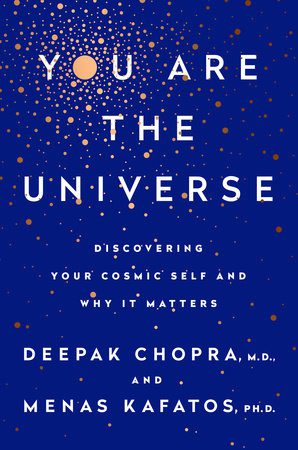
“At the core of existence there’s only interrelatedness and inseparability. At the core of existence there’s truth, beauty, goodness, and harmony,” Chopra said.
Our cosmic significance has perhaps been underestimated. Rather than existing as a tiny specks in the universe, Chopra says that each one of us is a universe and we hold the power to change our reality. That means there are 7 billion universes for the 7 billion people alive on Earth today. In the history of our planet, 108 billion people have come and gone—and their universes birthed and died along with them. There are also crocodile universes, dolphin universes, and even insect universes.
“You create your experience of the universe; without your experience there is no universe,” Chopra said. “You get a body, you get a mind, but these are constructs. The real you is not in time. Even birth and death are stories based around constructs.”
It has been said that the universe is chaotic—a sentiment that probably rings true as it relates to the lives of many citizens of Earth at this point in history. Our world seems rife with polarization, fake news, alternative facts, bigotry, hatred, racism, and many other modes of marginalization. Chopra believes that if you want to change the world, we must first get in touch with our innermost beings—which extends beyond our bodies and minds.
“When your awareness is really constricted, it’s like a person in a dark room bumping into everything … but once you turn on the light, you see that every obstacle is an opportunity,” Chopra said. “When your consciousness is totally free, it’s like a boundless universe.”
Although the central ideas of the book may seem separate from organized religion at first glance, they form the foundations of our religious experiences. The book is a synthesis of the beliefs and ideas held by the world’s religious founders and some of the most renowned philosophers that have existed in humankind, Chopra said.
“This is not my philosophy—this is the perennial philosophy discovered in the east and in the west—from the the Buddha, to Laozi, to Plato, to Wittgenstein, and many others.”
Chopra says that if we look at the experiences of the founders of organized religions, we will find three elements common in their spiritual journeys: transcendence—becoming at one with the universe; the emergence of platonic values—such as compassion, joy, and love; and the loss of the fear of death.
“God is just an name for the inevitable, infinite consciousness that us actually part of all of us,” he said.
Ultimately, Chopra hopes that this book will create dialogue between science and spirituality. He encourages anyone who aspires to grow in their understanding of their place in the world and how our universes are created to visit the website and the “Ask the Authors” discussion forums available to support the book and the broader conversation around consciousness at www.discoveringyourcosmicself.com.
“Awareness itself is the subjective realm for all experience. Most people never take time to get in touch with who they are.”
Learn more about the book (credit: Gotham Chopra, Danny Garcia, Dirty Robber Productions):
http://wp.production.patheos.com/blogs/takeandread/files/2017/02/deepak-video.mp4
Megan Schmidt is a staff writer at Patheos.
Previous Post

January 12, 2017
Don’t Get Too Comfortable: A Q&A With Erin Straza
Next Post
February 28, 2017 Living in the Age of Comfort Addiction: Q&A With Erin Straza
Browse Our Archives
Select a Category Author Q&A Book Review Christian Living Church Leadership Stump a Scholar Theology Uncategorized
Select a Month June 2022 March 2021 October 2020 August 2020 February 2019 November 2017 July 2017 June 2017 May 2017 March 2017 February 2017 January 2017 November 2016 October 2016 August 2016 July 2016 June 2016 May 2016 April 2016 March 2016 February 2016 January 2016 November 2015 October 2015 September 2015 August 2015 July 2015 June 2015 May 2015 April 2015 March 2015 February 2015 January 2015 December 2014 November 2014 October 2014 September 2014 August 2014 July 2014 June 2014 May 2014 April 2014 March 2014 February 2014 January 2014 December 2013 November 2013 October 2013 September 2013 August 2013 July 2013 June 2013 May 2013 April 2013 March 2013 February 2013 January 2013 December 2012 November 2012 October 2012 September 2012 August 2012 July 2012 June 2012 May 2012 April 2012 March 2012 February 2012 January 2012 December 2011 November 2011 October 2011 September 2011 August 2011 July 2011 June 2011 May 2011 April 2011 March 2011 February 2011 January 2011 December 2010 November 2010 October 2010 September 2010 August 2010 July 2010 June 2010
Follow Us!
TAKE THE
Religious Wisdom Quiz
How did Nehemiah show concern for the poor in Jerusalem's community?
Select your answer to see how you score.
He expelled foreigners He canceled debts and returned land He gave up rebuilding He doubled taxes
Related posts from Take and Read

"The Slow March of Light" Highlights The Human...

"A Brilliant Night of Stars and Ice" Recounts...

How To Judge The Bible By Its Cover

Life is an Endless Invitation: Q&A With Rob...
TRENDING AT PATHEOS Religious Music & Entertainment

"Les Diabolique" and Transgression
Alongside something like Arrival, Vertigo, or Charade, Les Diaboliques is a...

"The Plague Dogs" and Mortality
So, flashback to the late 70s, early 80s. Walt Disney Studios is...

With the recent and highly successful release of Christopher Nolan’s epic film,...

"L'avventura" and Human Weakness
Today's piece is going to be a little different for a few...

I first want to apologize for not posting or writing anything. I'm...

I've engaged in the multi-year project of reading through the Church Fathers,...
view all Religious Music & Entertainment blogs
Ad-Free & Subscriber Log-In Subscription Support
- About Us
- 2026 Calendar
- Videos
- Podcasts
- Library of World Religions
- Faith In Media Tracker
- Advertise With Us
- Write for Us
- Privacy Policy
- Terms of Service
- Do Not Sell My Data
- Contact Us
- Radiant Digital
- Manage Newsletter Subscriptions
- Unsubscribe From Notifications
- Sitemap
Copyright 2008-2026, Patheos. All rights reserved.
Subscription Support Ad-Free & Subscriber Log-In
Follow Patheos