
BuddhistCatholicContemplativeEvangelicalGeneral ChristianHinduJewishLatter-day SaintMuslimNew VisionsProgressive Christian
Beliefs
- Buddhist
- Catholic
- Contemplative
- Evangelical
- General Christian
- Hindu
- Jewish
- Latter-day Saint
- More Voices
- Muslim
- New Visions
- Pagan
- Progressive Christian
Topics
- Religion News
- Food and Religion
- Sports and Religion
- Religious Art
- Religious Music and Entertainment
- Religious Events
- History and Religion
- Style and Religion
- Politics and Religion
- Women in Religion
- Recreation Outdoors and Religion
- Business Finance and Religion
- Careers Workplace and Religion
- Education and Religion
- Family Parenting and Religion
- Health Fitness and Religion
- Home and Religion
- Relationships and Religion
- Technology and Religion
- Travel and Religion
Columnists
- Buddhist Columnists
- Business Finance and Religion Columnists
- Careers Workplace and Religion Columnists
- Catholic Columnists
- Contemplative Columnists
- Education and Religion Columnists
- Evangelists Columnists
- Family Parenting and Religion Columnists
- General Christian Columnists
- Health Fitness and Religion Columnists
- Hindu Columnists
- History and Religion Columnists
- Home and Religion Columnists
- Jewish Columnists
- More Voices Columnists
- Latter Day Columnists
- Muslim Columnists
- New Visions Columnists
- Nonreligious Columnists
- Pagan Columnists
- Politics and Religion Columnists
- Progressive Columnists
- Recreation Outdoors and Religion Columnists
- Relationships and Religion Columnists
- Religion News Columnists
- Religious Art Columnists
- Religious Events Columnists
- Religious Music and Entertainment Columnists
- Sports and Religion Columnists
- Style and Religion Columnists
- Technology and Religion Columnists
- Travel and Religion Columnists
- Women in Religion Columnists
Resource Library
- 2026 Calendar
- Library of World Religions
- The 100 Most Holy Places on Earth
- Patheos Answers
- Podcasts
- Videos
- Faith Leaders Database
- Anglican Episcopalian
- Bahai
- Baptist
- Buddhism
- Christianity
- Confucianism
- Eastern Orthodoxy
- Hinduism
- Holiness and Pentecostal
- ISKCON
- Islam
- Judaism
- Lutheran
- Methodist
- The Church of Jesus Christ of Latter-day Saints
- New Age
- Paganism
- Presbytarian and Reformed
- Protestantism
- Religion Behind the Scenes
- Roman Catholic
- Scientology
- Shia Islam
- Sikhism
- Sufism
- Sunni Islam
- Taoism
- Zen
- See all religions
Research Tools
 Ad-Free & Subscriber Log-In Subscription Support
Ad-Free & Subscriber Log-In Subscription Support
Follow Patheos 

- Trending:
- Forgiveness
- |
- Marriage
- |
- Consciousness
- |
- Death Penalty
- |
- Election
- |
- Halloween

- Home
- Religious Music & Entertainment
- Paul and His Passionate Priorities: A Q&A with E. Randolph Richards and Brandon O’Brien
Paul and His Passionate Priorities: A Q&A with E. Randolph Richards and Brandon O’Brien
Last updated on: November 22, 2016 at 1:50 pm by K. Mulhern
Paul and His Passionate Priorities: A Q&A with E. Randolph Richards and Brandon O’Brien 2016-11-22T13:50:47-07:00 K. Mulhern
Patheos Explore the world's faith through different perspectives on religion and spirituality! Patheos has the views of the prevalent religions and spiritualities of the world.
Paul has often been a lightning rod for the church. Jesus may be called “meek and mild,” but no one has ever thought of Paul that way. From the beginning, he challenged everyone—apostles, church members, Roman authorities, fellow Jews. His writings are dense, passionate, and at times, as Peter wrote, “hard to understand.” Yet his zeal only matches his confidence in the power of Christ to change the world.
Brandon O’Brien and Randolph Richards have tackled Paul’s reputation head-on. Point by point, they weigh the charges against him—accusations of racism, misogyny, meddling, and more. Patheos had a chance to ask the authors some questions that readers might have as they consider Paul.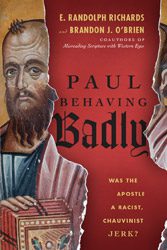
In some ways, Pauline material has “fallen on hard times.” People seem to want to pit Paul against Jesus. How do you tackle that division?
At some level, Paul has a PR problem. Whether or not people believe Jesus is the Son of God, they still seem to give him the benefit of the doubt. Jesus says nice things to the Samaritan woman at the well (John 4), so today people think, “Jesus treats women well.” The story of Jesus forgiving a woman caught in adultery is world famous (John 7:53-8:11), so Jesus is known as loving and forgiving. They sweep under the rug Jesus calling the Canaanite woman a dog (Matthew 15:26). Paul is known as anti-women despite promoting women as church leaders (Romans 16:1, 7). Few remember Paul urging the forgiveness of an offending brother (2 Corinthians 2:5-8). It is Jesus who talks all the time about hell; Paul never does. Yet Paul is the one often called judgmental, not Jesus. Many people expect to see cantankerous behavior from Paul and, for that reason, they see in his letters.
What kind of man do you think Paul really was? Would you have gotten along with him?
We suspect Paul was a Type A, driven person. He seems to have been very comfortable with subordinates but not so much with peers—there were lots of Timothys (i.e. disciples) in his life and very few Lukes (i.e., colleagues). Brandon might have gotten along with Paul—he’s younger and Paul liked to mentor. Randy is older, and the two of them might have butted heads.
Paul might have been hard to get along with for all the same reasons that he would be easy to respect. He seems like a man of conviction, with a clear sense of calling that he didn’t waver from. Stubbornness is what made Paul return to Lystra after just being pelted with stones and run out of town. We admire Paul’s stubbornness in that situation but resent it other times. We don’t like that Paul says “follow my example” (1 Corinthians 11:1), but when he is brave enough to preach to angry mobs, face dangerous storms, and witness even to governors and kings, we wish we were that brave and could follow his example.
Do you think Paul is as offensive to people today as he was to the Romans and to the Jews? How can we explain this in an age where we equate Christian with “being nice”?
No. He is almost certainly less offensive to people today than he was to the Romans and Jews of his own day. His views were even more countercultural back then. He had the audacity to tell a Roman man how to treat people in his own house. We say a man’s home is his castle, but in first-century Rome they really meant it. It was off limits. He told the Jews that their Law and their Temple had been replaced by the Spirit of God. That’s a real no-no.
None of this is to say that Paul endorsed being adversarial. After all, Paul commanded, “as far as it depends on you, live at peace with everyone” (Romans 12:18). Kindness, gentleness, and humility were important to Paul—they among the fruit of the Spirit (Galatians 5:22). But he never sacrificed the Gospel to spare someone’s feelings.
Paul encourages believers to imitate him. This seems really arrogant. Can you explain this?
Context helps here. Remember that when Paul was preaching and teaching, the gospels had not yet been written. Paul tells the Galatians, “Before your very eyes Jesus Christ was clearly portrayed as crucified” (Galatians 3:1). The Galatians weren’t at Calvary. They saw the example of Jesus’s self-sacrifice lived out by Paul. Paul was slandered, abused, and even stoned in Galatia (Lystra) but loved the Galatians and sacrificed for them. The example they saw of a godly, Christian life was the one they saw in Paul. If they wanted to live a life worthy of Christ, the only way they could know what that meant was by watching, and imitating, Paul’s example.
Besides, people were much more accustomed to the idea of discipleship in the first century. Every good philosopher or rabbi had disciples who learned from them—that’s just how education worked at the time. (It is how modern medicine is often taught today. Residents follow the teaching physician and are supposed to imitate him or her.) And you didn’t just learn ideas from a teacher. You learned lifestyle, attitudes, and actions by imitating a master.
In several of the chapters, you place Paul in a contrary position to culture, and yet he is rarely as draconian about his arguments as he could have been. What lessons can we take away from this about our own engagements with culture?
Paul never focused on issues, the way we often do today. He was concerned first and foremost—and maybe exclusively—about the Gospel of Christ. Of course the Gospel has implications for all of life, including relationships and social institutions and so on. But Paul’s starting place was to get the Gospel right, to urge his readers to recognize and embrace the power of Christ in their lives, and trust that the Spirit would do His work in them. The balance Paul had to strike was pointing both Jewish-background believers and Gentile-background believers toward the path of righteousness without instituting a new law. He ran afoul of the many cultures he engaged because he was always warning against self-righteousness on the one hand and self-indulgence on the other. After all, Paul had both former Pharisees and Epicureans in his churches. His teachings usually had one, and often both, angry with him. Today, Christians can often find themselves in the same place.
Previous Post

November 15, 2016
In the Driver's Seat: A Patheos Q&A with Rob Fuquay
Next Post
November 23, 2016 Living With and Loving the Saints: A Patheos Q&A with Fr. James Martin
Browse Our Archives
Select a Category Author Q&A Book Review Christian Living Church Leadership Stump a Scholar Theology Uncategorized
Select a Month June 2022 March 2021 October 2020 August 2020 February 2019 November 2017 July 2017 June 2017 May 2017 March 2017 February 2017 January 2017 November 2016 October 2016 August 2016 July 2016 June 2016 May 2016 April 2016 March 2016 February 2016 January 2016 November 2015 October 2015 September 2015 August 2015 July 2015 June 2015 May 2015 April 2015 March 2015 February 2015 January 2015 December 2014 November 2014 October 2014 September 2014 August 2014 July 2014 June 2014 May 2014 April 2014 March 2014 February 2014 January 2014 December 2013 November 2013 October 2013 September 2013 August 2013 July 2013 June 2013 May 2013 April 2013 March 2013 February 2013 January 2013 December 2012 November 2012 October 2012 September 2012 August 2012 July 2012 June 2012 May 2012 April 2012 March 2012 February 2012 January 2012 December 2011 November 2011 October 2011 September 2011 August 2011 July 2011 June 2011 May 2011 April 2011 March 2011 February 2011 January 2011 December 2010 November 2010 October 2010 September 2010 August 2010 July 2010 June 2010
Follow Us!
TAKE THE
Religious Wisdom Quiz
What did God use to guide the Israelites by night in the wilderness?
Select your answer to see how you score.
The moon A cloud A torch A pillar of fire
Related posts from Take and Read

Life is an Endless Invitation: Q&A With Rob...
Rethinking Ritual for a Secular Age: An Interview...

Even the Faith Giants Didn’t Always Get it...

Author Lily Burana on Experiencing God's Grace and...
TRENDING AT PATHEOS Religious Music & Entertainment

"Les Diabolique" and Transgression
Alongside something like Arrival, Vertigo, or Charade, Les Diaboliques is a...

"The Plague Dogs" and Mortality
So, flashback to the late 70s, early 80s. Walt Disney Studios is...

With the recent and highly successful release of Christopher Nolan’s epic film,...

"L'avventura" and Human Weakness
Today's piece is going to be a little different for a few...

I first want to apologize for not posting or writing anything. I'm...

I've engaged in the multi-year project of reading through the Church Fathers,...
view all Religious Music & Entertainment blogs
Ad-Free & Subscriber Log-In Subscription Support
- About Us
- 2026 Calendar
- Videos
- Podcasts
- Library of World Religions
- Faith In Media Tracker
- Advertise With Us
- Write for Us
- Privacy Policy
- Terms of Service
- Do Not Sell My Data
- Contact Us
- Radiant Digital
- Manage Newsletter Subscriptions
- Unsubscribe From Notifications
- Sitemap
Copyright 2008-2026, Patheos. All rights reserved.
Subscription Support Ad-Free & Subscriber Log-In
Follow Patheos