
BuddhistCatholicContemplativeEvangelicalGeneral ChristianHinduJewishLatter-day SaintMuslimNew VisionsProgressive Christian
Beliefs
- Buddhist
- Catholic
- Contemplative
- Evangelical
- General Christian
- Hindu
- Jewish
- Latter-day Saint
- More Voices
- Muslim
- New Visions
- Pagan
- Progressive Christian
Topics
- Religion News
- Food and Religion
- Sports and Religion
- Religious Art
- Religious Music and Entertainment
- Religious Events
- History and Religion
- Style and Religion
- Politics and Religion
- Women in Religion
- Recreation Outdoors and Religion
- Business Finance and Religion
- Careers Workplace and Religion
- Education and Religion
- Family Parenting and Religion
- Health Fitness and Religion
- Home and Religion
- Relationships and Religion
- Technology and Religion
- Travel and Religion
Columnists
- Buddhist Columnists
- Business Finance and Religion Columnists
- Careers Workplace and Religion Columnists
- Catholic Columnists
- Contemplative Columnists
- Education and Religion Columnists
- Evangelists Columnists
- Family Parenting and Religion Columnists
- General Christian Columnists
- Health Fitness and Religion Columnists
- Hindu Columnists
- History and Religion Columnists
- Home and Religion Columnists
- Jewish Columnists
- More Voices Columnists
- Latter Day Columnists
- Muslim Columnists
- New Visions Columnists
- Nonreligious Columnists
- Pagan Columnists
- Politics and Religion Columnists
- Progressive Columnists
- Recreation Outdoors and Religion Columnists
- Relationships and Religion Columnists
- Religion News Columnists
- Religious Art Columnists
- Religious Events Columnists
- Religious Music and Entertainment Columnists
- Sports and Religion Columnists
- Style and Religion Columnists
- Technology and Religion Columnists
- Travel and Religion Columnists
- Women in Religion Columnists
Resource Library
- 2026 Calendar
- Library of World Religions
- The 100 Most Holy Places on Earth
- Patheos Answers
- Podcasts
- Videos
- Faith Leaders Database
- Anglican Episcopalian
- Bahai
- Baptist
- Buddhism
- Christianity
- Confucianism
- Eastern Orthodoxy
- Hinduism
- Holiness and Pentecostal
- ISKCON
- Islam
- Judaism
- Lutheran
- Methodist
- The Church of Jesus Christ of Latter-day Saints
- New Age
- Paganism
- Presbytarian and Reformed
- Protestantism
- Religion Behind the Scenes
- Roman Catholic
- Scientology
- Shia Islam
- Sikhism
- Sufism
- Sunni Islam
- Taoism
- Zen
- See all religions
Research Tools
 Ad-Free & Subscriber Log-In Subscription Support
Ad-Free & Subscriber Log-In Subscription Support
Follow Patheos 

- Trending:
- Forgiveness
- |
- Marriage
- |
- Consciousness
- |
- Death Penalty
- |
- Election
- |
- Halloween

- Home
- Religious Music & Entertainment
- Living With and Loving the Saints: A Patheos Q&A with Fr. James Martin
Living With and Loving the Saints: A Patheos Q&A with Fr. James Martin
Last updated on: November 23, 2016 at 4:46 pm by K. Mulhern
Living With and Loving the Saints: A Patheos Q&A with Fr. James Martin 2016-11-23T16:46:03-07:00 K. Mulhern
Patheos Explore the world's faith through different perspectives on religion and spirituality! Patheos has the views of the prevalent religions and spiritualities of the world.
Ten years ago, Fr. James Martin wrote a best-seller: My Life With the Saints. In it, he introduced sixteen Catholic saints and wove their stories into his. Now he has updated this memoir with his reflections on the saints, his own yearning for saintliness, and new stories. Patheos invited Fr. Martin to answer some of the questions our readers might have as they encounter Fr. Martin’s wisdom and explore the lives of these men and women who have so powerfully changed human history.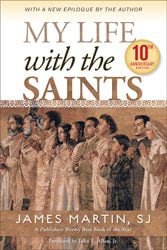
First of all, this book is an update from your best-selling memoir. Tell us, what has really changed and what hasn’t?
What’s changed is that my understanding of sanctity has deepened. Specifically, I understand better than I did ten years ago how hard it is. Perhaps when you’re younger you think that all you need to do is know and follow the Gospels, and then you start your path to sanctity. That is, the knowledge of what to do seems sufficient. Then you just do it. But as will not be a surprise to many people, but it took me a while to figure it out, it’s hard work. Forgiveness is hard. Loving is hard. Mercy is hard. So my appreciation for that has deepened, I think.
What’s not changed is my love for the saints. I still feel such fondness for them, see them as my examples and pray for their intercession. If anything, my love for them has grown since the first edition was published ten years ago.
Which of the saints you write about was most central to your experience before? And has that changed?
Before, it was John XXIII, who is now Saint John XXIII. (One of the fun things about the new edition was seeing how many of the holy men and women who were on the way to canonization have “moved up.” So we now have Saints John XXIII and Teresa of Calcutta, as well as Servants of God Dorothy Day and Pedro Arrupe.) I looked to John—and still do—as an avatar of how to live a joyful life in the church. Now, however—and this will sound funny—I think more about St. Ignatius Loyola. Of course, as a Jesuit my life was always colored by his spirituality, but in the last ten years I have come to love and know him more. So he’s more the center now. I hope John XXIII isn’t too upset!
Which saint do you most resonate with?
Again, John XXIII. I find his open-hearted joy and his lighthearted humor completely to my liking. And he was also not above some sly humor. He was once asked, “How many people work in the Vatican?” And he said, “About half of them.” I love that.
Which do you wish you were more like?
Oh, definitely St. Thérèse of Lisieux. I love that she decided that in the Body of Christ she would be the heart. That’s so beautiful. I need to love more, as she did, all the time, even with people who annoyed her. I think of her every day.
If you were to add another two or three saints, which might make the list?
Well, in fact, I ended up mentioning that in the new epilogue to the book. When I first wrote it, I didn’t want to have too many Jesuits. There are three: St. Ignatius, St. Aloysius Gonzaga, and Servant of God Pedro Arrupe. So I intentionally left out some of my favorite saints, a group of them really: St. Isaac Jogues and Companions, also known as the “North American Martyrs.” I’m always moved by the stories of missionaries. It’s a clarifying thing to ask yourself, “Would you leave everything you know—your country, your family and friends, your language, your culture, your comfort—to bring the Gospel to a people you had never met before, at the risk of your life?”
If some day you were to become a saint, what would your chapter title be called?
Ha! That will never happen. So the chapter will be called “Not a Saint!”
What are some ways that ordinary Christians could emulate these great Christians?
By remembering that, as Thomas Merton said, “For me to be a saint means to be myself.” That is, you don’t have to become Mother Teresa. You’re already you. And within you in the seed for sanctity in your own life. You just have to let it flower in the soil that is your existence.
Your concluding chapter is called “Holy in a Different Way.” Can you give us a hint about what you mean by that?
It’s similar to the idea of being yourself. We’re called to saints in different ways—with our unique personalities and in our own situations. It was the same for the canonized saints. Mother Teresa, for example, was very different from John XXIII and St. Ignatius Loyola. Very different! That doesn’t mean she was any less holy. Or that they were! They were “holy in a different way,” which is a quote from John XXIII.
Being holy sometimes means choosing different paths, too. Just think of St. John Paul II and Pope Emeritus Benedict XVI. Now Benedict is not a saint, but I think we can agree he’s a very holy man. When they were confronted with the same question: “Should I resign the papacy if I am infirm?” they arrived at totally different answers. John Paul said, in essence, “A father cannot resign from being a father,” so he stayed on. Benedict said, in essence, “If I can’t do the job I should resign,” so he resigned. Two holy men who took opposite paths. It’s being holy in a different way. Being who you are.
So what practices best help you as you’re “still trying to be a saint”?
That’s an easy question, since I try to follow them every day. Being loving and patient. Always giving people the benefit of the doubt. Not being a jerk even if I’m in a bad mood. Being generous to the poor and advocating for the marginalized. Praying. Offering someone a kind word when they need it. And then, loving some more.
Next Post

November 29, 2016 Angels Among Us: A Patheos Q&A with Joan Wester Anderson
Browse Our Archives
Select a Category Author Q&A Book Review Christian Living Church Leadership Stump a Scholar Theology Uncategorized
Select a Month June 2022 March 2021 October 2020 August 2020 February 2019 November 2017 July 2017 June 2017 May 2017 March 2017 February 2017 January 2017 November 2016 October 2016 August 2016 July 2016 June 2016 May 2016 April 2016 March 2016 February 2016 January 2016 November 2015 October 2015 September 2015 August 2015 July 2015 June 2015 May 2015 April 2015 March 2015 February 2015 January 2015 December 2014 November 2014 October 2014 September 2014 August 2014 July 2014 June 2014 May 2014 April 2014 March 2014 February 2014 January 2014 December 2013 November 2013 October 2013 September 2013 August 2013 July 2013 June 2013 May 2013 April 2013 March 2013 February 2013 January 2013 December 2012 November 2012 October 2012 September 2012 August 2012 July 2012 June 2012 May 2012 April 2012 March 2012 February 2012 January 2012 December 2011 November 2011 October 2011 September 2011 August 2011 July 2011 June 2011 May 2011 April 2011 March 2011 February 2011 January 2011 December 2010 November 2010 October 2010 September 2010 August 2010 July 2010 June 2010
Follow Us!
TAKE THE
Religious Wisdom Quiz
Great is your faithfulness! Your mercies are new every what?
Select your answer to see how you score.
Morning Hour Day Season
Related posts from Take and Read

Life is an Endless Invitation: Q&A With Rob...
Rethinking Ritual for a Secular Age: An Interview...

Even the Faith Giants Didn’t Always Get it...

Author Lily Burana on Experiencing God's Grace and...
TRENDING AT PATHEOS Religious Music & Entertainment

"Les Diabolique" and Transgression
Alongside something like Arrival, Vertigo, or Charade, Les Diaboliques is a...

"The Plague Dogs" and Mortality
So, flashback to the late 70s, early 80s. Walt Disney Studios is...

With the recent and highly successful release of Christopher Nolan’s epic film,...

"L'avventura" and Human Weakness
Today's piece is going to be a little different for a few...

I first want to apologize for not posting or writing anything. I'm...

I've engaged in the multi-year project of reading through the Church Fathers,...
view all Religious Music & Entertainment blogs
Ad-Free & Subscriber Log-In Subscription Support
- About Us
- 2026 Calendar
- Videos
- Podcasts
- Library of World Religions
- Faith In Media Tracker
- Advertise With Us
- Write for Us
- Privacy Policy
- Terms of Service
- Do Not Sell My Data
- Contact Us
- Radiant Digital
- Manage Newsletter Subscriptions
- Unsubscribe From Notifications
- Sitemap
Copyright 2008-2026, Patheos. All rights reserved.
Subscription Support Ad-Free & Subscriber Log-In
Follow Patheos