
BuddhistCatholicContemplativeEvangelicalGeneral ChristianHinduJewishLatter-day SaintMuslimNew VisionsProgressive Christian
Beliefs
- Buddhist
- Catholic
- Contemplative
- Evangelical
- General Christian
- Hindu
- Jewish
- Latter-day Saint
- More Voices
- Muslim
- New Visions
- Pagan
- Progressive Christian
Topics
- Religion News
- Food and Religion
- Sports and Religion
- Religious Art
- Religious Music and Entertainment
- Religious Events
- History and Religion
- Style and Religion
- Politics and Religion
- Women in Religion
- Recreation Outdoors and Religion
- Business Finance and Religion
- Careers Workplace and Religion
- Education and Religion
- Family Parenting and Religion
- Health Fitness and Religion
- Home and Religion
- Relationships and Religion
- Technology and Religion
- Travel and Religion
Columnists
- Buddhist Columnists
- Business Finance and Religion Columnists
- Careers Workplace and Religion Columnists
- Catholic Columnists
- Contemplative Columnists
- Education and Religion Columnists
- Evangelists Columnists
- Family Parenting and Religion Columnists
- General Christian Columnists
- Health Fitness and Religion Columnists
- Hindu Columnists
- History and Religion Columnists
- Home and Religion Columnists
- Jewish Columnists
- More Voices Columnists
- Latter Day Columnists
- Muslim Columnists
- New Visions Columnists
- Nonreligious Columnists
- Pagan Columnists
- Politics and Religion Columnists
- Progressive Columnists
- Recreation Outdoors and Religion Columnists
- Relationships and Religion Columnists
- Religion News Columnists
- Religious Art Columnists
- Religious Events Columnists
- Religious Music and Entertainment Columnists
- Sports and Religion Columnists
- Style and Religion Columnists
- Technology and Religion Columnists
- Travel and Religion Columnists
- Women in Religion Columnists
Resource Library
- 2026 Calendar
- Library of World Religions
- The 100 Most Holy Places on Earth
- Patheos Answers
- Podcasts
- Videos
- Faith Leaders Database
- Anglican Episcopalian
- Bahai
- Baptist
- Buddhism
- Christianity
- Confucianism
- Eastern Orthodoxy
- Hinduism
- Holiness and Pentecostal
- ISKCON
- Islam
- Judaism
- Lutheran
- Methodist
- The Church of Jesus Christ of Latter-day Saints
- New Age
- Paganism
- Presbytarian and Reformed
- Protestantism
- Religion Behind the Scenes
- Roman Catholic
- Scientology
- Shia Islam
- Sikhism
- Sufism
- Sunni Islam
- Taoism
- Zen
- See all religions
Research Tools
 Ad-Free & Subscriber Log-In Subscription Support
Ad-Free & Subscriber Log-In Subscription Support
Follow Patheos 

- Trending:
- Forgiveness
- |
- Marriage
- |
- Consciousness
- |
- Death Penalty
- |
- Election
- |
- Halloween

- Home
- Religious Music & Entertainment
- Jewish-Christian Difference and Modern Jewish Identity
Jewish-Christian Difference and Modern Jewish Identity
Last updated on: July 20, 2016 at 2:24 pm by Guest Contributor
Jewish-Christian Difference and Modern Jewish Identity 2016-07-20T14:24:13-06:00 Guest Contributor
Patheos Explore the world's faith through different perspectives on religion and spirituality! Patheos has the views of the prevalent religions and spiritualities of the world.
 By Gordon Newby
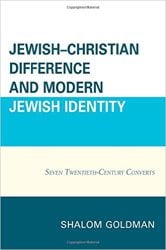
Shalom Goldman has shown in his previous writings that he has a keen eye for those places where Jews and Judaism rub up against other cultures and where various strains of Judaisms clash with one another. In his latest work, Jewish-Christian Difference and Modern Jewish Identity, Goldman goes right to the heart of Judaism’s being by examining seven well-chosen twentieth century examples of individuals who became Jewish, who tried to leave Judaism, and one who tried to live within a Judaism changed to fit his beliefs and practices.
Along the way, Goldman shows us that it’s not easy to become Jewish, even harder to try to leave, and, maybe most difficult of all, to remain Jewish in the face of changing beliefs. Most of all, Goldman’s narratives lead us to understand that neither the individual nor a reified Judaism is at the heart of issues of conversion and identity, but that at the center lie competing groups struggling to control the issue of “Who is a Jew.”
While the main narratives in this important work are from the twentieth century, Goldman starts with the conversion of Ruth. The biblical story portrays Ruth as a Moabite woman who marries the Hebrew, Elimelech, who dies, leaving her a widow. Rather than return to Moab, Ruth vows to join the people of her mother-in- law, Naomi. As presented in the book of Ruth, this appears to be another biblical inversion story: Ruth, the Moabite outsider is widowed and impoverished, but is saved by Boaz, who marries her, and she becomes the great-grandmother of King David. When this story is established in the biblical canon, however, it becomes treated as history, and biblical Judaism becomes a tradition open to converts.
After the destruction of the Temple in 70 C.E., Judaism becomes an interiorized religion concerned with issues of purity and presided over by rabbis who are concerned with defining and controlling the boundaries of what becomes modern Judaism. Ruth’s personal initiative now becomes interrogated by rabbis acting as gatekeepers to keep the worthy in and the unworthy out. Building fences around the Torah controls migration and keeps the rabbis at the center who is a Jew. In the Gaonic and Islamic periods, rabbinic control and rabbinic politics helped Rabbinic Judaism become the dominant form of Judaism against Karaites, Issawiyyah and other Jewish competitors as well as guarding the great divide between Rabbinic Judaism and Christianity.
Goldman’s salient condensation of this history brings us to the twentieth century and the newest competitor to Rabbinic Judaism: Zionism. As we weave our way through each of Goldman’s seven examples, we see how the rabbis contrive to maintain control of the gates of Judaism. We also see how, in the process, notions of race, born along with nationalism in the European nineteenth century, become accepted as part of modern Jewish identity at the same time that they were used against Jews by non-Jews and mid-twentieth century Europe. Goldman does not, and indeed cannot, provide us with a simple answer to where the problem of Who is a Jew will go, but it is clear that it is mixed with Who is an Israeli, and the issue will generate material for Goldman to soon write a sequel to this important and fascinating book.
Gordon D. Newby, PhD in Mediterranean Studies from Brandeis University, is the Goodrich C White Professor of Middle East and South Asian Studies at Emory University.
Read an excerpt from Jewish-Christian Difference and Modern Jewish Identity at the Patheos Book Club HERE.
Previous Post

June 9, 2016
Us Versus Us: A Q&A with Author Andrew Marin
Next Post
July 25, 2016 What Makes Someone Jewish? A Book Review
Browse Our Archives
Select a Category Author Q&A Book Review Christian Living Church Leadership Stump a Scholar Theology Uncategorized
Select a Month June 2022 March 2021 October 2020 August 2020 February 2019 November 2017 July 2017 June 2017 May 2017 March 2017 February 2017 January 2017 November 2016 October 2016 August 2016 July 2016 June 2016 May 2016 April 2016 March 2016 February 2016 January 2016 November 2015 October 2015 September 2015 August 2015 July 2015 June 2015 May 2015 April 2015 March 2015 February 2015 January 2015 December 2014 November 2014 October 2014 September 2014 August 2014 July 2014 June 2014 May 2014 April 2014 March 2014 February 2014 January 2014 December 2013 November 2013 October 2013 September 2013 August 2013 July 2013 June 2013 May 2013 April 2013 March 2013 February 2013 January 2013 December 2012 November 2012 October 2012 September 2012 August 2012 July 2012 June 2012 May 2012 April 2012 March 2012 February 2012 January 2012 December 2011 November 2011 October 2011 September 2011 August 2011 July 2011 June 2011 May 2011 April 2011 March 2011 February 2011 January 2011 December 2010 November 2010 October 2010 September 2010 August 2010 July 2010 June 2010
Follow Us!
TAKE THE
Religious Wisdom Quiz
What year was the Council of Nicea?
Select your answer to see how you score.
1054 AD 325 AD 500 AD 1517 AD
Related posts from Take and Read

"The Slow March of Light" Highlights The Human...

"A Brilliant Night of Stars and Ice" Recounts...

"Movies Are Prayers": A New Way of Discussing...

How the Church Can Heal the Race Divide
TRENDING AT PATHEOS Religious Music & Entertainment

"Les Diabolique" and Transgression
Alongside something like Arrival, Vertigo, or Charade, Les Diaboliques is a...

"The Plague Dogs" and Mortality
So, flashback to the late 70s, early 80s. Walt Disney Studios is...

With the recent and highly successful release of Christopher Nolan’s epic film,...

"L'avventura" and Human Weakness
Today's piece is going to be a little different for a few...

I first want to apologize for not posting or writing anything. I'm...

I've engaged in the multi-year project of reading through the Church Fathers,...
view all Religious Music & Entertainment blogs
Ad-Free & Subscriber Log-In Subscription Support
- About Us
- 2026 Calendar
- Videos
- Podcasts
- Library of World Religions
- Faith In Media Tracker
- Advertise With Us
- Write for Us
- Privacy Policy
- Terms of Service
- Do Not Sell My Data
- Contact Us
- Radiant Digital
- Manage Newsletter Subscriptions
- Unsubscribe From Notifications
- Sitemap
Copyright 2008-2026, Patheos. All rights reserved.
Subscription Support Ad-Free & Subscriber Log-In
Follow Patheos