
BuddhistCatholicContemplativeEvangelicalGeneral ChristianHinduJewishLatter-day SaintMuslimNew VisionsProgressive Christian
Beliefs
- Buddhist
- Catholic
- Contemplative
- Evangelical
- General Christian
- Hindu
- Jewish
- Latter-day Saint
- More Voices
- Muslim
- New Visions
- Pagan
- Progressive Christian
Topics
- Religion News
- Food and Religion
- Sports and Religion
- Religious Art
- Religious Music and Entertainment
- Religious Events
- History and Religion
- Style and Religion
- Politics and Religion
- Women in Religion
- Recreation Outdoors and Religion
- Business Finance and Religion
- Careers Workplace and Religion
- Education and Religion
- Family Parenting and Religion
- Health Fitness and Religion
- Home and Religion
- Relationships and Religion
- Technology and Religion
- Travel and Religion
Columnists
- Buddhist Columnists
- Business Finance and Religion Columnists
- Careers Workplace and Religion Columnists
- Catholic Columnists
- Contemplative Columnists
- Education and Religion Columnists
- Evangelists Columnists
- Family Parenting and Religion Columnists
- General Christian Columnists
- Health Fitness and Religion Columnists
- Hindu Columnists
- History and Religion Columnists
- Home and Religion Columnists
- Jewish Columnists
- More Voices Columnists
- Latter Day Columnists
- Muslim Columnists
- New Visions Columnists
- Nonreligious Columnists
- Pagan Columnists
- Politics and Religion Columnists
- Progressive Columnists
- Recreation Outdoors and Religion Columnists
- Relationships and Religion Columnists
- Religion News Columnists
- Religious Art Columnists
- Religious Events Columnists
- Religious Music and Entertainment Columnists
- Sports and Religion Columnists
- Style and Religion Columnists
- Technology and Religion Columnists
- Travel and Religion Columnists
- Women in Religion Columnists
Resource Library
- 2026 Calendar
- Library of World Religions
- The 100 Most Holy Places on Earth
- Patheos Answers
- Podcasts
- Videos
- Faith Leaders Database
- Anglican Episcopalian
- Bahai
- Baptist
- Buddhism
- Christianity
- Confucianism
- Eastern Orthodoxy
- Hinduism
- Holiness and Pentecostal
- ISKCON
- Islam
- Judaism
- Lutheran
- Methodist
- The Church of Jesus Christ of Latter-day Saints
- New Age
- Paganism
- Presbytarian and Reformed
- Protestantism
- Religion Behind the Scenes
- Roman Catholic
- Scientology
- Shia Islam
- Sikhism
- Sufism
- Sunni Islam
- Taoism
- Zen
- See all religions
Research Tools
 Ad-Free & Subscriber Log-In Subscription Support
Ad-Free & Subscriber Log-In Subscription Support
Follow Patheos 

- Trending:
- Forgiveness
- |
- Marriage
- |
- Consciousness
- |
- Death Penalty
- |
- Election
- |
- Halloween

- Home
- Religious Music & Entertainment
- Us Versus Us: A Q&A with Author Andrew Marin
Us Versus Us: A Q&A with Author Andrew Marin
Last updated on: June 9, 2016 at 4:08 pm by Deborah Arca
Us Versus Us: A Q&A with Author Andrew Marin 2016-06-09T16:08:14-06:00 Deborah Arca
Patheos Explore the world's faith through different perspectives on religion and spirituality! Patheos has the views of the prevalent religions and spiritualities of the world.
“I’m more concerned with working towards dialogue that actually promotes a shift in social engagement and relations than standing on one side yelling at the other to change. And if that means I am at times criticized on the internet by fundamentalist progressives the same as fundamentalist conservatives, so be it. There are a lot worse things that can happen in life than people who you have never met writing mean things about you behind a computer screen.”— Andrew Marin, author, Us Versus Us
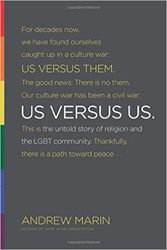
A provocative new book in the Patheos Book Club this month, Us Versus Us, explores the largest national scientific study ever done in the LGBT community regarding spirituality, religion, and church. Written by Andrew Marin, a renowned voice on the intersection of faith and sexuality and author of the award-winning book Love is An Orientation: Elevating the Conversation with the Gay Community, the book sheds light on some surprising research about the faith lives of the LGBTQ community that challenges the prevailing narrative in the on-going battle over LGBTQ inclusion in the Church. One of the more significant statistics, for instance, reveals that 86% of the LGBT community was raised in a church from ages 0-18. That’s 17% higher than the average American community.
As part of our discussion on the new book*,* we reached out to Marin with some questions about the research that prompted it. Marin is currently living in Scotland with his wife and researching and teaching in the divinity school at the University of St. Andrews. Read an excerpt from the book and more conversation at the Patheos Book Club here.
 Who did you write Us Versus Us for?
Today, few and far in between is anyone in the US not impacted by the LGBT and conservative religious disconnect. Regardless of which “side” one is coming from each has a clear worldview and following, a set of relational implications against their other. In terms of social engagement, the scientific research behind Us Versus Us found that the general perceptions from each community about their other are not actually true. My hope is for the book’s hard data, and stories behind them, to reshape the relational starting point between the two communities—a starting point that until now, has been based on opinion rather than fact.
Your book explores the results of a specific scientific survey concerning the religious experience of LGBTQ people. What drew you to that particular question? And what is one of the most surprising findings from your data?
For a dozen years after my three best friends came out to me in three consecutive months, I lived in the Boystown neighborhood of Chicago, one of the predominate LGBT neighborhoods in the country. About a year into living in Boystown I informally noticed a strange pattern throughout my daily interactions: (a) most LGBT people in Boystown regularly attended a faith community the majority of their youth; (b) most still believed in God and were interested in one day finding a faith community again; and (c) most were less concerned with a church’s theology of homosexuality than they were with how they were treated by individual Christians in those churches. Each of these were quite different to the broader narrative being presented by both communities! Thus came the idea for this scientific study, which over six years turned into the largest national scientific study ever done in the LGBT community regarding religion. And the data has been analyzed to the most stringent of academic standards and peer reviewed by four of the leading clinical researchers in the field, across the progressive to conservative spectrum.
One of the most surprising findings has to do with “sin.” The broader cultural narrative suggests until there is agreement on the theology and ethics of sex and sin, there can be no sustainable and productive engagement between the two communities. However our data found: A different theological interpretation on sin only accounts for 15% of the reasons why LGBT people leave their faith communities; and only 8% of the LGBT community cares if the church they attend agree with their sexual ethics.
This means, respectively: 85% of the LGBT community leave their church for other reasons than disagreement on sin; and 92% of the LGBT community will attend church regardless if there is agreement on the sexual ethics of sin.
Both of these findings are the exact opposite of what so many of the talking heads, from both communities, present as “fact.”
The book’s title, Us Versus Us, refers to one of the most important findings in your book. Can you tell us about that particular question and results?
Research suggests 75% of the general American population was raised in a faith community. Our data suggests 86% of the LGBT community was raised in a faith community. Here, our study defined “raised in” as “attending a religious service, event, gathering, conference, or group on average of at least one time per week throughout the ages of 0-18.” There is an 11% higher frequency of LGBT people being raised in a religious setting than the general population! The implications are profound. Not only is this culture war not ‘us versus them,’ our data suggests it is, and always has been, us versus us. Ultimately Us Versus Us is an exploration of the scientific, social, and political implications to this finding.
You’ve made a point of not stating your own personal opinion about the LGBTQ issue, so as to be a better bridge builder. There are those on both sides who criticize you for your neutral position. Why do you choose to remain neutral on the issue? Do you anticipate that changing at some point in the future?
There is a difference between apathy and coercion, and intentional neutrality. And I remain intentionally neutral to be able to facilitate these very heightened conversations.
My vocation as a bridge builder is predicated upon not taking sides. History has taught us that when people take sides (and partisan activism, by the way, is also a vocation), they lose the credibility with their other to be in sustainable dialogue with that other. I am more concerned with working towards dialogue that actually promotes a shift in social engagement and relations than standing on one side yelling at the other to change. And if that means I am at times criticized on the internet by fundamentalist progressives the same as fundamentalist conservatives, so be it. There are a lot worse things that can happen in life than people who you have never met writing mean things about you behind a computer screen. You can read more about the reasons behind my neutrality here.
As for the future, my vocation is not predicated upon other people’s partisan yearnings or other people’s expectations about what I need to say or not say. As Eric Lomax, a torture victim and former POW turned peace activist, says, “sometime the hating has to stop.” My vocation as a bridge builder who remains intentionally neutral is my commitment to helping the hate to stop. And though I might be hated for helping the hate to stop, that unfortunately, comes with the territory.
What is your greatest hope for this book and the continuing sexuality debate in the Church overall?
That the groundbreaking statistics behind Us Versus Us will refocus the LGBT and conservative religious culture war away from well-rehearsed talking points that divide and onto generalizable fact that unites. In fact, our data shows both sides are not actually that far apart.
Read more about Us Versus Us, including a book excerpt, at the Patheos Book Club here.
Previous Post

May 16, 2016
The Pursuing God: A Video Q&A with Joshua Ryan Butler
Next Post
July 20, 2016 Jewish-Christian Difference and Modern Jewish Identity
Browse Our Archives
Select a Category Author Q&A Book Review Christian Living Church Leadership Stump a Scholar Theology Uncategorized
Select a Month June 2022 March 2021 October 2020 August 2020 February 2019 November 2017 July 2017 June 2017 May 2017 March 2017 February 2017 January 2017 November 2016 October 2016 August 2016 July 2016 June 2016 May 2016 April 2016 March 2016 February 2016 January 2016 November 2015 October 2015 September 2015 August 2015 July 2015 June 2015 May 2015 April 2015 March 2015 February 2015 January 2015 December 2014 November 2014 October 2014 September 2014 August 2014 July 2014 June 2014 May 2014 April 2014 March 2014 February 2014 January 2014 December 2013 November 2013 October 2013 September 2013 August 2013 July 2013 June 2013 May 2013 April 2013 March 2013 February 2013 January 2013 December 2012 November 2012 October 2012 September 2012 August 2012 July 2012 June 2012 May 2012 April 2012 March 2012 February 2012 January 2012 December 2011 November 2011 October 2011 September 2011 August 2011 July 2011 June 2011 May 2011 April 2011 March 2011 February 2011 January 2011 December 2010 November 2010 October 2010 September 2010 August 2010 July 2010 June 2010
Follow Us!
TAKE THE
Religious Wisdom Quiz
Which branch of Christianity traces its leadership back to the Apostle Peter?
Select your answer to see how you score.
United Church of Christ Lutheran Eastern Orthodox Roman Catholic
Related posts from Take and Read

Life is an Endless Invitation: Q&A With Rob...
Rethinking Ritual for a Secular Age: An Interview...

Even the Faith Giants Didn’t Always Get it...

Author Lily Burana on Experiencing God's Grace and...
TRENDING AT PATHEOS Religious Music & Entertainment

"Les Diabolique" and Transgression
Alongside something like Arrival, Vertigo, or Charade, Les Diaboliques is a...

"The Plague Dogs" and Mortality
So, flashback to the late 70s, early 80s. Walt Disney Studios is...

With the recent and highly successful release of Christopher Nolan’s epic film,...

"L'avventura" and Human Weakness
Today's piece is going to be a little different for a few...

I first want to apologize for not posting or writing anything. I'm...

I've engaged in the multi-year project of reading through the Church Fathers,...
view all Religious Music & Entertainment blogs
Ad-Free & Subscriber Log-In Subscription Support
- About Us
- 2026 Calendar
- Videos
- Podcasts
- Library of World Religions
- Faith In Media Tracker
- Advertise With Us
- Write for Us
- Privacy Policy
- Terms of Service
- Do Not Sell My Data
- Contact Us
- Radiant Digital
- Manage Newsletter Subscriptions
- Unsubscribe From Notifications
- Sitemap
Copyright 2008-2026, Patheos. All rights reserved.
Subscription Support Ad-Free & Subscriber Log-In
Follow Patheos