
BuddhistCatholicContemplativeEvangelicalGeneral ChristianHinduJewishLatter-day SaintMuslimNew VisionsProgressive Christian
Beliefs
- Buddhist
- Catholic
- Contemplative
- Evangelical
- General Christian
- Hindu
- Jewish
- Latter-day Saint
- More Voices
- Muslim
- New Visions
- Pagan
- Progressive Christian
Topics
- Religion News
- Food and Religion
- Sports and Religion
- Religious Art
- Religious Music and Entertainment
- Religious Events
- History and Religion
- Style and Religion
- Politics and Religion
- Women in Religion
- Recreation Outdoors and Religion
- Business Finance and Religion
- Careers Workplace and Religion
- Education and Religion
- Family Parenting and Religion
- Health Fitness and Religion
- Home and Religion
- Relationships and Religion
- Technology and Religion
- Travel and Religion
Columnists
- Buddhist Columnists
- Business Finance and Religion Columnists
- Careers Workplace and Religion Columnists
- Catholic Columnists
- Contemplative Columnists
- Education and Religion Columnists
- Evangelists Columnists
- Family Parenting and Religion Columnists
- General Christian Columnists
- Health Fitness and Religion Columnists
- Hindu Columnists
- History and Religion Columnists
- Home and Religion Columnists
- Jewish Columnists
- More Voices Columnists
- Latter Day Columnists
- Muslim Columnists
- New Visions Columnists
- Nonreligious Columnists
- Pagan Columnists
- Politics and Religion Columnists
- Progressive Columnists
- Recreation Outdoors and Religion Columnists
- Relationships and Religion Columnists
- Religion News Columnists
- Religious Art Columnists
- Religious Events Columnists
- Religious Music and Entertainment Columnists
- Sports and Religion Columnists
- Style and Religion Columnists
- Technology and Religion Columnists
- Travel and Religion Columnists
- Women in Religion Columnists
Resource Library
- 2026 Calendar
- Library of World Religions
- The 100 Most Holy Places on Earth
- Patheos Answers
- Podcasts
- Videos
- Faith Leaders Database
- Anglican Episcopalian
- Bahai
- Baptist
- Buddhism
- Christianity
- Confucianism
- Eastern Orthodoxy
- Hinduism
- Holiness and Pentecostal
- ISKCON
- Islam
- Judaism
- Lutheran
- Methodist
- The Church of Jesus Christ of Latter-day Saints
- New Age
- Paganism
- Presbytarian and Reformed
- Protestantism
- Religion Behind the Scenes
- Roman Catholic
- Scientology
- Shia Islam
- Sikhism
- Sufism
- Sunni Islam
- Taoism
- Zen
- See all religions
Research Tools
 Ad-Free & Subscriber Log-In Subscription Support
Ad-Free & Subscriber Log-In Subscription Support
Follow Patheos 

- Trending:
- Forgiveness
- |
- Marriage
- |
- Consciousness
- |
- Death Penalty
- |
- Election
- |
- Halloween

- Home
- Religious Music & Entertainment
- 40 Days of Decrease: A Different Kind of Lent Book
40 Days of Decrease: A Different Kind of Lent Book
Last updated on: February 22, 2016 at 3:17 pm by David Swartz
40 Days of Decrease: A Different Kind of Lent Book 2016-02-22T15:17:07-07:00 David Swartz
Patheos Explore the world's faith through different perspectives on religion and spirituality! Patheos has the views of the prevalent religions and spiritualities of the world.
 Lent is a partisan animal. How much we pay attention to it largely depends on where we come down in the Body of Christ called the Church. Liturgical churches observing the annual church calendar all went for ashes on their foreheads a few weeks ago. Baptist, evangelical, charismatic, Pentecostal, non-denominational, etc mostly ignore it or do something else. Here in Detroit, with a significant Polish population, our choice is to pound down paczkis (poonch-keys) on Fat Tuesday. They’re a filled, heavily sugared, donut. The ones filled with Italian cannoli cream are the best. The Polish/Italian thing lets us use “diversity” as a rational to wolf down a few of these and to spend the rest of the day dragging around in sugar comas. So begins Lent for some of us in the Body of Christ.
Any ritual can melt down into meaningless rote observance. Speaking as an outsider, I hear people giving up this or that. Why? And if we give up something, what is the virtue of sheer deprivation of what might seem trivial? If we give it up, why take it up again after forty days? Just leave it alone. I’ve fasted from chicken livers for 365 days a year for years and it’s done me no perceivable good. Alicia Britt Chole had me in mind as well many faithful practitioners of the forty day period leading up to Easter known as Lent when she wrote her new book, 40 Days of Decrease.
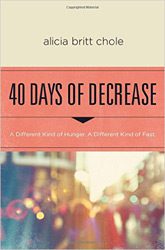
Alicia has done something wise even in the design of the cover. Publishing people sweat over book covers a lot. Book covers sell the book to readers. ‘Tis the season for Lenten devotionals, almost all of which have “Lent” or “Lenten” somewhere in the subtitle. And when they do, they’re singing to the choir. And the liturgical churches practicing Lent are worth singing to. But the full title of this one reads 40 Days of Decrease: A Different Kind of Hunger. A Different Kind of Fast. The title pricks the curiosity of those non-Lenten practitioners of us who still take God and knowing him quite seriously. And she sneaks up on those for whom Lent can be a flat routine and pokes them with a number of challenges.
Alicia Britt Chole writes well. That means more than making adverbs roll over like a dog performing for a biscuit. She makes the reader enjoy the read in a way that draws them quickly and engagingly from sentence to sentence. She clearly loves the beauty of words but not it a way that overrides with attention to herself or distraction from the meaning. She shares out of her life. “Little did I know that the pain was under assignment; it was making room in my life for another operation well beyond the reach of any surgeon’s scalpel. I would not trade that desert of pain for anything in the world.” Anybody here want to know more?
If Alicia writes well, it’s because she reads widely and thinks well. All good writing comes from this. A quick scan of her quotes covers more than two thousand years of biblical history, most corners of the Body of Christ and writers both scholarly and popular. She thinks well and it shows in the way she deals with Scripture in each entry as things move toward Good Friday and Easter. When hockey coaches train their teams, they do a drill using an egg. To teach passing, they have their players pass an egg back and forth on the ice without breaking it. This teaches players to have “softer” hands, to pass and take passes with control. Alicia has “soft hands” on the biblical texts of the forty sessions. She nuances meaning from them that many will find new or wondering why they haven’t seen them before (one mark of good teaching). While she has a few degrees, this isn’t about dazzling us about what she knows that we don’t.
The format of the daily meditations differs from probably any Lenten devotional or book we may have read. Often there’s just a short reading under the head of a Scripture verse followed by a brief, generic sounding prayer. It’s hit-or-miss, “it has okay lyrics but a nice beat to dance to” kind of feel. But Alicia practices spiritual direction and understands that the path to God isn’t the same for everyone. Each day packs different approaches into a daily box. She begins with a meditation on the biblical text. This often includes sidebar illustrative quotes from many different sources. Next comes the reflection which doesn’t dictate to the reader what they should have gotten out of the text but always has thoughtful points. Next comes the best feature of the book. Alicia suggests a different fast for every day and none of her suggestions are the kinds of things most people choose for themselves. Have we ever fasted for even a second from regrets, tidy faith, fixing, stinginess, discontentment, formulas or apathy? And that leaves thirty-three more. Finally, most days conclude with space for journaling the day’s thoughts.
The pages hold whiffs of serious theology. Many chapters end with references to early church fathers and others because she wishes to show that the spiritual/theological significance of Lent goes back to the earliest church. This is primal stuff and not just a scheme of churchmen in the Middle Ages to get moderns to give up chocolate. She holds on to the 40 day wilderness motif of Jesus’ temptations as a valid and essential frame for entering lent; wildernesses of all kinds are often God’s choicest classrooms. Finally, the reader will encounter various forms of the word “decrease” throughout the book. John the Baptist’s words, “He must increase, but I must decrease,” (John 3:30) seem to be the template Alicia lays across every text and thought. She will jog the reader’s thinking in many ways.
Alicia Britt Chole didn’t put the word “Lent” on the cover. One reason might be that 40 Days of Decrease isn’t just for Lent. It’s not even just for people who get Lent. I suppose one could eat a paczki or two while working through it (remember those cannoli cream filled ones!). 40 Days of Decrease is really for anyone willing to push through to a different kind of hunger, a different kind of fasting, any time of the calendar year.
Read an excerpt from 40 Days of Decrease at the Patheos Book Club here.
Previous Post

February 2, 2016
Five Reasons There’s No Getting Past Religion
Next Post
March 16, 2016 Tony Evans on the Power of the Cross
Browse Our Archives
Select a Category Author Q&A Book Review Christian Living Church Leadership Stump a Scholar Theology Uncategorized
Select a Month June 2022 March 2021 October 2020 August 2020 February 2019 November 2017 July 2017 June 2017 May 2017 March 2017 February 2017 January 2017 November 2016 October 2016 August 2016 July 2016 June 2016 May 2016 April 2016 March 2016 February 2016 January 2016 November 2015 October 2015 September 2015 August 2015 July 2015 June 2015 May 2015 April 2015 March 2015 February 2015 January 2015 December 2014 November 2014 October 2014 September 2014 August 2014 July 2014 June 2014 May 2014 April 2014 March 2014 February 2014 January 2014 December 2013 November 2013 October 2013 September 2013 August 2013 July 2013 June 2013 May 2013 April 2013 March 2013 February 2013 January 2013 December 2012 November 2012 October 2012 September 2012 August 2012 July 2012 June 2012 May 2012 April 2012 March 2012 February 2012 January 2012 December 2011 November 2011 October 2011 September 2011 August 2011 July 2011 June 2011 May 2011 April 2011 March 2011 February 2011 January 2011 December 2010 November 2010 October 2010 September 2010 August 2010 July 2010 June 2010
Follow Us!
TAKE THE
Religious Wisdom Quiz
Who pleaded with Joseph for Benjamin's release?
Select your answer to see how you score.
Reuben Naphtali Levi Judah
Related posts from Take and Read

"The Slow March of Light" Highlights The Human...

"A Brilliant Night of Stars and Ice" Recounts...

Even the Faith Giants Didn’t Always Get it...

"Movies Are Prayers": A New Way of Discussing...
TRENDING AT PATHEOS Religious Music & Entertainment

"Les Diabolique" and Transgression
Alongside something like Arrival, Vertigo, or Charade, Les Diaboliques is a...

"The Plague Dogs" and Mortality
So, flashback to the late 70s, early 80s. Walt Disney Studios is...

With the recent and highly successful release of Christopher Nolan’s epic film,...

"L'avventura" and Human Weakness
Today's piece is going to be a little different for a few...

I first want to apologize for not posting or writing anything. I'm...

I've engaged in the multi-year project of reading through the Church Fathers,...
view all Religious Music & Entertainment blogs
Ad-Free & Subscriber Log-In Subscription Support
- About Us
- 2026 Calendar
- Videos
- Podcasts
- Library of World Religions
- Faith In Media Tracker
- Advertise With Us
- Write for Us
- Privacy Policy
- Terms of Service
- Do Not Sell My Data
- Contact Us
- Radiant Digital
- Manage Newsletter Subscriptions
- Unsubscribe From Notifications
- Sitemap
Copyright 2008-2026, Patheos. All rights reserved.
Subscription Support Ad-Free & Subscriber Log-In
Follow Patheos