
BuddhistCatholicContemplativeEvangelicalGeneral ChristianHinduJewishLatter-day SaintMuslimNew VisionsProgressive Christian
Beliefs
- Buddhist
- Catholic
- Contemplative
- Evangelical
- General Christian
- Hindu
- Jewish
- Latter-day Saint
- More Voices
- Muslim
- New Visions
- Pagan
- Progressive Christian
Topics
- Religion News
- Food and Religion
- Sports and Religion
- Religious Art
- Religious Music and Entertainment
- Religious Events
- History and Religion
- Style and Religion
- Politics and Religion
- Women in Religion
- Recreation Outdoors and Religion
- Business Finance and Religion
- Careers Workplace and Religion
- Education and Religion
- Family Parenting and Religion
- Health Fitness and Religion
- Home and Religion
- Relationships and Religion
- Technology and Religion
- Travel and Religion
Columnists
- Buddhist Columnists
- Business Finance and Religion Columnists
- Careers Workplace and Religion Columnists
- Catholic Columnists
- Contemplative Columnists
- Education and Religion Columnists
- Evangelists Columnists
- Family Parenting and Religion Columnists
- General Christian Columnists
- Health Fitness and Religion Columnists
- Hindu Columnists
- History and Religion Columnists
- Home and Religion Columnists
- Jewish Columnists
- More Voices Columnists
- Latter Day Columnists
- Muslim Columnists
- New Visions Columnists
- Nonreligious Columnists
- Pagan Columnists
- Politics and Religion Columnists
- Progressive Columnists
- Recreation Outdoors and Religion Columnists
- Relationships and Religion Columnists
- Religion News Columnists
- Religious Art Columnists
- Religious Events Columnists
- Religious Music and Entertainment Columnists
- Sports and Religion Columnists
- Style and Religion Columnists
- Technology and Religion Columnists
- Travel and Religion Columnists
- Women in Religion Columnists
Resource Library
- 2026 Calendar
- Library of World Religions
- The 100 Most Holy Places on Earth
- Patheos Answers
- Podcasts
- Videos
- Faith Leaders Database
- Anglican Episcopalian
- Bahai
- Baptist
- Buddhism
- Christianity
- Confucianism
- Eastern Orthodoxy
- Hinduism
- Holiness and Pentecostal
- ISKCON
- Islam
- Judaism
- Lutheran
- Methodist
- The Church of Jesus Christ of Latter-day Saints
- New Age
- Paganism
- Presbytarian and Reformed
- Protestantism
- Religion Behind the Scenes
- Roman Catholic
- Scientology
- Shia Islam
- Sikhism
- Sufism
- Sunni Islam
- Taoism
- Zen
- See all religions
Research Tools
 Ad-Free & Subscriber Log-In Subscription Support
Ad-Free & Subscriber Log-In Subscription Support
Follow Patheos 

- Trending:
- Forgiveness
- |
- Marriage
- |
- Consciousness
- |
- Death Penalty
- |
- Election
- |
- Halloween

- Home
- Religious Music & Entertainment
- The Vulnerable Pastor: A Q&A with Mandy Smith
The Vulnerable Pastor: A Q&A with Mandy Smith
Last updated on: November 2, 2015 at 4:42 pm by Deborah Arca
The Vulnerable Pastor: A Q&A with Mandy Smith 2015-11-02T16:42:23-07:00 Deborah Arca
Patheos Explore the world's faith through different perspectives on religion and spirituality! Patheos has the views of the prevalent religions and spiritualities of the world.
“When so many are disillusioned by a manipulative or dogmatic church, how refreshing will it be to find the church lead by those who know how to listen and don’t need to control? When women lead in these ways, it not only encourages women, it also frees men to lead in new, whole ways. I’ve watched it and it’s beautiful.” — Mandy Smith, author, The Vulnerable Pastor
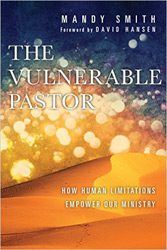
This month at the Patheos Book Club, we’re talking about the new book The Vulnerable Pastor by Mandy Smith. We asked Pastor Smith about the inspiration for her book, what “vulnerable leadership” looks and feels like, and what it’s like to be the only female lead pastor in the North American Christian Convention.
What led you to write The Vulnerable Pastor?
In the book I tell the story of attending a large conference for Christian leaders where I collided with leadership ideals that looked nothing like me. That triggered a 2-3 year wrestling process to figure out how to bring together my theology, my own story, and leadership models. That wrestling included a lot of journaling, part of which I shared at an Epic Fail pastor’s event and which then became an article (published in Leadership Journal in 2014). The response to those showed me I’m not alone—we’re all asking the same questions. I met so many pastors who feel inadequate and so many potential Christian leaders who aren’t stepping into their call because of un-scriptural ideas of leadership. I realized maybe all the wrestling I’d done and all the freedom I’d found wasn’t only for my own sake and sensed it was time to share it in a book.
You are the one and only woman pastor in your conference. Do you think women are more naturally inclined to be vulnerable leaders and thus seen as weaker and not as effective as male leaders? How have you struggled not only with being a woman in a man’s world, but also embracing a counter-cultural style of leadership?
 There are other female pastors in the movement but I’m the only female lead pastor, as far as I know. But I don’t think that will be the case for long. I do think that, generally, women are more comfortable being vulnerable—partly just because of biology—and so that can shape the way women lead. But I also think that women feel pressure to set aside those natural leanings to conform to expectations of leadership. There are some traditional leadership styles that look like strength which I think actually come from weakness, as leaders struggle to maintain the appearance of control. And there are things that look weak in leadership—being collaborative, asking questions, expressing feelings—which are actually true strength. So the hope is that “strength” and “weakness” can be redefined.
I am still very conscious that I don’t fit the norm in various ways and I would be lying if I said I never feel self-conscious. But the freedom has come, not from trying to figure out where I fit in the culture’s messed-up models but by seeking God. And it’s uncomfortable to find him pointing to the example of Christ—who wants to pour themselves out? And yet, at the same time, it’s what the Church has always done. I used to think women needed to lead for the sake of fairness but I now believe that the Church needs our humble, organic leadership style for the sake of the mission. When so many are disillusioned by a manipulative or dogmatic church, how refreshing will it be to find the church lead by those who know how to listen and don’t need to control? I believe that when women lead in these ways, it not only encourages women, it also frees men to lead in new, whole ways. I’ve watched it and it’s beautiful.
You believe that being a vulnerable leader is actually more faithful to the gospel and our lives as Christians. Say more about that.
If, when we say “vulnerable” we don’t only mean feeling vulnerable but truly being vulnerable then we’re talking about the human condition—our finite state. All our efforts to be invulnerable are often the very ways that keep us from knowing our need for God. When we feel uncertain, our power, privilege, wealth and technology promise to fill the void. But, when all our efforts to control life have failed and humans finally acknowledge their vulnerability—stop trying fill their own needs, stop trying to be God—then they will remember again how to need God, not only to get through life but to fill their deepest spiritual longing. And the connections to the Gospel there are pretty clear. It’s amazing how we can grow up in church, know all the right doctrines, serve and tithe and follow the rules and yet still not really remember how to just tell God, “I need you!” But receiving his Good News kind of depends on it.
What does a leader look like if they’re not the typical powerful, has-everything-together leader?
Tearful and joyful and comfortable in their own, human skin. Prayerfully and painfully aware of their need for God—personally and to fulfill this impossible call. They’ve stopped trying to be the one people follow and instead they’re comfortable being an example of how it looks to follow God. So our example is no longer our own, perfect selves but our faithfulness. It means we’re more comfortable asking questions, and sharing our failures. We’re more willing to invite people into the process with us and instead of feeling pressure to say, “Here’s the five year plan!” we say “Let’s listen for God together and who knows what he’ll do!”
Why do we put so much pressure on our leaders, pastors or otherwise, to always have the easy answers, feel God’s presence, and have political power?
Honestly, I think that we don’t really want to be asked to engage in a process that’s messy. We want relief from pain, three simple steps, leaders who can just fill in the gaps so we no longer have to watch carefully for God or learn to follow Him. But this puts unrealistic expectations on leaders and forgets that leadership in the church is not the same as running a business. It overlooks the fact that we’re following a God who likes to be mysterious and reveal himself one step at a time.
What opportunities do an emphasis on vulnerability in leadership provide for the church and other parachurch organizations?
Ironically, this approach is empowering. When we know we’re jars of clay, we feel the need to welcome the power of God’s presence. It makes us more collaborative, more creative, more engaged, less afraid of difference or failure. And when we engage with the world around us, it’s refreshing for folks to encounter Christians who, instead of offering arguments or easy answers, can say, “I’m still figuring this out but this God has changed my life!” When we’ve faced our own failings and limitations, we can look people in the eye, in their pain and say, “I don’t have all the answers but I’m learning to be comfortable in the mess. Can I be with you?” What a blessing to our witness!
Are there limits to our transparency as leaders? In other words, how vulnerable can we be as leaders? Is it ever important to not be vulnerable in certain situations?
There is certainly healthy and unhealthy transparency. It helps to ask: Am I choosing to share or not share for their sake or mine? Over-sharing or under-sharing often comes down to selfish motivation—drawing attention to ourselves or protecting ourselves. If we ask what others need to see or hear from us, we’ll get a sense of what’s right. I’ve found my tendency is not to overshare but under-share and my biggest discomfort comes from being called to let people in behind the scenes when I’d rather keep my tidy exterior. In the end, we’re never going to figure it out by a formula and we have to risk making mistakes. But it’s worth the risk, for all our sakes.
How are other pastors responding to your book so far? What’s your greatest hope for this book?
I’ve loved hearing people saying it’s bringing joy back to their ministries. I confess I can’t get enough of the look of hope I’m seeing in people’s eyes. My prayer is that the freedom God has shown me will find its way to many others. I believe that, when God’s people turn to him and cry out for help, revival will come. And I pray my book can be a tiny part of helping people turn to him in new ways.
Previous Post

October 23, 2015
Happiness: A Book Review
Next Post
November 16, 2015 Fractured Not Broken: A Q&A with Kelly Schaefer
Browse Our Archives
Select a Category Author Q&A Book Review Christian Living Church Leadership Stump a Scholar Theology Uncategorized
Select a Month June 2022 March 2021 October 2020 August 2020 February 2019 November 2017 July 2017 June 2017 May 2017 March 2017 February 2017 January 2017 November 2016 October 2016 August 2016 July 2016 June 2016 May 2016 April 2016 March 2016 February 2016 January 2016 November 2015 October 2015 September 2015 August 2015 July 2015 June 2015 May 2015 April 2015 March 2015 February 2015 January 2015 December 2014 November 2014 October 2014 September 2014 August 2014 July 2014 June 2014 May 2014 April 2014 March 2014 February 2014 January 2014 December 2013 November 2013 October 2013 September 2013 August 2013 July 2013 June 2013 May 2013 April 2013 March 2013 February 2013 January 2013 December 2012 November 2012 October 2012 September 2012 August 2012 July 2012 June 2012 May 2012 April 2012 March 2012 February 2012 January 2012 December 2011 November 2011 October 2011 September 2011 August 2011 July 2011 June 2011 May 2011 April 2011 March 2011 February 2011 January 2011 December 2010 November 2010 October 2010 September 2010 August 2010 July 2010 June 2010
Follow Us!
TAKE THE
Religious Wisdom Quiz
Therefore, I urge you, brothers, in view of God's mercy, to offer your bodies as _______, holy and pleasing to God-this is your spiritual act of worship.
Select your answer to see how you score.
Clay Vessels Living Sacrifices An Offering Sacrificial Lambs
Related posts from Take and Read

Life is an Endless Invitation: Q&A With Rob...
Rethinking Ritual for a Secular Age: An Interview...

Even the Faith Giants Didn’t Always Get it...

Author Lily Burana on Experiencing God's Grace and...
TRENDING AT PATHEOS Religious Music & Entertainment

"Les Diabolique" and Transgression
Alongside something like Arrival, Vertigo, or Charade, Les Diaboliques is a...

"The Plague Dogs" and Mortality
So, flashback to the late 70s, early 80s. Walt Disney Studios is...

With the recent and highly successful release of Christopher Nolan’s epic film,...

"L'avventura" and Human Weakness
Today's piece is going to be a little different for a few...

I first want to apologize for not posting or writing anything. I'm...

I've engaged in the multi-year project of reading through the Church Fathers,...
view all Religious Music & Entertainment blogs
Ad-Free & Subscriber Log-In Subscription Support
- About Us
- 2026 Calendar
- Videos
- Podcasts
- Library of World Religions
- Faith In Media Tracker
- Advertise With Us
- Write for Us
- Privacy Policy
- Terms of Service
- Do Not Sell My Data
- Contact Us
- Radiant Digital
- Manage Newsletter Subscriptions
- Unsubscribe From Notifications
- Sitemap
Copyright 2008-2026, Patheos. All rights reserved.
Subscription Support Ad-Free & Subscriber Log-In
Follow Patheos