
BuddhistCatholicContemplativeEvangelicalGeneral ChristianHinduJewishLatter-day SaintMuslimNew VisionsProgressive Christian
Beliefs
- Buddhist
- Catholic
- Contemplative
- Evangelical
- General Christian
- Hindu
- Jewish
- Latter-day Saint
- More Voices
- Muslim
- New Visions
- Pagan
- Progressive Christian
Topics
- Religion News
- Food and Religion
- Sports and Religion
- Religious Art
- Religious Music and Entertainment
- Religious Events
- History and Religion
- Style and Religion
- Politics and Religion
- Women in Religion
- Recreation Outdoors and Religion
- Business Finance and Religion
- Careers Workplace and Religion
- Education and Religion
- Family Parenting and Religion
- Health Fitness and Religion
- Home and Religion
- Relationships and Religion
- Technology and Religion
- Travel and Religion
Columnists
- Buddhist Columnists
- Business Finance and Religion Columnists
- Careers Workplace and Religion Columnists
- Catholic Columnists
- Contemplative Columnists
- Education and Religion Columnists
- Evangelists Columnists
- Family Parenting and Religion Columnists
- General Christian Columnists
- Health Fitness and Religion Columnists
- Hindu Columnists
- History and Religion Columnists
- Home and Religion Columnists
- Jewish Columnists
- More Voices Columnists
- Latter Day Columnists
- Muslim Columnists
- New Visions Columnists
- Nonreligious Columnists
- Pagan Columnists
- Politics and Religion Columnists
- Progressive Columnists
- Recreation Outdoors and Religion Columnists
- Relationships and Religion Columnists
- Religion News Columnists
- Religious Art Columnists
- Religious Events Columnists
- Religious Music and Entertainment Columnists
- Sports and Religion Columnists
- Style and Religion Columnists
- Technology and Religion Columnists
- Travel and Religion Columnists
- Women in Religion Columnists
Resource Library
- 2026 Calendar
- Library of World Religions
- The 100 Most Holy Places on Earth
- Patheos Answers
- Podcasts
- Videos
- Faith Leaders Database
- Anglican Episcopalian
- Bahai
- Baptist
- Buddhism
- Christianity
- Confucianism
- Eastern Orthodoxy
- Hinduism
- Holiness and Pentecostal
- ISKCON
- Islam
- Judaism
- Lutheran
- Methodist
- The Church of Jesus Christ of Latter-day Saints
- New Age
- Paganism
- Presbytarian and Reformed
- Protestantism
- Religion Behind the Scenes
- Roman Catholic
- Scientology
- Shia Islam
- Sikhism
- Sufism
- Sunni Islam
- Taoism
- Zen
- See all religions
Research Tools
 Ad-Free & Subscriber Log-In Subscription Support
Ad-Free & Subscriber Log-In Subscription Support
Follow Patheos 

- Trending:
- Forgiveness
- |
- Marriage
- |
- Consciousness
- |
- Death Penalty
- |
- Election
- |
- Halloween

- Home
- Religious Music & Entertainment
- On Dying Well: A Q&A with Author Janet Wehr
On Dying Well: A Q&A with Author Janet Wehr
Last updated on: October 6, 2015 at 1:41 pm by Deborah Arca
On Dying Well: A Q&A with Author Janet Wehr 2015-10-06T13:41:48-06:00 Deborah Arca
Patheos Explore the world's faith through different perspectives on religion and spirituality! Patheos has the views of the prevalent religions and spiritualities of the world.
“Perhaps the best gift of all that has come to me in my hospice work is that I have no fear of dying myself, and I have had numerous opportunities in my life to test this. My fervent hope for this book is that, by reading it, others may find a greater level of comfort in discussing and contemplating death and dying.” — Janet Wehr, RN, author of Peaceful Passages
This month in the Patheos Book Club, we’re talking about a tender new book, Peaceful Passages: A Hospice Nurse’s Stories of Dying Well, by registered nurse Janet Wehr. We spoke to Wehr about her book, her work as a hospice nurse, her views on an afterlife, and what’s she’s learned about dying — and living — in the process.
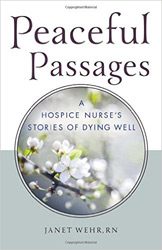 Why did you write Peaceful Passages? And who did you write it for?
Peaceful Passages began as a personal journal that I started early in my hospice career and has been ongoing for seventeen years. It began as an outlet for my own emotions and the questions about dying that were welling up inside of me. I realized that, through my journaling, my patients were telling their own stories about life, dying, and death.
I wrote the book for myself and for everyone who has thoughts, questions and feelings about dying, and for those who will walk through that door at some time in their own life journey, or in the journey of helping another. Although each of us will have our own personal experience with dying, just as with any other aspects of life, it would be good to have spent some time contemplating and learning something about the process at hand. My hope was for the book to be a starting point in opening up some of these thoughts and questions, and even conversations with others.
In the introduction to your book, titled “Why Hospice?,” you say that people often ask you if being a hospice nurse is full of sadness, tears, and despair, and why you would want to do it. What is your response to them?
Very early in my career, I was filled with sadness and tears. I knew that I would never have a long-term relationship with any patient or their family, nor was it likely that I would I ever help someone through an illness to restored health. This is because hospice is special care of which the goal is to provide comfort, not a cure. The patients assigned to me would all be terminal; they had either declined treatment for their illness or their treatment wasn’t successful, and they were moving toward their final days.
With experience, though, I began to realize that I could help these patients by focusing on the ability for them to live well until the end of life came for them. This often had more to do with their spiritual and emotional well-being than it did with their physical body because, when the needs of our spiritual and emotional selves are being met, our physical self is put very much at ease. Once these needs were met, in whatever way was needed by a particular patient, the person seemed to shift from “drive” to “cruise control”, and to live in a new and different way, with more focus on ‘how well’ and less focus on ‘how long.’
How long have you been a hospice nurse and how did you choose this field of nursing over others?
I am completing my seventeenth year working as a hospice nurse this year.
My first nursing job was working as a staff nurse in a large long-term care facility, where there are many patients to care for and the daily pace is fast by necessity. Although I loved caring for sick, elderly and disabled patients, I felt that some of the things that I wanted to offer my patients — my time, my touch, my words, my heart — were frequently rushed or postponed due to the many necessary physical tasks that needed to be accomplished.
In my fifth year of nursing, after observing a dedicated hospice nurse who made visits to hospice patients at our facility, I knew immediately that working in hospice was the way I could have the time and the place to engage my entire being with patients who likely needed it the most.
Can you share one of your favorite stories form the book? What do you hope your story conveyed to your readers?
My favorite story from the book is “An Indian Princess.” It was so humbling to be in the presence of another culture during their time of mourning and grief, and to be allowed to enter that sacred circle of family, friends, and neighbors who had come together. There was a sense of the surreal that night: the colors, the scents, the rituals, and for me to be welcomed so quickly into this group during such a personal and emotional time.
I have had other similar experiences with different cultures since that time, but this one stands out to me in its beauty and in the gracious spirit of the people that I encountered there that night.
In all of my stories, it was my hope and my intention to open up a dialogue among people who don’t or can’t comfortably discuss the subject of death. Especially in North America, we tend to push thoughts and conversations about dying away, and turn our needs during this precious time over to professionals who tell us what to think, what to do and how to feel. We can surmount this discomfort if we put it on the table and look at it sometimes. Just like any other area of learning, if we wait until we need it, it’s usually too late to gain a comfort level with it. In writing Peaceful Passages, it was important for me to show that, if we let go of our fear and discomfort, there are beautiful and even wondrous aspects of dying, and joyful experiences, that could otherwise easily be missed.
What have you learned about dying by companioning those who are moving through the last stages of their life?
By journeying with others in their dying process, the most valuable thing I have learned is how to live better in my own life. There really is no time or energy to spare in the short time that we have here–whether it be a shortened life or a lengthy one–on things that don’t enhance our lives and the way we live them. We are each slowly moving toward the end of our life from the moment that we are born into the world. Realizing that the things that hold us back from being all we can truly be — anger, resentment, envy, grudges — and wasting precious days of our lives cultivating these rather than the spirit of wholeness, has been the greatest gift of my life.
And what have you learned about living from being with people who are dying?
From the dying I have learned (am still learning!) to live well in all of the ways one can imagine it. Live happy. Live peacefully. Live healthy. Live surrounded by the things you love, whether that takes the form of nature, art, music, people or places. Live so that you can look back, smile, and say, “It was a good life.”
What is your understanding of what happens after we die? Do you believe in an Afterlife, and what do you imagine that looks like?
I have seen so many examples — and only a sprinkling of them are in Peaceful Passages — of the joy, the amazement, the beauty, and the Light that can, and often does, shine through when a person is moving closer to the time of their death. Some patients talk about it; with other patients, the evidence is seen, heard, or felt in the heart. There is something beautiful, blissful, and joyous that occurs in the moments surrounding dying, but those of us whose time hasn’t yet come can only glimpse it.
My personal belief is in a Higher Power; a benevolent Creator; God. I believe in an Afterlife and I believe that, after we die, we can assist those we love, especially at the time of their transition because I have personally seen and heard this occurring many times in my work as a guide to persons who are dying. I sense Heaven to be more of a state of being than an actual place, and a time of reunion with our Creator. I can only hope, with a lifetime of working on myself, to one day hear those renowned words of praise, “Well, done, good and faithful servant.”
Perhaps the best gift of all that has come to me in my hospice work is that I have no fear of dying myself, and I have had numerous opportunities in my life to test this. My fervent hope for Peaceful Passages is that, by reading it, others may find a greater level of comfort in discussing and contemplating death and dying.
Read more stories from the book, Peaceful Passages, at the Patheos Book Club here.
Previous Post

September 30, 2015
Where Jesus Prayed: A Q&A with Danielle Shroyer
Next Post
October 23, 2015 Happiness: A Book Review
Browse Our Archives
Select a Category Author Q&A Book Review Christian Living Church Leadership Stump a Scholar Theology Uncategorized
Select a Month June 2022 March 2021 October 2020 August 2020 February 2019 November 2017 July 2017 June 2017 May 2017 March 2017 February 2017 January 2017 November 2016 October 2016 August 2016 July 2016 June 2016 May 2016 April 2016 March 2016 February 2016 January 2016 November 2015 October 2015 September 2015 August 2015 July 2015 June 2015 May 2015 April 2015 March 2015 February 2015 January 2015 December 2014 November 2014 October 2014 September 2014 August 2014 July 2014 June 2014 May 2014 April 2014 March 2014 February 2014 January 2014 December 2013 November 2013 October 2013 September 2013 August 2013 July 2013 June 2013 May 2013 April 2013 March 2013 February 2013 January 2013 December 2012 November 2012 October 2012 September 2012 August 2012 July 2012 June 2012 May 2012 April 2012 March 2012 February 2012 January 2012 December 2011 November 2011 October 2011 September 2011 August 2011 July 2011 June 2011 May 2011 April 2011 March 2011 February 2011 January 2011 December 2010 November 2010 October 2010 September 2010 August 2010 July 2010 June 2010
Follow Us!
TAKE THE
Religious Wisdom Quiz
How many years between Abraham and David?
Select your answer to see how you score.
1200 years 1000 years 600 years 800 years
Related posts from Take and Read

Life is an Endless Invitation: Q&A With Rob...
Rethinking Ritual for a Secular Age: An Interview...

Even the Faith Giants Didn’t Always Get it...

Author Lily Burana on Experiencing God's Grace and...
TRENDING AT PATHEOS Religious Music & Entertainment

"Les Diabolique" and Transgression
Alongside something like Arrival, Vertigo, or Charade, Les Diaboliques is a...

"The Plague Dogs" and Mortality
So, flashback to the late 70s, early 80s. Walt Disney Studios is...

With the recent and highly successful release of Christopher Nolan’s epic film,...

"L'avventura" and Human Weakness
Today's piece is going to be a little different for a few...

I first want to apologize for not posting or writing anything. I'm...

I've engaged in the multi-year project of reading through the Church Fathers,...
view all Religious Music & Entertainment blogs
Ad-Free & Subscriber Log-In Subscription Support
- About Us
- 2026 Calendar
- Videos
- Podcasts
- Library of World Religions
- Faith In Media Tracker
- Advertise With Us
- Write for Us
- Privacy Policy
- Terms of Service
- Do Not Sell My Data
- Contact Us
- Radiant Digital
- Manage Newsletter Subscriptions
- Unsubscribe From Notifications
- Sitemap
Copyright 2008-2026, Patheos. All rights reserved.
Subscription Support Ad-Free & Subscriber Log-In
Follow Patheos