
BuddhistCatholicContemplativeEvangelicalGeneral ChristianHinduJewishLatter-day SaintMuslimNew VisionsProgressive Christian
Beliefs
- Buddhist
- Catholic
- Contemplative
- Evangelical
- General Christian
- Hindu
- Jewish
- Latter-day Saint
- More Voices
- Muslim
- New Visions
- Pagan
- Progressive Christian
Topics
- Religion News
- Food and Religion
- Sports and Religion
- Religious Art
- Religious Music and Entertainment
- Religious Events
- History and Religion
- Style and Religion
- Politics and Religion
- Women in Religion
- Recreation Outdoors and Religion
- Business Finance and Religion
- Careers Workplace and Religion
- Education and Religion
- Family Parenting and Religion
- Health Fitness and Religion
- Home and Religion
- Relationships and Religion
- Technology and Religion
- Travel and Religion
Columnists
- Buddhist Columnists
- Business Finance and Religion Columnists
- Careers Workplace and Religion Columnists
- Catholic Columnists
- Contemplative Columnists
- Education and Religion Columnists
- Evangelists Columnists
- Family Parenting and Religion Columnists
- General Christian Columnists
- Health Fitness and Religion Columnists
- Hindu Columnists
- History and Religion Columnists
- Home and Religion Columnists
- Jewish Columnists
- More Voices Columnists
- Latter Day Columnists
- Muslim Columnists
- New Visions Columnists
- Nonreligious Columnists
- Pagan Columnists
- Politics and Religion Columnists
- Progressive Columnists
- Recreation Outdoors and Religion Columnists
- Relationships and Religion Columnists
- Religion News Columnists
- Religious Art Columnists
- Religious Events Columnists
- Religious Music and Entertainment Columnists
- Sports and Religion Columnists
- Style and Religion Columnists
- Technology and Religion Columnists
- Travel and Religion Columnists
- Women in Religion Columnists
Resource Library
- 2026 Calendar
- Library of World Religions
- The 100 Most Holy Places on Earth
- Patheos Answers
- Podcasts
- Videos
- Faith Leaders Database
- Anglican Episcopalian
- Bahai
- Baptist
- Buddhism
- Christianity
- Confucianism
- Eastern Orthodoxy
- Hinduism
- Holiness and Pentecostal
- ISKCON
- Islam
- Judaism
- Lutheran
- Methodist
- The Church of Jesus Christ of Latter-day Saints
- New Age
- Paganism
- Presbytarian and Reformed
- Protestantism
- Religion Behind the Scenes
- Roman Catholic
- Scientology
- Shia Islam
- Sikhism
- Sufism
- Sunni Islam
- Taoism
- Zen
- See all religions
Research Tools
 Ad-Free & Subscriber Log-In Subscription Support
Ad-Free & Subscriber Log-In Subscription Support
Follow Patheos 

- Trending:
- Forgiveness
- |
- Marriage
- |
- Consciousness
- |
- Death Penalty
- |
- Election
- |
- Halloween

- Home
- Religious Music & Entertainment
- Happiness: A Book Review
Happiness: A Book Review
Last updated on: October 23, 2015 at 1:07 pm by David Swartz
Happiness: A Book Review 2015-10-23T13:07:55-06:00 David Swartz
Patheos Explore the world's faith through different perspectives on religion and spirituality! Patheos has the views of the prevalent religions and spiritualities of the world.
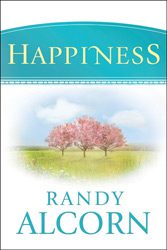 [Editor’s Note: This post is part of a conversation at the Patheos Book Club on the new book Happiness, by Randy Alcorn.]
I have a confession. I really didn’t like two songs that everybody else pretty much loved: Bobby McFerrin’s “Don’t Worry. Be Happy” and Pharrell Williams’ “Happy”. The secret of the last tune lies in the groove of the music. We could change the lyrics to sing about ketchup and the groove of the music still makes you want to dance your brains out. My gripe is this. My life experience (and that of many others) tends to say that happiness seems more elusive than the quick shot of three minutes of music (even good music). As pop culture continues to morph the lives of many to its shape, a lot of us are finding out the same thing. We find that pursuing happiness seems like knitting with steam. The harder we work at it, the more quickly it evaporates right through our fingers.
While we’ve never met, Randy Alcorn might agree. He’s a well-published (both in quantity and quality) author. He’s done some serious thinking in print recently about something we Christians don’t always think seriously about – heaven. And now he swivels his serious literary chops to bear on something we’re all interested in – being happy. And while Randy believes in happiness in many forms, this isn’t a short punchy shortcut to feeling good. Alcorn not only believes that happiness takes some effort; he believes that the effort is worthwhile. And that is why he wrote 423 page about it (small print, no pictures). Those spending the time and effort won’t be disappointed.
Always read a book’s introduction. The author tips his or her hand as to what the book’s about and what they thought it so important they had to write about it. One of my favorite quotes from one of my favorite movies goes like this. “You keep using that word…I do not think it means what you think it means.” We all think we know what certain words mean and would be offended if someone suggested we didn’t. Like “love.” If we all know what love is, why does the relational/marital/family landscape look like ground zero at a nuclear bomb test site? If we know what happiness is, why does something we want so badly elude our grasp? Right off the bat, Randy says, “Everyone has a theology of happiness – but is yours any good?”
The book divides into four main sections. Part 1 examines our longing and search for happiness. Our individual and cultural yearnings for this run stronger than we imagine and Randy probes below the surface more deeply than most of us have. Part 2 takes a look at something that almost nobody has thought about – the happiness of God. This describes the capacity for happiness that the expressions of the Trinity both experience between themselves and have blended into the image of God of every human being. Deep and very heady stuff but Randy makes it very accessible to the reader (which is good because I’m not sure this last sentence means what I thought it meant). Chapters like “Is God Happy With Himself (And Should He Be?)” and “Did Jesus Laugh, Play, and Have a Sense of Humor?” Part 3 takes stock of all the biblical passages that speak of happiness, joy and gladness. And there are a lot more than we thought. Part 4 discusses ways to live a Christ centered life. In American life, we reduce everything to putting our hands on things and making it happen; we reduce everything to action and technique. The reader will be tempted to leapfrog to Part 4 to get to the “good stuff” since many Christian books reduce complex things to four easy steps. But Part 4 breathes in harmony with the rest of the book. Much of it will be incomprehensible if we have skipped to it. And we will cheat ourselves.
Randy works hard to tell this story well (as he does in all his writing). One of the unwritten laws of good writing states that if someone else has already said something and have said it better than we would, then let them say it and give good footnotes. The reader will immediately notice that there will be more Scripture references than in many Christian books but not enough to become overwhelming. The reader will repeatedly find themselves saying, “I never saw this before” or “I thought I knew this but here is something new.” He has a nice touch of leaving the reader feeling smarter, and not just impressed at how much the author knew. Randy also brings in a lot of other voices including some who have gotten bad press. The reader will encounter many quotes from the Puritans, a group popularly pictured as a dour bunch of deadbeats. Just as it’s bad form to hang someone without a trial, it’s bad form to trash writers without reading what they wrote. This gang will surprise you. Randy also quotes (so to speak) Dean Koontz’s dog. Dean Koontz writes like Stephen King on a really dark day. I leave the dog to speak for himself (so to speak).
Some books we pick up and lay down, some very quickly. Some books we read and then move on to the next one. Happiness, I’m happy to say, is a book that, many times “reads us” … and that makes it uniquely valuable as a reading experience. It’s a book that both provokes the desire to change and makes us hunger for God Who shows us His face through Jesus Christ as only He can change us. The best usual compliment we give a book is “I enjoyed it”. Randy Alcorn’s writing targets and desires for the reader the joy he writes about. Many who read Happiness may say, ”I’m a different person from the one who opened the front cover of this book.”
Read an excerpt from Happiness at the Patheos Book Club here!
David Swartz pastors Bethel Baptist Church in Roseville, Michigan. He thinks that jazz is sacred music, that books are better company than most people, and that university towns rock. He blogs at geezeronthequad.com.
Previous Post

October 6, 2015
On Dying Well: A Q&A with Author Janet Wehr
Next Post
November 2, 2015 The Vulnerable Pastor: A Q&A with Mandy Smith
Browse Our Archives
Select a Category Author Q&A Book Review Christian Living Church Leadership Stump a Scholar Theology Uncategorized
Select a Month June 2022 March 2021 October 2020 August 2020 February 2019 November 2017 July 2017 June 2017 May 2017 March 2017 February 2017 January 2017 November 2016 October 2016 August 2016 July 2016 June 2016 May 2016 April 2016 March 2016 February 2016 January 2016 November 2015 October 2015 September 2015 August 2015 July 2015 June 2015 May 2015 April 2015 March 2015 February 2015 January 2015 December 2014 November 2014 October 2014 September 2014 August 2014 July 2014 June 2014 May 2014 April 2014 March 2014 February 2014 January 2014 December 2013 November 2013 October 2013 September 2013 August 2013 July 2013 June 2013 May 2013 April 2013 March 2013 February 2013 January 2013 December 2012 November 2012 October 2012 September 2012 August 2012 July 2012 June 2012 May 2012 April 2012 March 2012 February 2012 January 2012 December 2011 November 2011 October 2011 September 2011 August 2011 July 2011 June 2011 May 2011 April 2011 March 2011 February 2011 January 2011 December 2010 November 2010 October 2010 September 2010 August 2010 July 2010 June 2010
Follow Us!
TAKE THE
Religious Wisdom Quiz
What was the main language spoken by Jews during Jesus’ time?
Select your answer to see how you score.
Aramaic Latin Greek Hebrew
Related posts from Take and Read

"The Slow March of Light" Highlights The Human...

"A Brilliant Night of Stars and Ice" Recounts...

Even the Faith Giants Didn’t Always Get it...

"Movies Are Prayers": A New Way of Discussing...
TRENDING AT PATHEOS Religious Music & Entertainment

"Les Diabolique" and Transgression
Alongside something like Arrival, Vertigo, or Charade, Les Diaboliques is a...

"The Plague Dogs" and Mortality
So, flashback to the late 70s, early 80s. Walt Disney Studios is...

With the recent and highly successful release of Christopher Nolan’s epic film,...

"L'avventura" and Human Weakness
Today's piece is going to be a little different for a few...

I first want to apologize for not posting or writing anything. I'm...

I've engaged in the multi-year project of reading through the Church Fathers,...
view all Religious Music & Entertainment blogs
Ad-Free & Subscriber Log-In Subscription Support
- About Us
- 2026 Calendar
- Videos
- Podcasts
- Library of World Religions
- Faith In Media Tracker
- Advertise With Us
- Write for Us
- Privacy Policy
- Terms of Service
- Do Not Sell My Data
- Contact Us
- Radiant Digital
- Manage Newsletter Subscriptions
- Unsubscribe From Notifications
- Sitemap
Copyright 2008-2026, Patheos. All rights reserved.
Subscription Support Ad-Free & Subscriber Log-In
Follow Patheos