
BuddhistCatholicContemplativeEvangelicalGeneral ChristianHinduJewishLatter-day SaintMuslimNew VisionsProgressive Christian
Beliefs
- Buddhist
- Catholic
- Contemplative
- Evangelical
- General Christian
- Hindu
- Jewish
- Latter-day Saint
- More Voices
- Muslim
- New Visions
- Pagan
- Progressive Christian
Topics
- Religion News
- Food and Religion
- Sports and Religion
- Religious Art
- Religious Music and Entertainment
- Religious Events
- History and Religion
- Style and Religion
- Politics and Religion
- Women in Religion
- Recreation Outdoors and Religion
- Business Finance and Religion
- Careers Workplace and Religion
- Education and Religion
- Family Parenting and Religion
- Health Fitness and Religion
- Home and Religion
- Relationships and Religion
- Technology and Religion
- Travel and Religion
Columnists
- Buddhist Columnists
- Business Finance and Religion Columnists
- Careers Workplace and Religion Columnists
- Catholic Columnists
- Contemplative Columnists
- Education and Religion Columnists
- Evangelists Columnists
- Family Parenting and Religion Columnists
- General Christian Columnists
- Health Fitness and Religion Columnists
- Hindu Columnists
- History and Religion Columnists
- Home and Religion Columnists
- Jewish Columnists
- More Voices Columnists
- Latter Day Columnists
- Muslim Columnists
- New Visions Columnists
- Nonreligious Columnists
- Pagan Columnists
- Politics and Religion Columnists
- Progressive Columnists
- Recreation Outdoors and Religion Columnists
- Relationships and Religion Columnists
- Religion News Columnists
- Religious Art Columnists
- Religious Events Columnists
- Religious Music and Entertainment Columnists
- Sports and Religion Columnists
- Style and Religion Columnists
- Technology and Religion Columnists
- Travel and Religion Columnists
- Women in Religion Columnists
Resource Library
- 2026 Calendar
- Library of World Religions
- The 100 Most Holy Places on Earth
- Patheos Answers
- Podcasts
- Videos
- Faith Leaders Database
- Anglican Episcopalian
- Bahai
- Baptist
- Buddhism
- Christianity
- Confucianism
- Eastern Orthodoxy
- Hinduism
- Holiness and Pentecostal
- ISKCON
- Islam
- Judaism
- Lutheran
- Methodist
- The Church of Jesus Christ of Latter-day Saints
- New Age
- Paganism
- Presbytarian and Reformed
- Protestantism
- Religion Behind the Scenes
- Roman Catholic
- Scientology
- Shia Islam
- Sikhism
- Sufism
- Sunni Islam
- Taoism
- Zen
- See all religions
Research Tools
 Ad-Free & Subscriber Log-In Subscription Support
Ad-Free & Subscriber Log-In Subscription Support
Follow Patheos 

- Trending:
- Forgiveness
- |
- Marriage
- |
- Consciousness
- |
- Death Penalty
- |
- Election
- |
- Halloween

- Home
- Religious Music & Entertainment
- Tweeting with God: A Q&A with Fr. Michel Remery
Tweeting with God: A Q&A with Fr. Michel Remery
Last updated on: July 16, 2015 at 1:18 pm by Guest Contributor
Tweeting with God: A Q&A with Fr. Michel Remery 2015-07-16T13:18:41-06:00 Guest Contributor
Patheos Explore the world's faith through different perspectives on religion and spirituality! Patheos has the views of the prevalent religions and spiritualities of the world.
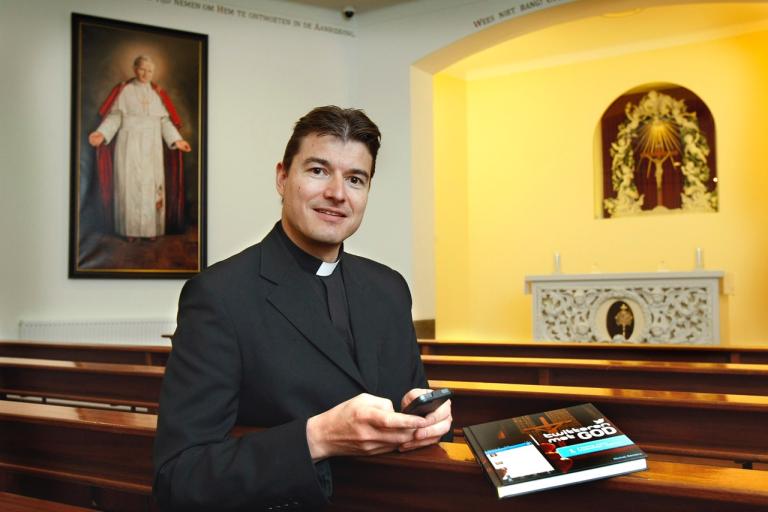
“If we intend to bring Jesus’ message to the people of today, we’ll have to be active also online. Jesus starts where people are to be found. He visits them, talks to them about their concerns. His main “tool” to convince people is his love for them. That is what drives him and that is what people find so attractive in him. He is present in their lives.” — Fr. Michel Remery, author, Tweeting with God
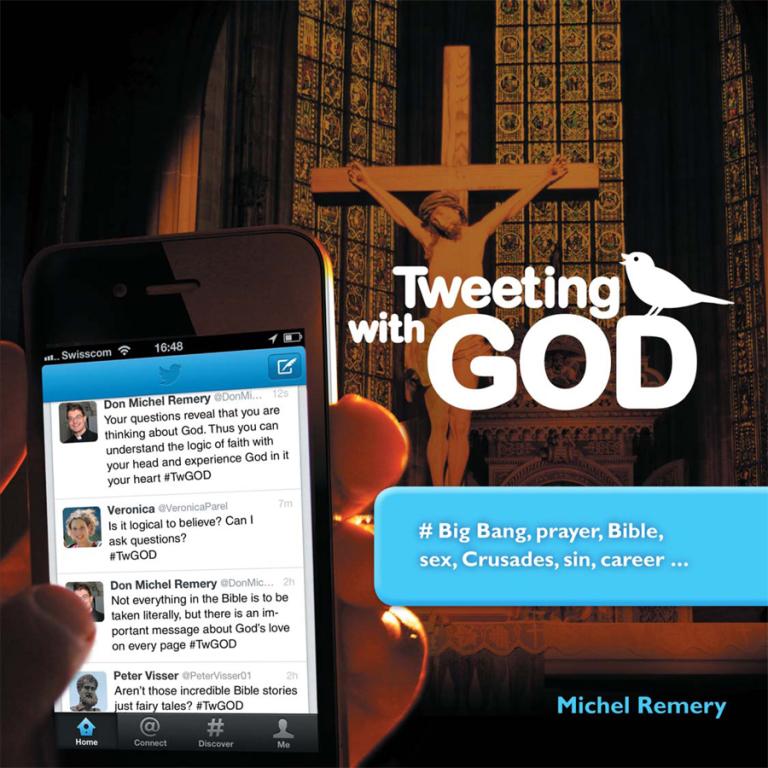
This month at the Patheos Book Club, we’re discussing the new book Tweeting with God from former advisor to the Vatican on new media and youth, Father Michel Remery. Patheos’s Catholic Channel Manager Elizabeth Scalia caught up with Fr. Remery this week to ask some questions about twitter evangelizing for our Book Club readers.
Scalia: The first, obvious question: what inspired this book? Was there something that identified Twitter, for you, as a ripe ground for evangelization? And second, how did you go about putting it together?
Fr. Remery: For many years I served in three parishes in Leiden, the Netherlands. After Mass young people would be waiting for me at the church door to ask me questions about the faith. They had so many questions that it was not possible to answer all of them at the church door. My suggestion that they would write down their questions was taken seriously: In total I received over 1,000 questions by Twitter, emails, Facebook, scratches of notebooks, etc.
 After ordering the questions into four large groups (see the four parts in the book), and singling out the questions that were too private or too delicate to discuss in a group, we gathered regularly to speak together. We would take one question and search together for an answer. No questions were taboo, and all opinions were allowed. The main rule was that you would listen to the opinion of the other person without judgement, and that you would try to see why he or she believed she was right. If necessary, in the end of the discussion, I would present the Church’s position on the topic, with the same question to listen carefully and try to see why the Church would teach thus.
It’s interesting that as we were becoming more experienced in talking about different subjects, looking for the internal logic of the faith, it became less and less necessary to explain extensively the position of the Church, for if you take the right point of departure, all answers fit into the teaching of the Church. We also discovered that there are many good reasons for this teaching. In a few words, we discovered how logical it is to believe!
Was the Youth Catechism a referencing point?
The structure of Tweeting With God (#TwGOD) is different from that of the Catechism, because Tweeting With God is based on the questions of young people that later were ordered in a logical sequence. The Catechism, Compendium and Youcat serve as background material, and especially for further reading. Every section in the #TwGOD book contains references to the Catechism, the Compendium and Youcat. These references can easily be read using the app, which is able to recognise on which page you find yourself, and thus present you with the reference material that you might want to read in connection to the current #TwGOD Tweet.
In fact, we have found that #TwGOD is very much complementary with great catechetical resources like Youcat, the Compendium and the Catechism (reference texts). #TwGOD starts with particular questions of today’s world and then moves towards the greater picture of our faith. The reference texts explain the totality of the faith starting from Scripture and the Tradition of the Church, which is then developed for more particular themes. We believe that both approaches are necessary in our world.
The approach of Tweeting with God is different from that of these reference texts, in the sense that #TwGOD starts there where people are, with their questions about the faith and there lives. Subsequently it helps them to see what the Church is teaching on this particular point, also referring to those reference texts, especially to the Bible. Thus, from the particular questions we intend to demonstrate how this fits in the entirety of our faith in a loving God who created us and is with us.
A tweet is limited to 140 characters; how challenging it is to put across a message of substance in so limited a venue?
The challenge of Twitter is precisely that: to say a lot in just a few words. With Tweeting With God we intend to explain elements of our faith. This is done on the basis of questions of people today. #TwGOD starts there where people are, with their questions about the faith and their lives. Subsequently it helps them to see what the Church is teaching on this particular point, also referring to those reference texts, especially to the Bible.
Thus, starting from particular questions we intend to demonstrate how this fits in the entirety of our faith in a loving God who created us and is with us. This cannot be done uniquely in tweets. Therefore, we have developed a number of different tools that all serve the same goal. If people are present on Twitter, Facebook and Instagram, that’s a good place to start. We try to build a relationship with our followers on social media. But the project Tweeting With God is more than just Tweets of 140 characters.
Our website www.tweetingwithgod.com and the app for Android and Apple expand on the tweeted answer, and so do the social media. The most comprehensive answer can be found in the book Tweeting With God, which answers every question on a double page. There is no need to read the book from the beginning to the end: you can go immediately to the question of your interest. On the double page that answers it you will find a tweet as an appetiser, while the body text intends to explain the deeper logic of the faith, investigating the different argumentations that can be heard on the topic.
How do you respond to people who might suggest that 140 character catechesis runs the risk of reducing Catholic theology and teaching to superficialities?
Whenever we communicate, there is always the danger of being superficial or misunderstood. That goes for all human communication, in whichever environment. But the alternative to this danger is not to communicate at all! It is a fact that we live in a world that is basing its conclusions ever more on headings and tweet-sized messages. Therefore, we need to adapt the way we communicate to this way of thinking. The message of the Gospel remains always the same, but the way we present it to people needs to be adapted in such a way that it can reach people’s hearts. In fact, Pope Francis is a wonderful example of someone speaking in tweets. He has the great capacity to say something essential in just a few words, or by using a catching example. That must be the reason that he has so many millions of followers on Twitter. For my work for the European Bishops’ Conferences, I travel a lot. Wherever I go, people see the Pope in a very favourable light. That is a great basis for the start of a conversation about the faith, both offline and online.
Short attention spans are a sign of our times; how effective do you think evangelization can be in this sort of “piecemeal” format will lead young Catholics to further seek out information on their own (to “cast out into the deep” as John Paul II said) or is there a risk that they’ll read a tweet, favorite and forget it five minutes later?
There always is the possibility that people forget about what they saw, heard or read, whether it concerns our #TwGOD messages or those of anyone else. That is why we have to try to make our messages appealing and convincing. Furthermore, we usually offer a direct link to our website or other #TwGOD media, which helps to deepen the concept. Also, knowing the superficiality with which messages are often considered, we have to find a way in which to repeat the message over and again, without being a bore. Jesus does the same: his basic message of Gods love is the same, and he repeats it over and again with new examples, new words, and in new situations. That is our inspiration for Tweeting With God.
Today, people, and especially young people, spend a lot of time online, and, in particular, on social media. So, if we intend to bring Jesus’ message to the people of today, we’ll have to be active also online (see e.g. Tweet 4.49-4.50 in the book about the new evangelisation). Jesus starts where people are to be found. He visits them, talks to them about their concerns. His main “tool” to convince people is his love for them. That is what drives him and that is what people find so attractive in him. He is present in their lives. And then, when a relation has been established, Jesus goes further and explains all that is demanded to live life to the full.
The pedagogy of Tweeting With God is based on this. We, too, intend to start where people are, with their questions, with their ailments, whether spiritual or physical. By witnessing of our own faith in Jesus, without imposing it to others, we demonstrate how it is to walk with Jesus. We invite people to get to know Jesus better, by recognising the logic of his teaching in the light of the entire creation by God. With every specific answer we intend to demonstrate how this fits into the great plan of salvation, which God has prepared for one reason only: his desire to share his love with us.
Can you give us an example of a tweet of yours that really seemed to catch the interest of many?
For #TwGOD, the logic of the faith is very important. The ultimate starting point of Tweeting With God is always our loving God, who created us, and who loves us. When you enter into the logic of this love, many things that before were obscure become clear. So, we do not only intent to tell people what the Church is teaching, but especially why it is so important for them in their lives.
We have found that the project is not only useful for young people, although it was developed together with them, but for all people. We were surprised to note that the 200 questions that form the basis of the book and the entire project are not only the questions of a certain group of young people in the Netherlands, but that these same questions are being asked by people around the world, both young and older. The questions in the project are the questions every one will pose one day or the other.
One question that comes up over and again is that which concerns the reason why there is suffering in the world. If God is love, how to reconcile this with the many evils we see in our world. Did God create evil? What does it have to do with my sins? If God is all-powerful, why do disasters happen? Why is there evil? Is it the Will of God that people die? Can suffering help us to come closer to God? Tweets 1.34 to 1.37 help to find answers to these questions.
What sort of response has the book gotten from church leadership?
The reaction from the side of the leaders of the Church has been very favourable. Each of the four parts of the book is introduced by another bishop. For every language edition, bishops from that particular language are asked to write these introductions, a task they have so fare done wholeheartedly and with great praise. For example, Cardinal Dolan said that Tweeting With God “combines the timeless teaching of our faith with the best of modern technology.”
Where do you hope to go with this project in the future? Will you be looking to bring it to something organized on diocesan and parish levels, or combing the tweeting project with other forms of outreach?
Our sole desire with Tweeting With God is to contribute to bringing the Gospel to everyone. The project was never planned to be as it is from the beginning: It simply came into being as we were speaking with a group of young people about important questions concerning the faith, and tried to be open to what God was asking from us. Also today, we have but one great desire: to bring the message of Jesus to all people. To do so, we would like to use all available means, and as we find new sponsors, we will be able to explore new ways to help the new evangelization. Video, for example, would be a great complement to the existing material. Furthermore, we are working on a manual to help groups to work with the project, in parishes, dioceses or other levels.
The #TwGOD project with 200 questions can be used both by individuals and by groups. #TwGOD is often used in faith reflection groups as a basis for discussion. Precisely, the combination between online and offline activities has proven to be very fruitful. The app in particular is a great tool for connecting the book with the online material, using an innovative technique that scans the photograph on whichever page in the book you are viewing. #TwGOD has also proven to be a great reference work for parents who have the difficult task of answering many questions about the faith to their children or grandchildren. We have had some moving testimonies from parents who managed for the first time to have a good conversation with their children about the faith, thanks to the book and online material.
At the moment we are working on more than 13 translations of the book and other materials, always on the request of the local countries. A good number of Bishops’ Conferences intend to use Tweeting With God in the preparation of World Youth Day 2016, and a follow-up when the young pilgrims come back to their parishes. It is our great hope that this project may contribute to the new evangelization, that it may help people to see their lives in the light of the love of God, who loves them whatever they do, and that they may try to give an answer to that love of God for them by working on their personal relationship with him.
Previous Post

July 15, 2015
Homage to a Broken Man: Q&A with Author Peter Mommsen
Next Post
July 15, 2015 Tweeting with God: A Book Review
Browse Our Archives
Select a Category Author Q&A Book Review Christian Living Church Leadership Stump a Scholar Theology Uncategorized
Select a Month June 2022 March 2021 October 2020 August 2020 February 2019 November 2017 July 2017 June 2017 May 2017 March 2017 February 2017 January 2017 November 2016 October 2016 August 2016 July 2016 June 2016 May 2016 April 2016 March 2016 February 2016 January 2016 November 2015 October 2015 September 2015 August 2015 July 2015 June 2015 May 2015 April 2015 March 2015 February 2015 January 2015 December 2014 November 2014 October 2014 September 2014 August 2014 July 2014 June 2014 May 2014 April 2014 March 2014 February 2014 January 2014 December 2013 November 2013 October 2013 September 2013 August 2013 July 2013 June 2013 May 2013 April 2013 March 2013 February 2013 January 2013 December 2012 November 2012 October 2012 September 2012 August 2012 July 2012 June 2012 May 2012 April 2012 March 2012 February 2012 January 2012 December 2011 November 2011 October 2011 September 2011 August 2011 July 2011 June 2011 May 2011 April 2011 March 2011 February 2011 January 2011 December 2010 November 2010 October 2010 September 2010 August 2010 July 2010 June 2010
Follow Us!
TAKE THE
Religious Wisdom Quiz
What does Jesus say will set you free?
Select your answer to see how you score.
Money Power The truth Fame
Related posts from Take and Read

Life is an Endless Invitation: Q&A With Rob...

Rethinking Ritual for a Secular Age: An Interview...

Even the Faith Giants Didn’t Always Get it...

Author Lily Burana on Experiencing God's Grace and...
TRENDING AT PATHEOS Religious Music & Entertainment

"Les Diabolique" and Transgression
Alongside something like Arrival, Vertigo, or Charade, Les Diaboliques is a...

"The Plague Dogs" and Mortality
So, flashback to the late 70s, early 80s. Walt Disney Studios is...

With the recent and highly successful release of Christopher Nolan’s epic film,...

"L'avventura" and Human Weakness
Today's piece is going to be a little different for a few...

I first want to apologize for not posting or writing anything. I'm...

I've engaged in the multi-year project of reading through the Church Fathers,...
view all Religious Music & Entertainment blogs
Ad-Free & Subscriber Log-In Subscription Support
- About Us
- 2026 Calendar
- Videos
- Podcasts
- Library of World Religions
- Faith In Media Tracker
- Advertise With Us
- Write for Us
- Privacy Policy
- Terms of Service
- Do Not Sell My Data
- Contact Us
- Radiant Digital
- Manage Newsletter Subscriptions
- Unsubscribe From Notifications
- Sitemap
Copyright 2008-2026, Patheos. All rights reserved.
Subscription Support Ad-Free & Subscriber Log-In
Follow Patheos