
BuddhistCatholicContemplativeEvangelicalGeneral ChristianHinduJewishLatter-day SaintMuslimNew VisionsProgressive Christian
Beliefs
- Buddhist
- Catholic
- Contemplative
- Evangelical
- General Christian
- Hindu
- Jewish
- Latter-day Saint
- More Voices
- Muslim
- New Visions
- Pagan
- Progressive Christian
Topics
- Religion News
- Food and Religion
- Sports and Religion
- Religious Art
- Religious Music and Entertainment
- Religious Events
- History and Religion
- Style and Religion
- Politics and Religion
- Women in Religion
- Recreation Outdoors and Religion
- Business Finance and Religion
- Careers Workplace and Religion
- Education and Religion
- Family Parenting and Religion
- Health Fitness and Religion
- Home and Religion
- Relationships and Religion
- Technology and Religion
- Travel and Religion
Columnists
- Buddhist Columnists
- Business Finance and Religion Columnists
- Careers Workplace and Religion Columnists
- Catholic Columnists
- Contemplative Columnists
- Education and Religion Columnists
- Evangelists Columnists
- Family Parenting and Religion Columnists
- General Christian Columnists
- Health Fitness and Religion Columnists
- Hindu Columnists
- History and Religion Columnists
- Home and Religion Columnists
- Jewish Columnists
- More Voices Columnists
- Latter Day Columnists
- Muslim Columnists
- New Visions Columnists
- Nonreligious Columnists
- Pagan Columnists
- Politics and Religion Columnists
- Progressive Columnists
- Recreation Outdoors and Religion Columnists
- Relationships and Religion Columnists
- Religion News Columnists
- Religious Art Columnists
- Religious Events Columnists
- Religious Music and Entertainment Columnists
- Sports and Religion Columnists
- Style and Religion Columnists
- Technology and Religion Columnists
- Travel and Religion Columnists
- Women in Religion Columnists
Resource Library
- 2026 Calendar
- Library of World Religions
- The 100 Most Holy Places on Earth
- Patheos Answers
- Podcasts
- Videos
- Faith Leaders Database
- Anglican Episcopalian
- Bahai
- Baptist
- Buddhism
- Christianity
- Confucianism
- Eastern Orthodoxy
- Hinduism
- Holiness and Pentecostal
- ISKCON
- Islam
- Judaism
- Lutheran
- Methodist
- The Church of Jesus Christ of Latter-day Saints
- New Age
- Paganism
- Presbytarian and Reformed
- Protestantism
- Religion Behind the Scenes
- Roman Catholic
- Scientology
- Shia Islam
- Sikhism
- Sufism
- Sunni Islam
- Taoism
- Zen
- See all religions
Research Tools
 Ad-Free & Subscriber Log-In Subscription Support
Ad-Free & Subscriber Log-In Subscription Support
Follow Patheos 

- Trending:
- Forgiveness
- |
- Marriage
- |
- Consciousness
- |
- Death Penalty
- |
- Election
- |
- Halloween

- Home
- Religious Music & Entertainment
- A Muslim Daughter, Her Christian Mother, Their Path to Peace: A Q&A with Patricia and Alana Raybon
A Muslim Daughter, Her Christian Mother, Their Path to Peace: A Q&A with Patricia and Alana Raybon
Last updated on: May 27, 2015 at 10:57 am by Deborah Arca
A Muslim Daughter, Her Christian Mother, Their Path to Peace: A Q&A with Patricia and Alana Raybon 2015-05-27T10:57:39-06:00 Deborah Arca
Patheos Explore the world's faith through different perspectives on religion and spirituality! Patheos has the views of the prevalent religions and spiritualities of the world.
“After throwing Bible scriptures and Qur’an hadiths at each other, we finally both saw that debating and arguing wasn’t settling anything—instead, it was drawing us deeper into conflict.” — Patricia Raybon, mother
“It took me a while to reach a place where I could stop being offended by her opposition to my faith, and try to understand her feelings. It was humbling, but refreshing, because it helped me look inward and find ways that I could be a more caring daughter.” — Alana Raybon, daughter
Many parents experience their children leaving the faith they were raised in; but what happens when your Christian daughter decides to become a Muslim? When Alana Raybon begin to express interest in — and then convert t0 — Islam, tensions with her parents were strong, words were left unsaid, hearts were broken. Until, at least, the mother and daughter decided it was time to address the issue, head on. The result of their courageous and honest efforts is a new book, titled Undivided: A Muslim Daughter, Her Christian Mother, Their Path to Peace. (Read an excerpt at the Patheos Book Club here.)
In this exclusive interview for Patheos, Patricia and Alana share generously and openly about their book, their relationship, the faith choices that divided them, and how they paved a path of peace back to each other.
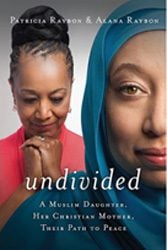 What inspired you to write this book, at this time?
Patricia: We got tired of pretending, of avoiding the obvious. Alana is no longer a Christian. She chose Islam. She wears hijab. She rejects Christ as Lord and the Bible as God’s inspiration. I didn’t pretend that didn’t happen, but I went 10 years not asking her why, or where do we go from there. As a result, as mother and daughter, our interaction was inauthentic. Our family felt divided by her faith choice, and I was angry and hurting, but not talking about it. It was time to address all of this and have a real conversation.
Alana: For years, my mother and I argued about religion. I became so exhausted from debates that I withdrew from any discussion about faith. We transitioned into a period of denial where I tried to ignore the problem. When my mother approached me to write our book, I was ready to face our conflict head on. I knew that continuing to bury my emotions was unhealthy. I agreed to enter into a healing process with my mother, and I was hopeful that the book would be therapeutic for me.
Was there a particular moment/experience that shifted the tension between the two of you or was it a gradual process? How long did it take to come to some peace around your differences in faith?
Patricia: After throwing Bible scriptures and Qur’an hadiths at each other, we finally both saw that debating and arguing wasn’t settling anything—instead, it was drawing us deeper into conflict. After several years of this, then finally starting our book, it became clear that our peace would come by releasing our faith divide to God. So I laid it at the Cross and left it there. Some have called that giving up. But it’s been far better for us to focus less on faith—our point of division—and more on our common bond as mother and daughter. I love better and pray better when I live this way. God works better, too, I believe, when I love.
Alana: At one point in the writing of our book, I began to realize the huge importance of empathy in relationships. I recognized my mother’s feelings more, and expressed my sympathy for her experience. It took me a while to reach a place where I could stop being offended by her opposition to my faith, and try to understand her feelings. It was humbling, but refreshing, because it helped me look inward and find ways that I could be a more caring daughter.
Did you ultimately find points of common ground between your two Gods?
Patricia: Ultimately, no, because Christians believe Jesus is Lord, Savior and God Incarnate, and Alana rejects that. She also rejects the Trinity and disavows the Bible—all deeply precious to me. These are big divides that aren’t “discussed away.” Finally, instead, I asked a different big question: can we get along anyway? In this way, the Lord released me to stop fighting with Alana—and start serving his world. That’s not a failure, as some have suggested. In Christ, instead, I was liberated to love my daughter and God’s kingdom. I count that a victory.
Alana: My mother and I discovered that debating each and every point about God was not helping. I began to admire my mother’s love for God, seeing within myself, a similar form of adoration. Although we differ in how we view God, I see in the both of us a desire to follow God’s plan, and a humbleness to accept that plan.
What was the hardest thing – or the greatest loss — for each of you regarding the other’s chosen religion?
Patricia: I mourned for years the loss of “family” as expressed in faith rituals and holidays. Those special times are like glue for a family. They say “we belong to each other and, together, we’ll survive and thrive.” In contrast, I’ve never sung Christmas carols or decorated a Christmas tree with my little grandchildren (Alana’s children) or celebrated Easter Sunday with Alana’s family. Alana has been adamant about not acknowledging these Christian holidays, so her absence on those days is keenly felt. We’ve had to find other ways to “be family.” But that path has drawn me closer to God, and closer to Alana anyway. That’s how good God is.
Alana: My mother has accepted my right to choose my faith, but we remain on different spiritual paths. As a believer who knows that God has a plan, I leave my fate, and that of my mother’s in God’s hands. I know that God loves us both, and I rejoice in seeing His blessings in this book.
How did your mother-daughter relationship change or grow in the process of writing this book together?
Patricia: Our relationship is guided now by respect. That word “respect,” at its root, means to look again, and as I look again at my daughter, I appreciate her strong positives. She’s intelligent, passionate and hard-working, and I admire those qualities in her. As I relate to her with those things in mind, I give to God her rejection of our family’s faith. The relationship I prioritize, that is, is my relationship with God. Do I trust him with the eternal outcome for my daughter? I do. In the meantime, I will love my daughter. And I pray for her salvation. God helps me to do that every day.
Alana: As I wrote about the issues deep in my heart, the door to conversation opened, allowing me to express thoughts I had never shared before. I began to notice the rift between us closing as our relationship healed. My mother and I still have many more conversations to have about faith, but now we know the importance of talking and listening to each other.
What was the hardest part about writing this book?
Patricia: Not being in control! Ours is a shared story, not just me telling a Christian narrative. To share a literary stage on the topic of faith, I had to let go, give God the reins and actively love Alana in practical, ordinary, everyday ways: listen more, collaborate, take my turn, wait for her reply, ask for information, and consider it prayerfully. More than all, I had to trust God to use our journey for good. In the end, it was the toughest writing project I’ve ever tackled, but the rewards have been some of the greatest.
Alana: As my mother expressed her feelings about my conversion and the hurt she experienced, I began to feel an overwhelming sense of guilt. I began to internalize the conflict and see it as my fault. It took quite some time for me to come to terms with these emotions, eventually replacing them with confidence in God’s plan.
What was the most rewarding part about the process?
Patricia: Gaining a fresh understanding of peace. I always thought peace was a place—where you arrived and “found peace” Instead, peace is a choice. A lifestyle. A way of walking through life. Not arguing or blaming. Yielding hurt to God. Accepting others, flaws and all. Meantime, if you hit a roadblock on this journey, or a bump in the road—and start to argue again, or say something hurtful—you both know it was a bump in the road, and you can get up and try again. So peace is a journey. As the Bible says, Jesus is our Peace. So peace is traveling with him day by day. And trusting that he goes before me. Learning that peace is process, not a destination, was life-changing.
Alana: It was extremely liberating for me to pour my heart out on paper, knowing that my mother would read every word. I had a chance of a lifetime at my fingertips, and I took it. For once, I felt like I could openly express my deepest thoughts about faith. Knowing that my mother was listening to me was extremely fulfilling.
How do you celebrate each others’ religious holidays now? Together, or each on your own?
Patricia: We live in different cities, and we’re both passionate about our faiths, so we don’t observe each other’s religious holidays together. I have gone to one or two iftar dinners with Alana and her family during Ramadan, but we don’t go out of our way to celebrate special holy days together. Instead, we focus on offering each other the gift of respect and authenticity every day. This is not compromise.
Alana: Holidays are still a difficult subject for our family. Christian and Muslim holidays are always spent with our own immediate families. When we do celebrate, it’s for non-secular holidays and birthdays. I’ve started to view it as an opportunity to find creative, non-religious ways to celebrate and get together.
What was the most important lesson you learned in the process of reconciling your differences that might serve as a helpful lesson to all of us, Christian and Muslims — and others, navigating interfaith dialogue and acceptance?
Patricia: Take your eyes off those differences. Those things are God’s business. Instead, love one another. How? Talk about things other than religion. Do life things together—share a meal, paint a house, see a play, help the poor, take a walk, go on vacation. Meantime, love. Actively. This is the adventure with Christ.
Alana: In any relationship, listening with empathy is key. Each participant must be willing to put aside their opinions while they listen, in order to truly appreciate the experiences of the other person. Pre-judgement is currently plaguing our society. We must willingly seek out opportunities to interact with different people, thus expanding our understanding of the diverse cultures around us.
What do you most hope readers take away from your book?
Patricia: A family divide can be healed. But you have to choose to heal. To walk the road of peace. I think of Jesus, hanging crucified on a cross, yet urging his friend John to remember to take care of his mother. In family, peace work is divine, but family members have to seek it. To be intentional. I had to invite Alana to bridge our divide, to say let’s fix this—but also keep working at it. That’s what we hope to model to others. Reach out. Start the healing. Then keep working. Adjusting. Trying again. That is the way of peace.
Alana: I hope readers will find inspiration from our journey and tackle their own relationship divides. My mother and I discovered that peace not a destination. It is an ongoing process, like a garden that needs constant tending. I hope that readers will commit to talking with their loved ones, with the goal of establishing a relationship of mutual respect and understanding.
Read more about the new book Undivided – including a book excerpt – at the Patheos Book Club here.
Previous Post

May 20, 2015
"Redeeming Sex" by Debra Hirsch
Next Post
June 1, 2015 On Biblical Manhood: A Q&A with Author Carolyn Custis James
Browse Our Archives
Select a Category Author Q&A Book Review Christian Living Church Leadership Stump a Scholar Theology Uncategorized
Select a Month June 2022 March 2021 October 2020 August 2020 February 2019 November 2017 July 2017 June 2017 May 2017 March 2017 February 2017 January 2017 November 2016 October 2016 August 2016 July 2016 June 2016 May 2016 April 2016 March 2016 February 2016 January 2016 November 2015 October 2015 September 2015 August 2015 July 2015 June 2015 May 2015 April 2015 March 2015 February 2015 January 2015 December 2014 November 2014 October 2014 September 2014 August 2014 July 2014 June 2014 May 2014 April 2014 March 2014 February 2014 January 2014 December 2013 November 2013 October 2013 September 2013 August 2013 July 2013 June 2013 May 2013 April 2013 March 2013 February 2013 January 2013 December 2012 November 2012 October 2012 September 2012 August 2012 July 2012 June 2012 May 2012 April 2012 March 2012 February 2012 January 2012 December 2011 November 2011 October 2011 September 2011 August 2011 July 2011 June 2011 May 2011 April 2011 March 2011 February 2011 January 2011 December 2010 November 2010 October 2010 September 2010 August 2010 July 2010 June 2010
Follow Us!
TAKE THE
Religious Wisdom Quiz
Who did God call as a boy in the Tabernacle, saying his name three times?
Select your answer to see how you score.
David Samuel Eli Saul
Related posts from Take and Read

Life is an Endless Invitation: Q&A With Rob...
Rethinking Ritual for a Secular Age: An Interview...

Even the Faith Giants Didn’t Always Get it...

Author Lily Burana on Experiencing God's Grace and...
TRENDING AT PATHEOS Religious Music & Entertainment

"Les Diabolique" and Transgression
Alongside something like Arrival, Vertigo, or Charade, Les Diaboliques is a...

"The Plague Dogs" and Mortality
So, flashback to the late 70s, early 80s. Walt Disney Studios is...

With the recent and highly successful release of Christopher Nolan’s epic film,...

"L'avventura" and Human Weakness
Today's piece is going to be a little different for a few...

I first want to apologize for not posting or writing anything. I'm...

I've engaged in the multi-year project of reading through the Church Fathers,...
view all Religious Music & Entertainment blogs
Ad-Free & Subscriber Log-In Subscription Support
- About Us
- 2026 Calendar
- Videos
- Podcasts
- Library of World Religions
- Faith In Media Tracker
- Advertise With Us
- Write for Us
- Privacy Policy
- Terms of Service
- Do Not Sell My Data
- Contact Us
- Radiant Digital
- Manage Newsletter Subscriptions
- Unsubscribe From Notifications
- Sitemap
Copyright 2008-2026, Patheos. All rights reserved.
Subscription Support Ad-Free & Subscriber Log-In
Follow Patheos