
BuddhistCatholicContemplativeEvangelicalGeneral ChristianHinduJewishLatter-day SaintMuslimNew VisionsProgressive Christian
Beliefs
- Buddhist
- Catholic
- Contemplative
- Evangelical
- General Christian
- Hindu
- Jewish
- Latter-day Saint
- More Voices
- Muslim
- New Visions
- Pagan
- Progressive Christian
Topics
- Religion News
- Food and Religion
- Sports and Religion
- Religious Art
- Religious Music and Entertainment
- Religious Events
- History and Religion
- Style and Religion
- Politics and Religion
- Women in Religion
- Recreation Outdoors and Religion
- Business Finance and Religion
- Careers Workplace and Religion
- Education and Religion
- Family Parenting and Religion
- Health Fitness and Religion
- Home and Religion
- Relationships and Religion
- Technology and Religion
- Travel and Religion
Columnists
- Buddhist Columnists
- Business Finance and Religion Columnists
- Careers Workplace and Religion Columnists
- Catholic Columnists
- Contemplative Columnists
- Education and Religion Columnists
- Evangelists Columnists
- Family Parenting and Religion Columnists
- General Christian Columnists
- Health Fitness and Religion Columnists
- Hindu Columnists
- History and Religion Columnists
- Home and Religion Columnists
- Jewish Columnists
- More Voices Columnists
- Latter Day Columnists
- Muslim Columnists
- New Visions Columnists
- Nonreligious Columnists
- Pagan Columnists
- Politics and Religion Columnists
- Progressive Columnists
- Recreation Outdoors and Religion Columnists
- Relationships and Religion Columnists
- Religion News Columnists
- Religious Art Columnists
- Religious Events Columnists
- Religious Music and Entertainment Columnists
- Sports and Religion Columnists
- Style and Religion Columnists
- Technology and Religion Columnists
- Travel and Religion Columnists
- Women in Religion Columnists
Resource Library
- 2026 Calendar
- Library of World Religions
- The 100 Most Holy Places on Earth
- Patheos Answers
- Podcasts
- Videos
- Faith Leaders Database
- Anglican Episcopalian
- Bahai
- Baptist
- Buddhism
- Christianity
- Confucianism
- Eastern Orthodoxy
- Hinduism
- Holiness and Pentecostal
- ISKCON
- Islam
- Judaism
- Lutheran
- Methodist
- The Church of Jesus Christ of Latter-day Saints
- New Age
- Paganism
- Presbytarian and Reformed
- Protestantism
- Religion Behind the Scenes
- Roman Catholic
- Scientology
- Shia Islam
- Sikhism
- Sufism
- Sunni Islam
- Taoism
- Zen
- See all religions
Research Tools
 Ad-Free & Subscriber Log-In Subscription Support
Ad-Free & Subscriber Log-In Subscription Support
Follow Patheos 

- Trending:
- Forgiveness
- |
- Marriage
- |
- Consciousness
- |
- Death Penalty
- |
- Election
- |
- Halloween

- Home
- Religious Music & Entertainment
- St. Patrick, AA, and Vulnerable Faith: A Q&A with Jamie Arpin-Ricci
St. Patrick, AA, and Vulnerable Faith: A Q&A with Jamie Arpin-Ricci
Last updated on: March 2, 2015 at 10:24 pm by Deborah Arca
St. Patrick, AA, and Vulnerable Faith: A Q&A with Jamie Arpin-Ricci 2015-03-02T22:24:28-07:00 Deborah Arca
Patheos Explore the world's faith through different perspectives on religion and spirituality! Patheos has the views of the prevalent religions and spiritualities of the world.
“Who willingly exposes their weaknesses? Yet that is exactly that path Jesus calls us to tread, and for good reason: There is more hope in honest brokenness than in the pretense of false wholeness.
— Jamie Arpin-Ricci, author, Vulnerable Faith
This month at the Patheos Book Club, we’re featuring a new book by inner city pastor Jamie Arpin-Ricci called Vulnerable Faith: Missional Living in the Radical Way of St. Patrick. In this exclusive interview, Arpin-Ricci shares the story behind the book, how his church community ended up ministering to him, and what Alcoholics Anonymous can teach us about vulnerable faith.
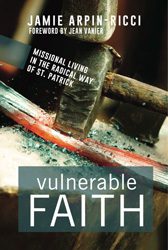 What was the inspiration for writing Vulnerable Faith?
The inspiration goes a long way back. Even as a child, I had a deep sense of longing, even calling, for friendship, acceptance and community. I would even feel guilty if I didn’t include all my toys when playing. That stayed with me, even into my teen years when I discovered the writing of M. Scott Peck. It was in his work that I first encountered the idea that community was not only what we were designed for, but that it took genuine effort and that it formed and developed following stages.
After graduating, I joined a missionary organization that placed a strong emphasis of intentional community living, revealing both the beauty and challenges of what it takes to share our lives in authentic ways. It required a willingness to be vulnerable with one another, to let go of our masks and face our own fears, biases and prejudices. While Peck’s writing was critical in this understanding, the added dimension of a shared missional vocation added something new.
As we sought to live this in community, I recorded our journey and began to share with others the hard-earned wisdom. After years of teaching & experimenting with the ideas, I decided to put it down into a book — and Vulnerable Faith was born.
Why did you choose St. Patrick as the model for a book on missional living?
In truth, as I looked at the lives of Christians through history, the pattern of their lives often beautifully reflected the stages we explore in the book. However, St. Patrick’s story of capture, captivity, conversion and escape was uniquely compelling, especially because he willingly returned to the land of the captors to bring the gospel.
Further, the legacy of St. Patrick and Celtic Christianity at large makes for a strong argument for the lasting transformation that occurred there. It shows how the individual conversion of one man lost to the wilds could be transformed into one of Christianity’s most beautiful examples of the kingdom of God. I believe the book offers the same invitation: While inviting individuals and small groups into vulnerable faith, I believe it has the potential of much greater impact.
You also talk about the 12-Step Program of Alcoholics Anonymous as offering us wisdom for living out a life of transformation and service. What does AA have to do with “vulnerable faith”?
Years ago, while watching a popular TV show, it occurred to me that well we often see the church as the brunt of pop culture humour, we rarely see Alcoholics Anonymous treated with anything but respect. And while I could (sadly) think of many reasons why we Christians deserve such representation, I was moved by the fact that AA, a community of admitted addicts who have collectively declared their helpless could inspire the kind of response that I only hope my Christian community could inspire. One of key reasons AA is able to do this is because of their unwavering commitment to finding hope in and through vulnerability.
The 12 Steps most explicitly embody this vulnerable path. They are particularly helpful because they integrate guiding principles with concrete actions, refusing to let them be abstracted into mere ideals. As I reflected on them in the book, I realized that the twelve steps involve admitting that we cannot control our brokenness; recognizing the need for God’s intervention to give us strength; reflecting on all our failures, past and present, with the help of others; seeking reconciliation and making restitution whenever possible and beneficial; embracing a new life devoted to the principles learned; and compassionate reaching out to help others on the same journey. One could argue that these spiritual principles are necessary for everyone. Few movements reflect the kind of vulnerable faith we need like Alcoholics Anonymous.
In your introduction, you ask: “How do we become the kind of people who embrace this transformation and step into the fearless love of selfless service to God and neighbor?” How, indeed, do we begin?
We begin by examining and admitting where we are at. We begin by recognizing the fears that keep us tied up in selfishness and pretense. We begin by willingly embracing a hopeful vulnerability. After all, in the pop wisdom of TV’s Dr. Phil, “You cannot change what you do not acknowledge.” Again, the wisdom of AA and 12 Steps is practical and to the point: we must admit that we are powerless over the things that keep us from wholeness.
Too often, though, we attempt to ignore, minimize and mitigate our own problems and failures in an effort to avoid this costly path. We compare ourselves to others who we think are “worse than us”. We explain away our weaknesses as circumstantial. Consciously or not, we even convince ourselves that, as long as no one else sees us for what we really are, it isn’t true. Such responses, while ultimately unhealthy, are at least understandable. Who willingly exposes their weaknesses? Yet that is exactly that path Jesus calls us to tread, and for good reason: There is more hope in honest brokenness than in the pretense of false wholeness.
What have you learned in your own life of servant living in community about transformation? About becoming vulnerable? About self-sacrifice? About love?
For many years, I have served as the pastor of an inner city church community, helping people with addictions, mental illness, poverty and all the other every day challenges people face. And it has been a good and worthy ministry. And yet, for all that “noble service”, it was in this last year that my own faith has been newly challenged to embrace vulnerability.
Last year, after a pattern of unpredictable outbursts, I was diagnosed with Post-Traumatic Stress Disorder, likely the result of witnessing a friend take his own life. Suddenly, I went from being the pastor of people with mental illness to living with mental illness myself. And in recognizing that reality, I needed to accept help — from family, friends and professionals. Above all, I realized that those people who I lived with mental illness — the people I had served and loved — were best equipped to understand and support me in my journey. They became my pastors.
Who did you write this book for? Who do you hope most reads it?
Serving in the context I do, I often get invitations from suburban and rural churches to come and share about our ministry, to talk about ministry among the poor and the mentally ill. Often people will express sincere compassion for the how much need there is in my community. While this is true, I have come to realize that the difference between my community and those I visit is often simply that my community has had the pretense of false wholeness stripped away. Circumstances have conspired to expose the raw brokenness in our lives. Yet, for many Christians in more “stable”and “healthy”contexts, our privilege (be it economic, social or racial) often serves to effectively hide their brokenness. Pretense, intentional or not, is the great enemy of vulnerable faith.
This book is written for anyone willing to face their vulnerability because of the hope of transformation that awaits them on the other side of the cross of Christ. And not simply a transformation for our own sakes, but so that we can be united and empowered by the Holy Spirit to bring the hope of forgiveness, salvation and fullness of life to others. As Jean Vanier so powerfully expressed in the book’s foreword:
“The urgency of the invitation to each of us in Vulnerable Faith cannot be ignored. In a world of terror and hatred, of protection and retaliation, it is a bold and important reminder to Christians of the radical nature of our witness as followers of Jesus. He is the Word made flesh, the vulnerable incarnation of God’s love for each and every one of us. And it is in a relationship of mutual vulnerability with the One who loves us that we will be able to grow to freedom, that God’s desire and our hope of shalom will be realized.”
Read an excerpt from Vulnerable Faith at the Patheos Book Club here.
Previous Post

March 2, 2015
Tongue Pierced: A Review
Next Post
March 3, 2015 Are Adam and Eve For Real? A Q&A with Author John Walton
Browse Our Archives
Select a Category Author Q&A Book Review Christian Living Church Leadership Stump a Scholar Theology Uncategorized
Select a Month June 2022 March 2021 October 2020 August 2020 February 2019 November 2017 July 2017 June 2017 May 2017 March 2017 February 2017 January 2017 November 2016 October 2016 August 2016 July 2016 June 2016 May 2016 April 2016 March 2016 February 2016 January 2016 November 2015 October 2015 September 2015 August 2015 July 2015 June 2015 May 2015 April 2015 March 2015 February 2015 January 2015 December 2014 November 2014 October 2014 September 2014 August 2014 July 2014 June 2014 May 2014 April 2014 March 2014 February 2014 January 2014 December 2013 November 2013 October 2013 September 2013 August 2013 July 2013 June 2013 May 2013 April 2013 March 2013 February 2013 January 2013 December 2012 November 2012 October 2012 September 2012 August 2012 July 2012 June 2012 May 2012 April 2012 March 2012 February 2012 January 2012 December 2011 November 2011 October 2011 September 2011 August 2011 July 2011 June 2011 May 2011 April 2011 March 2011 February 2011 January 2011 December 2010 November 2010 October 2010 September 2010 August 2010 July 2010 June 2010
Follow Us!
TAKE THE
Religious Wisdom Quiz
What does the name "Jesus" mean?
Select your answer to see how you score.
The Lord saves God is with us Teacher Prince of peace
Related posts from Take and Read

Life is an Endless Invitation: Q&A With Rob...
Rethinking Ritual for a Secular Age: An Interview...

Even the Faith Giants Didn’t Always Get it...

Author Lily Burana on Experiencing God's Grace and...
TRENDING AT PATHEOS Religious Music & Entertainment

"Les Diabolique" and Transgression
Alongside something like Arrival, Vertigo, or Charade, Les Diaboliques is a...

"The Plague Dogs" and Mortality
So, flashback to the late 70s, early 80s. Walt Disney Studios is...

With the recent and highly successful release of Christopher Nolan’s epic film,...

"L'avventura" and Human Weakness
Today's piece is going to be a little different for a few...

I first want to apologize for not posting or writing anything. I'm...

I've engaged in the multi-year project of reading through the Church Fathers,...
view all Religious Music & Entertainment blogs
Ad-Free & Subscriber Log-In Subscription Support
- About Us
- 2026 Calendar
- Videos
- Podcasts
- Library of World Religions
- Faith In Media Tracker
- Advertise With Us
- Write for Us
- Privacy Policy
- Terms of Service
- Do Not Sell My Data
- Contact Us
- Radiant Digital
- Manage Newsletter Subscriptions
- Unsubscribe From Notifications
- Sitemap
Copyright 2008-2026, Patheos. All rights reserved.
Subscription Support Ad-Free & Subscriber Log-In
Follow Patheos