
BuddhistCatholicContemplativeEvangelicalGeneral ChristianHinduJewishLatter-day SaintMuslimNew VisionsProgressive Christian
Beliefs
- Buddhist
- Catholic
- Contemplative
- Evangelical
- General Christian
- Hindu
- Jewish
- Latter-day Saint
- More Voices
- Muslim
- New Visions
- Pagan
- Progressive Christian
Topics
- Religion News
- Food and Religion
- Sports and Religion
- Religious Art
- Religious Music and Entertainment
- Religious Events
- History and Religion
- Style and Religion
- Politics and Religion
- Women in Religion
- Recreation Outdoors and Religion
- Business Finance and Religion
- Careers Workplace and Religion
- Education and Religion
- Family Parenting and Religion
- Health Fitness and Religion
- Home and Religion
- Relationships and Religion
- Technology and Religion
- Travel and Religion
Columnists
- Buddhist Columnists
- Business Finance and Religion Columnists
- Careers Workplace and Religion Columnists
- Catholic Columnists
- Contemplative Columnists
- Education and Religion Columnists
- Evangelists Columnists
- Family Parenting and Religion Columnists
- General Christian Columnists
- Health Fitness and Religion Columnists
- Hindu Columnists
- History and Religion Columnists
- Home and Religion Columnists
- Jewish Columnists
- More Voices Columnists
- Latter Day Columnists
- Muslim Columnists
- New Visions Columnists
- Nonreligious Columnists
- Pagan Columnists
- Politics and Religion Columnists
- Progressive Columnists
- Recreation Outdoors and Religion Columnists
- Relationships and Religion Columnists
- Religion News Columnists
- Religious Art Columnists
- Religious Events Columnists
- Religious Music and Entertainment Columnists
- Sports and Religion Columnists
- Style and Religion Columnists
- Technology and Religion Columnists
- Travel and Religion Columnists
- Women in Religion Columnists
Resource Library
- 2026 Calendar
- Library of World Religions
- The 100 Most Holy Places on Earth
- Patheos Answers
- Podcasts
- Videos
- Faith Leaders Database
- Anglican Episcopalian
- Bahai
- Baptist
- Buddhism
- Christianity
- Confucianism
- Eastern Orthodoxy
- Hinduism
- Holiness and Pentecostal
- ISKCON
- Islam
- Judaism
- Lutheran
- Methodist
- The Church of Jesus Christ of Latter-day Saints
- New Age
- Paganism
- Presbytarian and Reformed
- Protestantism
- Religion Behind the Scenes
- Roman Catholic
- Scientology
- Shia Islam
- Sikhism
- Sufism
- Sunni Islam
- Taoism
- Zen
- See all religions
Research Tools
 Ad-Free & Subscriber Log-In Subscription Support
Ad-Free & Subscriber Log-In Subscription Support
Follow Patheos 

- Trending:
- Forgiveness
- |
- Marriage
- |
- Consciousness
- |
- Death Penalty
- |
- Election
- |
- Halloween

- Home
- Religious Music & Entertainment
- On the Messiness of Life and the Mystery of God: A Review of Ken Wytsma’s “The Grand Paradox”
On the Messiness of Life and the Mystery of God: A Review of Ken Wytsma’s “The Grand Paradox”
Last updated on: February 11, 2015 at 1:30 pm by David Swartz
On the Messiness of Life and the Mystery of God: A Review of Ken Wytsma’s “The Grand Paradox” 2015-02-11T13:30:30-07:00 David Swartz
Patheos Explore the world's faith through different perspectives on religion and spirituality! Patheos has the views of the prevalent religions and spiritualities of the world.
Say the word “theology” and eyes can glaze over. A number of reasons for this come to mind. Sometimes our thinking on theology is sincerely misguided. Some believe that being Christian bypasses the mind, that thinking too much just provokes arguments and stifles simple faith. Some of us are lazy, shirking the mental work of faith to our pastors or professors. Others are intimidated intellectually and fear that theology is antithetical to living a biblical faith. It can be. It depends on who’s writing the theology. It can bristle with Greek tenses and Hebrew verb stems with a few Latin footnotes thrown in. It can drop names we don’t know and words we don’t understand like “heilsgeschichte” (a German microbrew?) or Sitz im Leben (designer lederhosen?)
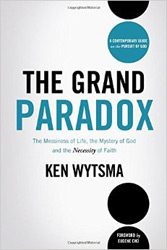
Enter Pastor Ken Wytsma with The Grand Paradox; The Messiness of Life, the Mystery of God and the Necessity of Faith. He writes theology for real people. The book’s subtitle reads: “A Contemporary Guide on the Pursuit of God.” If we’re looking for a quick fix, instant solution to ensure lasting prosperity and complete happiness for the foreseeable future, this book is not for us. If we’d like a satisfying read, a long and thoughtful chew on things biblical and spiritual that will galvanize us for a lifetime of following Jesus, The Grand Paradox will be worth our while. In both style and content, Ken achieves this goal this in a number of ways.
Whenever we write, especially on a topic with a broad focus like living Christianly for the rest of our life, it’s easy to put down everything we know, to disgorge every creative thought out on the page, to make every sentence worthy of a Nobel Prize. Ken wrote an earlier book, Pursuing Justice; The Call to Live and Die for Bigger Things. Maybe he did all these things there. But I doubt it. He writes with an urgent, yet restrained style that says this is too important to breeze through or skim. He writes in a style that slows the reader down to drink in what he’s written and make them glad they did.
He also does some things I mentioned above. He drops names not everyone will know. He loves C.S. Lewis (what’s not to love?), Augustine, Nouwen, Kierkegaard, Brueggemann, Heschel, Underhill and others. As Ken introduces these names into the text, it’s not to impress us. He wants us to meet his friends so they can be ours too, potentially in life changing ways. He also uses Scripture. How can any book even pretense to be a Christian book that excludes it? The reader will repeatedly find himself inspired by Scripture passages they may never have read seriously before.
Ken even uses print layout to make biblical theology more comprehendible. On pages 12-13, Ken describes the biblical thought form known as “paradox”. Instead of giving his own homemade definition, he gives an inset of eight bullet pointed examples straight from the Scripture. Ken also observes the good writing rule that says if anyone else has said it better, let them. Quote freaks will find more than one to tuck away and be remembered.
Ken is also an expert of sorts on social justice issues. A graduate of Kilns College, a school centering on justice and philosophy, Ken began a conference that has awakened thousands to the issues surrounding biblical justice. He is adamant that what the Bible describes as salvation includes far more than personal concerns. It concerns a world made right (chapter 5); as sin is also systemic and cultural, salvation must be as well.
Chapter 6 takes a long look at happiness and our obsession with and sense of entitlement to it. The desire for happiness is actually part of the hardwiring of the Image of God within us but we attach and frustrate it by squandering the desire for happiness in pursuit of things less than God. In Chapter 7, Ken analyzes doubt, pointing out that stifling or ignoring it does far more to destroy faith than defend it. Grappling with real doubt alongside those who will allow us to struggle without drumming us out of the church produces paradoxically much stronger faith, much more durable Christians and churches.
Ken also gets into our callings, mission and the will of God (Chapter 8). I applaud his appeal to personal daily faithfulness to the things God calls us to in day-to-day life. The Body of Christ has a big backside that often can envision no more than personal comfort, prosperity, protection and love of convenience – the spiritual equivalent of pounding down Krispy Kremes. Much talk about wanting to know the will of God arises from passive dispositions. My favorite (and I didn’t think it would be) was Chapter 10, “Complexity and the Limits of Human Understanding.” He describes our information-overload and the tyranny that technology exercises over our lives if we’ll let it. Since I firmly believe our obsession with social media cripples us socially and accelerates the dumbing down of our culture, I found his simple prompts refreshingly to the point. Ken brings relief with his suggestions for how not just to silence “the voices,” but to hear The Voice.
Ken also writes tellingly about fatigue as an expected, even valuable, part of Christian living. He clarifies well what traditionally we’ve know as the Dark Night of the Soul but have corrupted through distortion into the image of our own self-centeredness. As I read The Grand Paradox, I found myself thinking, “This guy is in my corner.” And he is. But what I imagine Ken Wytsma really wants us to see is that Jesus Christ is the One in our corner whether we sense it or not … for the long haul, for the rest of our lives.
Read an excerpt and more from The Grand Paradox at the Patheos Book Club here.
Previous Post

January 21, 2015
Blessed Mourning: Reflections on ALOOF, Chapter 10
Next Post
February 9, 2015 On Stealing from God: Why Atheists Need God to Make Their Case
Browse Our Archives
Select a Category Author Q&A Book Review Christian Living Church Leadership Stump a Scholar Theology Uncategorized
Select a Month June 2022 March 2021 October 2020 August 2020 February 2019 November 2017 July 2017 June 2017 May 2017 March 2017 February 2017 January 2017 November 2016 October 2016 August 2016 July 2016 June 2016 May 2016 April 2016 March 2016 February 2016 January 2016 November 2015 October 2015 September 2015 August 2015 July 2015 June 2015 May 2015 April 2015 March 2015 February 2015 January 2015 December 2014 November 2014 October 2014 September 2014 August 2014 July 2014 June 2014 May 2014 April 2014 March 2014 February 2014 January 2014 December 2013 November 2013 October 2013 September 2013 August 2013 July 2013 June 2013 May 2013 April 2013 March 2013 February 2013 January 2013 December 2012 November 2012 October 2012 September 2012 August 2012 July 2012 June 2012 May 2012 April 2012 March 2012 February 2012 January 2012 December 2011 November 2011 October 2011 September 2011 August 2011 July 2011 June 2011 May 2011 April 2011 March 2011 February 2011 January 2011 December 2010 November 2010 October 2010 September 2010 August 2010 July 2010 June 2010
Follow Us!
TAKE THE
Religious Wisdom Quiz
What did Samuel's mother promise if God gave her a son?
Select your answer to see how you score.
To move to Jerusalem To dedicate him to the Lord To offer a burnt sacrifice To fast for 40 days
Related posts from Take and Read

"The Slow March of Light" Highlights The Human...

"A Brilliant Night of Stars and Ice" Recounts...

"Movies Are Prayers": A New Way of Discussing...

Symbols of Faith in "Take the Flag"
TRENDING AT PATHEOS Religious Music & Entertainment

"Les Diabolique" and Transgression
Alongside something like Arrival, Vertigo, or Charade, Les Diaboliques is a...

"The Plague Dogs" and Mortality
So, flashback to the late 70s, early 80s. Walt Disney Studios is...

With the recent and highly successful release of Christopher Nolan’s epic film,...

"L'avventura" and Human Weakness
Today's piece is going to be a little different for a few...

I first want to apologize for not posting or writing anything. I'm...

I've engaged in the multi-year project of reading through the Church Fathers,...
view all Religious Music & Entertainment blogs
Ad-Free & Subscriber Log-In Subscription Support
- About Us
- 2026 Calendar
- Videos
- Podcasts
- Library of World Religions
- Faith In Media Tracker
- Advertise With Us
- Write for Us
- Privacy Policy
- Terms of Service
- Do Not Sell My Data
- Contact Us
- Radiant Digital
- Manage Newsletter Subscriptions
- Unsubscribe From Notifications
- Sitemap
Copyright 2008-2026, Patheos. All rights reserved.
Subscription Support Ad-Free & Subscriber Log-In
Follow Patheos