
BuddhistCatholicContemplativeEvangelicalGeneral ChristianHinduJewishLatter-day SaintMuslimNew VisionsProgressive Christian
Beliefs
- Buddhist
- Catholic
- Contemplative
- Evangelical
- General Christian
- Hindu
- Jewish
- Latter-day Saint
- More Voices
- Muslim
- New Visions
- Pagan
- Progressive Christian
Topics
- Religion News
- Food and Religion
- Sports and Religion
- Religious Art
- Religious Music and Entertainment
- Religious Events
- History and Religion
- Style and Religion
- Politics and Religion
- Women in Religion
- Recreation Outdoors and Religion
- Business Finance and Religion
- Careers Workplace and Religion
- Education and Religion
- Family Parenting and Religion
- Health Fitness and Religion
- Home and Religion
- Relationships and Religion
- Technology and Religion
- Travel and Religion
Columnists
- Buddhist Columnists
- Business Finance and Religion Columnists
- Careers Workplace and Religion Columnists
- Catholic Columnists
- Contemplative Columnists
- Education and Religion Columnists
- Evangelists Columnists
- Family Parenting and Religion Columnists
- General Christian Columnists
- Health Fitness and Religion Columnists
- Hindu Columnists
- History and Religion Columnists
- Home and Religion Columnists
- Jewish Columnists
- More Voices Columnists
- Latter Day Columnists
- Muslim Columnists
- New Visions Columnists
- Nonreligious Columnists
- Pagan Columnists
- Politics and Religion Columnists
- Progressive Columnists
- Recreation Outdoors and Religion Columnists
- Relationships and Religion Columnists
- Religion News Columnists
- Religious Art Columnists
- Religious Events Columnists
- Religious Music and Entertainment Columnists
- Sports and Religion Columnists
- Style and Religion Columnists
- Technology and Religion Columnists
- Travel and Religion Columnists
- Women in Religion Columnists
Resource Library
- 2026 Calendar
- Library of World Religions
- The 100 Most Holy Places on Earth
- Patheos Answers
- Podcasts
- Videos
- Faith Leaders Database
- Anglican Episcopalian
- Bahai
- Baptist
- Buddhism
- Christianity
- Confucianism
- Eastern Orthodoxy
- Hinduism
- Holiness and Pentecostal
- ISKCON
- Islam
- Judaism
- Lutheran
- Methodist
- The Church of Jesus Christ of Latter-day Saints
- New Age
- Paganism
- Presbytarian and Reformed
- Protestantism
- Religion Behind the Scenes
- Roman Catholic
- Scientology
- Shia Islam
- Sikhism
- Sufism
- Sunni Islam
- Taoism
- Zen
- See all religions
Research Tools
 Ad-Free & Subscriber Log-In Subscription Support
Ad-Free & Subscriber Log-In Subscription Support
Follow Patheos 

- Trending:
- Forgiveness
- |
- Marriage
- |
- Consciousness
- |
- Death Penalty
- |
- Election
- |
- Halloween

- Home
- Religious Music & Entertainment
- On Stealing from God: Why Atheists Need God to Make Their Case
On Stealing from God: Why Atheists Need God to Make Their Case
Last updated on: February 9, 2015 at 5:06 pm by Guest Contributor
On Stealing from God: Why Atheists Need God to Make Their Case 2015-02-09T17:06:50-07:00 Guest Contributor
Patheos Explore the world's faith through different perspectives on religion and spirituality! Patheos has the views of the prevalent religions and spiritualities of the world.
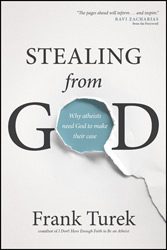 Author Interview with Frank Turek
Your new book has the provocative title, Stealing from God: Why Atheists Need God to Make Their Case. The back cover says: “What if your best arguments against God prove that He really exists?” How are atheists stealing from God and proving He exists?
Atheists are using aspects of reality to argue against God that wouldn’t exist if atheism were true. In other words, when atheists give arguments for their atheistic worldview, they are stealing from a theistic worldview to make their case. In effect, they are stealing from God in order to argue against Him. These aspects of reality are so much part of our common sense that many atheists seem to take them for granted. But they simply can’t exist if atheism is true. Theism can explain them, but atheism cannot.
Stealing from God is organized around the acronym CRIMES, which you say represents the intellectual CRIMES atheists are making. What are those CRIMES?
“CRIMES” stands for Causality, Reason, Information & Intentionality, Morality, Evil and Science. These are all aspects of reality that atheists say disprove God, when, in fact, these things wouldn’t exist without God. I spend a chapter on each one of the CRIMES in the book.
 In the Causality chapter, you claim that some atheists are endangering science in order to avoid God as the cause of the Big Bang. What do you mean by that?
The Big Bang gives atheists fits because the evidence shows that spacetime and matter had a beginning. Well, if spacetime and matter had a beginning, then the cause can’t be made of spacetime or matter. The cause must be spaceless, timeless, immaterial and extremely powerful to create universe out of nothing. Those are attributes of a theistic God.
In order to avoid this conclusion, popular atheist and physicist Lawrence Krauss casts doubt on the law of causality. In discussing the “vexing problem” of the beginning of the universe, Krauss says, “All things that begin may have a cause, even if the cause is rather obscure and purposeless.”
“May” have a cause? What happened to simply “all things that begin do have a cause”? Why does he suddenly doubt the law of causality? By doing so he casts doubt on the very discipline he’s trying to champion—science. The entire scientific enterprise depends on the cause-and-effect relationship. If things can come into existence without causes, then how can anyone do science?
If atheists are going to claim that the universe can pop into existence uncaused out of nothing, then why doesn’t everything do so? Why don’t iPads, Teslas, atheist books, and pizzas pop into existence out of nothing? If you’re hungry for a pizza right now, does it make more sense to order one or just wait and hope? Talk about faith.
But who made God?
No one because God is eternal. He is the unmoved mover—the uncreated creator. The evidence shows that there must be such a being. Here’s why.
Contrary to what many atheists seem to believe, the law of causality does not say that everything has a cause. The law of causality says that everything that has a beginning has a cause, or every effect has a cause. But not everything can be an effect. In order for there to be motion or change at all, there has to be something that isn’t an effect but an eternal, uncaused first cause—an “unmoved mover.” We can’t go on an infinite regress of causes. When we trace the causal chain back, it must end at a self-existent, uncaused first cause.
So when atheists ask, “Who made God?” they misunderstand the law of causality and the nature of God. They are thinking the God of the Bible is a created, Zeus-like idol. But that’s not the God of the Bible, who is the self-existent, uncaused first cause and sustainer of the universe. Since God created time, He is timeless or eternal. If you’re timeless, you don’t have a beginning and thus don’t have a cause.
In the chapter on reason you say that every time atheists attempt to use logic and reason to disprove God, they are actually proving He exists. How so?
Atheists claim to be champions of reason. They even organize “reason” rallies and call themselves “free thinkers.” The problem is there is no “free” or thinking going on if atheism is true. If we are just molecules in motion as atheistic materialism asserts, then we are nothing but moist robots whose every thought is the result of a previous natural cause. Free-thinking can’t exist in such a world. The category of immaterial reality is not available to the atheist, but that’s what the laws of logic and our ability to reason require. On the other hand, reason is well explained by a theistic God whose very nature is rational—“in the beginning was the Word” (or rationality) as the opening line of John’s gospel declares.
Ironically, atheists must rely on faith rather than reason. Being materialists, atheists Sam Harris and Daniel Dennett claim that consciousness, and free will are illusions (one wonders if they freely came to those conclusions while conscious!). But if they are correct, then “you” and “me” don’t really exist and neither do arguments—we are just molecular machines who are just reacting not reasoning.
This is the central problem that emerges repeatedly in atheist arguments: Atheists exempt themselves from their own claims and theories. If free will is an illusion and everyone is a molecular machine, then why are Harris and Dennett acting as if they can freely and reasonably arrive at atheistic conclusions?
The bottom line is that atheism cannot be shown to be true in principle. It has destroyed all the tools necessary to do the job. In order to construct any valid argument for atheism, the atheist has to steal tools from God’s universe because no such tools exist in the world of atheism. They are stealing from the Being who makes reason possible in the first place. So atheists can assert that atheism is true, but they can’t rely on arguments to support the claim. They have to accept it on blind faith.
You have a chapter on how morality points to God. But atheists say science can help us know what’s right. You don’t need God.
That’s what atheist Sam Harris says, but he’s addressing the wrong question. The question isn’t how we know what’s Right, but why does an authoritative standard of Rightness exists in the first place?
You may come to know about objective morality in many different ways: from parents, teachers, society, your conscience, etc. (Harris talks about brain states.) And you can know it while denying God exists. But that’s like saying you can know what a book says while denying there’s an author. Of course you can do that, but there would be no book to know unless there was an author! In other words, atheists can know objective morality while denying God exists, but there would be no objective morality unless God exists.
Science might be able to tell you if an action may hurt someone—like if giving a man cyanide will kill him—but science can’t tell you whether or not you ought to hurt someone. Who said it’s wrong to harm people? Sam Harris? Does he have authority over the rest of humanity? Is his nature the standard of Good? Sam Harris has to steal an objective moral standard from God to get his atheistic system off the ground.
But can’t morality be explained by evolution?
I give six reasons why evolution can’t explain morality. Here’s just one: You can’t explain an immaterial moral law by a material biological process. Justice is not made of molecules. Moral laws are prescriptive and come from authoritative personal agents. Biological processes are descriptive and have no authority to tell you what to do. How could a mutating genetic code have the moral authority to tell you how you ought to behave?
Christians and atheists often disagree over politics and human rights. But you say that atheists unwittingly steal from God in order to argue for some of their political rights, whether it’s abortion, same-sex marriage, government healthcare or whatever. How so?
By what objective standard are abortion, same-sex marriage, taxpayer-provided health care, and the like, moral rights? There isn’t such a standard in an atheistic universe. If there is no God, all moral questions are matter of human opinion. So atheists must steal the grounds for objective moral rights from God while arguing that God doesn’t exist.
Atheists are caught in a dilemma. If God doesn’t exist, then objective moral rights don’t exist, including all those that atheists support. If God does exist, then objective moral rights exist. But those rights clearly don’t include cutting up babies in the womb, same-sex marriage, and other invented absolutes contrary to every major religion and the “self-evident” natural law. (It’s ironic that atheists often call theists arrogant for deferring to God as the authority on morality, when atheists think they are the authority on morality.)
But doesn’t the Constitution provide us with rights?
The Constitution legally codifies rights, but it’s not the ultimate source of rights. What if we change the Constitution? Do your rights vanish?
While it’s true that you don’t have to appeal to God to write laws, you do have to appeal to God if you want to ground them in anything other than human opinion. Otherwise, your “rights” are mere preferences that can be voted out of existence at the ballot box or at the whim of an activist judge or dictator. That’s why our Declaration of Independence grounds our rights in the Creator.
However, my point in the book isn’t about how we should put objective human rights into human law. My point is, without God there are no objective human rights. There is no right to abortion or same- sex marriage. Of course, without God there is no right to life or natural marriage either!
In other words, no matter what side of the political aisle you’re on—no matter how passionate you believe in certain causes or rights—without God they aren’t really rights at all. Human rights amount to no more than your subjective preferences. So atheists can believe in and fight for rights to abortion, same-sex marriage, and taxpayer-provided entitlements, but they can’t justify them as truly being rights. They are preferences, not rights.
Doesn’t evil disprove God?
No, evil disproves atheism. Evil can’t exist unless good exists, and good can’t exist unless God exists. In other words, there can be no objective evil unless there is objective good, and there can be no objective good unless God exists. If evil is real—and we all know it is—then God exists.
We could put it this way: The shadows prove the sunshine. There can be sunshine without shadows, but there can’t be shadows without sunshine. In other words, there can be good without evil, but there can’t be evil without good; and there can’t be objective good without God. So evil may show there’s a devil out there, but it can’t disprove God. Evil actually boomerangs back to show that God exists.
But isn’t the God of the Old Testament evil?
Atheists try to have it both ways. On the one hand, atheists claim there is no good or evil—we just “dance to the music of our DNA.” On the other hand, atheists are outraged at the “evil” God of the Bible and all the evil done in His name. Which is it?
But to answer your question directly: no, the God of the Old Testament is not evil as I explain in the book. While the God of Old Testament seems to present a moral problem for Christians, atheists have no grounds by which to object to such a God. When Richard Dawkins complains about the “evil” God of the Old Testament, he has to steal goodness from God to even make sense of his complaint. He has to sit in God’s lap to slap His face.
Atheists claim that there’s a war between science and Christianity. But you say that’s not true—the war is actually between science and atheism. How so?
Because theism can explain why the tools of science exist but atheism cannot. You need immaterial realities such as the laws of logic, the law of causality, and the reliability of observation to do science that atheism can’t provide.
In fact, we wouldn’t be able to do science reliably if atheism were true. Materialism scuttles free will and destroys our confidence in everything we think. As C. S. Lewis put it, “Unless human reasoning is valid no science can be true.” Even atheist Thomas Nagel admits this. He writes, “Evolutionary naturalism provides an account of our capacities that undermines their reliability, and in doing so undermines itself.”It also ignores the immaterial realities that are necessary for anyone to do science in the first place.
Now, I’m not saying atheists can’t do science. Obviously they can. What I am saying is that they are unwittingly stealing tools from God in order to do it. Thus, the war is not between science and religion, but between science and atheism.
You write in the chapter on science, “To say that a scientist can disprove the existence of God is like saying a mechanic can disprove the existence of Henry Ford.” Unpack that a little more.
The subtitle of the chapter is “Science doesn’t say anything. Scientists do.“ What I mean is that all data needs to be gathered and interpreted. Science doesn’t gather and interpret evidence, people do. And people sometimes get it wrong.
Many people think that our wonderful technological advances somehow disprove the need for creator and sustainer of the universe. The exact opposite is true. God and science are not competing explanations for the universe and life, any more than Henry Ford and the laws of internal combustion are competing explanations for the Model T. Both are necessary. Learning more about how a car works will never disprove the existence of the carmaker. Likewise, learning more about how the natural world works (which enables us to make technological advances) will never disprove the existence of the Creator or Sustainer of the natural world.
What do you mean “a Sustainer” of the natural world?
I mean that there must be some sustaining intellect that keeps nature reliably goal-directed throughout time. The entire natural order—including all living and non-living things and the natural forces of physics—are being consistently goal-directed. For example, in the living world, we see that the heart is directed to pump blood; an acorn is directed to become an oak tree; a human embryo is directed to become an adult. In the nonliving world, we see the microscopic to the enormous directed toward an end. Electrons reliably orbit the nucleus of their atom; atoms consistently form certain molecules but not others; and planets follow a precise orbit—they don’t fly off into oblivion or start and stop randomly.
This regularity is what Aristotle and Aquinas called “final causality.” All of reality, conscious and unconscious, is ordered and goal-directed toward an end or final state. Where does this order and direction come from?
Let’s trace it back. When you chose to read this article, your choice and actions were dependent on a series of deeper realities that are also goal-directed. In order to choose anything, your neurons must fire properly. And in order for your neurons to fire properly, atoms must act precisely as they do. And in order for atoms to act precisely as they do, the four fundamental forces of nature must be in place and act in the consistent and orderly way they do. And in order for the four fundamental forces of nature to . . . well, you see where this is headed. The layers of explanation can’t go on forever. At some point they must terminate at an uncaused first cause that Aristotle called the “unmoved mover.”
This case for a sustaining intelligence holds regardless of whether or not the universe had a beginning. In other words, we are not going backward in time, but rather downward at the present moment to discover the layers of causes at work simultaneously. Each layer is dependent on the one below it until we arrive at the independent, self-existing Being who initiates and sustains the motion or change from the bottom up (or top down, if you want to think of it that way).
This argument is explained much more fully in the chapter on information and intentionality, and it’s one of the most exciting insights I researched to write Stealing from God.
You say that this final causality argument even defuses the atheist’s assertions about evolution. How so?
I present what I think are several fatal problems with the molecules-to-man version of evolution that most atheists assert. However, even if evolutionary processes are responsible for new life forms, there still must be an external intellect sustaining the material world to make life and evolution possible. In other words, evolutionary processes themselves rely on the goal-directedness of the material world. Evolution could not work without a mind actively directing the repetitive and precise natural forces that keep life together and make mutation and natural selection possible! This completely nullifies the “god of the gaps” objection atheists make. I am not saying God did it because we have yet to find a natural cause. I’m saying that natural causes themselves require sustaining intellect like God. The existence of Causality, Reason, Information & Intentionality, Morality, Evil and Science all point in a positive way toward theism. We don’t just lack natural explanations for CRIMES. They provide positive evidence for a being with the attributes of theistic God.
But how does any of this prove the Christian God?
It doesn’t necessarily. I think these arguments and realities certainly point toward theism, but to which theism? That’s why I have a chapter on the specific evidence for what C.S. Lewis called Mere Christianity—the evidence demonstrating that the essentials of Christianity are true. The chapter summarizes the arguments we made in I Don’t Have Enough Faith to be an Atheist and adds several new insights.
And then just to get myself into more trouble, the final chapter answers objections related to Hell and accepting things on “faith.” It’s titled “God Won’t Force You Into Heaven Against Your Will.” (The free CrossExamined app provides quick answers to these and other objections as well. It’s available at CrossExamined.org).
For more on Stealing from God, visit the Patheos Book Club here.
Next Post

February 12, 2015 Watch Your Tongue: A Q&A with Author Nelson Searcy
Browse Our Archives
Select a Category Author Q&A Book Review Christian Living Church Leadership Stump a Scholar Theology Uncategorized
Select a Month June 2022 March 2021 October 2020 August 2020 February 2019 November 2017 July 2017 June 2017 May 2017 March 2017 February 2017 January 2017 November 2016 October 2016 August 2016 July 2016 June 2016 May 2016 April 2016 March 2016 February 2016 January 2016 November 2015 October 2015 September 2015 August 2015 July 2015 June 2015 May 2015 April 2015 March 2015 February 2015 January 2015 December 2014 November 2014 October 2014 September 2014 August 2014 July 2014 June 2014 May 2014 April 2014 March 2014 February 2014 January 2014 December 2013 November 2013 October 2013 September 2013 August 2013 July 2013 June 2013 May 2013 April 2013 March 2013 February 2013 January 2013 December 2012 November 2012 October 2012 September 2012 August 2012 July 2012 June 2012 May 2012 April 2012 March 2012 February 2012 January 2012 December 2011 November 2011 October 2011 September 2011 August 2011 July 2011 June 2011 May 2011 April 2011 March 2011 February 2011 January 2011 December 2010 November 2010 October 2010 September 2010 August 2010 July 2010 June 2010
Follow Us!
TAKE THE
Religious Wisdom Quiz
Who did God call as a boy in the Tabernacle, saying his name three times?
Select your answer to see how you score.
David Samuel Eli Saul
Related posts from Take and Read

Life is an Endless Invitation: Q&A With Rob...

Rethinking Ritual for a Secular Age: An Interview...

Even the Faith Giants Didn’t Always Get it...

Author Lily Burana on Experiencing God's Grace and...
TRENDING AT PATHEOS Religious Music & Entertainment

"Les Diabolique" and Transgression
Alongside something like Arrival, Vertigo, or Charade, Les Diaboliques is a...

"The Plague Dogs" and Mortality
So, flashback to the late 70s, early 80s. Walt Disney Studios is...

With the recent and highly successful release of Christopher Nolan’s epic film,...

"L'avventura" and Human Weakness
Today's piece is going to be a little different for a few...

I first want to apologize for not posting or writing anything. I'm...

I've engaged in the multi-year project of reading through the Church Fathers,...
view all Religious Music & Entertainment blogs
Ad-Free & Subscriber Log-In Subscription Support
- About Us
- 2026 Calendar
- Videos
- Podcasts
- Library of World Religions
- Faith In Media Tracker
- Advertise With Us
- Write for Us
- Privacy Policy
- Terms of Service
- Do Not Sell My Data
- Contact Us
- Radiant Digital
- Manage Newsletter Subscriptions
- Unsubscribe From Notifications
- Sitemap
Copyright 2008-2026, Patheos. All rights reserved.
Subscription Support Ad-Free & Subscriber Log-In
Follow Patheos