
BuddhistCatholicContemplativeEvangelicalGeneral ChristianHinduJewishLatter-day SaintMuslimNew VisionsProgressive Christian
Beliefs
- Buddhist
- Catholic
- Contemplative
- Evangelical
- General Christian
- Hindu
- Jewish
- Latter-day Saint
- More Voices
- Muslim
- New Visions
- Pagan
- Progressive Christian
Topics
- Religion News
- Food and Religion
- Sports and Religion
- Religious Art
- Religious Music and Entertainment
- Religious Events
- History and Religion
- Style and Religion
- Politics and Religion
- Women in Religion
- Recreation Outdoors and Religion
- Business Finance and Religion
- Careers Workplace and Religion
- Education and Religion
- Family Parenting and Religion
- Health Fitness and Religion
- Home and Religion
- Relationships and Religion
- Technology and Religion
- Travel and Religion
Columnists
- Buddhist Columnists
- Business Finance and Religion Columnists
- Careers Workplace and Religion Columnists
- Catholic Columnists
- Contemplative Columnists
- Education and Religion Columnists
- Evangelists Columnists
- Family Parenting and Religion Columnists
- General Christian Columnists
- Health Fitness and Religion Columnists
- Hindu Columnists
- History and Religion Columnists
- Home and Religion Columnists
- Jewish Columnists
- More Voices Columnists
- Latter Day Columnists
- Muslim Columnists
- New Visions Columnists
- Nonreligious Columnists
- Pagan Columnists
- Politics and Religion Columnists
- Progressive Columnists
- Recreation Outdoors and Religion Columnists
- Relationships and Religion Columnists
- Religion News Columnists
- Religious Art Columnists
- Religious Events Columnists
- Religious Music and Entertainment Columnists
- Sports and Religion Columnists
- Style and Religion Columnists
- Technology and Religion Columnists
- Travel and Religion Columnists
- Women in Religion Columnists
Resource Library
- 2026 Calendar
- Library of World Religions
- The 100 Most Holy Places on Earth
- Patheos Answers
- Podcasts
- Videos
- Faith Leaders Database
- Anglican Episcopalian
- Bahai
- Baptist
- Buddhism
- Christianity
- Confucianism
- Eastern Orthodoxy
- Hinduism
- Holiness and Pentecostal
- ISKCON
- Islam
- Judaism
- Lutheran
- Methodist
- The Church of Jesus Christ of Latter-day Saints
- New Age
- Paganism
- Presbytarian and Reformed
- Protestantism
- Religion Behind the Scenes
- Roman Catholic
- Scientology
- Shia Islam
- Sikhism
- Sufism
- Sunni Islam
- Taoism
- Zen
- See all religions
Research Tools
 Ad-Free & Subscriber Log-In Subscription Support
Ad-Free & Subscriber Log-In Subscription Support
Follow Patheos 

- Trending:
- Forgiveness
- |
- Marriage
- |
- Consciousness
- |
- Death Penalty
- |
- Election
- |
- Halloween

- Home
- Religious Music & Entertainment
- Worried to Death: Amy Simpson’s “Anxious” and the Sin of Worry
Worried to Death: Amy Simpson’s “Anxious” and the Sin of Worry
Last updated on: November 6, 2014 at 10:50 am by Amber Stamper
Worried to Death: Amy Simpson’s “Anxious” and the Sin of Worry 2014-11-06T10:50:52-07:00 Amber Stamper
Patheos Explore the world's faith through different perspectives on religion and spirituality! Patheos has the views of the prevalent religions and spiritualities of the world.
 Most Christians are well aware of what Scripture has to say about worry.
Our Pinterest boards and Facebook timelines testify to it: image after image of serene sunrises, placid oceans, fair skies, and green meadows is emblazoned with delicate cursive script reminding us to “Be anxious for nothing,” to “Fear not,” to “Cast all [our] cares on God,” and “Do not worry about tomorrow.”
We understand and believe, in theory, that worry is a lack of faith. And yet, as John MacArthur has said, “Worry is the sin…that Christians commit perhaps more frequently than any other.”
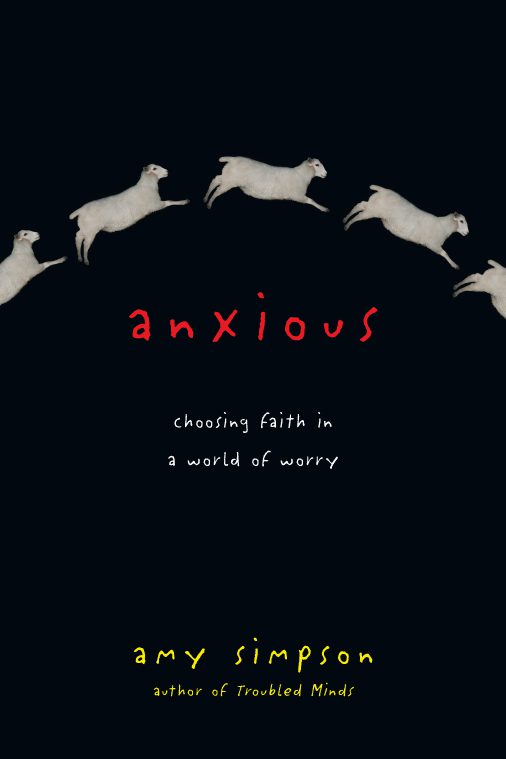
In Amy Simpson’s latest book Anxious: Choosing Faith in a World of Worry, she examines the cause of this disconnect. Her conclusions are both convicting and profound.
As a starting point, Simpson notes that the sin of worry is one we tend to see as “other people’s” problem. We tend to think that the things we worry over are “acceptable,” that our level of worry is appropriate or even necessary. In fact, Simpson writes:
“Worry is part of our culture, an expectation of responsible people. We seem to equate worry with good citizenship and awareness. We are expected to remain on emotional ‘high alert’ as evidence that we care about the world around us. Our attitude is, to paraphrase a bit of bumper-sticker wisdom, ‘If you’re not worried, you’re not paying attention.’”
Specifically, Simpson writes that we feel nearly obligated to worry about (1) our jobs (Will I lose my job? Will I find a job? Will I be promoted? Will I have to sacrifice too much for my job?), (2) our parenting (Are my kids eating right? Do they have the right kind of friends? Are their grades good enough? Are they safe? Are they happy? Are they taking life seriously?), and (3) the latest civic issues (the economy, the schools, health care, politics). In fact, if we are not worried about these things, we’re considered abnormal, negligent, or out of touch. This “appropriate” type of worry is encouraged via social media, where we gain acceptance by publicly concerning ourselves about the “right” things and where we glean approval for our worry through the “likes” of our friends and followers. Worrying appropriately becomes nearly a badge of honor: we are considered informed and aware and “good” for having the right kinds of concerns.
The problem is that worry is still a sin, and the Bible is very clear that no worry is our standard. Obsessive, all-consuming, large worry is a sin, yes, but so is low-grade, nagging, small worry. What we need to rectify this problem, Simpson argues, is both a clear theology of worry and a clear knowledge of how to quit the sin of worry.
Over the course of Anxious, Simpson makes the case for why even culturally-appropriate worry is damaging and offers as an alternative the concept of Sabbath. By “Sabbath,” she doesn’t mean just a day of rest, but a life in which our souls are at rest, a state which requires both confession of the sin of worry and a commitment to place our trust repeatedly, constantly, daily, and even moment-by-moment in God. She writes in one especially convicting statement that “For people who claim to trust in God, worry is unnecessary, hypocritical and insulting to him.”
For those who read Anxious carefully and are willing to humble themselves and open their minds to the possibility that they may in fact be “worriers,” this book will undoubtedly change the way lives are lived. While we may be familiar with many of the most commonly quoted verses of Scripture about worry, Simpson takes her readers through an extended study of both Old and New Testament cases, examining how worry is described, its consequences, and how it is dealt with. The sheer number of times Scripture presents us with the admonishment to not worry and trust God reveals God’s awareness of how we would struggle with this particular sin. By the end of the book, there is no way to beat around the bush. Any level of worry is unacceptable, and individuals who worry need to reevaluate their theology. Worry has numerous detrimental effects, the most serious being that it inhibits our relationship with God and demonstrates to the world a lack of faith.
I can imagine that the message of Anxious may be unpopular, but its unpopularity will undoubtedly be because it rings so deeply of truth. What the Bible tells us to do with our worry requires Christians to respond in ways that are deeply counter-cultural. It requires us to throw away the “American” ideal that we deserve or can industriously earn a life of “ease and prosperity.” By contrast, Jesus told us to expect trouble. It requires us to throw away the belief that we have control over our circumstances. But fortunately, as Anxious reiterates: God is in control, God knows what we need, and no matter what we are going through, He will never leave us alone.
Simpson’s message is in line with the Gospel; that is, it is a message of hope. As I read this book, I felt over and over again that sensation that God was calling me to give something up—in this case, worries over various things—and at the same time fear that I wouldn’t somehow be okay if I stopped worrying. I’m certain this irrational, unscriptural response will afflict many readers. But such discomfort is always, to me, a sure sign that release is essential. That the burden of turning against cultural instincts will be light and easy to bear, and, indeed, in actuality, a source of greater freedom and greater relationship with God. I am grateful this book crossed my path. I hope many other readers will be changed by it as well.
For more conversation on Anxious, visit the Patheos Book Club here.
 Amber M. Stamper holds a Ph.D. in English (Rhetoric and Composition) and is an Assistant Professor of Language, Literature, and Communication at Elizabeth City State University in North Carolina. Her research and publications center on religious rhetoric and communication, especially issues of Christian evangelism and the digital church.
Previous Post

November 3, 2014
Confessions of an Advent Extremist: A Q&A with Sybil MacBeth
Browse Our Archives
Select a Category Author Q&A Book Review Christian Living Church Leadership Stump a Scholar Theology Uncategorized
Select a Month June 2022 March 2021 October 2020 August 2020 February 2019 November 2017 July 2017 June 2017 May 2017 March 2017 February 2017 January 2017 November 2016 October 2016 August 2016 July 2016 June 2016 May 2016 April 2016 March 2016 February 2016 January 2016 November 2015 October 2015 September 2015 August 2015 July 2015 June 2015 May 2015 April 2015 March 2015 February 2015 January 2015 December 2014 November 2014 October 2014 September 2014 August 2014 July 2014 June 2014 May 2014 April 2014 March 2014 February 2014 January 2014 December 2013 November 2013 October 2013 September 2013 August 2013 July 2013 June 2013 May 2013 April 2013 March 2013 February 2013 January 2013 December 2012 November 2012 October 2012 September 2012 August 2012 July 2012 June 2012 May 2012 April 2012 March 2012 February 2012 January 2012 December 2011 November 2011 October 2011 September 2011 August 2011 July 2011 June 2011 May 2011 April 2011 March 2011 February 2011 January 2011 December 2010 November 2010 October 2010 September 2010 August 2010 July 2010 June 2010
Follow Us!
TAKE THE
Religious Wisdom Quiz
Which book of the Bible contains the phrase "Vanity of vanities"?
Select your answer to see how you score.
Job Proverbs Ecclesiastes Psalms
Related posts from Take and Read

Even the Faith Giants Didn’t Always Get it...

Author Lily Burana on Experiencing God's Grace and...

How the Church Can Heal the Race Divide

Finding Inspiration in "Where Angels Walk"
TRENDING AT PATHEOS Religious Music & Entertainment

"Les Diabolique" and Transgression
Alongside something like Arrival, Vertigo, or Charade, Les Diaboliques is a...

"The Plague Dogs" and Mortality
So, flashback to the late 70s, early 80s. Walt Disney Studios is...

With the recent and highly successful release of Christopher Nolan’s epic film,...

"L'avventura" and Human Weakness
Today's piece is going to be a little different for a few...

I first want to apologize for not posting or writing anything. I'm...

I've engaged in the multi-year project of reading through the Church Fathers,...
view all Religious Music & Entertainment blogs
Ad-Free & Subscriber Log-In Subscription Support
- About Us
- 2026 Calendar
- Videos
- Podcasts
- Library of World Religions
- Faith In Media Tracker
- Advertise With Us
- Write for Us
- Privacy Policy
- Terms of Service
- Do Not Sell My Data
- Contact Us
- Radiant Digital
- Manage Newsletter Subscriptions
- Unsubscribe From Notifications
- Sitemap
Copyright 2008-2026, Patheos. All rights reserved.
Subscription Support Ad-Free & Subscriber Log-In
Follow Patheos