
BuddhistCatholicContemplativeEvangelicalGeneral ChristianHinduJewishLatter-day SaintMuslimNew VisionsProgressive Christian
Beliefs
- Buddhist
- Catholic
- Contemplative
- Evangelical
- General Christian
- Hindu
- Jewish
- Latter-day Saint
- More Voices
- Muslim
- New Visions
- Pagan
- Progressive Christian
Topics
- Religion News
- Food and Religion
- Sports and Religion
- Religious Art
- Religious Music and Entertainment
- Religious Events
- History and Religion
- Style and Religion
- Politics and Religion
- Women in Religion
- Recreation Outdoors and Religion
- Business Finance and Religion
- Careers Workplace and Religion
- Education and Religion
- Family Parenting and Religion
- Health Fitness and Religion
- Home and Religion
- Relationships and Religion
- Technology and Religion
- Travel and Religion
Columnists
- Buddhist Columnists
- Business Finance and Religion Columnists
- Careers Workplace and Religion Columnists
- Catholic Columnists
- Contemplative Columnists
- Education and Religion Columnists
- Evangelists Columnists
- Family Parenting and Religion Columnists
- General Christian Columnists
- Health Fitness and Religion Columnists
- Hindu Columnists
- History and Religion Columnists
- Home and Religion Columnists
- Jewish Columnists
- More Voices Columnists
- Latter Day Columnists
- Muslim Columnists
- New Visions Columnists
- Nonreligious Columnists
- Pagan Columnists
- Politics and Religion Columnists
- Progressive Columnists
- Recreation Outdoors and Religion Columnists
- Relationships and Religion Columnists
- Religion News Columnists
- Religious Art Columnists
- Religious Events Columnists
- Religious Music and Entertainment Columnists
- Sports and Religion Columnists
- Style and Religion Columnists
- Technology and Religion Columnists
- Travel and Religion Columnists
- Women in Religion Columnists
Resource Library
- 2026 Calendar
- Library of World Religions
- The 100 Most Holy Places on Earth
- Patheos Answers
- Podcasts
- Videos
- Faith Leaders Database
- Anglican Episcopalian
- Bahai
- Baptist
- Buddhism
- Christianity
- Confucianism
- Eastern Orthodoxy
- Hinduism
- Holiness and Pentecostal
- ISKCON
- Islam
- Judaism
- Lutheran
- Methodist
- The Church of Jesus Christ of Latter-day Saints
- New Age
- Paganism
- Presbytarian and Reformed
- Protestantism
- Religion Behind the Scenes
- Roman Catholic
- Scientology
- Shia Islam
- Sikhism
- Sufism
- Sunni Islam
- Taoism
- Zen
- See all religions
Research Tools
 Ad-Free & Subscriber Log-In Subscription Support
Ad-Free & Subscriber Log-In Subscription Support
Follow Patheos 

- Trending:
- Forgiveness
- |
- Marriage
- |
- Consciousness
- |
- Death Penalty
- |
- Election
- |
- Halloween

- Home
- Religious Music & Entertainment
- Restoring Reverence for Children: An Interview with Author Johann Christoph Arnold
Restoring Reverence for Children: An Interview with Author Johann Christoph Arnold
Last updated on: November 5, 2014 at 4:50 pm by Guest Contributor
Restoring Reverence for Children: An Interview with Author Johann Christoph Arnold 2014-11-05T16:50:54-07:00 Guest Contributor
Patheos Explore the world's faith through different perspectives on religion and spirituality! Patheos has the views of the prevalent religions and spiritualities of the world.
“Children are not computers or robots that can be programmed according to our wishes; they have a heart and soul, not only a brain.” — Johann Christoph Arnold, author, Their Name Is Today
This month in the Patheos Book Club, we’re talking about an important new book called Their Name Is Today: Reclaiming Childhood in a Hostile World, by popular author and teacher Johann Christoph Arnold. In this interview, Arnold talks about his reverence for children — and his disdain for standardized testing, technology, overmedication, and forcing kids to grow up too fast.
You write that it’s time for a hopeful book about the state of childhood. What makes you so hopeful, in the face of all the major problems facing parents and teachers?
In my work with families, teachers, and schools, I encounter so many people that are giving everything they’ve got. The more hardships they encounter, and the more they are tested, the greater their resilience and courage grow. I draw my hope from that dogged spirit, that determination that “no matter what, the child comes first.”
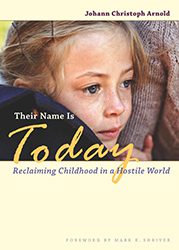 Can you explain the significance of the book’s title?
Gabriela Mistral was a Chilean poet, diplomat, and Nobel laureate. She cared deeply about children, and protested against the way they are so often ignored, undervalued, or exploited. The title of my book refers to my favorite poem by Mistral, “Su nombre es hoy,” where she expresses the thought, “Many things can wait. Children cannot…. Their name is today.”
Common Core Standards have been billed as the savior of our educational system. Why do you advocate so strongly against standardized testing?
Quantifying and measuring success belongs in the world of business. Children are not computers or robots that can be programmed according to our wishes; they have a heart and soul, not only a brain. We need to question the motives behind these measurements, which cannot take into account a child’s home life, and the difficulties he or she may be facing. If families and teachers were getting the support they needed, our country’s educational outcomes would improve drastically. Measurements and testing use up time and resources, they add tension and stress, and they don’t address the root of the problems children face.
We live in the great age of technology. Smartphones are an extension of our arms, and toddlers use tablets. Have our children benefitted?
No, technology can cause great harm to children. I know that’s a strong statement, and I’m not advocating that we go back to the stone age, but anyone who works with children can see that younger and younger children are glued to screens for more and more hours each day. There’s no debate that it affects their physical health: eyesight, hearing, and weight. But we also need to ask what it is doing to their souls.
Teachers and therapists are encountering children who struggle to communicate with human beings because they are only comfortable interacting with their phones. As I speak at high school assemblies around the country, I meet many teens who are lonely, unhappy, and confused about their own identity. Often these doubts arise because they’ve spent their lives creating online personas that are more glamorous, confident, and cool than any human can be. At a time when they need to be discovering their own strengths and powers, they are stuck between the real world and the virtual.
Two things you suggest children can never get too much of are unstructured free play and contact with the great outdoors. In your book, you explain that these concepts are something of a family heritage, going back to the inventor of the kindergarten. Can you describe that connection?
Friedrich Froebel, who created the concept of the kindergarten, was a nineteenth-century German educator whose greatest gift was his ability to view life through a child’s eyes. His educational philosophy makes sense to anyone who loves children today. When he coined the name “kindergarten,” he meant it literally – “a garden of children” – where each child is nurtured with the same love and care given to a seedling. He knew that humans are essentially creative and compassionate beings, and that education must involve the development of these traits.
On the importance of children’s play, he noted: “A child who plays thoroughly and perseveringly, until physical fatigue forbids, will be a determined adult, capable of self-sacrifice both for his own welfare and that of others.”
I have heard this quote all my life, as my mother, Annemarie, was Froebel’s great-great-grandniece. His school in the little German village of Keilhau was run by my mother’s family for many years, until the Nazis commandeered it. My mother kept the vision of Keilhau alive through the war years, as her family migrated from Germany to England, then to Paraguay, and eventually to the United States. Because of her commitment to her educational heritage, my own children and grandchildren and many others have benefited from Froebel’s approach. And we have seen that it works.
In Their Name Is Today, you describe your own childhood growing up in the developing world, and warn against the dangers of affluence. If toys and extracurricular activities are good, why aren’t more toys and activities better?
Toys, gifts, and activities may be meant as an expression of love. But they can burden and distract children, weighing them down with ownership and possessiveness, with a focus on having instead of being. Children don’t see material benefits in the same way adults do, at least, not until they’ve become used to overabundance! From my childhood in South America, I recall a visitor who asked me and my sisters if it was hard to live so simply. (He meant “in such poverty.”) Looking up at the stranger, I wondered if he was crazy. Hard? What on earth did he mean? I couldn’t imagine a happier childhood. But now I understand the foundation of our happiness.
Instead of things, my parents gave us time and attention on a daily basis. No matter how hectic their schedule, they tried to eat breakfast with us before we went off to school each morning. Though they worked long hours, they made a point of drawing us all in at the end of the day to gather and regroup. By today’s standards, we had nothing. But the love, patience, and guidance I received then have stayed with me my whole life.
Reverence is an old-fashioned word that keeps resurfacing in Their Name Is Today. What does having reverence for children mean to you?
I believe that at birth, all children bear the stamp of their Creator. Their purity and innocence is a great gift. Once it has been lost, it cannot be replaced. All the more, it must be guarded as a treasure which no one has a right to destroy. So many features of our “advanced civilization” attack the spirit of childhood. Be it materialism, overmedication, standardization, technological devices, or the debased sensationalism that passes for entertainment, all of it harms children.
Our response upon encountering a child must be nothing less than reverence. Perhaps because the word sounds old-fashioned, its true meaning has been blurred. Reverence is more than just love. It includes an appreciation for the qualities children possess (and which we ourselves have lost), a readiness to rediscover their value, and the humility to learn from them.
Read an excerpt – and more – from Their Name Is Today at the Patheos Book Club here.
Previous Post

November 4, 2014
Worried to Death: Amy Simpson’s "Anxious" and the Sin of Worry
Next Post
November 6, 2014 A Wider Season: Reflections on "The Season of the Nativity"
Browse Our Archives
Select a Category Author Q&A Book Review Christian Living Church Leadership Stump a Scholar Theology Uncategorized
Select a Month June 2022 March 2021 October 2020 August 2020 February 2019 November 2017 July 2017 June 2017 May 2017 March 2017 February 2017 January 2017 November 2016 October 2016 August 2016 July 2016 June 2016 May 2016 April 2016 March 2016 February 2016 January 2016 November 2015 October 2015 September 2015 August 2015 July 2015 June 2015 May 2015 April 2015 March 2015 February 2015 January 2015 December 2014 November 2014 October 2014 September 2014 August 2014 July 2014 June 2014 May 2014 April 2014 March 2014 February 2014 January 2014 December 2013 November 2013 October 2013 September 2013 August 2013 July 2013 June 2013 May 2013 April 2013 March 2013 February 2013 January 2013 December 2012 November 2012 October 2012 September 2012 August 2012 July 2012 June 2012 May 2012 April 2012 March 2012 February 2012 January 2012 December 2011 November 2011 October 2011 September 2011 August 2011 July 2011 June 2011 May 2011 April 2011 March 2011 February 2011 January 2011 December 2010 November 2010 October 2010 September 2010 August 2010 July 2010 June 2010
Follow Us!
TAKE THE
Religious Wisdom Quiz
Who predicted Jesus' betrayal price?
Select your answer to see how you score.
Jeremiah Daniel Isaiah Zechariah
Related posts from Take and Read

Even the Faith Giants Didn’t Always Get it...

How the Church Can Heal the Race Divide

Finding Inspiration in "Where Angels Walk"

Happiness Is Found Outside of Our Comfort Zones
TRENDING AT PATHEOS Religious Music & Entertainment

"Les Diabolique" and Transgression
Alongside something like Arrival, Vertigo, or Charade, Les Diaboliques is a...

"The Plague Dogs" and Mortality
So, flashback to the late 70s, early 80s. Walt Disney Studios is...

With the recent and highly successful release of Christopher Nolan’s epic film,...

"L'avventura" and Human Weakness
Today's piece is going to be a little different for a few...

I first want to apologize for not posting or writing anything. I'm...

I've engaged in the multi-year project of reading through the Church Fathers,...
view all Religious Music & Entertainment blogs
Ad-Free & Subscriber Log-In Subscription Support
- About Us
- 2026 Calendar
- Videos
- Podcasts
- Library of World Religions
- Faith In Media Tracker
- Advertise With Us
- Write for Us
- Privacy Policy
- Terms of Service
- Do Not Sell My Data
- Contact Us
- Radiant Digital
- Manage Newsletter Subscriptions
- Unsubscribe From Notifications
- Sitemap
Copyright 2008-2026, Patheos. All rights reserved.
Subscription Support Ad-Free & Subscriber Log-In
Follow Patheos