
BuddhistCatholicContemplativeEvangelicalGeneral ChristianHinduJewishLatter-day SaintMuslimNew VisionsProgressive Christian
Beliefs
- Buddhist
- Catholic
- Contemplative
- Evangelical
- General Christian
- Hindu
- Jewish
- Latter-day Saint
- More Voices
- Muslim
- New Visions
- Pagan
- Progressive Christian
Topics
- Religion News
- Food and Religion
- Sports and Religion
- Religious Art
- Religious Music and Entertainment
- Religious Events
- History and Religion
- Style and Religion
- Politics and Religion
- Women in Religion
- Recreation Outdoors and Religion
- Business Finance and Religion
- Careers Workplace and Religion
- Education and Religion
- Family Parenting and Religion
- Health Fitness and Religion
- Home and Religion
- Relationships and Religion
- Technology and Religion
- Travel and Religion
Columnists
- Buddhist Columnists
- Business Finance and Religion Columnists
- Careers Workplace and Religion Columnists
- Catholic Columnists
- Contemplative Columnists
- Education and Religion Columnists
- Evangelists Columnists
- Family Parenting and Religion Columnists
- General Christian Columnists
- Health Fitness and Religion Columnists
- Hindu Columnists
- History and Religion Columnists
- Home and Religion Columnists
- Jewish Columnists
- More Voices Columnists
- Latter Day Columnists
- Muslim Columnists
- New Visions Columnists
- Nonreligious Columnists
- Pagan Columnists
- Politics and Religion Columnists
- Progressive Columnists
- Recreation Outdoors and Religion Columnists
- Relationships and Religion Columnists
- Religion News Columnists
- Religious Art Columnists
- Religious Events Columnists
- Religious Music and Entertainment Columnists
- Sports and Religion Columnists
- Style and Religion Columnists
- Technology and Religion Columnists
- Travel and Religion Columnists
- Women in Religion Columnists
Resource Library
- 2026 Calendar
- Library of World Religions
- The 100 Most Holy Places on Earth
- Patheos Answers
- Podcasts
- Videos
- Faith Leaders Database
- Anglican Episcopalian
- Bahai
- Baptist
- Buddhism
- Christianity
- Confucianism
- Eastern Orthodoxy
- Hinduism
- Holiness and Pentecostal
- ISKCON
- Islam
- Judaism
- Lutheran
- Methodist
- The Church of Jesus Christ of Latter-day Saints
- New Age
- Paganism
- Presbytarian and Reformed
- Protestantism
- Religion Behind the Scenes
- Roman Catholic
- Scientology
- Shia Islam
- Sikhism
- Sufism
- Sunni Islam
- Taoism
- Zen
- See all religions
Research Tools
 Ad-Free & Subscriber Log-In Subscription Support
Ad-Free & Subscriber Log-In Subscription Support
Follow Patheos 

- Trending:
- Forgiveness
- |
- Marriage
- |
- Consciousness
- |
- Death Penalty
- |
- Election
- |
- Halloween

- Home
- Religious Music & Entertainment
- Is Mormonism Congruent with Christianity?
Is Mormonism Congruent with Christianity?
Last updated on: November 3, 2014 at 3:20 pm by Guest Contributor
Is Mormonism Congruent with Christianity? 2014-11-03T15:20:45-07:00 Guest Contributor
Patheos Explore the world's faith through different perspectives on religion and spirituality! Patheos has the views of the prevalent religions and spiritualities of the world.
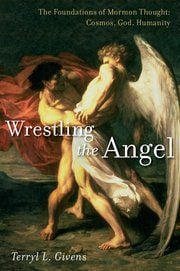 By Terryl Givens
Mormonism’s status as a Christian faith, and its exact relationship to Christianity, continue to be subjects of long-standing dispute. As prominent scholar Sydney Ahlstrom remarked of Mormonism in his celebrated Religious History of the American People, “One cannot even be sure if the object of our consideration is a sect, a mystery cult, a new religion, a church, a people, a nation, or an American subculture.”
The Catholic and mainline Protestant churches alike have declared in recent years that Mormonism “does not fit within the bounds of the historic, apostolic tradition of Christian faith.” In writing Wrestling the Angel: The Foundations of Mormon Thought, I hoped to illuminate which aspects of the Latter-day Saints (LDS) tradition are continuous with the Christian tradition and which are distinct from the more orthodox varieties. The study may not resolve the question, but it should better inform the debate
From the LDS perspective, the faith’s congruence with the essentials of Christian orthodoxy is unambiguous. Joseph Smith came out of a Protestant past, was influenced by Methodism and had family members in the Presbyterian faith as well. His first religious experience was born of the typical Puritan anxiety of salvation. He sought spiritual assurance, and reported of his famous “First Vision” that “the Lord opened the heavens upon me and I saw the Lord and he spake unto me saying Joseph my son they sins are forgiven thee.”
Accordingly, Mormonism has never varied in establishing its theology upon a belief in Jesus Christ as savior. For Latter-day Saints, reunion with God is absolutely predicated on the central and indispensable gesture of Christ’s selfless gift of atonement; Mormons emphatically affirm that it is “by grace that we are saved.”
Mormons view materiality more favorably than most Christians, asserting that God himself is a material, embodied being.
On that basis, Mormons assert without caveat that they are professing Christians. Additionally, Mormons believe in the Father, Son, and Holy Ghost, as their first Article of Faith professes. God is the Creator God, Christ is the Redeemer, born through a miraculous conception and raised from the dead on the third day after his crucifixion. The Holy Ghost is the third member of the Godhead, the Comforter and Testator, bestowed upon the newly baptized as an essential sacrament (or ordinance, in Mormon parlance). Most Mormons would have no problem, in this regard, assenting to the Apostles’ Creed.
At the same time, Mormonism’s substantive differences from the contemporary Christian mainstream are undeniable. They are most evident in, and largely attributable to, a unique underlying cosmic narrative — one that gives new meaning to some of the propositions above. Mormonism posits a distinctive cosmology and metaphysics, in which it situates an unconventional narrative of human identity and a re-envisioned divine nature.
A foundational tenet of Mormon metaphysics that alters the whole landscape of its religious worldview is its “eternalism.” Mormonism posits a universe that is eternal, everlasting, without beginning or end — along with its constituent elements. What this means is that Mormonism’s God is indeed a Creator God — but a Creator ex materia, rather than ex nihilo. He is the Supreme organizer and fashioner of what is, not the Summoner out of what never was. (Early Christians were divided on this question; Justin Martyr’s position was, for a time, the standard Christian line: “we have been taught that He in the beginning did of His goodness, for man’s sake, create all things out of unformed matter.”)
Equally novel in modern Christendom is the corollary that humans are co-eternal with God, having existed as eternal intelligence before they were fashioned into (or adopted as) his spirit offspring. (Here again, a seeming heresy — premortality of humans — finds frequent antecedents with Origin, Clement of Alexandria, the early Augustine, and many others). Since mortality is seen as a planned, educative step in the eternal soul’s ascent toward godliness, humans are seen as inheritors of a mortal proving ground rather than of sin and exile, and original sin has no place in Mormon thought. An emphasis in Mormonism with agency, primordial innocence, and eventual perfectibility, is profound enough to lead to charges of Pelagianism.
Another aspect of Mormon cosmology is its denial of the radical duality typical of Christian metaphysics. Mormons reject what Samuel Coleridge considered the lynchpin of a religious outlook: “the heterogeneity of Spirit and Matter.” Spirit is in the Mormon view a more highly refined matter (as it was for William Blake and the Cambridge Platonists). Accordingly, Mormons view materiality more favorably than most Christians, asserting that God himself is a material, embodied being. Corporeality is therefore a step toward, rather than away from, divine nature.
The Mormon God, “of body, parts, and passions,” is strikingly unlike the creedal God of Christendom, even if there are significant precursors and parallels among the church fathers and contemporary theologians alike.
Mormons believe that grace — the freely offered, unmerited, gift of atonement — makes possible human repentance and re-choosing.
When it comes to Christology, the differences from orthodox traditions diminish. Strikingly absent from Joseph Smith’s thought and revelations, so explosively daring in other ways, are revisionist versions of atonement theology. In Smith’s rendering of the Book of Mormon, salvation is by grace, “after all we can do.”
Mormons believe that grace — the freely offered, unmerited, gift of atonement — makes possible human repentance and re-choosing, so to speak. But seeing sanctification as occurring only through compliance with eternal laws, Mormons assert that obedience is as indispensable in the working out of salvation as the grace that enables the whole process. Mormon exile from the Christian category, if it is to be theologically grounded, generally owes more to their radical rejection of Trinitarian thought (as well as their extra-biblical scriptures), than to any rejection of Christ’s status as savior of the world.
If the history of Mormon thought shows anything, it is a fact as common to Mormonism as it is to Christianity generally. The Mormon “restoration” is a continuing process. Mormon thought has evolved, unfolded, followed a few cul-de-sacs and dead ends, and found itself unwilling or unable to arbitrate a number of doctrines contested among its own faithful — Is God the author and source of eternal law, or its most perfect master? Did God begin as a human, much as humans are gods in embryo? Will the entire human family continue to progress through kingdoms of glory?
At the same time, excavating the Christian past reveals a surprising number of congruences and intersections with Mormonism’s most radical teachings. In both cases, Christian heterodoxies and Mormonism’s theological adventuresomeness, one can deplore the narrative that departs from an imagined linear model of divinely ordained revelation. Or one can relish the ongoing project whereby humans of diverse makeup and imperfect understanding struggle to come to terms with the divine, like Jacob with his angel.
This post first appeared on On Faith.
For more conversation, and to read a book excerpt, from Wrestling the Angel — The Foundations of Mormon Thought: Cosmos, God, Humanity by Terryl L. Givens, visit the Patheos Book Club here.
Terryl L. Givens is Professor of Literature and Religion and James A. Bostwick Chair of English at the University of Richmond. His books on Mormonism and American religious culture include By the Hand of Mormon, People of Paradox, Parley P. Pratt (with Matthew Grow), and Viper on the Hearth.
Previous Post

October 28, 2014
A Balm for the Anxious Soul: A Review of Amy Simpson's "Anxious"
Next Post
November 3, 2014 Evangelicals and Sex: A Q&A with Amy DeRogatis
Browse Our Archives
Select a Category Author Q&A Book Review Christian Living Church Leadership Stump a Scholar Theology Uncategorized
Select a Month June 2022 March 2021 October 2020 August 2020 February 2019 November 2017 July 2017 June 2017 May 2017 March 2017 February 2017 January 2017 November 2016 October 2016 August 2016 July 2016 June 2016 May 2016 April 2016 March 2016 February 2016 January 2016 November 2015 October 2015 September 2015 August 2015 July 2015 June 2015 May 2015 April 2015 March 2015 February 2015 January 2015 December 2014 November 2014 October 2014 September 2014 August 2014 July 2014 June 2014 May 2014 April 2014 March 2014 February 2014 January 2014 December 2013 November 2013 October 2013 September 2013 August 2013 July 2013 June 2013 May 2013 April 2013 March 2013 February 2013 January 2013 December 2012 November 2012 October 2012 September 2012 August 2012 July 2012 June 2012 May 2012 April 2012 March 2012 February 2012 January 2012 December 2011 November 2011 October 2011 September 2011 August 2011 July 2011 June 2011 May 2011 April 2011 March 2011 February 2011 January 2011 December 2010 November 2010 October 2010 September 2010 August 2010 July 2010 June 2010
Follow Us!
TAKE THE
Religious Wisdom Quiz
What was Jesus’ first recorded miracle in Mark?
Select your answer to see how you score.
Raising a widow’s son Turning water into wine Casting out an unclean spirit Healing a leper
Related posts from Take and Read
God Unbound: Wisdom for the Church in Anxious...

Are Adam and Eve For Real? A Q&A...
The Atheist Awakening and the Internet
Atheist Awakening: A Q&A with Researchers Richard Cimino...
TRENDING AT PATHEOS Religious Music & Entertainment

"Les Diabolique" and Transgression
Alongside something like Arrival, Vertigo, or Charade, Les Diaboliques is a...

"The Plague Dogs" and Mortality
So, flashback to the late 70s, early 80s. Walt Disney Studios is...

With the recent and highly successful release of Christopher Nolan’s epic film,...

"L'avventura" and Human Weakness
Today's piece is going to be a little different for a few...

I first want to apologize for not posting or writing anything. I'm...

I've engaged in the multi-year project of reading through the Church Fathers,...
view all Religious Music & Entertainment blogs
Ad-Free & Subscriber Log-In Subscription Support
- About Us
- 2026 Calendar
- Videos
- Podcasts
- Library of World Religions
- Faith In Media Tracker
- Advertise With Us
- Write for Us
- Privacy Policy
- Terms of Service
- Do Not Sell My Data
- Contact Us
- Radiant Digital
- Manage Newsletter Subscriptions
- Unsubscribe From Notifications
- Sitemap
Copyright 2008-2026, Patheos. All rights reserved.
Subscription Support Ad-Free & Subscriber Log-In
Follow Patheos