
BuddhistCatholicContemplativeEvangelicalGeneral ChristianHinduJewishLatter-day SaintMuslimNew VisionsProgressive Christian
Beliefs
- Buddhist
- Catholic
- Contemplative
- Evangelical
- General Christian
- Hindu
- Jewish
- Latter-day Saint
- More Voices
- Muslim
- New Visions
- Pagan
- Progressive Christian
Topics
- Religion News
- Food and Religion
- Sports and Religion
- Religious Art
- Religious Music and Entertainment
- Religious Events
- History and Religion
- Style and Religion
- Politics and Religion
- Women in Religion
- Recreation Outdoors and Religion
- Business Finance and Religion
- Careers Workplace and Religion
- Education and Religion
- Family Parenting and Religion
- Health Fitness and Religion
- Home and Religion
- Relationships and Religion
- Technology and Religion
- Travel and Religion
Columnists
- Buddhist Columnists
- Business Finance and Religion Columnists
- Careers Workplace and Religion Columnists
- Catholic Columnists
- Contemplative Columnists
- Education and Religion Columnists
- Evangelists Columnists
- Family Parenting and Religion Columnists
- General Christian Columnists
- Health Fitness and Religion Columnists
- Hindu Columnists
- History and Religion Columnists
- Home and Religion Columnists
- Jewish Columnists
- More Voices Columnists
- Latter Day Columnists
- Muslim Columnists
- New Visions Columnists
- Nonreligious Columnists
- Pagan Columnists
- Politics and Religion Columnists
- Progressive Columnists
- Recreation Outdoors and Religion Columnists
- Relationships and Religion Columnists
- Religion News Columnists
- Religious Art Columnists
- Religious Events Columnists
- Religious Music and Entertainment Columnists
- Sports and Religion Columnists
- Style and Religion Columnists
- Technology and Religion Columnists
- Travel and Religion Columnists
- Women in Religion Columnists
Resource Library
- 2026 Calendar
- Library of World Religions
- The 100 Most Holy Places on Earth
- Patheos Answers
- Podcasts
- Videos
- Faith Leaders Database
- Anglican Episcopalian
- Bahai
- Baptist
- Buddhism
- Christianity
- Confucianism
- Eastern Orthodoxy
- Hinduism
- Holiness and Pentecostal
- ISKCON
- Islam
- Judaism
- Lutheran
- Methodist
- The Church of Jesus Christ of Latter-day Saints
- New Age
- Paganism
- Presbytarian and Reformed
- Protestantism
- Religion Behind the Scenes
- Roman Catholic
- Scientology
- Shia Islam
- Sikhism
- Sufism
- Sunni Islam
- Taoism
- Zen
- See all religions
Research Tools
 Ad-Free & Subscriber Log-In Subscription Support
Ad-Free & Subscriber Log-In Subscription Support
Follow Patheos 

- Trending:
- Forgiveness
- |
- Marriage
- |
- Consciousness
- |
- Death Penalty
- |
- Election
- |
- Halloween

- Home
- Religious Music & Entertainment
- Abraham as Archetype, Abraham as Man
Abraham as Archetype, Abraham as Man
Last updated on: October 14, 2014 at 5:46 pm by Amber Stamper
Abraham as Archetype, Abraham as Man 2014-10-14T17:46:01-06:00 Amber Stamper
Patheos Explore the world's faith through different perspectives on religion and spirituality! Patheos has the views of the prevalent religions and spiritualities of the world.
 As an academic, I am pretty much required by contract to embrace complexity: to be of scholarly (i.e., publishable) caliber, any argument forwarded must be nuanced; a literature review must incorporate a diversity of perspectives; the opposition viewpoint should always be acknowledged. In fact, what I often find to be the real beauty of academic argumentation is the way conversations unfold layer after layer, how one thought leads to another, how questions can be left open and unanswered or answered with room for uncertainty, how one scholar’s work may bleed into another’s, and the conversation is open for as many voices as would like to come to the table. Complexity is characteristic. Indeed, when one thinks of scholarly literature, “simplicity” is rarely a word that comes to mind.
But there is something beautiful about simplicity as well. About fundamentals and capital-T Truths. Facts. Basics. Essentials expressed in clear, uncomplicated language. Things that take us back to the beginning and establish the groundwork.
And when you come across a piece of literature that combines both: the complexity of quality scholarship with fundamentals, written about in a simple and straightforward manner, you’ve really found something great.
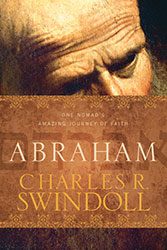
Charles Swindoll’s latest work, a biography of Abraham, is just such an accomplishment.
Abraham: One Nomad’s Amazing Journey of Faith is part history, part sermon, part devotional. It will undoubtedly speak most directly to a Christian audience, as each chapter includes faith-building pointers and questions that would be excellent for a study group as well as working under the assumption that we are already at least partially-interested in Abraham as a significant religious figure in the lineage of Christ, but I was delighted to find that Swindoll has done some substantial extra-biblical research into the culture, time period, geography, and history of the Old Testament account of Abraham’s life as well. Indeed, as Swindoll accurately notes, “few periods from ancient history are as well documented by artifacts and inscriptions as is the time of Abraham.” Abraham’s life story is practically crying out to be read in light of this material.
The book is thorough–taking each moment of Abraham’s life and contextualizing it; “bringing it to life” with historical detail and occasional notes on translation; encouraging readers to visualize what the landscape of Canaan might have looked like or how social dynamics might have played out in a time before strong national governments; and scrutinizing all details for spiritual resonance–and strikes an excellent balance between scholarly biography and religious treatise. This approach is especially helpful since Abraham is one of those figures in the Bible that often–at least in my experience–gets sermonized into abstraction. He easily becomes such a symbol–an exemplar of obedience, the ultimate patriarch, a prime model of the theological doctrine of sola fide–that we lose sight of or forget about Abraham the man. Swindoll revives him as such: a man who made mistakes, who had doubts, who came himself out of a pagan culture, who struggled with family members who clung to this culture, and whose life was simultaneously common and miraculous. He also offers fresh spiritual insight, with fascinating and valuable thoughts on what Abraham’s life can teach Christians about friendship, prayer, and family. The simultaneous biographical detail and religious insight of this volume make it rewarding both intellectually and spiritually, and readers interested in growing in both directions will undoubtedly find it a valuable read.
Visit the Patheos Book Club to read a book excerpt, and for more conversation on Abraham!
 Amber M. Stamper holds a Ph.D. in English (Rhetoric and Composition) and is an Assistant Professor of Language, Literature, and Communication at Elizabeth City State University in North Carolina. Her research and publications center on religious rhetoric and communication, especially issues of Christian evangelism and the digital church.
Previous Post

October 8, 2014
Called: A Book Review
Next Post
October 15, 2014 Three Tips for Facing the Future without Worry
Browse Our Archives
Select a Category Author Q&A Book Review Christian Living Church Leadership Stump a Scholar Theology Uncategorized
Select a Month June 2022 March 2021 October 2020 August 2020 February 2019 November 2017 July 2017 June 2017 May 2017 March 2017 February 2017 January 2017 November 2016 October 2016 August 2016 July 2016 June 2016 May 2016 April 2016 March 2016 February 2016 January 2016 November 2015 October 2015 September 2015 August 2015 July 2015 June 2015 May 2015 April 2015 March 2015 February 2015 January 2015 December 2014 November 2014 October 2014 September 2014 August 2014 July 2014 June 2014 May 2014 April 2014 March 2014 February 2014 January 2014 December 2013 November 2013 October 2013 September 2013 August 2013 July 2013 June 2013 May 2013 April 2013 March 2013 February 2013 January 2013 December 2012 November 2012 October 2012 September 2012 August 2012 July 2012 June 2012 May 2012 April 2012 March 2012 February 2012 January 2012 December 2011 November 2011 October 2011 September 2011 August 2011 July 2011 June 2011 May 2011 April 2011 March 2011 February 2011 January 2011 December 2010 November 2010 October 2010 September 2010 August 2010 July 2010 June 2010
Follow Us!
TAKE THE
Religious Wisdom Quiz
Which letter contains a section on taming the tongue?
Select your answer to see how you score.
Titus James Galatians Romans
Related posts from Take and Read

Even the Faith Giants Didn’t Always Get it...

How the Church Can Heal the Race Divide

Finding Inspiration in "Where Angels Walk"

Happiness Is Found Outside of Our Comfort Zones
TRENDING AT PATHEOS Religious Music & Entertainment

"Les Diabolique" and Transgression
Alongside something like Arrival, Vertigo, or Charade, Les Diaboliques is a...

"The Plague Dogs" and Mortality
So, flashback to the late 70s, early 80s. Walt Disney Studios is...

With the recent and highly successful release of Christopher Nolan’s epic film,...

"L'avventura" and Human Weakness
Today's piece is going to be a little different for a few...

I first want to apologize for not posting or writing anything. I'm...

I've engaged in the multi-year project of reading through the Church Fathers,...
view all Religious Music & Entertainment blogs
Ad-Free & Subscriber Log-In Subscription Support
- About Us
- 2026 Calendar
- Videos
- Podcasts
- Library of World Religions
- Faith In Media Tracker
- Advertise With Us
- Write for Us
- Privacy Policy
- Terms of Service
- Do Not Sell My Data
- Contact Us
- Radiant Digital
- Manage Newsletter Subscriptions
- Unsubscribe From Notifications
- Sitemap
Copyright 2008-2026, Patheos. All rights reserved.
Subscription Support Ad-Free & Subscriber Log-In
Follow Patheos