
BuddhistCatholicContemplativeEvangelicalGeneral ChristianHinduJewishLatter-day SaintMuslimNew VisionsProgressive Christian
Beliefs
- Buddhist
- Catholic
- Contemplative
- Evangelical
- General Christian
- Hindu
- Jewish
- Latter-day Saint
- More Voices
- Muslim
- New Visions
- Pagan
- Progressive Christian
Topics
- Religion News
- Food and Religion
- Sports and Religion
- Religious Art
- Religious Music and Entertainment
- Religious Events
- History and Religion
- Style and Religion
- Politics and Religion
- Women in Religion
- Recreation Outdoors and Religion
- Business Finance and Religion
- Careers Workplace and Religion
- Education and Religion
- Family Parenting and Religion
- Health Fitness and Religion
- Home and Religion
- Relationships and Religion
- Technology and Religion
- Travel and Religion
Columnists
- Buddhist Columnists
- Business Finance and Religion Columnists
- Careers Workplace and Religion Columnists
- Catholic Columnists
- Contemplative Columnists
- Education and Religion Columnists
- Evangelists Columnists
- Family Parenting and Religion Columnists
- General Christian Columnists
- Health Fitness and Religion Columnists
- Hindu Columnists
- History and Religion Columnists
- Home and Religion Columnists
- Jewish Columnists
- More Voices Columnists
- Latter Day Columnists
- Muslim Columnists
- New Visions Columnists
- Nonreligious Columnists
- Pagan Columnists
- Politics and Religion Columnists
- Progressive Columnists
- Recreation Outdoors and Religion Columnists
- Relationships and Religion Columnists
- Religion News Columnists
- Religious Art Columnists
- Religious Events Columnists
- Religious Music and Entertainment Columnists
- Sports and Religion Columnists
- Style and Religion Columnists
- Technology and Religion Columnists
- Travel and Religion Columnists
- Women in Religion Columnists
Resource Library
- 2026 Calendar
- Library of World Religions
- The 100 Most Holy Places on Earth
- Patheos Answers
- Podcasts
- Videos
- Faith Leaders Database
- Anglican Episcopalian
- Bahai
- Baptist
- Buddhism
- Christianity
- Confucianism
- Eastern Orthodoxy
- Hinduism
- Holiness and Pentecostal
- ISKCON
- Islam
- Judaism
- Lutheran
- Methodist
- The Church of Jesus Christ of Latter-day Saints
- New Age
- Paganism
- Presbytarian and Reformed
- Protestantism
- Religion Behind the Scenes
- Roman Catholic
- Scientology
- Shia Islam
- Sikhism
- Sufism
- Sunni Islam
- Taoism
- Zen
- See all religions
Research Tools
 Ad-Free & Subscriber Log-In Subscription Support
Ad-Free & Subscriber Log-In Subscription Support
Follow Patheos 

- Trending:
- Forgiveness
- |
- Marriage
- |
- Consciousness
- |
- Death Penalty
- |
- Election
- |
- Halloween

- Home
- Religious Music & Entertainment
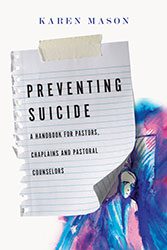
- Preventing Suicide: A Book Review
Preventing Suicide: A Book Review
Last updated on: September 25, 2014 at 5:13 pm by Amber Stamper
Preventing Suicide: A Book Review 2014-09-25T17:13:33-06:00 Amber Stamper
Patheos Explore the world's faith through different perspectives on religion and spirituality! Patheos has the views of the prevalent religions and spiritualities of the world.
 “Religion protects against suicide.”
–Karen Mason, Preventing Suicide
At the heart of the Christian gospel is the promise of peace and joy: peace in our redemption from sin and reconciliation with a Creator Who loves us; joy in the promise of an eternal and restored life to come. It is a gospel of hope and life. A gospel of freedom and grace. It is a gospel of such great and unfathomable goodness that two millennia of theologians and philosophers and artists and poets are still working to pin it down. It is experiential. In infinite ways its greatness cannot be depicted or described.
But it is also a gospel intimately familiar with suffering: the suffering of generation after generation shackled to and tortured by sin, the suffering of a Christ Who took on this burden and died for it, the suffering of a Christ Who—we must not forget—cried out for rescue and died nevertheless. It is a gospel that must be chosen, and not everyone does. It is a gospel that requires its allegiants to persist in a world where evil thrives.
It is easer to talk about the good stuff. Which—because it is our responsibility to drag darkness into the light—is why it’s all the more important to talk about the flip side.
In Karen Mason’s Preventing Suicide: A Handbook for Pastors, Chaplains and Pastoral Counselors, Mason does just this, taking on what is perhaps one of the most challenging issues for the church to discuss in a way that is scholastically and theologically responsible and will undoubtedly inspire, encourage, challenge, and equip audiences far beyond the spiritual leaders and advisors to whom it is primarily addressed.
Combining her expertise in psychology with theology, Mason covers a lot of ground:
(1) She makes the strong case that suicide is a concern that the church cannot ignore. Among the extensive data she cites, readers will learn, for example, that:
- In the United States alone, one person dies by suicide every sixteen minutes.
- Over 39,000 Americans died by suicide in 2011, the last year for which data was collected.
- For every 1400 suicides per 100,000 people each year, 500 people attempt suicide and 3,000 think about it.
In other words, the likelihood that a congregation will be touched by suicide is nearly assured. In fact, Christian history is full of individuals who grappled with feelings of extreme depression (the number one psychological risk factor for suicide) or who even wished for death (Job, Moses, Elijah, Jonah, Rebekah, Rachel, and Jeremiah as well John Donne, Martin Luther, C.H. Spurgeon, and Martin Luther King, Jr.).
2) She cites the fact that religious adherence (specifically, church attendance, dependence on spiritual practices like prayer and the reading of scripture for strength, and counseling with religious leaders) is a primary risk prevention factor for suicide as a starting point for equipping Christian leaders know how to intervene. This includes:
- Dealing with common misconceptions about who is most likely to commit suicide and the factors that lead to this decision
- Considering the theological problems and unacknowledged complexities of common Christian responses to suicide (for example, she points out that the all-too-common claim that someone who is suicidal isn’t a “real” Christian is illogical because “To argue that a suicidal Christian is an unworthy Christian or non-Christian because he or she does not apprehend some of God’s truths is to argue that we are all unworthy Christians or non-Christians because we all know God imperfectly.”)
- Emphasizing the importance of each spiritual leader developing a clear theology of suicide, a project which is important because theology impacts one’s behavior and interaction with others, because Christians hold a range of beliefs which leaders must be equipped to respond to, and because few denominations have a stated position on suicide
(3) Having led spiritual leaders and counselors through the psychological and theological aspects of understanding suicide, she equips them to deal in practical ways with a variety of relevant populations, including:
- individuals considering suicide
- individuals who have attempted suicide and survived
- the family and friends of individuals who are suicidal
- the family, friends, and faith community who are left behind when a loved one dies by suicide
Though suicide will undoubtedly never be an easy issue for religious leaders to navigate, nor will it ever be entirely preventable, Mason provides a resource that will likely go a long way towards providing her readers with the confidence to begin attempting intervention and providing better and more informed guidance.
A search on Amazon for books on suicide under the category of Christianity yields just shy of 500 titles. The vast majority of these texts are written for the survivors of suicide or describe various theologies and theories of suicide. Only a handful center on prevention, and Mason’s work is so expansive and comprehensive; so simultaneously scientific, theologically-grounded, and practical; so well and clearly written; and so rich in resources that it will unquestionably serve as a unique and essential resource for Christian leaders and counselors.
Read an excerpt from Preventing Suicide – and a Q&A with the author — at the Patheos Book Club here.
 Amber M. Stamper holds a Ph.D. in English (Rhetoric and Composition) and is an Assistant Professor of Language, Literature, and Communication at Elizabeth City State University in North Carolina. Her research and publications center on religious rhetoric and communication, especially issues of Christian evangelism and the digital church.
Previous Post

September 24, 2014
Unstoppable: A Book Review
Next Post
September 30, 2014 Jon Sweeney on When Saint Francis Saved the Church
Browse Our Archives
Select a Category Author Q&A Book Review Christian Living Church Leadership Stump a Scholar Theology Uncategorized
Select a Month June 2022 March 2021 October 2020 August 2020 February 2019 November 2017 July 2017 June 2017 May 2017 March 2017 February 2017 January 2017 November 2016 October 2016 August 2016 July 2016 June 2016 May 2016 April 2016 March 2016 February 2016 January 2016 November 2015 October 2015 September 2015 August 2015 July 2015 June 2015 May 2015 April 2015 March 2015 February 2015 January 2015 December 2014 November 2014 October 2014 September 2014 August 2014 July 2014 June 2014 May 2014 April 2014 March 2014 February 2014 January 2014 December 2013 November 2013 October 2013 September 2013 August 2013 July 2013 June 2013 May 2013 April 2013 March 2013 February 2013 January 2013 December 2012 November 2012 October 2012 September 2012 August 2012 July 2012 June 2012 May 2012 April 2012 March 2012 February 2012 January 2012 December 2011 November 2011 October 2011 September 2011 August 2011 July 2011 June 2011 May 2011 April 2011 March 2011 February 2011 January 2011 December 2010 November 2010 October 2010 September 2010 August 2010 July 2010 June 2010
Follow Us!
TAKE THE
Religious Wisdom Quiz
Which principle does the "Golden Rule" teach?
Select your answer to see how you score.
Rest on the Sabbath Pray aloud Treat others as you want to be treated Spread the Gospel
Related posts from Take and Read

Even the Faith Giants Didn’t Always Get it...

How the Church Can Heal the Race Divide

Finding Inspiration in "Where Angels Walk"

Happiness Is Found Outside of Our Comfort Zones
TRENDING AT PATHEOS Religious Music & Entertainment

"Les Diabolique" and Transgression
Alongside something like Arrival, Vertigo, or Charade, Les Diaboliques is a...

"The Plague Dogs" and Mortality
So, flashback to the late 70s, early 80s. Walt Disney Studios is...

With the recent and highly successful release of Christopher Nolan’s epic film,...

"L'avventura" and Human Weakness
Today's piece is going to be a little different for a few...

I first want to apologize for not posting or writing anything. I'm...

I've engaged in the multi-year project of reading through the Church Fathers,...
view all Religious Music & Entertainment blogs
Ad-Free & Subscriber Log-In Subscription Support
- About Us
- 2026 Calendar
- Videos
- Podcasts
- Library of World Religions
- Faith In Media Tracker
- Advertise With Us
- Write for Us
- Privacy Policy
- Terms of Service
- Do Not Sell My Data
- Contact Us
- Radiant Digital
- Manage Newsletter Subscriptions
- Unsubscribe From Notifications
- Sitemap
Copyright 2008-2026, Patheos. All rights reserved.
Subscription Support Ad-Free & Subscriber Log-In
Follow Patheos