
BuddhistCatholicContemplativeEvangelicalGeneral ChristianHinduJewishLatter-day SaintMuslimNew VisionsProgressive Christian
Beliefs
- Buddhist
- Catholic
- Contemplative
- Evangelical
- General Christian
- Hindu
- Jewish
- Latter-day Saint
- More Voices
- Muslim
- New Visions
- Pagan
- Progressive Christian
Topics
- Religion News
- Food and Religion
- Sports and Religion
- Religious Art
- Religious Music and Entertainment
- Religious Events
- History and Religion
- Style and Religion
- Politics and Religion
- Women in Religion
- Recreation Outdoors and Religion
- Business Finance and Religion
- Careers Workplace and Religion
- Education and Religion
- Family Parenting and Religion
- Health Fitness and Religion
- Home and Religion
- Relationships and Religion
- Technology and Religion
- Travel and Religion
Columnists
- Buddhist Columnists
- Business Finance and Religion Columnists
- Careers Workplace and Religion Columnists
- Catholic Columnists
- Contemplative Columnists
- Education and Religion Columnists
- Evangelists Columnists
- Family Parenting and Religion Columnists
- General Christian Columnists
- Health Fitness and Religion Columnists
- Hindu Columnists
- History and Religion Columnists
- Home and Religion Columnists
- Jewish Columnists
- More Voices Columnists
- Latter Day Columnists
- Muslim Columnists
- New Visions Columnists
- Nonreligious Columnists
- Pagan Columnists
- Politics and Religion Columnists
- Progressive Columnists
- Recreation Outdoors and Religion Columnists
- Relationships and Religion Columnists
- Religion News Columnists
- Religious Art Columnists
- Religious Events Columnists
- Religious Music and Entertainment Columnists
- Sports and Religion Columnists
- Style and Religion Columnists
- Technology and Religion Columnists
- Travel and Religion Columnists
- Women in Religion Columnists
Resource Library
- 2026 Calendar
- Library of World Religions
- The 100 Most Holy Places on Earth
- Patheos Answers
- Podcasts
- Videos
- Faith Leaders Database
- Anglican Episcopalian
- Bahai
- Baptist
- Buddhism
- Christianity
- Confucianism
- Eastern Orthodoxy
- Hinduism
- Holiness and Pentecostal
- ISKCON
- Islam
- Judaism
- Lutheran
- Methodist
- The Church of Jesus Christ of Latter-day Saints
- New Age
- Paganism
- Presbytarian and Reformed
- Protestantism
- Religion Behind the Scenes
- Roman Catholic
- Scientology
- Shia Islam
- Sikhism
- Sufism
- Sunni Islam
- Taoism
- Zen
- See all religions
Research Tools
 Ad-Free & Subscriber Log-In Subscription Support
Ad-Free & Subscriber Log-In Subscription Support
Follow Patheos 

- Trending:
- Forgiveness
- |
- Marriage
- |
- Consciousness
- |
- Death Penalty
- |
- Election
- |
- Halloween

- Home
- Religious Music & Entertainment
- J.R. Briggs’ Fail: A Review
J.R. Briggs’ Fail: A Review
Last updated on: September 3, 2014 at 1:32 pm by Amber Stamper
J.R. Briggs’ Fail: A Review 2014-09-03T13:32:03-06:00 Amber Stamper
Patheos Explore the world's faith through different perspectives on religion and spirituality! Patheos has the views of the prevalent religions and spiritualities of the world.
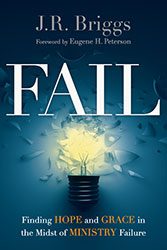 If one duty of the church is—as Proverbs 31 commands—to “speak on behalf of the voiceless,” J.R. Briggs’s Fail: Finding Hope and Grace in the Midst of Ministry Failure is truly doing a good work. The voiceless population he calls into the healing light of grace is pastors who have “failed,” those who—at least according to the megachurch standards of Western culture—have not managed to grow their congregations large enough, swell their coffers heavy enough, or expand their parking lots and sanctuaries and TV and Internet extension campuses wide enough.
Though not a pastor myself, I can honestly say I was shocked to hear of how common feelings of failure are in the pastorate (almost half of all pastors have considered quitting in the past three months!). It’s just not the kind of thing the lay Christian thinks about, tending more often to assume that pastors, who have presumably the confidence of their “calling” and many years of seminary training to bolster them, rarely doubt themselves or struggle with their position of leadership. Of course, anyone who even half keeps an eye on the news is familiar with the wringer “failed” celebrity pastors are put through. Our media openly revels at any opportunity to point out pastors found in adultery, monetary mismanagement, or other scandal as a sign of the diminishing influence or transformative power of Christianity. For a pastor to fail publicly in this way is certainly a blow both to the individual and the church, and Briggs addresses the need for pastors to deal with failure that results from sin. However, where Fail becomes perhaps most interesting and uniquely useful for ministry is in Briggs’s address of the more subtle, amoral ways that pastors feel themselves to be failures and his advice as to how pastors might overcome such feelings. By and large, these feelings of failure come from the (unbiblical) standards of “success” that he argues have become the status quo in the Western church. Concern over purely numerical measures of success—names on members’ lists, bodies in pews, dollars in the treasury—often result in both an over-inflation of the pastor’s role in the church and an inappropriate measure of a church’s health.
Briggs attacks this false conception of success on several fronts: statistical, anecdotal, and biblical. Statistically, for example, to use the Western megachurch as a model of success is setting ourselves up for failure from the get-go. As Briggs points out, “we are a country of small churches.” In fact, megachurches make up less than .05% of the number of churches in America: hardly the norm! Anecdotally, Briggs offers his own story of “failures”: his feelings of insufficiency at a friend’s ordination ceremony where he was afraid to participate, not himself being ordained, though presumed to be so by all the other “real” reverends involved as well as the rejection he faced when deciding to leave one church where he was being groomed as the “Golden Boy” and upcoming pastor (“the next Andy Stanley” as one congregation member dubbed him) to lead a church plant. And biblically, Briggs points out that Jesus’s ministry was incredibly inefficient in terms of the Forbes-based standards we set for contemporary ministry success. He could have marketed better, focused more on earnings and membership, set up a few brick and mortar locations (or even just one!). And yet, His church has thrived.
Briggs encourages pastors to speak openly about their feelings of failure and not to buy into the notion that pastors should be some kind of glossy wax figure of perfection who arrives perfectly coiffed and prepared every Sunday morning in the pulpit. He encourages them to reorient their understandings of success towards a more kingdom-focused standard, one centered on “a process, not a product,” “on congruence, not efficiency,” on “the development of Christlike character and coherence of our stories with the character of God…rather than productivity, competence or progress,” one whose evidence is stories, not numbers, “stories of hope and redemption among the people we’re called to love.”
In addition to offering a “theology of failure” for his readership, Briggs offers what I imagine will be very helpful practical tips for pastors who need their spirits uplifted and their focus on God’s kingdom and their right position and calling restored. They range from tips you might expect—find a mentor, journal—to the novel—give up reading how-to ministry books, watch Brené Brown’s TED videos.
Though Briggs’s primary audience is certainly the burnt-out pastors of the world, I benefitted from reading this book as well, and I would encourage other lay Christians to do the same. It offers a revaluation of what “success” should mean for the American church, and it pushes us to consider how the pastorate fits into this definition of success. It reminds us of our common goals and purpose as Christians and inspires us to push back against unbiblical standards of success promoted by our culture. It encourages sympathy and appreciation for the sacrifices made by those whose lives are devoted to ministry, and it reminds us not to make idols of any man or institution. In essence, while speaking to pastors, it points all readers back to the core elements of the Gospel. One of my favorite moments of the text is an anecdote from one of Briggs’s “Epic Fail Pastors” events, a moment which encapsulates what this book has to offer pastors who feel as though they’ve “failed” and the larger readership of the American church:
“After singing a few worship songs, we were just about to end the first evening of one of our Epic Fail Pastors events when I saw a hand in the back. A young church planter was so burned out he looked crispy around the edges. He leaned back in his chair and said, ‘This may be way off topic, but we sing these songs about Jesus and I don’t even know who Jesus is anymore or what I believe about him.’
He paused. ‘Can someone tell me the gospel again? I need to hear it.’ After a long silence a pastor across the room cleared is throat and shared the outlandishly good news of the life, death and resurrection of Jesus. When the pastor was finished speaking, the church planter looked up, smiled and said, ‘Thanks. I needed that.’
It was a sacred moment—and it most certainly was not off topic. In fact, it might have been the most significant three minutes of the entire event. As pastors, maybe more than almost anybody else, we need to preach the gospel to ourselves or at least have the courage to ask others to preach it to us.”
Read an excerpt from Fail – and an interview with the author – at the Patheos Book Club here!
 Amber M. Stamper holds a Ph.D. in English (Rhetoric and Composition) and is an Assistant Professor of Language, Literature, and Communication at Elizabeth City State University in North Carolina. Her research and publications center on religious rhetoric and communication, especially issues of Christian evangelism and the digital church.
Next Post

September 3, 2014 Ben Corey's Undiluted: A Review
Browse Our Archives
Select a Category Author Q&A Book Review Christian Living Church Leadership Stump a Scholar Theology Uncategorized
Select a Month June 2022 March 2021 October 2020 August 2020 February 2019 November 2017 July 2017 June 2017 May 2017 March 2017 February 2017 January 2017 November 2016 October 2016 August 2016 July 2016 June 2016 May 2016 April 2016 March 2016 February 2016 January 2016 November 2015 October 2015 September 2015 August 2015 July 2015 June 2015 May 2015 April 2015 March 2015 February 2015 January 2015 December 2014 November 2014 October 2014 September 2014 August 2014 July 2014 June 2014 May 2014 April 2014 March 2014 February 2014 January 2014 December 2013 November 2013 October 2013 September 2013 August 2013 July 2013 June 2013 May 2013 April 2013 March 2013 February 2013 January 2013 December 2012 November 2012 October 2012 September 2012 August 2012 July 2012 June 2012 May 2012 April 2012 March 2012 February 2012 January 2012 December 2011 November 2011 October 2011 September 2011 August 2011 July 2011 June 2011 May 2011 April 2011 March 2011 February 2011 January 2011 December 2010 November 2010 October 2010 September 2010 August 2010 July 2010 June 2010
Follow Us!
TAKE THE
Religious Wisdom Quiz
What river did Jesus get baptized in?
Select your answer to see how you score.
Nile Jordan Euphrates Tigris
Related posts from Take and Read

Author Lily Burana on Experiencing God's Grace and...

How the Church Can Heal the Race Divide

Finding Inspiration in "Where Angels Walk"

Happiness Is Found Outside of Our Comfort Zones
TRENDING AT PATHEOS Religious Music & Entertainment

"Les Diabolique" and Transgression
Alongside something like Arrival, Vertigo, or Charade, Les Diaboliques is a...

"The Plague Dogs" and Mortality
So, flashback to the late 70s, early 80s. Walt Disney Studios is...

With the recent and highly successful release of Christopher Nolan’s epic film,...

"L'avventura" and Human Weakness
Today's piece is going to be a little different for a few...

I first want to apologize for not posting or writing anything. I'm...

I've engaged in the multi-year project of reading through the Church Fathers,...
view all Religious Music & Entertainment blogs
Ad-Free & Subscriber Log-In Subscription Support
- About Us
- 2026 Calendar
- Videos
- Podcasts
- Library of World Religions
- Faith In Media Tracker
- Advertise With Us
- Write for Us
- Privacy Policy
- Terms of Service
- Do Not Sell My Data
- Contact Us
- Radiant Digital
- Manage Newsletter Subscriptions
- Unsubscribe From Notifications
- Sitemap
Copyright 2008-2026, Patheos. All rights reserved.
Subscription Support Ad-Free & Subscriber Log-In
Follow Patheos