
BuddhistCatholicContemplativeEvangelicalGeneral ChristianHinduJewishLatter-day SaintMuslimNew VisionsProgressive Christian
Beliefs
- Buddhist
- Catholic
- Contemplative
- Evangelical
- General Christian
- Hindu
- Jewish
- Latter-day Saint
- More Voices
- Muslim
- New Visions
- Pagan
- Progressive Christian
Topics
- Religion News
- Food and Religion
- Sports and Religion
- Religious Art
- Religious Music and Entertainment
- Religious Events
- History and Religion
- Style and Religion
- Politics and Religion
- Women in Religion
- Recreation Outdoors and Religion
- Business Finance and Religion
- Careers Workplace and Religion
- Education and Religion
- Family Parenting and Religion
- Health Fitness and Religion
- Home and Religion
- Relationships and Religion
- Technology and Religion
- Travel and Religion
Columnists
- Buddhist Columnists
- Business Finance and Religion Columnists
- Careers Workplace and Religion Columnists
- Catholic Columnists
- Contemplative Columnists
- Education and Religion Columnists
- Evangelists Columnists
- Family Parenting and Religion Columnists
- General Christian Columnists
- Health Fitness and Religion Columnists
- Hindu Columnists
- History and Religion Columnists
- Home and Religion Columnists
- Jewish Columnists
- More Voices Columnists
- Latter Day Columnists
- Muslim Columnists
- New Visions Columnists
- Nonreligious Columnists
- Pagan Columnists
- Politics and Religion Columnists
- Progressive Columnists
- Recreation Outdoors and Religion Columnists
- Relationships and Religion Columnists
- Religion News Columnists
- Religious Art Columnists
- Religious Events Columnists
- Religious Music and Entertainment Columnists
- Sports and Religion Columnists
- Style and Religion Columnists
- Technology and Religion Columnists
- Travel and Religion Columnists
- Women in Religion Columnists
Resource Library
- 2026 Calendar
- Library of World Religions
- The 100 Most Holy Places on Earth
- Patheos Answers
- Podcasts
- Videos
- Faith Leaders Database
- Anglican Episcopalian
- Bahai
- Baptist
- Buddhism
- Christianity
- Confucianism
- Eastern Orthodoxy
- Hinduism
- Holiness and Pentecostal
- ISKCON
- Islam
- Judaism
- Lutheran
- Methodist
- The Church of Jesus Christ of Latter-day Saints
- New Age
- Paganism
- Presbytarian and Reformed
- Protestantism
- Religion Behind the Scenes
- Roman Catholic
- Scientology
- Shia Islam
- Sikhism
- Sufism
- Sunni Islam
- Taoism
- Zen
- See all religions
Research Tools
 Ad-Free & Subscriber Log-In Subscription Support
Ad-Free & Subscriber Log-In Subscription Support
Follow Patheos 

- Trending:
- Forgiveness
- |
- Marriage
- |
- Consciousness
- |
- Death Penalty
- |
- Election
- |
- Halloween

- Home
- Religious Music & Entertainment
- Colliding with Destiny by Sarah Jakes: A Book Review
Colliding with Destiny by Sarah Jakes: A Book Review
Last updated on: September 23, 2014 at 2:43 pm by Amber Stamper
Colliding with Destiny by Sarah Jakes: A Book Review 2014-09-23T14:43:10-06:00 Amber Stamper
Patheos Explore the world's faith through different perspectives on religion and spirituality! Patheos has the views of the prevalent religions and spiritualities of the world.
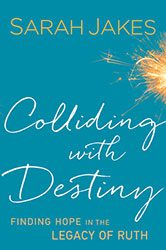 Colliding with Destiny: Finding Hope in the Legacy of Ruth, written by Sarah Jakes (daughter of Bishop T.D. Jakes), is a devotional centered on the story of Ruth designed to inspire women facing discouragement to have greater strength and faith while they await their moment of “collision” with the destiny God has planned for them. Each brief chapter contains an excerpt from the book of Ruth, a short contemporary anecdote (usually from Jakes’s own life) which she has chosen as exemplary of a value or lesson mirrored in the Scripture passage, and a sample prayer to recite with an accompanying series of journaling questions to help readers handle their daily challenges with greater power.
Perhaps the strongest endorsement for this book is Jakes’s own testimony. Having had her first child as a young teen and later finding herself the victim of adultery and divorce, the trials she has faced—undoubtedly made even more challenging by the spotlight of her parents’ ministry—make her credibility as one who has endured adversity and thrived in spite of it irrefutable. Jakes is generous in sharing her experiences and refreshingly unconcerned about what her past might “look like” to anyone ready to judge.
The organizing theological principle at the heart of this book is that God has great plans for each of our lives and that there are specific things we can do to get out of His (and our own) way in arriving at this destiny. Jakes’s positive attitude and tireless assurance that at any moment we will have the breakthrough we have been looking for will certainly encourage some readers. It is worth noting though that such a focus will also make other readers uncomfortable, maybe even discouraged, Jakes’s challenge, of course, being how to explain all the tragedy, disaster, conflict, crisis, depression, or pain that persists in the lives of many of God’s faithful, suffering that does not resolve or reap an abundance of positive fruit (at least not in this life). It may not always work for Jakes’s readers for her to characterize destiny as a moment of arrival or discovery rather than a trajectory of a life which may not necessarily end up looking successful or accomplished. These are not issues Jakes addresses. Journal questions about the things in our lives we are allowing to stand in the way of our destiny and which of our relationships are too negative and should be eliminated are fine questions to ask, but they will not lead some readers out of their wildernesses nor are they likely to speak to the concerns of Christians beyond the first world or in countries where persecution and even martyrdom are more common.
One way, for example, that Jakes might have addressed this disparity could have been a segment on the ways in which getting outside ourselves—getting beyond the search for what she calls our “true self”—by serving and working for others, contributes to experiencing the joy of Christ more directly. There are lots of things we can do to align our minds with God’s—prayer and immersion in His Word, for example—but it’s also true that there are also real limits on this, and we should be careful to not place too much faith in our own efforts. And surely it’s not just me, but Paul’s “thorn” seems often to be a more relatable experience of daily faith—the fleshly and constant awareness of my sin, the persistence of temptation that may plague us till death but that we endure with hope (though not necessarily without pain)—than a guaranteed restoration in this life that comes through like clockwork if we can just wait it out or take the right steps or cultivate the right mindset.
In addition, we must ask: so what does all of this have to do with Ruth? Jakes’s portrayal of Ruth is, as we might expect, in line with her theology: In Colliding with Destiny, Ruth’s story is written as the tale of a woman racked by sorrow at her first husband’s death, a woman who felt lost and abandoned by the God of her new religion when He widowed her, a woman who—because of faithful acts (following Naomi rather than abandoning her, choosing to remain a Jew rather than return to the pagan religion of Moab, serving industriously in Boaz’s fields until she is noticed and married off to him)—is ultimately launched into a relationship that every young American Christian girl has been taught to long for. Sometimes the connection between the scripture and the points Jake extracts seemed a little disjointed. The story of Ruth at times felt like a patina added on as an organizing principle for the various motivational points taught in each chapter rather than a central and foundationally-essential component of the text, and I wondered if Jakes might have done just as well to rely more centrally on her own inspiring testimony to make many of her points.
I will, as a final point, note that, though the connection between Ruth’s story and Jakes’s strategies for colliding with our destiny were not always as transparent as I might have liked, one of the greatest outcomes of having read this book for me was that I was inspired to go back to Ruth in my own Bible and to study her story independently. Jakes is right to have identified her as a character we can learn from, and I have since found myself not only rereading Ruth’s story in Scripture, but seeking out historical and theological studies on Ruth as well as historical fiction (John Piper’s A Sweet and Bitter Providence, John MacArthur’s Ruth & Esther, and Francine Rivers’s Unshaken are all great, if you’re looking for a starting point!). So while I did not always find Jakes’s tips and analysis as penetrating or personally-motivating as some readers undoubtedly will, the fact that this book turned me back to God’s Word with the desire to study it further and independently is a worthy accomplishment unto itself and certainly deserving of praise.
For more on Colliding with Destiny – and to read an excerpt – visit the Patheos Book Club here.
 Amber M. Stamper holds a Ph.D. in English (Rhetoric and Composition) and is an Assistant Professor of Language, Literature, and Communication at Elizabeth City State University in North Carolina. Her research and publications center on religious rhetoric and communication, especially issues of Christian evangelism and the digital church.
Previous Post

September 22, 2014
Reviving the Congregation: A Book Review
Next Post
September 24, 2014 Providing Hope and Preventing Suicide
Browse Our Archives
Select a Category Author Q&A Book Review Christian Living Church Leadership Stump a Scholar Theology Uncategorized
Select a Month June 2022 March 2021 October 2020 August 2020 February 2019 November 2017 July 2017 June 2017 May 2017 March 2017 February 2017 January 2017 November 2016 October 2016 August 2016 July 2016 June 2016 May 2016 April 2016 March 2016 February 2016 January 2016 November 2015 October 2015 September 2015 August 2015 July 2015 June 2015 May 2015 April 2015 March 2015 February 2015 January 2015 December 2014 November 2014 October 2014 September 2014 August 2014 July 2014 June 2014 May 2014 April 2014 March 2014 February 2014 January 2014 December 2013 November 2013 October 2013 September 2013 August 2013 July 2013 June 2013 May 2013 April 2013 March 2013 February 2013 January 2013 December 2012 November 2012 October 2012 September 2012 August 2012 July 2012 June 2012 May 2012 April 2012 March 2012 February 2012 January 2012 December 2011 November 2011 October 2011 September 2011 August 2011 July 2011 June 2011 May 2011 April 2011 March 2011 February 2011 January 2011 December 2010 November 2010 October 2010 September 2010 August 2010 July 2010 June 2010
Follow Us!
TAKE THE
Religious Wisdom Quiz
True or False: In Revelation, the tree of life produces twelve different kinds of fruit, yielding its fruit every month.
Select your answer to see how you score.
FALSE TRUE
Related posts from Take and Read

Even the Faith Giants Didn’t Always Get it...

How the Church Can Heal the Race Divide

Finding Inspiration in "Where Angels Walk"

Happiness Is Found Outside of Our Comfort Zones
TRENDING AT PATHEOS Religious Music & Entertainment

"Les Diabolique" and Transgression
Alongside something like Arrival, Vertigo, or Charade, Les Diaboliques is a...

"The Plague Dogs" and Mortality
So, flashback to the late 70s, early 80s. Walt Disney Studios is...

With the recent and highly successful release of Christopher Nolan’s epic film,...

"L'avventura" and Human Weakness
Today's piece is going to be a little different for a few...

I first want to apologize for not posting or writing anything. I'm...

I've engaged in the multi-year project of reading through the Church Fathers,...
view all Religious Music & Entertainment blogs
Ad-Free & Subscriber Log-In Subscription Support
- About Us
- 2026 Calendar
- Videos
- Podcasts
- Library of World Religions
- Faith In Media Tracker
- Advertise With Us
- Write for Us
- Privacy Policy
- Terms of Service
- Do Not Sell My Data
- Contact Us
- Radiant Digital
- Manage Newsletter Subscriptions
- Unsubscribe From Notifications
- Sitemap
Copyright 2008-2026, Patheos. All rights reserved.
Subscription Support Ad-Free & Subscriber Log-In
Follow Patheos