
BuddhistCatholicContemplativeEvangelicalGeneral ChristianHinduJewishLatter-day SaintMuslimNew VisionsProgressive Christian
Beliefs
- Buddhist
- Catholic
- Contemplative
- Evangelical
- General Christian
- Hindu
- Jewish
- Latter-day Saint
- More Voices
- Muslim
- New Visions
- Pagan
- Progressive Christian
Topics
- Religion News
- Food and Religion
- Sports and Religion
- Religious Art
- Religious Music and Entertainment
- Religious Events
- History and Religion
- Style and Religion
- Politics and Religion
- Women in Religion
- Recreation Outdoors and Religion
- Business Finance and Religion
- Careers Workplace and Religion
- Education and Religion
- Family Parenting and Religion
- Health Fitness and Religion
- Home and Religion
- Relationships and Religion
- Technology and Religion
- Travel and Religion
Columnists
- Buddhist Columnists
- Business Finance and Religion Columnists
- Careers Workplace and Religion Columnists
- Catholic Columnists
- Contemplative Columnists
- Education and Religion Columnists
- Evangelists Columnists
- Family Parenting and Religion Columnists
- General Christian Columnists
- Health Fitness and Religion Columnists
- Hindu Columnists
- History and Religion Columnists
- Home and Religion Columnists
- Jewish Columnists
- More Voices Columnists
- Latter Day Columnists
- Muslim Columnists
- New Visions Columnists
- Nonreligious Columnists
- Pagan Columnists
- Politics and Religion Columnists
- Progressive Columnists
- Recreation Outdoors and Religion Columnists
- Relationships and Religion Columnists
- Religion News Columnists
- Religious Art Columnists
- Religious Events Columnists
- Religious Music and Entertainment Columnists
- Sports and Religion Columnists
- Style and Religion Columnists
- Technology and Religion Columnists
- Travel and Religion Columnists
- Women in Religion Columnists
Resource Library
- 2026 Calendar
- Library of World Religions
- The 100 Most Holy Places on Earth
- Patheos Answers
- Podcasts
- Videos
- Faith Leaders Database
- Anglican Episcopalian
- Bahai
- Baptist
- Buddhism
- Christianity
- Confucianism
- Eastern Orthodoxy
- Hinduism
- Holiness and Pentecostal
- ISKCON
- Islam
- Judaism
- Lutheran
- Methodist
- The Church of Jesus Christ of Latter-day Saints
- New Age
- Paganism
- Presbytarian and Reformed
- Protestantism
- Religion Behind the Scenes
- Roman Catholic
- Scientology
- Shia Islam
- Sikhism
- Sufism
- Sunni Islam
- Taoism
- Zen
- See all religions
Research Tools
 Ad-Free & Subscriber Log-In Subscription Support
Ad-Free & Subscriber Log-In Subscription Support
Follow Patheos 

- Trending:
- Forgiveness
- |
- Marriage
- |
- Consciousness
- |
- Death Penalty
- |
- Election
- |
- Halloween

- Home
- Religious Music & Entertainment
- Teach Us To Want: A Review
Teach Us To Want: A Review
Last updated on: August 4, 2014 at 4:30 pm by Amber Stamper
Teach Us To Want: A Review 2014-08-04T16:30:58-06:00 Amber Stamper
Patheos Explore the world's faith through different perspectives on religion and spirituality! Patheos has the views of the prevalent religions and spiritualities of the world.
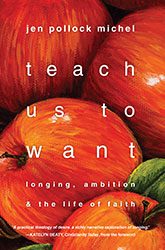 If, as Madeleine L’Engle has written, a book “can be a star, ‘explosive material, capable of stirring up fresh life endlessly,’ a living fire to lighten the darkness, leading out into the expanding universe,” then Jen Pollock Michel’s first book—Teach Us To Want: Longing, Ambition & The Life of Faith—certainly makes the cut. Michel’s goal—to establish and explore a theology of desire—is decidedly academic. And yet, her ability to weave personal anecdote with scripture and the depth and breadth of her sources—quoting as adeptly from Augustine and Aristotle as H.G. Wells and Annie Dillard as N.T. Wright and Dietrich Bonhoeffer—is more akin to poetry.
Michel begins by (rightly, I believe) noting how challenging it is for contemporary Christians to navigate their desires. On the one hand, our churches often teach the necessity of reigning in, controlling, and extinguishing desire. On the other, our culture glorifies the indulgence of desire, suggesting that desires of all ilk are worthy and acceptable. And yet, Michel argues, a careful reading of scripture seems to offer us a third option: desire that is godly; desire that is holy.
In each chapter, Michel offers a way of correcting our misconceptions about desire or a method of living beyond the rejection of desire, an action point to help us allow our desires to be shaped by God’s will. Using desire in her own life—in particular the desire to write despite what long appeared to be her conflicting role as a mother to five children—as an example, she leads her readers to reconsider our fear of desire and to let courage, grace, and the Gospel itself be our guides instead. By staying committed to the practices of scripture reading, prayer, confession, and community, we can ensure not only that our deepest and most heartfelt desires are recognized and fulfilled but that they become more than we might have ever imagined as they are boldly shaped by God’s will and plan for our lives.
Perhaps one of the most profound moments of revelation for me in this book (and there were many such moments) was Michel’s exegesis of the Lord’s Prayer, in which she leads us to the truths that we should not give in to the pressures of the world to see grace as based often or even primarily in our deeds, desire as solely appropriate for spiritual subjects, and the “self” as the sovereign force behind the fulfillment of desire. These points may seem obvious when spelled out in this way and are certainly the sorts of theological truths that will garner instant head-nodding from evangelicals at least, but Michel pushes us over and over again to ask how well we are doing at putting theory into practice. Are we desiring, for example, our daily bread? Do we really believe it is good and worthy to pray sincerely and actively and persistently for God to, say, find us our dream home? Or do we feel foolish praying for bread when we live in a culture of feasting? And do we feel selfish praying for material blessings when we already have so much? If so, Michel suggests we might do well to see both sides of the spectrum through God’s eyes. Ultimately, she makes the point that God is a god of great blessings. He DESIRES to bless us, He PROMISES to bless is, He REVELS in blessing us. But this is no prosperity gospel she is preaching. The flip side of the coin is how well we are willing to release our desires to God. Are we afraid to acknowledge and speak them? Are we afraid they won’t be acceptable? Or can we freely and whole-heartedly hand over every single one of them with open hands to a God Whom we can trust to handle them?
Teach Us To Want will, at the very least, get you thinking. It likely will get you searching scripture and considering your own thoughts about desire as well. It may even revolutionize and liberate your entire walk as a Christian. To be human is to desire. As Michel points out, the very first sin was one of misplaced and misused desire. We have struggled with desire from the get-go and can likely, as this text makes clear, not give up or grow lazy in continuing to approach it and confront it head on, both in our theology and in our lives.
 Amber M. Stamper holds a Ph.D. in English (Rhetoric and Composition) and is an Assistant Professor of Language, Literature, and Communication at Elizabeth City State University in North Carolina. Her research and publications center on religious rhetoric and communication, especially issues of Christian evangelism and the digital church
Previous Post

August 4, 2014
On Praying with Beads: A Q&A with Author Kristen Vincent
Next Post
August 18, 2014 When Believers and Nonbelievers Marry: A Q&A with Dale McGowan
Browse Our Archives
Select a Category Author Q&A Book Review Christian Living Church Leadership Stump a Scholar Theology Uncategorized
Select a Month June 2022 March 2021 October 2020 August 2020 February 2019 November 2017 July 2017 June 2017 May 2017 March 2017 February 2017 January 2017 November 2016 October 2016 August 2016 July 2016 June 2016 May 2016 April 2016 March 2016 February 2016 January 2016 November 2015 October 2015 September 2015 August 2015 July 2015 June 2015 May 2015 April 2015 March 2015 February 2015 January 2015 December 2014 November 2014 October 2014 September 2014 August 2014 July 2014 June 2014 May 2014 April 2014 March 2014 February 2014 January 2014 December 2013 November 2013 October 2013 September 2013 August 2013 July 2013 June 2013 May 2013 April 2013 March 2013 February 2013 January 2013 December 2012 November 2012 October 2012 September 2012 August 2012 July 2012 June 2012 May 2012 April 2012 March 2012 February 2012 January 2012 December 2011 November 2011 October 2011 September 2011 August 2011 July 2011 June 2011 May 2011 April 2011 March 2011 February 2011 January 2011 December 2010 November 2010 October 2010 September 2010 August 2010 July 2010 June 2010
Follow Us!
TAKE THE
Religious Wisdom Quiz
What did Job maintain throughout his speeches?
Select your answer to see how you score.
His silence His guilt His innocence His wealth
Related posts from Take and Read

Even the Faith Giants Didn’t Always Get it...

How the Church Can Heal the Race Divide

Finding Inspiration in "Where Angels Walk"

Happiness Is Found Outside of Our Comfort Zones
TRENDING AT PATHEOS Religious Music & Entertainment

"Les Diabolique" and Transgression
Alongside something like Arrival, Vertigo, or Charade, Les Diaboliques is a...

"The Plague Dogs" and Mortality
So, flashback to the late 70s, early 80s. Walt Disney Studios is...

With the recent and highly successful release of Christopher Nolan’s epic film,...

"L'avventura" and Human Weakness
Today's piece is going to be a little different for a few...

I first want to apologize for not posting or writing anything. I'm...

I've engaged in the multi-year project of reading through the Church Fathers,...
view all Religious Music & Entertainment blogs
Ad-Free & Subscriber Log-In Subscription Support
- About Us
- 2026 Calendar
- Videos
- Podcasts
- Library of World Religions
- Faith In Media Tracker
- Advertise With Us
- Write for Us
- Privacy Policy
- Terms of Service
- Do Not Sell My Data
- Contact Us
- Radiant Digital
- Manage Newsletter Subscriptions
- Unsubscribe From Notifications
- Sitemap
Copyright 2008-2026, Patheos. All rights reserved.
Subscription Support Ad-Free & Subscriber Log-In
Follow Patheos