
BuddhistCatholicContemplativeEvangelicalGeneral ChristianHinduJewishLatter-day SaintMuslimNew VisionsProgressive Christian
Beliefs
- Buddhist
- Catholic
- Contemplative
- Evangelical
- General Christian
- Hindu
- Jewish
- Latter-day Saint
- More Voices
- Muslim
- New Visions
- Pagan
- Progressive Christian
Topics
- Religion News
- Food and Religion
- Sports and Religion
- Religious Art
- Religious Music and Entertainment
- Religious Events
- History and Religion
- Style and Religion
- Politics and Religion
- Women in Religion
- Recreation Outdoors and Religion
- Business Finance and Religion
- Careers Workplace and Religion
- Education and Religion
- Family Parenting and Religion
- Health Fitness and Religion
- Home and Religion
- Relationships and Religion
- Technology and Religion
- Travel and Religion
Columnists
- Buddhist Columnists
- Business Finance and Religion Columnists
- Careers Workplace and Religion Columnists
- Catholic Columnists
- Contemplative Columnists
- Education and Religion Columnists
- Evangelists Columnists
- Family Parenting and Religion Columnists
- General Christian Columnists
- Health Fitness and Religion Columnists
- Hindu Columnists
- History and Religion Columnists
- Home and Religion Columnists
- Jewish Columnists
- More Voices Columnists
- Latter Day Columnists
- Muslim Columnists
- New Visions Columnists
- Nonreligious Columnists
- Pagan Columnists
- Politics and Religion Columnists
- Progressive Columnists
- Recreation Outdoors and Religion Columnists
- Relationships and Religion Columnists
- Religion News Columnists
- Religious Art Columnists
- Religious Events Columnists
- Religious Music and Entertainment Columnists
- Sports and Religion Columnists
- Style and Religion Columnists
- Technology and Religion Columnists
- Travel and Religion Columnists
- Women in Religion Columnists
Resource Library
- 2026 Calendar
- Library of World Religions
- The 100 Most Holy Places on Earth
- Patheos Answers
- Podcasts
- Videos
- Faith Leaders Database
- Anglican Episcopalian
- Bahai
- Baptist
- Buddhism
- Christianity
- Confucianism
- Eastern Orthodoxy
- Hinduism
- Holiness and Pentecostal
- ISKCON
- Islam
- Judaism
- Lutheran
- Methodist
- The Church of Jesus Christ of Latter-day Saints
- New Age
- Paganism
- Presbytarian and Reformed
- Protestantism
- Religion Behind the Scenes
- Roman Catholic
- Scientology
- Shia Islam
- Sikhism
- Sufism
- Sunni Islam
- Taoism
- Zen
- See all religions
Research Tools
 Ad-Free & Subscriber Log-In Subscription Support
Ad-Free & Subscriber Log-In Subscription Support
Follow Patheos 

- Trending:
- Forgiveness
- |
- Marriage
- |
- Consciousness
- |
- Death Penalty
- |
- Election
- |
- Halloween

- Home
- Religious Music & Entertainment
- Why God Created the World: A Q&A with Ben Stevens
Why God Created the World: A Q&A with Ben Stevens
Last updated on: July 3, 2014 at 10:53 am by Deborah Arca
Why God Created the World: A Q&A with Ben Stevens 2014-07-03T10:53:34-06:00 Deborah Arca
Patheos Explore the world's faith through different perspectives on religion and spirituality! Patheos has the views of the prevalent religions and spiritualities of the world.
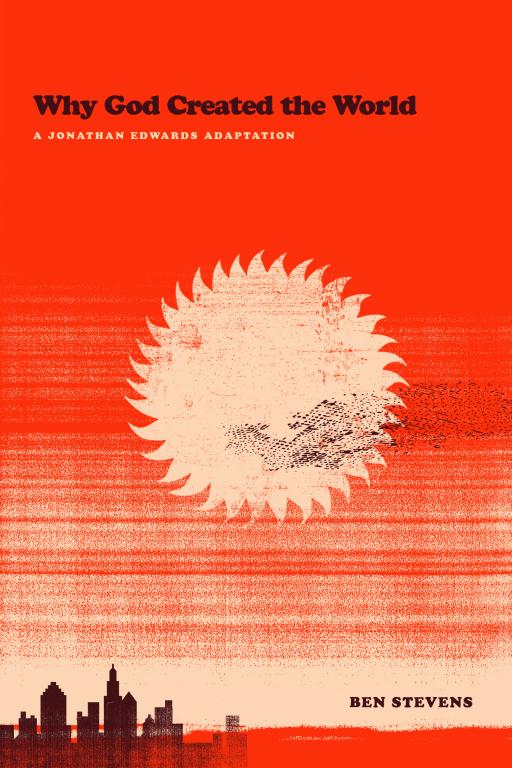
 This month at the Patheos Book Club, we’re featuring a new book by Ben Stevens, Why God Created the World, a remarkable new adaptation bringing Jonathan Edwards’ powerful arguments to life in fresh, contemporary language. Stevens shared some thoughts about the book with us here.
What got you interested in this topic?
I stumbled onto it while working on a different project, actually. I have always been intrigued by the statement “everything that’s important in the Bible is counter-intuitive.” And I’ve been trying to identify all those main counter-intuitive hooks in Scripture to use in a kind of theological confession I’m writing for my work in Berlin. Well, one day it dawned on me that the question “Why did God create the world in the first place?” should play a big part in any such explanation of Christianity…and that I had no clue how to answer it. So that got me looking for answers.
Your book is an adaptation of a book you found on the topic. So where did you first hear about the book itself?
 Right. The original was called A Dissertation Concerning the End for Which God Created the World, and it was written by Jonathan Edwards, an 18th century theologian in New England. One of my seminary friends had mentioned the book to me in passing once, and I had attempted, and subsequently failed, to get through the first chapter while in school. But then I heard an interview with John Piper years later in which he called it the “most important book I ever read, second only to the Bible.” Given such an endorsement, and the fact that I knew of no other books like it, I decided to take a peek at it again. And I’m glad I did.
Now, the subtitle of the book is “A Jonathan Edwards Adaptation.” What exactly does that mean and why was it necessary to adapt the book?
Edwards had a rather wordy style. You hear it, for example, in the name of one of his other books. It was called:
“A Humble Attempt at Promoting Explicit Agreement and Visible Union of God’s People Through the World in Extraordinary Prayer for the Revival of Religion and the Advancement of Christ’s Kingdom on Earth Pursuant to Scripture, Promise, and Prophecies Concerning the Last Times.”
Some people say this is the only way he could have said such things, and that you can only explain complex topics with complex sentences. I think Jesus’ own teaching shows that that’s not true. So I quickly decided that it would be helpful to translate, or adapt, his brilliant ideas into words that modern readers could understand. I read a paragraph, digested it, and then restated it. The style and tone of the book are mine, and the ideas are his.
Okay, I know it’s a big subject, but is it possible to summarize his answer briefly? Why did God create the world?
Yes, I think so. It revolves around three core ideas.
First, it makes no sense to say God created the world to fulfill a need. There’s nothing material we have which He couldn’t have had without us, and even when it comes to community, Christianity says God had better fellowship in the Trinity before time than we can offer Him. It also doesn’t work to say He created it because of His love for us because we weren’t always there to love and at some point had to be thought up too. So what motivated Him to start thinking about the creation of anything.
Second, if God didn’t create the world to fulfill a need He had, He must have done it to promote something He valued, something like goodness, truth, or beauty. That is to say, if He is promoting something He values, it must be something which He already valued before creation existed.
Third, a question: what existed before the creation of the world which was good, true, and beautiful? I believe you will see that everything which existed before the creation of the world, which was good, true, and beautiful . . . was God. If there is a God who created the universe as we know it, then that means there was also a time when everything we love, which inspires us, and which gives us goose bumps, was all simply an aspect of His personality.
Creation must have arisen because of the way it accomplishes something God values. God values things like goodness, truth, and beauty. And yet those words are simply labels we have come up with to describe things which were, before creation, all Him. So I think we are logical to conclude that if God could have created the universe to expand and increase Himself—and, implicitly, all the things which we have come to know in the abstract as goodness, truth, and beauty—then that best explains the logic behind His decision to create a universe in the first place. Suffice it to say the book handles this answer, and the logical objections against it, with in a lot more detail.
This sounds good to Christian ears, but some would argue that this is not really good news for us. I mean, if God is focused on increasing Himself, what good does that do us?
There’s an analogy Edwards used which I embellished a bit, and it speaks really well to this question. Here’s how I put it in the book:
What is it that we cherish about diamonds? We cherish the way they sparkle and reflect the light. That is, we value them because they magnify and reveal something else. Our admiration for the things themselves is a bit ironic. The beauty we see in a gemstone is really just the beauty of the light. What value would diamonds have in a dark world?
There is no dichotomy between a diamond’s desire to sparkle and the sun’s desire to shine. In fact, from the point of view of the diamond, these two goals are inseparable. When you rush to see a shiny new diamond on someone’s finger, you are in fact, knowingly or unknowingly, rushing to admire how beautiful the light can be when seen through a vessel made specifically to reflect it well. And the diamond you find on that finger will be beautiful only insofar as the sun shines brightly.
I think this analogy applies well to God’s desire to glorify Himself and our desire to flourish. It shows how they can be one in the same process.
You say in the preface that this is one of the few books, or maybe the only book, which has tried to answer this question from a Christian perspective. Given the significance of the question, why do you think that is?
I think it’s sadly a product of what we do with Christianity. We try to make it one of the things from which we draw inspiration. We add God to the constellation of people and things which we see as orbiting around us. Of course, it is this view itself, that God Himself orbits around us, that He exists primarily as a source for our inspiration, which is close to the heart of sin itself, whether packaged in secular or in Christian language.
While I was still writing the proposal for the book, I contacted a well-known Christian author I had met once to ask him what he thought of it. He replied that he had never heard anyone ever ask this question before, and that there would be no market for it. He suggested that I should write a book called “Why God Created You” instead. “Always think reader-first.”
I understand the concern on a marketing level, but I can’t help but think it belies a me-first view of God, too. How can it be possibly be irrelevant why God created the world for anyone who is truly interested in living out His will? For that reason, I’m very hopeful this book will help sew seeds of doubt inside the Christianity Lite camp.
Do you have any other adaptations in mind? Should we expect more books like this from you?
I’m actually in the early stages of a second adaptation right now. I don’t think I’ll say which one yet, but here’s a clue: it’s the book which C.S. Lewis said “baptized his intellect.” Hope to be back to talk about that project some day soon!
Ben Stevens holds an MDiv with an emphases in preaching and intercultural studies from Trinity Evangelical Divinity School. Born in west Tennessee and raised throughout the South, he later studied German at Missouri State University and at Philipps Universität (Marburg, Germany). He and his wife, Becky, serve cross-culturally in Berlin, Germany. His writing has been published in the online versions of The Washington Times, First Things, Huffington Post, Christianity Today, Relevant Magazine, and the Gospel Coalition blog.

Next Post

July 8, 2014 Connecting Two Poles: Saints and Social Justice
Browse Our Archives
Select a Category Author Q&A Book Review Christian Living Church Leadership Stump a Scholar Theology Uncategorized
Select a Month June 2022 March 2021 October 2020 August 2020 February 2019 November 2017 July 2017 June 2017 May 2017 March 2017 February 2017 January 2017 November 2016 October 2016 August 2016 July 2016 June 2016 May 2016 April 2016 March 2016 February 2016 January 2016 November 2015 October 2015 September 2015 August 2015 July 2015 June 2015 May 2015 April 2015 March 2015 February 2015 January 2015 December 2014 November 2014 October 2014 September 2014 August 2014 July 2014 June 2014 May 2014 April 2014 March 2014 February 2014 January 2014 December 2013 November 2013 October 2013 September 2013 August 2013 July 2013 June 2013 May 2013 April 2013 March 2013 February 2013 January 2013 December 2012 November 2012 October 2012 September 2012 August 2012 July 2012 June 2012 May 2012 April 2012 March 2012 February 2012 January 2012 December 2011 November 2011 October 2011 September 2011 August 2011 July 2011 June 2011 May 2011 April 2011 March 2011 February 2011 January 2011 December 2010 November 2010 October 2010 September 2010 August 2010 July 2010 June 2010
Follow Us!
TAKE THE
Religious Wisdom Quiz
What does Proverbs say about quick-tempered people?
Select your answer to see how you score.
They are always respected They make peace They cause trouble They are wise
Related posts from Take and Read

"The Slow March of Light" Highlights The Human...

"A Brilliant Night of Stars and Ice" Recounts...

How To Judge The Bible By Its Cover

Life is an Endless Invitation: Q&A With Rob...
TRENDING AT PATHEOS Religious Music & Entertainment

"Les Diabolique" and Transgression
Alongside something like Arrival, Vertigo, or Charade, Les Diaboliques is a...

"The Plague Dogs" and Mortality
So, flashback to the late 70s, early 80s. Walt Disney Studios is...

With the recent and highly successful release of Christopher Nolan’s epic film,...

"L'avventura" and Human Weakness
Today's piece is going to be a little different for a few...

I first want to apologize for not posting or writing anything. I'm...

I've engaged in the multi-year project of reading through the Church Fathers,...
view all Religious Music & Entertainment blogs
Ad-Free & Subscriber Log-In Subscription Support
- About Us
- 2026 Calendar
- Videos
- Podcasts
- Library of World Religions
- Faith In Media Tracker
- Advertise With Us
- Write for Us
- Privacy Policy
- Terms of Service
- Do Not Sell My Data
- Contact Us
- Radiant Digital
- Manage Newsletter Subscriptions
- Unsubscribe From Notifications
- Sitemap
Copyright 2008-2026, Patheos. All rights reserved.
Subscription Support Ad-Free & Subscriber Log-In
Follow Patheos