
BuddhistCatholicContemplativeEvangelicalGeneral ChristianHinduJewishLatter-day SaintMuslimNew VisionsProgressive Christian
Beliefs
- Buddhist
- Catholic
- Contemplative
- Evangelical
- General Christian
- Hindu
- Jewish
- Latter-day Saint
- More Voices
- Muslim
- New Visions
- Pagan
- Progressive Christian
Topics
- Religion News
- Food and Religion
- Sports and Religion
- Religious Art
- Religious Music and Entertainment
- Religious Events
- History and Religion
- Style and Religion
- Politics and Religion
- Women in Religion
- Recreation Outdoors and Religion
- Business Finance and Religion
- Careers Workplace and Religion
- Education and Religion
- Family Parenting and Religion
- Health Fitness and Religion
- Home and Religion
- Relationships and Religion
- Technology and Religion
- Travel and Religion
Columnists
- Buddhist Columnists
- Business Finance and Religion Columnists
- Careers Workplace and Religion Columnists
- Catholic Columnists
- Contemplative Columnists
- Education and Religion Columnists
- Evangelists Columnists
- Family Parenting and Religion Columnists
- General Christian Columnists
- Health Fitness and Religion Columnists
- Hindu Columnists
- History and Religion Columnists
- Home and Religion Columnists
- Jewish Columnists
- More Voices Columnists
- Latter Day Columnists
- Muslim Columnists
- New Visions Columnists
- Nonreligious Columnists
- Pagan Columnists
- Politics and Religion Columnists
- Progressive Columnists
- Recreation Outdoors and Religion Columnists
- Relationships and Religion Columnists
- Religion News Columnists
- Religious Art Columnists
- Religious Events Columnists
- Religious Music and Entertainment Columnists
- Sports and Religion Columnists
- Style and Religion Columnists
- Technology and Religion Columnists
- Travel and Religion Columnists
- Women in Religion Columnists
Resource Library
- 2026 Calendar
- Library of World Religions
- The 100 Most Holy Places on Earth
- Patheos Answers
- Podcasts
- Videos
- Faith Leaders Database
- Anglican Episcopalian
- Bahai
- Baptist
- Buddhism
- Christianity
- Confucianism
- Eastern Orthodoxy
- Hinduism
- Holiness and Pentecostal
- ISKCON
- Islam
- Judaism
- Lutheran
- Methodist
- The Church of Jesus Christ of Latter-day Saints
- New Age
- Paganism
- Presbytarian and Reformed
- Protestantism
- Religion Behind the Scenes
- Roman Catholic
- Scientology
- Shia Islam
- Sikhism
- Sufism
- Sunni Islam
- Taoism
- Zen
- See all religions
Research Tools
 Ad-Free & Subscriber Log-In Subscription Support
Ad-Free & Subscriber Log-In Subscription Support
Follow Patheos 

- Trending:
- Forgiveness
- |
- Marriage
- |
- Consciousness
- |
- Death Penalty
- |
- Election
- |
- Halloween

- Home
- Religious Music & Entertainment
- Vinh Chung’s “Where the Wind Leads”: A Review
Vinh Chung’s “Where the Wind Leads”: A Review
Last updated on: June 2, 2014 at 10:57 am by Amber Stamper
Vinh Chung’s “Where the Wind Leads”: A Review 2014-06-02T10:57:32-06:00 Amber Stamper
Patheos Explore the world's faith through different perspectives on religion and spirituality! Patheos has the views of the prevalent religions and spiritualities of the world.
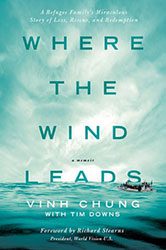 The first time I was inspired to buy 317 million copies of a book and have them delivered to each doorstep in America was after discovering Randy Alcorn’s paradigm-shifting Safely Home back in 2012. I now have a second book to add to the list: Vinh Chung’s Where the Wind Leads.
Seriously, this book will change your life.
To preface:
I am raising newborn twins, and I read all 348 pages in less than 24 hours.
For those who may not be parents, or for those who may not be parents of multiples, what this means is that at nap time, with one baby asleep in my arms, the book propped between my knees, my foot rhythmically rocking the other in his cradle, I was reading. It means that on our afternoon walk, as I awkwardly weaved the double stroller through the neighborhood with one hand, I was turning pages with the other. It means that when both little cuddle bugs were swept off by their father or grandfather or grandmother or aunt—bless their sweet hearts!—to be snuggled and ooh-ed and aah-ed over, I did not choose to eat, sleep, shower, or (distant fourth place) clean, but instead sat in the recliner and sipped some lemonade and read. And it means that instead of Margaret Wise Brown’s Big Red Barn at bedtime, my boys drifted off to sleep to the tale of a family who lost everything in one part of the world only to find it again in a totally new and miraculous way in another.
Where the Wind Leads is just that good. Not thriller-pop fiction-sensationalist good, not I’m-getting-yanked-around-by-these-end-of-chapter-cliffhangers good. It’s the kind of good that rocks you to the core and makes you want to do life differently.
Both the plot of Where the Wind Leads—a riches to rags to riches tale of a family of Chinese refugees from Vietnam on their winding, treacherous way to America—and Chung’s style—at once detailed, colloquial, earnest, and humorous—have been praised highly in myriad reviews. So instead of reiterating these accolades, I’d like to offer a couple of reasons why this book has the potential to not only grip and entertain its readers, but to revolutionize our thinking and renew our approach to life and faith:
(1) It points us to radical gratitude.
The opening epigraph is a Chinese proverb: “The winds of heaven change suddenly; so do human fortunes.” Most of us will never experience the type of loss the Chung family undergoes—over the course of a couple chapters, we see them thrown from living under the luxurious umbrella of a multi-million dollar rice-milling, shipping and trading empire in Vietnam to nearly dying of dehydration while fleeing the country on a crude boat full of refugees, an existence plagued by the perpetual fear of piracy and the worry that they may never see land again—but the suddenness of their loss reminds us of the tenuousness of our own first world wealth. This loss becomes for the Chung family a moment of renewal, not just materially but spiritually. Their values are changed by the devastation. In particular, they begin to find themselves suddenly grateful for the smallest, most simple acts of grace: strangers who offer Chung’s father just enough money for a ride to and from the hospital so that his brother Bruce’s life might be saved from food poisoning; Bruce taking off his shirt so his sister Yen’s delicate feet could have respite from the blistering barefoot walks the refugees were commanded to take around the Malaysian beaches; powerful Grandmother Chung throwing her body in front of her sons to save them from a brutal beating; the possession of one dirty tarp to collect water to drink when it rains. Appreciation for such small gifts, gifts that in a life of material wealth or comfort would easily be overlooked or not even considered gifts at all, is a reminder of how really rich we are.
(2) It depicts radical humility.
If there is any family that might deserve to be proud, it is the Chungs. By the end of the memoir, the former “boat people” have each laid claim to their own (very impressive) corners of the American dream: the children hold twenty-one university degrees between them! Chung himself made his way to Harvard University and then Harvard Medical school, but while he praises others for their industriousness and innovation, he persistently reflects on how—having seen hard-earned wealth wiped out, homelands changed beyond recognition, and families devastated in the blink of an eye—he can’t help but recognize that great gain is a gift and one to be held with an open hand at that. He recognizes as well that we are all called to help one another, for any one one of us might be the one in need at any moment (a recognition he enacts by giving all book sale proceeds to World Vision, the organization that helped rescue his family). Another wonderful display of Chung’s humility is his self-deprecating and hilarious description of his relationship and experience falling in love with his now-wife Leisle. The way he portrays his awkwardness with her (the first girl he had ever been interested in)—calling her his “special friend” instead of girlfriend and admitting that his style consisted mainly of free t-shirts offered for various promotionals on campus—is so charming. He even shares excerpts from the hysterically-awkward letters he sent her when they dated. His ability to mock himself—even as he has so much he could be bitter about in his past and so much he could have pride about in his success in America—is not only endearing and fun to read but a good model of how we might approach life: with a lightheartedness that can carry us through the good times and the bad.
(3) It encourages radical hope.
In other words: if there is one lesson to be learned from Where the Wind Leads is that prayer is powerful and miracles—fantastically large and intimately small—still happen. Though Chung’s parents were not Christians when they begin their long flight out of Vietnam, they each arrived at faith along the way. And because of the dire circumstances in which they found this faith, they learned to thoroughly depend on it as their sole hope. And God carries them through, bringing wonders large and small: at one point, as the passengers on the boat are nearly dying of thirst, Chung’s father cries out in prayer for rain, and it immediately begins to storm. Then, when the rainwaters begin to flood their small ship, he prays again, and the rains cease. At another moment, when Vinh’s mother has to be hospitalized after miscarrying a twin pregnancy, the family fears they may never be reunited again, but due to—what some might take for coincidence—a small and unexpected change in the refugees’ departure schedule, Chung’s mother is able to find them again. The reality is that—while in the Chung’s story dependence on faith becomes circumstantially necessary—faith is the sole hope for all of us, whether we recognize it behind the layers of apparent material satisfaction and prosperity and comfort.
Towards the end of Where the Wind Leads, Chung reflects on raising his own children, who were born in America to two well-educated, well-off parents, children who likely will never know the trials or challenges of his own childhood. He asks:
“How can I give my children all the things I never had without allowing them to become complacent? How do I teach them that America is a land of opportunity but was never meant to be a place of entitlement? How do I allow them comfort and ease but instill in them the value of hard work? How do I allow them to grow up American but still pass on that tap root my parents left to me?”
And then he answers his own question:
“I am a refugee and always will be. But in a way, all of us are refugees. We are all born in a time and place we didn’t choose, born without language, property, or money, dependent entirely on the decisions of others for our very survival. We are all strangers in a strange land, left to fend for ourselves in a world we barely comprehend, and as we find our way in this world, we need to help others do the same. We all have been blessed—every one of us—and we all are expected to give back.”
And this is an ethic we all can live by: radical gratitude, radical humility, and radical hope will change us and, if enough of us are changed, will change the world. More books should lead is to this kind of challenge. You can’t turn the final page of Where the Wind Leads and just walk away. It’s one of those stories that—once known, in all it’s tragic drama and great redemption—can’t be forgotten. We ignore its implications at our own risk. We accept its ideals at nothing short of great fulfillment and gain.
Whenever I complete a book for review, I store it away on a special section of my shelves reserved for review copies. Not this one though. This one went straight to the nursery. Though it looks awkward at the moment—a huge, hard-back volume with a dust jacket that would melt against just one round of baby gumming—sitting between Eric Carle’s The Artist Who Painted a Blue Horse board book and our beloved John Deere: Farm ABC’s, it’s a book that belongs in their possession. The gratitude and hope, industry and innovation, commitment and determination, faith and courage of the Chung family’s story are values that I want to pass down.
Read an excerpt from Where the Wind Leads – and an author Q&A – at the Patheos Book Club.
 Amber M. Stamper holds a Ph.D. in English (Rhetoric and Composition) and is an Assistant Professor of Language, Literature, and Communication at Elizabeth City State University in North Carolina. Her research and publications center on religious rhetoric and communication, especially issues of Christian evangelism and the digital church.
Previous Post

May 30, 2014
Got Religion? A Q&A with Naomi Schaefer Riley
Next Post
June 9, 2014 Got Religion? A Book Review
Browse Our Archives
Select a Category Author Q&A Book Review Christian Living Church Leadership Stump a Scholar Theology Uncategorized
Select a Month June 2022 March 2021 October 2020 August 2020 February 2019 November 2017 July 2017 June 2017 May 2017 March 2017 February 2017 January 2017 November 2016 October 2016 August 2016 July 2016 June 2016 May 2016 April 2016 March 2016 February 2016 January 2016 November 2015 October 2015 September 2015 August 2015 July 2015 June 2015 May 2015 April 2015 March 2015 February 2015 January 2015 December 2014 November 2014 October 2014 September 2014 August 2014 July 2014 June 2014 May 2014 April 2014 March 2014 February 2014 January 2014 December 2013 November 2013 October 2013 September 2013 August 2013 July 2013 June 2013 May 2013 April 2013 March 2013 February 2013 January 2013 December 2012 November 2012 October 2012 September 2012 August 2012 July 2012 June 2012 May 2012 April 2012 March 2012 February 2012 January 2012 December 2011 November 2011 October 2011 September 2011 August 2011 July 2011 June 2011 May 2011 April 2011 March 2011 February 2011 January 2011 December 2010 November 2010 October 2010 September 2010 August 2010 July 2010 June 2010
Follow Us!
TAKE THE
Religious Wisdom Quiz
What did Job maintain throughout his speeches?
Select your answer to see how you score.
His silence His guilt His innocence His wealth
Related posts from Take and Read

Even the Faith Giants Didn’t Always Get it...

How the Church Can Heal the Race Divide

Finding Inspiration in "Where Angels Walk"

Happiness Is Found Outside of Our Comfort Zones
TRENDING AT PATHEOS Religious Music & Entertainment

"Les Diabolique" and Transgression
Alongside something like Arrival, Vertigo, or Charade, Les Diaboliques is a...

"The Plague Dogs" and Mortality
So, flashback to the late 70s, early 80s. Walt Disney Studios is...

With the recent and highly successful release of Christopher Nolan’s epic film,...

"L'avventura" and Human Weakness
Today's piece is going to be a little different for a few...

I first want to apologize for not posting or writing anything. I'm...

I've engaged in the multi-year project of reading through the Church Fathers,...
view all Religious Music & Entertainment blogs
Ad-Free & Subscriber Log-In Subscription Support
- About Us
- 2026 Calendar
- Videos
- Podcasts
- Library of World Religions
- Faith In Media Tracker
- Advertise With Us
- Write for Us
- Privacy Policy
- Terms of Service
- Do Not Sell My Data
- Contact Us
- Radiant Digital
- Manage Newsletter Subscriptions
- Unsubscribe From Notifications
- Sitemap
Copyright 2008-2026, Patheos. All rights reserved.
Subscription Support Ad-Free & Subscriber Log-In
Follow Patheos