
BuddhistCatholicContemplativeEvangelicalGeneral ChristianHinduJewishLatter-day SaintMuslimNew VisionsProgressive Christian
Beliefs
- Buddhist
- Catholic
- Contemplative
- Evangelical
- General Christian
- Hindu
- Jewish
- Latter-day Saint
- More Voices
- Muslim
- New Visions
- Pagan
- Progressive Christian
Topics
- Religion News
- Food and Religion
- Sports and Religion
- Religious Art
- Religious Music and Entertainment
- Religious Events
- History and Religion
- Style and Religion
- Politics and Religion
- Women in Religion
- Recreation Outdoors and Religion
- Business Finance and Religion
- Careers Workplace and Religion
- Education and Religion
- Family Parenting and Religion
- Health Fitness and Religion
- Home and Religion
- Relationships and Religion
- Technology and Religion
- Travel and Religion
Columnists
- Buddhist Columnists
- Business Finance and Religion Columnists
- Careers Workplace and Religion Columnists
- Catholic Columnists
- Contemplative Columnists
- Education and Religion Columnists
- Evangelists Columnists
- Family Parenting and Religion Columnists
- General Christian Columnists
- Health Fitness and Religion Columnists
- Hindu Columnists
- History and Religion Columnists
- Home and Religion Columnists
- Jewish Columnists
- More Voices Columnists
- Latter Day Columnists
- Muslim Columnists
- New Visions Columnists
- Nonreligious Columnists
- Pagan Columnists
- Politics and Religion Columnists
- Progressive Columnists
- Recreation Outdoors and Religion Columnists
- Relationships and Religion Columnists
- Religion News Columnists
- Religious Art Columnists
- Religious Events Columnists
- Religious Music and Entertainment Columnists
- Sports and Religion Columnists
- Style and Religion Columnists
- Technology and Religion Columnists
- Travel and Religion Columnists
- Women in Religion Columnists
Resource Library
- 2026 Calendar
- Library of World Religions
- The 100 Most Holy Places on Earth
- Patheos Answers
- Podcasts
- Videos
- Faith Leaders Database
- Anglican Episcopalian
- Bahai
- Baptist
- Buddhism
- Christianity
- Confucianism
- Eastern Orthodoxy
- Hinduism
- Holiness and Pentecostal
- ISKCON
- Islam
- Judaism
- Lutheran
- Methodist
- The Church of Jesus Christ of Latter-day Saints
- New Age
- Paganism
- Presbytarian and Reformed
- Protestantism
- Religion Behind the Scenes
- Roman Catholic
- Scientology
- Shia Islam
- Sikhism
- Sufism
- Sunni Islam
- Taoism
- Zen
- See all religions
Research Tools
 Ad-Free & Subscriber Log-In Subscription Support
Ad-Free & Subscriber Log-In Subscription Support
Follow Patheos 

- Trending:
- Forgiveness
- |
- Marriage
- |
- Consciousness
- |
- Death Penalty
- |
- Election
- |
- Halloween

- Home
- Religious Music & Entertainment
- If I Had Lunch with C. S. Lewis: Asking the Big Questions
If I Had Lunch with C. S. Lewis: Asking the Big Questions
Last updated on: April 4, 2014 at 12:08 pm by Amber Stamper
If I Had Lunch with C. S. Lewis: Asking the Big Questions 2014-04-04T12:08:56-06:00 Amber Stamper
Patheos Explore the world's faith through different perspectives on religion and spirituality! Patheos has the views of the prevalent religions and spiritualities of the world.
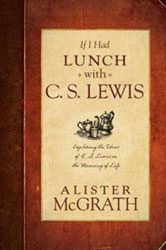 I’ll begin with a confession: I’ve never been able to “get into” C. S. Lewis.
As a child, the Narnia stories never held the magic for me that they did for my friends, and as an adult, despite committing myself to The Space Trilogy, The Screwtape Letters, Mere Christianity, and The Great Divorce, I just couldn’t connect. Where others found Lewis’s writing intimate and enlightening, I found it cool and formal. Being an English professor, writer, and Christian myself, this is really rather strange. C. S. Lewis and I seem to be a natural match. (It’s also a little embarrassing, something akin to being a huge basketball fan who thinks Michael Jordan was “just okay”). Needless to say, I’ve always had the sneaking suspicion that I was missing something important.
So it was with a deep sense of gratitude and renewed excitement that I turned the final page of theologian Alistair McGrath’s new book If I Had Lunch with C. S. Lewis. McGrath offered me a revitalized perspective on Lewis’s work: a big picture approach, one that reveals the larger themes and concerns of Lewis’s opus, highlighting his commitment to developing and examining our culture and the Christian worldview and always asking the tough questions, no matter where they might lead him. The sheer act of presenting Lewis in this way, as a humble man exploring the great quandaries of existence through various genres and styles of writing, a man who—having suffered great loss and trial in his own personal life (the deaths of both his mother and wife; service in the British Army during World War II; and experiencing a crisis of faith in which he rejected atheism for Christianity)—was writing perhaps out of necessity more than any other motive.
The book is divided into eight sections, each exploring Lewis’s thoughts on a different facet of the “meaning of life.” While each chapter offers a wealth of insight on topics as diverse and intriguing as faith, suffering, friendship, and apologetics, as a professional educator myself, the chapter on education struck me as especially powerful. Lewis’s primary work on education is The Abolition of Man. Written during World War II, Lewis was living in the midst of a world where mass destruction and Nazism had taken center stage, and, in wondering how humanity could have come to this point, Lewis pinpointed education as a central factor. He believed that education shapes worldviews and that a teacher’s work should be about far more than instructing students to master skills or preparing them for a job; instead, teachers should lead students to recognize objective truths and to distinguish between right and wrong. He felt that in this way education was failing its pupils: moral relativism was the ideology of the day, and Lewis, a teacher of English literature at Oxford and Cambridge, saw the propagation of this ideology as a challenge to the very functioning of society. This issue is no less relevant today than it was nearly a century ago. If anything, the removal of instruction in values from the classroom has progressed even further, and moral relativism is now firmly entrenched as the ideology of academia leaving Lewis’s advice perhaps even more pressing and relevant today. In particular, McGrath identifies three points Lewis makes regarding the ideal process and purpose of education:
1) Avoid chronological snobbery, or the notion that new ideas are inherently superior because they are new. Lewis encourages students to read old books as a way of revealing that “basic assumptions have been quite different in different periods” and that every age has always thought its own new ideas were the most right. Lewis encourages students as well to hold off on jumping on the latest intellectual, ideological, or cultural bandwagon in preference for applying a critical eye to its merits.
2) Expand your vision. Lewis believed education is a way to help us better understand the world and other people. Reading literature, for example, helps us “to see with other eyes, to imagine with other imaginations, to feel with other hearts” and is a way of “entering fully into the opinions, and therefore also the attitudes, feelings, and total experience” of others. By learning to view the world from different perspectives and inhabit different lives as we read, we can find the perspectives of value and adopt them as our own.
3) Go deeper. In particular for Christians, Lewis found education important for steering clear of what he perceived to be the negative influences of liberalism and modernism on the church. Lewis said we should allow our education to guide us towards what he called “Deep Church,” or church that is simultaneously “rooted in the past and engaged with the present.” We can do this by reading the works of great Christian writers (he suggests, for example, St. Augustine and Thomas Aquinas).
In light of McGrath’s work on Lewis in this volume, it strikes me how really rare the C. S. Lewis’s of the world are. Steeped in the secular culture of academia as I am, I find myself often bogged down by the “small questions”: the concerns of the latest academic publications or cutting edge research, the morning’s news updates or the week’s political drama, the latest dips in the economy and who said what in this or that journal or on this or that blog and how I should respond. But the big questions should hardly be limited to a Sunday-morning-sermon affair, and the refreshing release that comes with discovering an author who values such questions and upholds them as worthy may help us reconsider our approach to life entirely.
I recall a time when I was in elementary and even middle school where I used to lie in bed at night and think about the types of questions Lewis asks: what heaven might be like, why God allows suffering, how to possibly wrap my mind around concepts of eternity or evil or sin. But somewhere along the line, I stopped asking. Somewhere along the line, the things waking me up at night were smaller troubles: did I forget to send out an important email, will I need to get gas before work in the morning, should I go to the gym before or after my morning doctor’s appointment. But the reason these questions ceased to be asked was certainly not because the answers have been made clear; rather, it was because such questions—after a certain point in one’s life—are not often encouraged or at the forefront of cultural concerns. As Lewis makes abundantly clear though, this is a shame. In reality, what questions could possibly be more important?
McGrath has succeeded in If I Had Lunch With C. S. Lewis not primarily because he is able to encompass and clarify an abundance of material in only 229 short pages or because he has organized Lewis’s work and presented it in a way that is comprehensible and clear, but because he directs his readers back to Lewis himself. McGrath’s book is a road sign pointing his readership to the books of Lewis. I’m ready to return to the “L” section of my bookshelves. And this time, I think things are going to work out perfectly.
For more conversation on If I Had Lunch with Lewis, visit the Patheos Book Club here.
 Amber M. Stamper holds a Ph.D. in English (Rhetoric and Composition) and is an Assistant Professor of Language, Literature, and Communication at Elizabeth City State University in North Carolina. Her research and publications center on religious rhetoric and communication, especially issues of Christian evangelism and the digital church.
Previous Post
April 1, 2014
When Grace meets Maya: A Postmodern Tale
Next Post
April 14, 2014 In Search of the Real Jesus: A Q&A with Garrett Glass
Browse Our Archives
Select a Category Author Q&A Book Review Christian Living Church Leadership Stump a Scholar Theology Uncategorized
Select a Month June 2022 March 2021 October 2020 August 2020 February 2019 November 2017 July 2017 June 2017 May 2017 March 2017 February 2017 January 2017 November 2016 October 2016 August 2016 July 2016 June 2016 May 2016 April 2016 March 2016 February 2016 January 2016 November 2015 October 2015 September 2015 August 2015 July 2015 June 2015 May 2015 April 2015 March 2015 February 2015 January 2015 December 2014 November 2014 October 2014 September 2014 August 2014 July 2014 June 2014 May 2014 April 2014 March 2014 February 2014 January 2014 December 2013 November 2013 October 2013 September 2013 August 2013 July 2013 June 2013 May 2013 April 2013 March 2013 February 2013 January 2013 December 2012 November 2012 October 2012 September 2012 August 2012 July 2012 June 2012 May 2012 April 2012 March 2012 February 2012 January 2012 December 2011 November 2011 October 2011 September 2011 August 2011 July 2011 June 2011 May 2011 April 2011 March 2011 February 2011 January 2011 December 2010 November 2010 October 2010 September 2010 August 2010 July 2010 June 2010
Follow Us!
TAKE THE
Religious Wisdom Quiz
What teaching is behind Jesus washing his disciples' feet?
Select your answer to see how you score.
Never serve Seek power Rule over them Serve others
Related posts from Take and Read

Even the Faith Giants Didn’t Always Get it...

How the Church Can Heal the Race Divide

Finding Inspiration in "Where Angels Walk"

Happiness Is Found Outside of Our Comfort Zones
TRENDING AT PATHEOS Religious Music & Entertainment

"Les Diabolique" and Transgression
Alongside something like Arrival, Vertigo, or Charade, Les Diaboliques is a...

"The Plague Dogs" and Mortality
So, flashback to the late 70s, early 80s. Walt Disney Studios is...

With the recent and highly successful release of Christopher Nolan’s epic film,...

"L'avventura" and Human Weakness
Today's piece is going to be a little different for a few...

I first want to apologize for not posting or writing anything. I'm...

I've engaged in the multi-year project of reading through the Church Fathers,...
view all Religious Music & Entertainment blogs
Ad-Free & Subscriber Log-In Subscription Support
- About Us
- 2026 Calendar
- Videos
- Podcasts
- Library of World Religions
- Faith In Media Tracker
- Advertise With Us
- Write for Us
- Privacy Policy
- Terms of Service
- Do Not Sell My Data
- Contact Us
- Radiant Digital
- Manage Newsletter Subscriptions
- Unsubscribe From Notifications
- Sitemap
Copyright 2008-2026, Patheos. All rights reserved.
Subscription Support Ad-Free & Subscriber Log-In
Follow Patheos