
BuddhistCatholicContemplativeEvangelicalGeneral ChristianHinduJewishLatter-day SaintMuslimNew VisionsProgressive Christian
Beliefs
- Buddhist
- Catholic
- Contemplative
- Evangelical
- General Christian
- Hindu
- Jewish
- Latter-day Saint
- More Voices
- Muslim
- New Visions
- Pagan
- Progressive Christian
Topics
- Religion News
- Food and Religion
- Sports and Religion
- Religious Art
- Religious Music and Entertainment
- Religious Events
- History and Religion
- Style and Religion
- Politics and Religion
- Women in Religion
- Recreation Outdoors and Religion
- Business Finance and Religion
- Careers Workplace and Religion
- Education and Religion
- Family Parenting and Religion
- Health Fitness and Religion
- Home and Religion
- Relationships and Religion
- Technology and Religion
- Travel and Religion
Columnists
- Buddhist Columnists
- Business Finance and Religion Columnists
- Careers Workplace and Religion Columnists
- Catholic Columnists
- Contemplative Columnists
- Education and Religion Columnists
- Evangelists Columnists
- Family Parenting and Religion Columnists
- General Christian Columnists
- Health Fitness and Religion Columnists
- Hindu Columnists
- History and Religion Columnists
- Home and Religion Columnists
- Jewish Columnists
- More Voices Columnists
- Latter Day Columnists
- Muslim Columnists
- New Visions Columnists
- Nonreligious Columnists
- Pagan Columnists
- Politics and Religion Columnists
- Progressive Columnists
- Recreation Outdoors and Religion Columnists
- Relationships and Religion Columnists
- Religion News Columnists
- Religious Art Columnists
- Religious Events Columnists
- Religious Music and Entertainment Columnists
- Sports and Religion Columnists
- Style and Religion Columnists
- Technology and Religion Columnists
- Travel and Religion Columnists
- Women in Religion Columnists
Resource Library
- 2026 Calendar
- Library of World Religions
- The 100 Most Holy Places on Earth
- Patheos Answers
- Podcasts
- Videos
- Faith Leaders Database
- Anglican Episcopalian
- Bahai
- Baptist
- Buddhism
- Christianity
- Confucianism
- Eastern Orthodoxy
- Hinduism
- Holiness and Pentecostal
- ISKCON
- Islam
- Judaism
- Lutheran
- Methodist
- The Church of Jesus Christ of Latter-day Saints
- New Age
- Paganism
- Presbytarian and Reformed
- Protestantism
- Religion Behind the Scenes
- Roman Catholic
- Scientology
- Shia Islam
- Sikhism
- Sufism
- Sunni Islam
- Taoism
- Zen
- See all religions
Research Tools
 Ad-Free & Subscriber Log-In Subscription Support
Ad-Free & Subscriber Log-In Subscription Support
Follow Patheos 

- Trending:
- Forgiveness
- |
- Marriage
- |
- Consciousness
- |
- Death Penalty
- |
- Election
- |
- Halloween

- Home
- Religious Music & Entertainment
- C. S. Lewis on Education
C. S. Lewis on Education
Last updated on: April 14, 2014 at 1:54 pm by David Swartz
C. S. Lewis on Education 2014-04-14T13:54:39-06:00 David Swartz
Patheos Explore the world's faith through different perspectives on religion and spirituality! Patheos has the views of the prevalent religions and spiritualities of the world.
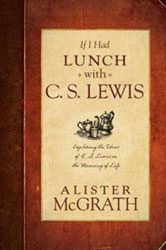 Alister McGrath’s new book If I Had Lunch With C.S. Lewis walks the reader through imaginary sittings with Lewis where he would mentor his listeners through major life issues and questions. One of those life issues is hidden in plain sight.
We’re so used to seeing Lewis as a Christian apologist and storyteller that we forget that he was a professor – at both Oxford and Cambridge. And Lewis had much to say about the importance of what he did, about education. Above all else, an education made better people. He had no time for learning that amounted to nothing more than warehousing information. Learning invariably involved ideas, ideas pressed one into thinking and thinking built, shaped and changed lives. Education that fell short of this produced “men without chests”, people incompetent to engage reality, to know right from wrong, the good from the bad.
He would be a tough nut in modern conversations on education where almost all the talk centers around what kind of a job one can find after graduation. Lewis might counter that anyone who saw their education only as a means to a job wouldn’t be worth hiring. He has a point. For Lewis, learning to think at least equaled the pragmatic acquisition of skills. (Learning to read well is crucially important.) We learn to love the good, hate the bad and, most importantly, how to know the difference. Learning should help us become both good and wise in all things. Lewis’ slant still exists in American education but it fades the farther along in the process we go. I was invited to give the invocation and benediction at my daughter’s graduation from a state university. I prayed that this newly minted education would eventually ripen into wisdom and observed that these two things do not always show up in the same person. An audible buzz rippled through the faculty section right behind me and a dean, beside me in the recessional, remarked that she hoped others besides God were listening.
Lewis would challenge the idea that “new is always better.” Much of what is current, hot and pressing now will fade within months; the nattering of experts, pundits and gurus may prove to be nothing more than fading novelty. The old is held in contempt or disregarded merely because it’s old. We lived in a town with four extensive theological libraries and I occasionally found myself awash in book sales. Standing alongside the students rummaging together through piles of books, I knew I would always find some good deals because students were busy snatching up the new and relevant stuff bypassing classics and works of depth that not only had shaped the past but still could breathe fire into the present and future. When I would suggest they might benefit more by this or that title in print longer than they’d been alive, they would sniff at it, smile politely and move on. But in doing this, Lewis was no crank ranting about how it was better ‘back in my day.” He would also point out that some old ideas need to be left behind, the sooner the better in some cases. McGrath uses eugenics (genetic manipulation though controlling who reproduces) as an example so effectively here that his description instantly brings others to the reader’s mind. What Lewis wants us to become is critical so we will not remain gullible.
Lewis also wants to deliver us from the conceit that our own ideas are always the best. (And they are, aren’t they?) Every age, every culture, every group assumes that its ideas are the best, superior to everything that came before. He calls it “chronological snobbery”. We basically act like God is only speaking when our mouth is open. The Internet has blown this to pandemic proportions. People think their opinions are important merely because they have them. But even without the Internet, history bristles with many examples of academic, ecclesiastical, political, racial or ethnic and nationalistic hubris of thought that warp even our best moments.
McGrath cites one Oxford don who dismissed another with “On the surface, he’s profound, but deep down, he’s superficial.” Lewis had no time for any pretender to the Christian faith that didn’t relish thinking. A Bible study I know of has a beautician, a nurse, a retired mill worker, an auto designer, an accountant, a school teacher, a seller of industrial electrical supplies and the manager of the frozen foods department of a super market. It crackles with life. Ideas spark off each other. They always run over because they lose track of time. Theology varies but it’s always served up hot. They’re readers and more than a few theologians might find themselves pushed inside this group. They enjoy thinking; it feeds something down inside that produces the faith that has drawn so many to Lewis. This is what learning at any level was for as far as C.S. Lewis was concerned. Working the muscles of thought has certainly been one of the richest satisfactions of my faith born in the Jesus Movement when Lewis’ influence was strong then also.
If I Had Lunch With C.S. Lewis catches him at his best in ways other books about him do not. And not many savored what happened when even the humblest mind began to breathe and flesh out the image of God like C. S. Lewis did.
Read reflections on other chapters from If I Had Lunch with C. S. Lewis at the Patheos Book Club here.
David Swartz pastors Bethel Baptist Church in Roseville, Michigan. He thinks that jazz is sacred music, that books are better company than most people, and that university towns rock. He blogs at geezeronthequad.com.
Previous Post

April 14, 2014
In Search of the Real Jesus: A Q&A with Garrett Glass
Next Post

April 15, 2014 Easter Down Under
Recent Comments
Browse Our Archives
Select a Category Author Q&A Book Review Christian Living Church Leadership Stump a Scholar Theology Uncategorized
Select a Month June 2022 March 2021 October 2020 August 2020 February 2019 November 2017 July 2017 June 2017 May 2017 March 2017 February 2017 January 2017 November 2016 October 2016 August 2016 July 2016 June 2016 May 2016 April 2016 March 2016 February 2016 January 2016 November 2015 October 2015 September 2015 August 2015 July 2015 June 2015 May 2015 April 2015 March 2015 February 2015 January 2015 December 2014 November 2014 October 2014 September 2014 August 2014 July 2014 June 2014 May 2014 April 2014 March 2014 February 2014 January 2014 December 2013 November 2013 October 2013 September 2013 August 2013 July 2013 June 2013 May 2013 April 2013 March 2013 February 2013 January 2013 December 2012 November 2012 October 2012 September 2012 August 2012 July 2012 June 2012 May 2012 April 2012 March 2012 February 2012 January 2012 December 2011 November 2011 October 2011 September 2011 August 2011 July 2011 June 2011 May 2011 April 2011 March 2011 February 2011 January 2011 December 2010 November 2010 October 2010 September 2010 August 2010 July 2010 June 2010
Follow Us!
TAKE THE
Religious Wisdom Quiz
Though commanded to prophesy, I could not speak or warn the people until God opened my mouth. What affliction kept me silent?
Select your answer to see how you score.
Fear Paralysis A disease Muteness
Related posts from Take and Read

Even the Faith Giants Didn’t Always Get it...

How the Church Can Heal the Race Divide

Finding Inspiration in "Where Angels Walk"

Happiness Is Found Outside of Our Comfort Zones
TRENDING AT PATHEOS Religious Music & Entertainment

"Les Diabolique" and Transgression
Alongside something like Arrival, Vertigo, or Charade, Les Diaboliques is a...

"The Plague Dogs" and Mortality
So, flashback to the late 70s, early 80s. Walt Disney Studios is...

With the recent and highly successful release of Christopher Nolan’s epic film,...

"L'avventura" and Human Weakness
Today's piece is going to be a little different for a few...

I first want to apologize for not posting or writing anything. I'm...

I've engaged in the multi-year project of reading through the Church Fathers,...
view all Religious Music & Entertainment blogs
Ad-Free & Subscriber Log-In Subscription Support
- About Us
- 2026 Calendar
- Videos
- Podcasts
- Library of World Religions
- Faith In Media Tracker
- Advertise With Us
- Write for Us
- Privacy Policy
- Terms of Service
- Do Not Sell My Data
- Contact Us
- Radiant Digital
- Manage Newsletter Subscriptions
- Unsubscribe From Notifications
- Sitemap
Copyright 2008-2026, Patheos. All rights reserved.
Subscription Support Ad-Free & Subscriber Log-In
Follow Patheos