
BuddhistCatholicContemplativeEvangelicalGeneral ChristianHinduJewishLatter-day SaintMuslimNew VisionsProgressive Christian
Beliefs
- Buddhist
- Catholic
- Contemplative
- Evangelical
- General Christian
- Hindu
- Jewish
- Latter-day Saint
- More Voices
- Muslim
- New Visions
- Pagan
- Progressive Christian
Topics
- Religion News
- Food and Religion
- Sports and Religion
- Religious Art
- Religious Music and Entertainment
- Religious Events
- History and Religion
- Style and Religion
- Politics and Religion
- Women in Religion
- Recreation Outdoors and Religion
- Business Finance and Religion
- Careers Workplace and Religion
- Education and Religion
- Family Parenting and Religion
- Health Fitness and Religion
- Home and Religion
- Relationships and Religion
- Technology and Religion
- Travel and Religion
Columnists
- Buddhist Columnists
- Business Finance and Religion Columnists
- Careers Workplace and Religion Columnists
- Catholic Columnists
- Contemplative Columnists
- Education and Religion Columnists
- Evangelists Columnists
- Family Parenting and Religion Columnists
- General Christian Columnists
- Health Fitness and Religion Columnists
- Hindu Columnists
- History and Religion Columnists
- Home and Religion Columnists
- Jewish Columnists
- More Voices Columnists
- Latter Day Columnists
- Muslim Columnists
- New Visions Columnists
- Nonreligious Columnists
- Pagan Columnists
- Politics and Religion Columnists
- Progressive Columnists
- Recreation Outdoors and Religion Columnists
- Relationships and Religion Columnists
- Religion News Columnists
- Religious Art Columnists
- Religious Events Columnists
- Religious Music and Entertainment Columnists
- Sports and Religion Columnists
- Style and Religion Columnists
- Technology and Religion Columnists
- Travel and Religion Columnists
- Women in Religion Columnists
Resource Library
- 2026 Calendar
- Library of World Religions
- The 100 Most Holy Places on Earth
- Patheos Answers
- Podcasts
- Videos
- Faith Leaders Database
- Anglican Episcopalian
- Bahai
- Baptist
- Buddhism
- Christianity
- Confucianism
- Eastern Orthodoxy
- Hinduism
- Holiness and Pentecostal
- ISKCON
- Islam
- Judaism
- Lutheran
- Methodist
- The Church of Jesus Christ of Latter-day Saints
- New Age
- Paganism
- Presbytarian and Reformed
- Protestantism
- Religion Behind the Scenes
- Roman Catholic
- Scientology
- Shia Islam
- Sikhism
- Sufism
- Sunni Islam
- Taoism
- Zen
- See all religions
Research Tools
 Ad-Free & Subscriber Log-In Subscription Support
Ad-Free & Subscriber Log-In Subscription Support
Follow Patheos 

- Trending:
- Forgiveness
- |
- Marriage
- |
- Consciousness
- |
- Death Penalty
- |
- Election
- |
- Halloween

- Home
- Religious Music & Entertainment
- On Discipleship and Christian Maturity: A Q&A with Ronald Rolheiser
On Discipleship and Christian Maturity: A Q&A with Ronald Rolheiser
Last updated on: March 27, 2014 at 12:50 pm by Guest Contributor
On Discipleship and Christian Maturity: A Q&A with Ronald Rolheiser 2014-03-27T12:50:09-06:00 Guest Contributor
Patheos Explore the world's faith through different perspectives on religion and spirituality! Patheos has the views of the prevalent religions and spiritualities of the world.
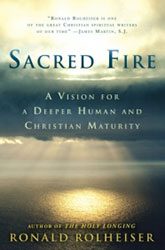 Sacred Fire: A Vision for a Deeper Human and Christian Maturity, by popular Catholic author Ronald Rolheiser, is currently featured at the Patheos Book Club. We invited Fr. Rolheiser to share some thoughts about the new book – and the meaning of Christian discipleship – here.
Sacred Fire is the sequel to your best-selling contemporary classic, The Holy Longing, which was published 15 years ago. Did you always intend to write a sequel? Why now?
Yes, I always intended a sequel to The Holy Longing. The last chapter of the book suggests that a spirituality should follow from the principles of THE HOLY LONGING and, in caption, gives some of that spirituality. SACRED FIRE tries to lay out that spirituality in some detail and, importantly too, show where it fits into the overall paradigm of the spiritual life.
Why now? I needed time to research, teach, and mature the ideas for a SACRED FIRE. As well, given that I have a full time, and very time-demanding job, I needed to have some Sabbatical time within which to write SACRED FIRE. I got that time in 2012-2013 and, hence, SACRED FIRE. That’s its origins and its timing.
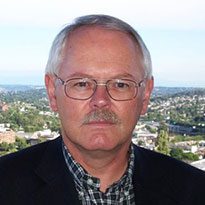 In Sacred Fire, you talk about three stages of discipleship — essential, mature, and radical. How does one identify his/her current stage of discipleship and what are some of the challenges of moving from one stage to the next?
In terms of identifying one’s own current stage in the journey, there are real dangers in self-diagnosis. One is best to do this with the help of a spiritual mentor. However, that being said, the movement between “essential” and “mature” is somewhat easier to determine, i.e., basically it is a question of “Am I living for others or am I living for myself?” Or, in another criterion: Is my biggest concern: “How will this turn out for me?” Or, “How can I be helpful here?”
What are the challenges in moving from one state to the next?
In moving from “essential” to “mature” the major challenge is to awake from the long sleep of adolescence, namely, to channel our energies (all of them, not least our sexuality) in a way that they are life-giving for others (and of course too for ourselves). But this is hard in our culture because so much within our culture invites us and tempts us never to grow up, to always be the adolescent.
In moving from “mature” to “radical” the challenge is to “let go”, to let go of virtually everything we have accumulated in our lives so that when we finally have to die we can die without clinging, without bitterness, without anger, and without despair. As the last chapter of SACRED FIRE suggests, we have to be willing to make our death our final act of giving. But, of course, this is very, very difficult, everything within our natural instincts resists. Life wants always to preserve itself. Nobody, unless he or she is clinically depressed, wants to die. This earth, for all its shortcomings, is the only life we know.
The primary focus of Sacred Fire is on the second stage, mature discipleship, which coincides with the struggle to give our lives away. What do you think is the most challenging aspect of mature discipleship? What is the most rewarding?
What is most challenging? Accepting and living out the fact that our lives are not our own, but that we belong to community and to a reality larger than ourselves. This is what older cultures used to try to teach in their initiation rites. Since, in our culture, we do not really have any deep, meaningful initiation rites (to turn a girl into a woman and a boy into a man) we end up, mostly, having to “self-initiate” and that can take a long time and have a lot of painful false starts, false turns, and setbacks. Sometimes too we simply don’t make it. The thousands of young people who die every year from drugs and senseless accidents are mostly young people trying to “self-initiate”. Within “mature” discipleship itself one of the biggest challenges is simply to sustain enthusiasm and energy through the many years of giving. John of the Cross, for example, said that during out “mature” years the biggest challenge in sustaining our prayer lives is flat-out boredom. It is not easy to sustain good will, energy, and selflessness for 60-70 years.
What is most rewarding? Mature living is its own reward! Living for others brings us joys that dwarf the pleasures of our adolescent years. Just ask a young mother how the joy of being a mother rates in relationship to the partying she did in adolescent years. Goodness brings its own reward. It’s like some of those ads inviting us to keep slim that say: “Nothing feels as good as being this healthy!” Well, nothing feels as good as being unselfish and giving life for others.
In Sacred Fire, you write, “God does not meet us in the abstract but in our real lives.” What can we do to ensure that we are ready to accept God’s invitations to us in our daily lives?
All we can do is to live honestly – and our honesty will leave us open, as open as a loving womb waiting to receive God’s seed.
What do you hope readers get out of this book?
I nurse a double hope here:
1. That readers will sense in this book a “palatable” invitation to move from being good people to being greater people.
2. That SACRED FIRE, in the places where it talks about the stages of the spiritual journey, will give readers a structure within which to see and understand the stages of both the human and the spiritual journey.
Your book The Holy Longing has more than a quarter of a million copies in print. On March 11, 2014 it became available for the first time in paperback. What is it about The Holy Longing that gives it such timeless appeal? What do you hope new readers will take away from it?
I wrote HOLY LONGING in response to an invitation from the then Religious Editor at Image Books, Eric Major. He asked me to write a book that … in his words … He could give to his own adult-children and friends to explain to them why he still believed in God and Jesus and why he still went to church – and that he could read himself on days when he wasn’t sure why. So the intent of HOLY LONGING was quite fundamental, basic, i.e., to give a contemporary apologetics of sorts. Eric Major’s hunch was right. The book found a huge market, not just among Roman Catholics, but within every kind of Christian church. There is a hunger, almost universal, today for this kind of book which speaks about God, Christ, faith, and the spiritual journey in a language that is faithful to the tradition but is not the normal, overt church language. Among other things, too, HOLY LONGING has become popular textbook for undergraduate theology classes in many schools and universities.
The Holy Longing is used extensively in RCIA and Faith Formation programs around the country; do you think Sacred Fire could also be used in this capacity?
Yes, that is my hope. It will take people to the next step beyond the fundamentals, but it still builds upon the fundamentals. It is the first “graduate” course after HOLY LONGING (which might be entitled, SPIRITUALITY 101).
Read an excerpt – and more – from Sacred Fire at the Patheos Book Club here.
Previous Post
March 24, 2014
Between Heaven and Earth: A Review
Next Post

March 30, 2014 How to Survive Life (and Death): A Q&A with Robert Kopecky
Browse Our Archives
Select a Category Author Q&A Book Review Christian Living Church Leadership Stump a Scholar Theology Uncategorized
Select a Month June 2022 March 2021 October 2020 August 2020 February 2019 November 2017 July 2017 June 2017 May 2017 March 2017 February 2017 January 2017 November 2016 October 2016 August 2016 July 2016 June 2016 May 2016 April 2016 March 2016 February 2016 January 2016 November 2015 October 2015 September 2015 August 2015 July 2015 June 2015 May 2015 April 2015 March 2015 February 2015 January 2015 December 2014 November 2014 October 2014 September 2014 August 2014 July 2014 June 2014 May 2014 April 2014 March 2014 February 2014 January 2014 December 2013 November 2013 October 2013 September 2013 August 2013 July 2013 June 2013 May 2013 April 2013 March 2013 February 2013 January 2013 December 2012 November 2012 October 2012 September 2012 August 2012 July 2012 June 2012 May 2012 April 2012 March 2012 February 2012 January 2012 December 2011 November 2011 October 2011 September 2011 August 2011 July 2011 June 2011 May 2011 April 2011 March 2011 February 2011 January 2011 December 2010 November 2010 October 2010 September 2010 August 2010 July 2010 June 2010
Follow Us!
TAKE THE
Religious Wisdom Quiz
Which Christian group is known for speaking in tongues?
Select your answer to see how you score.
Catholic Methodist Pentecostal Baptist
Related posts from Take and Read

Even the Faith Giants Didn’t Always Get it...

How the Church Can Heal the Race Divide

Finding Inspiration in "Where Angels Walk"

Happiness Is Found Outside of Our Comfort Zones
TRENDING AT PATHEOS Religious Music & Entertainment

"Les Diabolique" and Transgression
Alongside something like Arrival, Vertigo, or Charade, Les Diaboliques is a...

"The Plague Dogs" and Mortality
So, flashback to the late 70s, early 80s. Walt Disney Studios is...

With the recent and highly successful release of Christopher Nolan’s epic film,...

"L'avventura" and Human Weakness
Today's piece is going to be a little different for a few...

I first want to apologize for not posting or writing anything. I'm...

I've engaged in the multi-year project of reading through the Church Fathers,...
view all Religious Music & Entertainment blogs
Ad-Free & Subscriber Log-In Subscription Support
- About Us
- 2026 Calendar
- Videos
- Podcasts
- Library of World Religions
- Faith In Media Tracker
- Advertise With Us
- Write for Us
- Privacy Policy
- Terms of Service
- Do Not Sell My Data
- Contact Us
- Radiant Digital
- Manage Newsletter Subscriptions
- Unsubscribe From Notifications
- Sitemap
Copyright 2008-2026, Patheos. All rights reserved.
Subscription Support Ad-Free & Subscriber Log-In
Follow Patheos