
BuddhistCatholicContemplativeEvangelicalGeneral ChristianHinduJewishLatter-day SaintMuslimNew VisionsProgressive Christian
Beliefs
- Buddhist
- Catholic
- Contemplative
- Evangelical
- General Christian
- Hindu
- Jewish
- Latter-day Saint
- More Voices
- Muslim
- New Visions
- Pagan
- Progressive Christian
Topics
- Religion News
- Food and Religion
- Sports and Religion
- Religious Art
- Religious Music and Entertainment
- Religious Events
- History and Religion
- Style and Religion
- Politics and Religion
- Women in Religion
- Recreation Outdoors and Religion
- Business Finance and Religion
- Careers Workplace and Religion
- Education and Religion
- Family Parenting and Religion
- Health Fitness and Religion
- Home and Religion
- Relationships and Religion
- Technology and Religion
- Travel and Religion
Columnists
- Buddhist Columnists
- Business Finance and Religion Columnists
- Careers Workplace and Religion Columnists
- Catholic Columnists
- Contemplative Columnists
- Education and Religion Columnists
- Evangelists Columnists
- Family Parenting and Religion Columnists
- General Christian Columnists
- Health Fitness and Religion Columnists
- Hindu Columnists
- History and Religion Columnists
- Home and Religion Columnists
- Jewish Columnists
- More Voices Columnists
- Latter Day Columnists
- Muslim Columnists
- New Visions Columnists
- Nonreligious Columnists
- Pagan Columnists
- Politics and Religion Columnists
- Progressive Columnists
- Recreation Outdoors and Religion Columnists
- Relationships and Religion Columnists
- Religion News Columnists
- Religious Art Columnists
- Religious Events Columnists
- Religious Music and Entertainment Columnists
- Sports and Religion Columnists
- Style and Religion Columnists
- Technology and Religion Columnists
- Travel and Religion Columnists
- Women in Religion Columnists
Resource Library
- 2026 Calendar
- Library of World Religions
- The 100 Most Holy Places on Earth
- Patheos Answers
- Podcasts
- Videos
- Faith Leaders Database
- Anglican Episcopalian
- Bahai
- Baptist
- Buddhism
- Christianity
- Confucianism
- Eastern Orthodoxy
- Hinduism
- Holiness and Pentecostal
- ISKCON
- Islam
- Judaism
- Lutheran
- Methodist
- The Church of Jesus Christ of Latter-day Saints
- New Age
- Paganism
- Presbytarian and Reformed
- Protestantism
- Religion Behind the Scenes
- Roman Catholic
- Scientology
- Shia Islam
- Sikhism
- Sufism
- Sunni Islam
- Taoism
- Zen
- See all religions
Research Tools
 Ad-Free & Subscriber Log-In Subscription Support
Ad-Free & Subscriber Log-In Subscription Support
Follow Patheos 

- Trending:
- Forgiveness
- |
- Marriage
- |
- Consciousness
- |
- Death Penalty
- |
- Election
- |
- Halloween

- Home
- Religious Music & Entertainment
- Gravity: Technology and Transcendence
Gravity: Technology and Transcendence
Last updated on: February 13, 2014 at 12:50 pm by Guest Contributor
Gravity: Technology and Transcendence 2014-02-13T12:50:47-07:00 Guest Contributor
Patheos Explore the world's faith through different perspectives on religion and spirituality! Patheos has the views of the prevalent religions and spiritualities of the world.
 By Lyn and Tom Davis Genelli
Authors, Death At The Movies
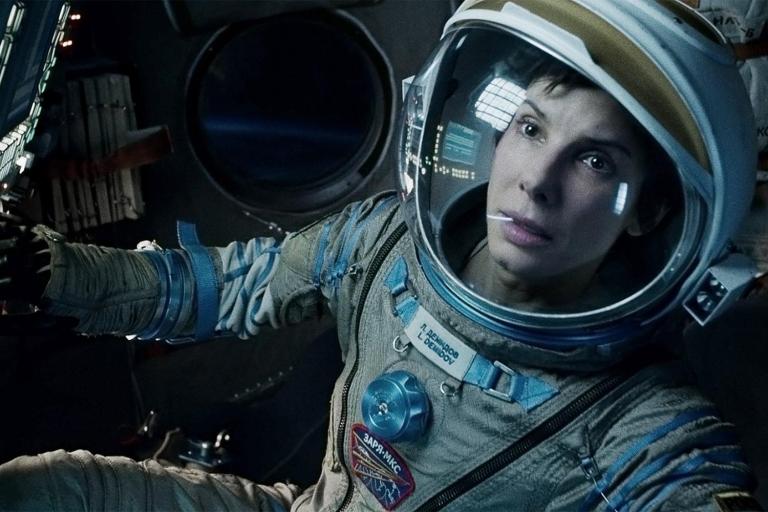
Alfonso Cuaron’s 3-D space opera Gravity, a leading Oscar contender, met with universal acclaim from critics and audiences alike. Nominations include Best Picture, Director, Actress and Original Score. Alongside such enduring favorites as Groundhog Day and The Wizard of Oz, the film explores perennial themes of death, rebirth and the transition between the two — a film destined to join the list of classic transit movies. As the Venerable Chogyam Trungpa Rinpoche pointed out many years ago, transit, or bardo states are occurring all the time, even between any two breaths. Transit states occur when we have come to the end of a relationship, a job, a belief system, a self-identity — not only after physical death. In the transit state, we feel lost, bewildered, often terrified, unable to find our footing in anything that feels secure. It begins to dawn on us that we can never return to the shore we’ve left behind, but the new land is not in sight. We are adrift in the pathless space of consciousness.
Fortunately we are with Matt Kowalski (George Clooney), the space mission’s Commander and seasoned astronaut, floating around the space capsule making routine observations and repairs. Matt is a really human guy inside his space suit, playing country songs, telling shaggy-dog stories, managing to entertain and reassure everybody, both in space and back at mission control. His Medical Engineer and Mission Specialist, Ryan Stone (Sandra Bullock) is, on the other hand, not having fun. Even the wonder of space doesn’t move her. She’s just doing her job, like a human computer. Matt, however, is having none of that. He draws her out and discovers that she is alone in the world, having lost her beloved daughter to a random accident one afternoon at daycare. We see that she has, in a real sense died to her heart and soul. Back on earth, she confesses, all she does is drive endlessly in a state of numbness. We recognize in her a being in transit, no longer connected to life, lost in the bardo of grief, an underworld journey occurring in the emptiness of space.
Very quickly things go horribly wrong. A shower of space debris wrecks the space capsule. Matt and Ryan are the only survivors. We see her tumbling through space, gasping for breath, lost in terror. This is an after world of a dreadful sort, lost in empty and endless space — one that evokes our deepest fears. However, like many of the transit heroes in our book Death at the Movies, Ryan is blessed with a bardo guide, like Whoopi Goldberg’s Oda Mae Brown in Ghost, Louie the chiropractor in Jacob’s Ladder, or Clarence, Angel Second Class in It’s a Wonderful Life. In transit movies, angels or guides seldom come in winged form. For Ryan, he comes wrapped in a space suit and talking like George Clooney. With unfailing competence and cheer, he tells her exactly what she must do in order to survive: first of all, slow down her breath (almost always an excellent idea) to make her oxygen last. Then get to a nearby Soyuz capsule and ride that home. It doesn’t take long for Matt to realize that he won’t be able to save himself, that indeed his destiny (his dharma, as Buddhists might say) is to move toward death in a state of awe and even bliss, seeing the sun rise over the Ganges. He has done all he can. His life is complete.
In order to survive, to complete her transit and be reborn, Ryan must face the grief of her life, the loss of her child. Without facing that loss, saying goodbye, she cannot possibly mobilize the complete human response that she needs to save herself. She needs every bit of herself to meet this moment, especially her whole heart. At the crucial moment, Matt the angel reappears magically inside the Soyuz capsule. He tells her, with enormous compassion and no pity, that indeed a terrible thing has happened to her, and now she must choose. In the face of human life in which the only certainty is loss, will she nevertheless say yes to that life and its unyielding terms? Nothing less than total commitment can be enough. She says goodbye to Matt and to her daughter, her heart now open to all the beauty, fear and pain of life. Moving from immobilized terror to radiant acceptance she acknowledges that she’s done all she can to save herself, followed all the instructions as best she can, and now she’s ready for whatever comes — that whatever it is, it’ll be one helluva ride!
And a helluva ride it is, plunging into earth’s waters, nearly drowning in her burdensome space suit, freeing herself, and swimming up to the surface, born again, in the same body but a transformed spirit, now accepting and even glorying in the weight, the gravity of human life on this bluegreen planet, this land of opportunity.
 Tom Genelli, who holds a Ph.D. in psychology, has worked as an ABC film collection librarian, film producer/director and as an instructor in film production in addition to his main career as a psychotherapist.
Lyn Genelli, a licensed marriage and family therapist, is the director of the Bay Area Institute for Integrative Body Psychotherapy. The Genellis have written and published articles dealing with the cross-fertilization of film and psychology and have also worked as broadcast film critics for the local City Arts Monthly, a popular arts magazine in the Bay Area.
Previous Post
January 31, 2014
Death at the Movies: A Q&A with Lyn and Tom Davis Genelli
Next Post

February 14, 2014 Freestyle: A Q&A with the Rev. Michael Waters
Recent Comments
2,646 Comments | Leave a Comment
Browse Our Archives
Select a Category Author Q&A Book Review Christian Living Church Leadership Stump a Scholar Theology Uncategorized
Select a Month June 2022 March 2021 October 2020 August 2020 February 2019 November 2017 July 2017 June 2017 May 2017 March 2017 February 2017 January 2017 November 2016 October 2016 August 2016 July 2016 June 2016 May 2016 April 2016 March 2016 February 2016 January 2016 November 2015 October 2015 September 2015 August 2015 July 2015 June 2015 May 2015 April 2015 March 2015 February 2015 January 2015 December 2014 November 2014 October 2014 September 2014 August 2014 July 2014 June 2014 May 2014 April 2014 March 2014 February 2014 January 2014 December 2013 November 2013 October 2013 September 2013 August 2013 July 2013 June 2013 May 2013 April 2013 March 2013 February 2013 January 2013 December 2012 November 2012 October 2012 September 2012 August 2012 July 2012 June 2012 May 2012 April 2012 March 2012 February 2012 January 2012 December 2011 November 2011 October 2011 September 2011 August 2011 July 2011 June 2011 May 2011 April 2011 March 2011 February 2011 January 2011 December 2010 November 2010 October 2010 September 2010 August 2010 July 2010 June 2010
Follow Us!
TAKE THE
Religious Wisdom Quiz
I was only seven years old when I became king and reigned for forty years in Jerusalem. Who am I?
Select your answer to see how you score.
Manasseh Josiah Joash (or Jehoash) Hezekiah
Related posts from Take and Read

"Movies Are Prayers": A New Way of Discussing...

Us Versus Us: A Q&A with Author Andrew...

Tasting God: A Q&A with Ginny Kubitz Moyer
40 Days of Decrease: A Different Kind of...
TRENDING AT PATHEOS Religious Music & Entertainment

"Les Diabolique" and Transgression
Alongside something like Arrival, Vertigo, or Charade, Les Diaboliques is a...

"The Plague Dogs" and Mortality
So, flashback to the late 70s, early 80s. Walt Disney Studios is...

With the recent and highly successful release of Christopher Nolan’s epic film,...

"L'avventura" and Human Weakness
Today's piece is going to be a little different for a few...

I first want to apologize for not posting or writing anything. I'm...

I've engaged in the multi-year project of reading through the Church Fathers,...
view all Religious Music & Entertainment blogs
Ad-Free & Subscriber Log-In Subscription Support
- About Us
- 2026 Calendar
- Videos
- Podcasts
- Library of World Religions
- Faith In Media Tracker
- Advertise With Us
- Write for Us
- Privacy Policy
- Terms of Service
- Do Not Sell My Data
- Contact Us
- Radiant Digital
- Manage Newsletter Subscriptions
- Unsubscribe From Notifications
- Sitemap
Copyright 2008-2026, Patheos. All rights reserved.
Subscription Support Ad-Free & Subscriber Log-In
Follow Patheos