
BuddhistCatholicContemplativeEvangelicalGeneral ChristianHinduJewishLatter-day SaintMuslimNew VisionsProgressive Christian
Beliefs
- Buddhist
- Catholic
- Contemplative
- Evangelical
- General Christian
- Hindu
- Jewish
- Latter-day Saint
- More Voices
- Muslim
- New Visions
- Pagan
- Progressive Christian
Topics
- Religion News
- Food and Religion
- Sports and Religion
- Religious Art
- Religious Music and Entertainment
- Religious Events
- History and Religion
- Style and Religion
- Politics and Religion
- Women in Religion
- Recreation Outdoors and Religion
- Business Finance and Religion
- Careers Workplace and Religion
- Education and Religion
- Family Parenting and Religion
- Health Fitness and Religion
- Home and Religion
- Relationships and Religion
- Technology and Religion
- Travel and Religion
Columnists
- Buddhist Columnists
- Business Finance and Religion Columnists
- Careers Workplace and Religion Columnists
- Catholic Columnists
- Contemplative Columnists
- Education and Religion Columnists
- Evangelists Columnists
- Family Parenting and Religion Columnists
- General Christian Columnists
- Health Fitness and Religion Columnists
- Hindu Columnists
- History and Religion Columnists
- Home and Religion Columnists
- Jewish Columnists
- More Voices Columnists
- Latter Day Columnists
- Muslim Columnists
- New Visions Columnists
- Nonreligious Columnists
- Pagan Columnists
- Politics and Religion Columnists
- Progressive Columnists
- Recreation Outdoors and Religion Columnists
- Relationships and Religion Columnists
- Religion News Columnists
- Religious Art Columnists
- Religious Events Columnists
- Religious Music and Entertainment Columnists
- Sports and Religion Columnists
- Style and Religion Columnists
- Technology and Religion Columnists
- Travel and Religion Columnists
- Women in Religion Columnists
Resource Library
- 2026 Calendar
- Library of World Religions
- The 100 Most Holy Places on Earth
- Patheos Answers
- Podcasts
- Videos
- Faith Leaders Database
- Anglican Episcopalian
- Bahai
- Baptist
- Buddhism
- Christianity
- Confucianism
- Eastern Orthodoxy
- Hinduism
- Holiness and Pentecostal
- ISKCON
- Islam
- Judaism
- Lutheran
- Methodist
- The Church of Jesus Christ of Latter-day Saints
- New Age
- Paganism
- Presbytarian and Reformed
- Protestantism
- Religion Behind the Scenes
- Roman Catholic
- Scientology
- Shia Islam
- Sikhism
- Sufism
- Sunni Islam
- Taoism
- Zen
- See all religions
Research Tools
 Ad-Free & Subscriber Log-In Subscription Support
Ad-Free & Subscriber Log-In Subscription Support
Follow Patheos 

- Trending:
- Forgiveness
- |
- Marriage
- |
- Consciousness
- |
- Death Penalty
- |
- Election
- |
- Halloween

- Home
- Religious Music & Entertainment
- Birmingham Revolution: A Book Review
Birmingham Revolution: A Book Review
Last updated on: February 17, 2014 at 11:21 am by Amber Stamper
Birmingham Revolution: A Book Review 2014-02-17T11:21:27-07:00 Amber Stamper
Patheos Explore the world's faith through different perspectives on religion and spirituality! Patheos has the views of the prevalent religions and spiritualities of the world.
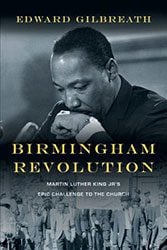 Edward Gilbreath’s phenomenal new book Birmingham Revolution: Martin Luther King Jr.’s Epic Challenge to the Church is proof that we will likely never cease to uncover new levels of appreciation for or new revelations in regards to the incredible life and ministry of Dr. King. Taking a focused look at King’s campaign for civil rights in Birmingham, Gilbreath uses this moment to both discuss the role King’s faith played in his campaign for racial equality and to challenge today’s church to consider how we might continue to learn from and, more importantly, act on, King’s legacy.
Gilbreath makes a strong case that a deeper, more thoroughly nuanced and researched, historically contextualized, and complex understanding of King is desperately needed today. He cites historian Tim Tyson’s concern that King has been transformed into “a kind of innocuous black Santa Claus, genial and vacant, a benign vessel that can be filled with whatever generic good wishes the occasion dictates” and expresses frustration that
“In various ways, King has been sanitized, domesticated or simply forgotten. The real Baptist churchman and fighter for social justice has been reduced to the fatherly saint who ‘had a dream.’ Conservatives who once reviled him now claim him as one of their own (at least when it comes to select issues). Liberals who once failed to fully grasp his significance now treat him as their modern standard-bearer while ignoring his roots in the church. But all of these versions of King pale in comparison to the radical visionary who composed ‘Letter from Birmingham Jail.’ Revisionist history abounds, but somehow the real man has been misplaced” (94, 139).
The particular corrective Gilbreath offers in Birmingham Revolution is a close analysis of King’s Birmingham campaign, in particular his Letter from Birmingham Jail, addressed from solitary confinement to eight white moderate ministers who had publically condemned his demonstrations as “unwise and untimely” (81). While they claimed to support the cause of civil rights, they were uncomfortable with King’s tactics and maintained segregated congregations, arguing that the fight for equality should take place through legal channels and not grassroots efforts on the streets.
King’s response—while addressed directly to the Birmingham Eight—was more generally an address to the greater society of onlookers, especially the church, to which it is a “blistering indictment…[of] its refusal to get behind the freedom movement, its proclivity to act ‘more cautious than courageous’ and its tendency to remain ‘silent behind the anesthetizing security of stained-glass windows” (107). King’s concern that the church of 1960s America had lost its willingness to risk comfort and security for the cause of justice might apply equally to the church today in 2014. Gilbreath challenges his readers to take seriously King’s reminder of the early church’s commitment to justice, racial and otherwise. He suggests that the church today should be engaged with not just talk on but action regarding “income disparity, public education and immigration reform,” issues to which we might add even more arenas of civil rights like abortion legislation (165). Gilbreath’s—and King’s—central question is “What does it mean to live out the Christian gospel in the context of a broken, unjust society?” (16). Both men agree that the answer involves thinking critically about and advocating for justice wherever and whenever we are able. King warned that if the church does not take up this role, we risk being “dismissed as an irrelevant social club,” words surprisingly uncomfortable to read in light of the status of the Christian church today in American culture (16).
The chapter that resonated most powerfully to me though was entitled “Dreams and Nightmares.” In it, Gilbreath shares conversations with teachers, professors, and scholars of religion regarding how King’s legacy is being treated in our educational system and churches today. One eighth grade teacher shares her shock at how—even though education on Black History month was included in the curriculum and book reports on King biographies were assigned—her students were aware of only the most general details of King’s life. Along the same lines, Edward Blum, professor of race and religion at San Diego State University, wonders why—despite being raised in the Presbyterian church—it was only at a secular university that he was introduced to King’s letter. Blum potently asks:
“Why was his letter kept from me? Why did we never encounter it from youth pastors who took us to Jackson, Mississippi, on mission trips or from high school history teachers who were obsessed with the injustice of the Holocaust but not Jim Crow? Why did I have to wait to be in a ‘secular’ space at a state university to finally read a spiritual document addressed to people white, male, and religious like me?” (159).
This emphasis on education hit home for me especially because this past August, I began work at Elizabeth City State University, a historically black college in North Carolina. Several weeks ago, in a discussion on the value of developing one’s writing skills, I used King’s Letter from Birmingham Jail as an example of how writing well can have powerful social, cultural, and civic implications. Not a single one of my students—in a class with over thirty in attendance, nearly all black—had ever encountered the letter. Absolutely shocking.
The revival of more authentic education on King’s ministry is clearly essential to our society. For the church, it is not a choice, and as a Christian I will work more assertively to incorporate King’s ideals and Gilbreath’s indictment for the contemporary church into my faith. Additionally, as an educator in a secular university with a predominantly black population, I will be teaching King’s work with more care and detail as well. His legacy is not one that should dwindle to platitudes and nostalgia. His work is not done yet and must continue to impact our perspective on the world and our actions in it. This won’t be possible if the right education on his legacy is not taking place. Gilbreath’s work goes a long way in pointing us toward this revival of King’s revolution.
[For those interested in taking on this challenge with me, Gilbreath’s book culminates in the inclusion of a list of extensive resources: the list of recommended reading at the end of Birmingham Revolution is extensive, and his website includes a free downloadable discussion guide companion to the book.]
 Amber M. Stamper holds a Ph.D. in English (Rhetoric and Composition) and is an Assistant Professor of Language, Literature, and Communication at Elizabeth City State University in North Carolina. Her research and publications center on religious rhetoric and communication, especially issues of Christian evangelism and the digital church.
Previous Post

February 14, 2014
Freestyle: A Q&A with the Rev. Michael Waters
Next Post

February 17, 2014 What Happens in Lent Doesn't Stay in Lent
Recent Comments
2,338 Comments | Leave a Comment
Browse Our Archives
Select a Category Author Q&A Book Review Christian Living Church Leadership Stump a Scholar Theology Uncategorized
Select a Month June 2022 March 2021 October 2020 August 2020 February 2019 November 2017 July 2017 June 2017 May 2017 March 2017 February 2017 January 2017 November 2016 October 2016 August 2016 July 2016 June 2016 May 2016 April 2016 March 2016 February 2016 January 2016 November 2015 October 2015 September 2015 August 2015 July 2015 June 2015 May 2015 April 2015 March 2015 February 2015 January 2015 December 2014 November 2014 October 2014 September 2014 August 2014 July 2014 June 2014 May 2014 April 2014 March 2014 February 2014 January 2014 December 2013 November 2013 October 2013 September 2013 August 2013 July 2013 June 2013 May 2013 April 2013 March 2013 February 2013 January 2013 December 2012 November 2012 October 2012 September 2012 August 2012 July 2012 June 2012 May 2012 April 2012 March 2012 February 2012 January 2012 December 2011 November 2011 October 2011 September 2011 August 2011 July 2011 June 2011 May 2011 April 2011 March 2011 February 2011 January 2011 December 2010 November 2010 October 2010 September 2010 August 2010 July 2010 June 2010
Follow Us!
TAKE THE
Religious Wisdom Quiz
What is the main theme of the Ten Commandments?
Select your answer to see how you score.
How to be successful How to live in Jewish society How to live and treat others How to earn your way to Heaven
Related posts from Take and Read

Even the Faith Giants Didn’t Always Get it...

How the Church Can Heal the Race Divide

Finding Inspiration in "Where Angels Walk"

Happiness Is Found Outside of Our Comfort Zones
TRENDING AT PATHEOS Religious Music & Entertainment

"Les Diabolique" and Transgression
Alongside something like Arrival, Vertigo, or Charade, Les Diaboliques is a...

"The Plague Dogs" and Mortality
So, flashback to the late 70s, early 80s. Walt Disney Studios is...

With the recent and highly successful release of Christopher Nolan’s epic film,...

"L'avventura" and Human Weakness
Today's piece is going to be a little different for a few...

I first want to apologize for not posting or writing anything. I'm...

I've engaged in the multi-year project of reading through the Church Fathers,...
view all Religious Music & Entertainment blogs
Ad-Free & Subscriber Log-In Subscription Support
- About Us
- 2026 Calendar
- Videos
- Podcasts
- Library of World Religions
- Faith In Media Tracker
- Advertise With Us
- Write for Us
- Privacy Policy
- Terms of Service
- Do Not Sell My Data
- Contact Us
- Radiant Digital
- Manage Newsletter Subscriptions
- Unsubscribe From Notifications
- Sitemap
Copyright 2008-2026, Patheos. All rights reserved.
Subscription Support Ad-Free & Subscriber Log-In
Follow Patheos