
BuddhistCatholicContemplativeEvangelicalGeneral ChristianHinduJewishLatter-day SaintMuslimNew VisionsProgressive Christian
Beliefs
- Buddhist
- Catholic
- Contemplative
- Evangelical
- General Christian
- Hindu
- Jewish
- Latter-day Saint
- More Voices
- Muslim
- New Visions
- Pagan
- Progressive Christian
Topics
- Religion News
- Food and Religion
- Sports and Religion
- Religious Art
- Religious Music and Entertainment
- Religious Events
- History and Religion
- Style and Religion
- Politics and Religion
- Women in Religion
- Recreation Outdoors and Religion
- Business Finance and Religion
- Careers Workplace and Religion
- Education and Religion
- Family Parenting and Religion
- Health Fitness and Religion
- Home and Religion
- Relationships and Religion
- Technology and Religion
- Travel and Religion
Columnists
- Buddhist Columnists
- Business Finance and Religion Columnists
- Careers Workplace and Religion Columnists
- Catholic Columnists
- Contemplative Columnists
- Education and Religion Columnists
- Evangelists Columnists
- Family Parenting and Religion Columnists
- General Christian Columnists
- Health Fitness and Religion Columnists
- Hindu Columnists
- History and Religion Columnists
- Home and Religion Columnists
- Jewish Columnists
- More Voices Columnists
- Latter Day Columnists
- Muslim Columnists
- New Visions Columnists
- Nonreligious Columnists
- Pagan Columnists
- Politics and Religion Columnists
- Progressive Columnists
- Recreation Outdoors and Religion Columnists
- Relationships and Religion Columnists
- Religion News Columnists
- Religious Art Columnists
- Religious Events Columnists
- Religious Music and Entertainment Columnists
- Sports and Religion Columnists
- Style and Religion Columnists
- Technology and Religion Columnists
- Travel and Religion Columnists
- Women in Religion Columnists
Resource Library
- 2026 Calendar
- Library of World Religions
- The 100 Most Holy Places on Earth
- Patheos Answers
- Podcasts
- Videos
- Faith Leaders Database
- Anglican Episcopalian
- Bahai
- Baptist
- Buddhism
- Christianity
- Confucianism
- Eastern Orthodoxy
- Hinduism
- Holiness and Pentecostal
- ISKCON
- Islam
- Judaism
- Lutheran
- Methodist
- The Church of Jesus Christ of Latter-day Saints
- New Age
- Paganism
- Presbytarian and Reformed
- Protestantism
- Religion Behind the Scenes
- Roman Catholic
- Scientology
- Shia Islam
- Sikhism
- Sufism
- Sunni Islam
- Taoism
- Zen
- See all religions
Research Tools
 Ad-Free & Subscriber Log-In Subscription Support
Ad-Free & Subscriber Log-In Subscription Support
Follow Patheos 

- Trending:
- Forgiveness
- |
- Marriage
- |
- Consciousness
- |
- Death Penalty
- |
- Election
- |
- Halloween

- Home
- Religious Music & Entertainment
- Pete Wilson’s “Let Hope In”: A Review
Pete Wilson’s “Let Hope In”: A Review
Last updated on: January 6, 2014 at 4:24 pm by Guest Contributor
Pete Wilson’s “Let Hope In”: A Review 2014-01-06T16:24:32-07:00 Guest Contributor
Patheos Explore the world's faith through different perspectives on religion and spirituality! Patheos has the views of the prevalent religions and spiritualities of the world.
 By Amber Stamper
Assistant Professor of Language, Literature, and Communication at Elizabeth City State University, NC
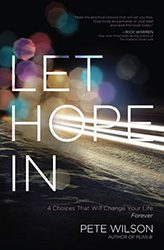
Nashville megachurch pastor Pete Wilson’s most recent book—Let Hope In: 4 Choices That Will Change Your Life Forever (Thomas Nelson 2013, $15.99)—is among the latest additions to an ever-expanding pantheon of works by Christian writers on the subject of hope. A brief scan of my own personal collection reveals some of the classics on this subject that have touched me most deeply: N.T. Wright’s Surprised by Hope, Josef Pieper’s treatise “On Hope,” Jürgen Moltmann’s Theology of Hope, C.S. Lewis’s chapter on Hope in Mere Christianity, and Billy Graham’s The Reason for my Hope are all among my most treasured*.* Hope—a concept and emotion so closely tied to the heart of the Gospel message—is a subject that the greatest of Christian writers have examined, explored, and attempted to explain, capture, theologize and philosophize for centuries. So as I cracked open Wilson’s book and began to read, I focused myself on asking: What new here do we have to learn? What revelation will come from these pages? How does this particular exegesis of hope fit into the canon of great pastoral, missional, and theological texts on such an essential Christian topic?
One of the most immediately attractive qualities of Let Hope In is Wilson’s colloquial and personable approach. He speaks simply, shares anecdotes from his own life as a father and husband, and doesn’t posture: he positions himself as one on the journey to understand and discover hope with us rather than one already arrived, project completed. The logic of Wilson’s approach is also very simple: he offers the reader four choices which, he argues, if responded to appropriately, lead to the sort of everlasting, abiding hope we all long for. The choices are:
(1) Do we choose to let negative events and feelings from our past continue to impact our present, or do we transform them?
(2) Do we accept our brokenness, or do we reject our weakness and flaws, attempting to hide or ignore them?
(3) Do we choose to trust God with our lives on a spiritual and internal level, or do we choose to please him externally, presenting ourselves as “well” publically while wasting away spiritually?
(4) Do we choose to use our freedom as Christians to lead others to freedom, or do we choose to allow the hurt inflicted on us continue to hurt those we interact with?
The “right” response is of course obvious in each case, and Wilson’s chapters are peppered with memorable, quotable, tweetable one-liners to reinforce his points:
“Once you let hope in, you have a responsibility—and often a desire—to then let that hope out.” (70)
“Focusing on sinning less doesn’t guarantee you will love more, but focusing on loving more will always guarantee that you will sin less.” (180)
“God’s main purpose for you is not what you do. It’s who you become.” (125)
While each choice we must make to let hope in is always supported by biblical narratives characterizing incredible moments when God brought hope to the most hopeless of situations, I must admit that I often found myself longing for even more scriptural references and more theological depth. I was surprised, for example, to find little attention given to the role of eternal life and heaven as sources of a Christian’s hope, and I resisted what at times seemed an oversimplification of how hope might arrive in a Christian’s heart. What I have loved about writing like that by Lewis and Wright on hope is their acknowledgment of the real miracle and mystery of Christian hope: how truly undeserving of any hope humanity is and how incredible that it was granted to us freely and fully. All four of the choices Wilson offers are certainly good and valuable to make and perfectly in line with Scripture; however, the rhetoric of simplification—just make these four choices and hope will come!—struck me as somewhat reductive of the phenomenon of Christian hope and at times somewhat uncomfortably in line with an American ethos of self-empowerment and the desire for simple and fast results. Especially reading this book during the recent Advent season, I found myself acutely attune to how powerful, revolutionary, and miraculous the moment when Hope entered the world really was, and I searched Wilsons’ words for a parallel understanding of how non-reductive the message of hope is.
Nevertheless, Christian readers struggling with regret or who feel that a troubled past is impacting how they view God and His message will find gems of wisdom in this book. And I can imagine this book working very well for a small group, accompanied by dialogue that could supplement the text with additional scriptural context and theological discussion. Indeed, where Wilson is at his best is when he is not offering suggestions of things for us to do or choose but when he is reminding us of who we already are in Christ (beloved, completely forgiven, valuable) and of how truly great the God we serve is (capable, faithful, powerful, loving). Moments when Wilson placed the Gospel before his readers in its most simple and pure form struck me as the most powerful reminder of why we should hope and how revolutionary the moment is when God does at last release this hope into our hearts.
Read an excerpt from Let Hope In at the Patheos Book Club here!
 Amber M. Stamper holds a Ph.D. in English (Rhetoric and Composition) and is an Assistant Professor of Language, Literature, and Communication at Elizabeth City State University in North Carolina. Her research and publications center on religious rhetoric and communication, especially issues of Christian evangelism and the digital church.
Previous Post
January 5, 2014
All Shook Up: A Q&A with Elvis Spiritual Biographer Gary Tillery
Next Post

January 7, 2014 A Prayer for the New Year, For You
Recent Comments
2,401 Comments | Leave a Comment
Browse Our Archives
Select a Category Author Q&A Book Review Christian Living Church Leadership Stump a Scholar Theology Uncategorized
Select a Month June 2022 March 2021 October 2020 August 2020 February 2019 November 2017 July 2017 June 2017 May 2017 March 2017 February 2017 January 2017 November 2016 October 2016 August 2016 July 2016 June 2016 May 2016 April 2016 March 2016 February 2016 January 2016 November 2015 October 2015 September 2015 August 2015 July 2015 June 2015 May 2015 April 2015 March 2015 February 2015 January 2015 December 2014 November 2014 October 2014 September 2014 August 2014 July 2014 June 2014 May 2014 April 2014 March 2014 February 2014 January 2014 December 2013 November 2013 October 2013 September 2013 August 2013 July 2013 June 2013 May 2013 April 2013 March 2013 February 2013 January 2013 December 2012 November 2012 October 2012 September 2012 August 2012 July 2012 June 2012 May 2012 April 2012 March 2012 February 2012 January 2012 December 2011 November 2011 October 2011 September 2011 August 2011 July 2011 June 2011 May 2011 April 2011 March 2011 February 2011 January 2011 December 2010 November 2010 October 2010 September 2010 August 2010 July 2010 June 2010
Follow Us!
TAKE THE
Religious Wisdom Quiz
What weapon did David use to defeat Goliath?
Select your answer to see how you score.
A spear A bow and arrow A sling and a stone A sword
Related posts from Take and Read

Even the Faith Giants Didn’t Always Get it...

How the Church Can Heal the Race Divide

Finding Inspiration in "Where Angels Walk"

Happiness Is Found Outside of Our Comfort Zones
TRENDING AT PATHEOS Religious Music & Entertainment

"Les Diabolique" and Transgression
Alongside something like Arrival, Vertigo, or Charade, Les Diaboliques is a...

"The Plague Dogs" and Mortality
So, flashback to the late 70s, early 80s. Walt Disney Studios is...

With the recent and highly successful release of Christopher Nolan’s epic film,...

"L'avventura" and Human Weakness
Today's piece is going to be a little different for a few...

I first want to apologize for not posting or writing anything. I'm...

I've engaged in the multi-year project of reading through the Church Fathers,...
view all Religious Music & Entertainment blogs
Ad-Free & Subscriber Log-In Subscription Support
- About Us
- 2026 Calendar
- Videos
- Podcasts
- Library of World Religions
- Faith In Media Tracker
- Advertise With Us
- Write for Us
- Privacy Policy
- Terms of Service
- Do Not Sell My Data
- Contact Us
- Radiant Digital
- Manage Newsletter Subscriptions
- Unsubscribe From Notifications
- Sitemap
Copyright 2008-2026, Patheos. All rights reserved.
Subscription Support Ad-Free & Subscriber Log-In
Follow Patheos