
BuddhistCatholicContemplativeEvangelicalGeneral ChristianHinduJewishLatter-day SaintMuslimNew VisionsProgressive Christian
Beliefs
- Buddhist
- Catholic
- Contemplative
- Evangelical
- General Christian
- Hindu
- Jewish
- Latter-day Saint
- More Voices
- Muslim
- New Visions
- Pagan
- Progressive Christian
Topics
- Religion News
- Food and Religion
- Sports and Religion
- Religious Art
- Religious Music and Entertainment
- Religious Events
- History and Religion
- Style and Religion
- Politics and Religion
- Women in Religion
- Recreation Outdoors and Religion
- Business Finance and Religion
- Careers Workplace and Religion
- Education and Religion
- Family Parenting and Religion
- Health Fitness and Religion
- Home and Religion
- Relationships and Religion
- Technology and Religion
- Travel and Religion
Columnists
- Buddhist Columnists
- Business Finance and Religion Columnists
- Careers Workplace and Religion Columnists
- Catholic Columnists
- Contemplative Columnists
- Education and Religion Columnists
- Evangelists Columnists
- Family Parenting and Religion Columnists
- General Christian Columnists
- Health Fitness and Religion Columnists
- Hindu Columnists
- History and Religion Columnists
- Home and Religion Columnists
- Jewish Columnists
- More Voices Columnists
- Latter Day Columnists
- Muslim Columnists
- New Visions Columnists
- Nonreligious Columnists
- Pagan Columnists
- Politics and Religion Columnists
- Progressive Columnists
- Recreation Outdoors and Religion Columnists
- Relationships and Religion Columnists
- Religion News Columnists
- Religious Art Columnists
- Religious Events Columnists
- Religious Music and Entertainment Columnists
- Sports and Religion Columnists
- Style and Religion Columnists
- Technology and Religion Columnists
- Travel and Religion Columnists
- Women in Religion Columnists
Resource Library
- 2026 Calendar
- Library of World Religions
- The 100 Most Holy Places on Earth
- Patheos Answers
- Podcasts
- Videos
- Faith Leaders Database
- Anglican Episcopalian
- Bahai
- Baptist
- Buddhism
- Christianity
- Confucianism
- Eastern Orthodoxy
- Hinduism
- Holiness and Pentecostal
- ISKCON
- Islam
- Judaism
- Lutheran
- Methodist
- The Church of Jesus Christ of Latter-day Saints
- New Age
- Paganism
- Presbytarian and Reformed
- Protestantism
- Religion Behind the Scenes
- Roman Catholic
- Scientology
- Shia Islam
- Sikhism
- Sufism
- Sunni Islam
- Taoism
- Zen
- See all religions
Research Tools
 Ad-Free & Subscriber Log-In Subscription Support
Ad-Free & Subscriber Log-In Subscription Support
Follow Patheos 

- Trending:
- Forgiveness
- |
- Marriage
- |
- Consciousness
- |
- Death Penalty
- |
- Election
- |
- Halloween

- Home
- Religious Music & Entertainment
- What Our Hearts Know: A Q&A with Charles Eisenstein
What Our Hearts Know: A Q&A with Charles Eisenstein
Last updated on: November 18, 2013 at 11:43 am by Deborah Arca
What Our Hearts Know: A Q&A with Charles Eisenstein 2013-11-18T11:43:48-07:00 Deborah Arca
Patheos Explore the world's faith through different perspectives on religion and spirituality! Patheos has the views of the prevalent religions and spiritualities of the world.
“If my words fulfill their intention, which is to catalyze a next step, big or small, into the more beautiful world our hearts know is possible, my very ordinariness becomes highly significant. It shows how close we all are, all of us ordinary humans, to a profound transformation of consciousness and being. If I, an ordinary man, can see it, we must almost be there.” — Charles Eisenstein, The More Beautiful World Our Hearts Know is Possible
In a time of social and ecological crisis, what can we as individuals do to make the world a better place? In his new book, The More Beautiful World Our Hearts Know is Possible, Charles Eisenstein, sought-after speaker and author of the popular Sacred Economics and The Ascent of Humanity, probes this question in a series of short, soulful and provocative reflections on deep topics, such as Separation, Breakdown, Cynicism and Hope.
We invited Eisenstein to respond to some questions about his book for our Patheos Book Club this month.
Let’s start with the book’s title. Can you break down what you mean for us by: “a more beautiful world”; “our hearts know”; and “is possible”?
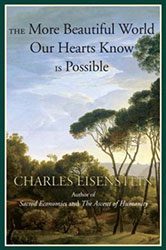 By a “more beautiful world” I mean something very intuitive. I’m afraid if I try to define that, I will muddy the waters not clarify them. Certainly people differ in their conceptions of beauty, on what a better world would look like, but most of us agree on some things.
“Our hearts know” that a world more joyful, intimate, authentic, and beautiful than what we’ve been offered as normal is possible, but generally speaking our minds do not believe it, not fully. Our minds have difficulty accepting that things will ever be substantially different than they have always been. Furthermore, according to what we in our culture generally accept as possible, practical, and realistic, our situation is hopeless. The powers aligned behind war, imprisonment, ecocide, exploitation, etc. are vast: the military-industrial complex, the surveillance state, the banks, the corporate media, and so on. However, in our hearts we know ourselves as powerful beings; we know that our small invisible actions carry a significance that our minds cannot fathom. And many of us have had experiences that show that the conventional understanding of what is possible is too narrow.
You begin your book by claiming that as a people at this time, our old ‘story’ – the Story of Separation – is breaking down and that we are in the throes of a new “story” — a Story of Interbeing. Can you flesh this out a bit for us here? And what is your basis for making this claim?
I don’t believe we have moved into a new story yet. We are still in the last stages of the old story. I call it the story of Separation because it holds us as separate individuals in a universe of other, and holds humanity separate from nature. It denies the qualities of a self to anything but human beings; in particular, the world outside ourselves possesses no intelligence, consciousness, purpose, or sentience. In that story, well-being comes through control — control over the impersonal forces and competing others of nature, and the destiny of humanity is therefore to become the lords and masters of nature. Our social institutions draw upon this mythology, and reinforce it in turn. For example, our economy fills our lives with standard commodities that seem not to have the qualities of uniqueness and interconnectedness that a self has; it also generates competition and makes it seem that we do indeed live in a hostile, impersonal world.
This story is breaking down today. It is breaking down scientifically; it is in fact over eighty years obsolete as quantum mechanics invalidates the self-other distinction. Meanwhile, complexity theory seems to show that purpose is an inherent property of the universe. It is also breaking down in the sense that the institutions built on it are not functioning properly any more. The money system, the medical system, the educational system, the political system are all facing an intermittent but growing crisis, while technology has failed to give us the age of leisure, freedom from disease, space colonies, etc. that it promised. To the contrary, despite our increasing power to manipulate and control matter, nature seems to be spiraling further and further out of control.
As the old world falls apart, we enter an empty space, an in-between space, from which a new world can be born, a world built on a new (and ancient) story that no longer holds us separate from each other and from the natural world. Already we can see it emerging, for example in many things we call radical, alternative, or holistic. These are based on the perception that we are interconnected, that the outside mirrors the inside, that what we do to the world, we do to ourselves; that there is an intelligence in nature that we must respect and that we can learn from.
You state that the 2012 Sandy Hook massacre is one of the “end time” events that is dismantling our culture’s mythology. What was it about that particular event that was so critical to the breaking down of our current human narrative?
It was hard to fit into our “story of normal.” I guess in the end people made it all about gun control, or about a monstrous aberrant individual, or something like that, but underneath I think it provoked a deep unease coming from a recognition that this was a symptom of something fundamentally wrong.
In your chapter on Urgency, you suggest that the paradigm of urgency in response to any number of the world’s crises might be part of the problem, and that we might instead try slowing down. What is gained by slowing down when the world is spiraling out of control?
Urgency makes sense when you know what to do. I use the metaphor of a house fire. If it is small and you have a fire extinguisher, yeah you’d better act urgently. But what happens when you look out the window and see every house on fire? All you have is a puny fire extinguisher, so it probably doesn’t make sense to march into the nearest inferno and blast away, knowing it won’t do any good. Instead you’d better tell everyone, “Hey, the neighborhood is on fire.” Well, that would be an urgently necessary action, but what happens if no one believes you? What if they glance at the smoke and say, “There’s no fire. If there were, everyone wouldn’t be talking about football and the Kardashians. Everyone wouldn’t be acting like everything were normal.” And what happens when you suspect that the way you are shouting at people is repelling them? What happens when you suspect that most of your efforts to change the world haven’t borne fruit? Then perhaps it is time to pause, to listen, to take stock. When we are stuck in fruitless habits, sometimes we need to just stop.
In that same chapter, you suggest that our only path out of “this mess” is to recover our own indigenous soul. What wisdom lies there?
“Indigenous soul” isn’t a term I use a lot; I think I’m drawing perhaps from Martin Prechtel and others who are more knowledgeable about indigeneity. Of course, we are all indigenous to this planet, and the ways of knowing and ways of relating that characterize indigenous societies are available to all of us. They are our birthright and they can be recovered.
You say “the more beautiful world my heart knows is possible” is a world with a lot more pleasure. What kinds of pleasure are you advocating? And why is it an important element to any successful revolution that might take place in our world?
One piece of the old story is what I call “the war against the self.” It mirrors the war on nature, and says that goodness comes through struggle, through sacrifice, through dominating the body with the mind, the will, or the reason. In that mentality, pleasure is bad, an obstacle, a temptation. Ending the war on nature includes ending the war against the self. Now it might seem that pleasure and desire are usually an enemy of anything good — “What if it gives you pleasure to drive sports cars, to overconsume, to dominate others…?” But many people who follow this path discover that these things are mere substitutes for what they really want and what really feels good. Which feels better, really: a big new flatscreen TV, or the experience of deep intimacy and connection ?
You clearly believe that the new Story of the People – the Story of Interbeing – could heal the world. What will be the challenges for us in embracing this new story? What words of courage might you offer?
One of the biggest challenges is the loneliness that many people experience as they begin to step into it. It is fairly new territory for our society, and we are surrounded by people and institutions that are firmly grounded in the old. In their eyes, we are crazy for trusting, for example, that if we fully give ourselves in service we’ll be taken care of as well. We are crazy for believing in our visions of what is possible. A thousand voices, whether explicit or implicit, tell us to play it safe. Fortunately, the age is turning, and more and more people are affirming that we are not crazy. I’m adding my voice to that turning.
What was the hardest thing about writing this book? And the most life-giving? Did you learn anything new about yourself in the process of writing?
Unlike my two previous books, this isn’t a research-based book. It contains only a minimal amount of research. It is mostly “Here’s what Charles thinks,” and part of me wonders, Who am I to write such a book, and who gives a shit what Charles thinks? After all, I am a fairly normal person. I haven’t overcome some great trauma, I haven’t accomplished any heroic acts, I don’t channel ascended masters, I didn’t get a Ph.D. at the age of 17… The book comes from conversations I’ve had, stories I’ve received from other people and from somewhere else. Often in writing the book I had a strong sense of being plugged into a kind of field, of being an antenna, of being in service to something that wants to be born.
If there was one main take-away people would glean from your book, what would it be? What is your greatest hope for this book?
One take-away is that this transition we are undergoing is a collective phenomenon. It isn’t that one person becomes enlightened through personal efforts and then leads the others. We are in this together, holding each other in the new story. Each of us at times has the strength to hold others in interbeing, love, forgiveness, gratitude — to say, maybe not in words, “I know who you are. I know why you are here. You are a mirror of the whole universe. You are me, looking out from different eyes. You are the bearer of unique gifts, and you are here for a magnificent purpose, whether it appears large or small from the eyes of separation.” And other times, we cannot believe that even of ourselves, and another comes to believe it while we are weak, holding open the invitation for us to step back into that story. We, humanity, will only make this transition by being in service to each other, and that is our deepest desire anyway.
Visit the Patheos Book Club for more conversation on The More Beautiful World Our Hearts Know is Possible.

Next Post
November 18, 2013 The First Thanksgiving: A Review
Recent Comments
Browse Our Archives
Select a Category Author Q&A Book Review Christian Living Church Leadership Stump a Scholar Theology Uncategorized
Select a Month June 2022 March 2021 October 2020 August 2020 February 2019 November 2017 July 2017 June 2017 May 2017 March 2017 February 2017 January 2017 November 2016 October 2016 August 2016 July 2016 June 2016 May 2016 April 2016 March 2016 February 2016 January 2016 November 2015 October 2015 September 2015 August 2015 July 2015 June 2015 May 2015 April 2015 March 2015 February 2015 January 2015 December 2014 November 2014 October 2014 September 2014 August 2014 July 2014 June 2014 May 2014 April 2014 March 2014 February 2014 January 2014 December 2013 November 2013 October 2013 September 2013 August 2013 July 2013 June 2013 May 2013 April 2013 March 2013 February 2013 January 2013 December 2012 November 2012 October 2012 September 2012 August 2012 July 2012 June 2012 May 2012 April 2012 March 2012 February 2012 January 2012 December 2011 November 2011 October 2011 September 2011 August 2011 July 2011 June 2011 May 2011 April 2011 March 2011 February 2011 January 2011 December 2010 November 2010 October 2010 September 2010 August 2010 July 2010 June 2010
Follow Us!
TAKE THE
Religious Wisdom Quiz
What did Samuel's mother promise if God gave her a son?
Select your answer to see how you score.
To move to Jerusalem To dedicate him to the Lord To offer a burnt sacrifice To fast for 40 days
Related posts from Take and Read

Us Versus Us: A Q&A with Author Andrew...
Tasting God: A Q&A with Ginny Kubitz Moyer
40 Days of Decrease: A Different Kind of...
Five Reasons There’s No Getting Past Religion
TRENDING AT PATHEOS Religious Music & Entertainment

"Les Diabolique" and Transgression
Alongside something like Arrival, Vertigo, or Charade, Les Diaboliques is a...

"The Plague Dogs" and Mortality
So, flashback to the late 70s, early 80s. Walt Disney Studios is...

With the recent and highly successful release of Christopher Nolan’s epic film,...

"L'avventura" and Human Weakness
Today's piece is going to be a little different for a few...

I first want to apologize for not posting or writing anything. I'm...

I've engaged in the multi-year project of reading through the Church Fathers,...
view all Religious Music & Entertainment blogs
Ad-Free & Subscriber Log-In Subscription Support
- About Us
- 2026 Calendar
- Videos
- Podcasts
- Library of World Religions
- Faith In Media Tracker
- Advertise With Us
- Write for Us
- Privacy Policy
- Terms of Service
- Do Not Sell My Data
- Contact Us
- Radiant Digital
- Manage Newsletter Subscriptions
- Unsubscribe From Notifications
- Sitemap
Copyright 2008-2026, Patheos. All rights reserved.
Subscription Support Ad-Free & Subscriber Log-In
Follow Patheos