
BuddhistCatholicContemplativeEvangelicalGeneral ChristianHinduJewishLatter-day SaintMuslimNew VisionsProgressive Christian
Beliefs
- Buddhist
- Catholic
- Contemplative
- Evangelical
- General Christian
- Hindu
- Jewish
- Latter-day Saint
- More Voices
- Muslim
- New Visions
- Pagan
- Progressive Christian
Topics
- Religion News
- Food and Religion
- Sports and Religion
- Religious Art
- Religious Music and Entertainment
- Religious Events
- History and Religion
- Style and Religion
- Politics and Religion
- Women in Religion
- Recreation Outdoors and Religion
- Business Finance and Religion
- Careers Workplace and Religion
- Education and Religion
- Family Parenting and Religion
- Health Fitness and Religion
- Home and Religion
- Relationships and Religion
- Technology and Religion
- Travel and Religion
Columnists
- Buddhist Columnists
- Business Finance and Religion Columnists
- Careers Workplace and Religion Columnists
- Catholic Columnists
- Contemplative Columnists
- Education and Religion Columnists
- Evangelists Columnists
- Family Parenting and Religion Columnists
- General Christian Columnists
- Health Fitness and Religion Columnists
- Hindu Columnists
- History and Religion Columnists
- Home and Religion Columnists
- Jewish Columnists
- More Voices Columnists
- Latter Day Columnists
- Muslim Columnists
- New Visions Columnists
- Nonreligious Columnists
- Pagan Columnists
- Politics and Religion Columnists
- Progressive Columnists
- Recreation Outdoors and Religion Columnists
- Relationships and Religion Columnists
- Religion News Columnists
- Religious Art Columnists
- Religious Events Columnists
- Religious Music and Entertainment Columnists
- Sports and Religion Columnists
- Style and Religion Columnists
- Technology and Religion Columnists
- Travel and Religion Columnists
- Women in Religion Columnists
Resource Library
- 2026 Calendar
- Library of World Religions
- The 100 Most Holy Places on Earth
- Patheos Answers
- Podcasts
- Videos
- Faith Leaders Database
- Anglican Episcopalian
- Bahai
- Baptist
- Buddhism
- Christianity
- Confucianism
- Eastern Orthodoxy
- Hinduism
- Holiness and Pentecostal
- ISKCON
- Islam
- Judaism
- Lutheran
- Methodist
- The Church of Jesus Christ of Latter-day Saints
- New Age
- Paganism
- Presbytarian and Reformed
- Protestantism
- Religion Behind the Scenes
- Roman Catholic
- Scientology
- Shia Islam
- Sikhism
- Sufism
- Sunni Islam
- Taoism
- Zen
- See all religions
Research Tools
 Ad-Free & Subscriber Log-In Subscription Support
Ad-Free & Subscriber Log-In Subscription Support
Follow Patheos 

- Trending:
- Forgiveness
- |
- Marriage
- |
- Consciousness
- |
- Death Penalty
- |
- Election
- |
- Halloween

- Home
- Religious Music & Entertainment
- The First Thanksgiving: A Review
The First Thanksgiving: A Review
Last updated on: November 18, 2013 at 2:00 pm by David Swartz
The First Thanksgiving: A Review 2013-11-18T14:00:27-07:00 David Swartz
Patheos Explore the world's faith through different perspectives on religion and spirituality! Patheos has the views of the prevalent religions and spiritualities of the world.
 If the Beatles had sung their song “Imagine” with Thanksgiving in mind, it might have started like this:
Imagine there’s no turkey…
Forget the stuffing too…
No pie or cranberries…
Just some eel and a turnip or two…
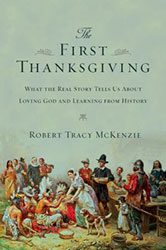
Robert Tracy McKenzie, in The First Thanksgiving, hacks away much of the sentimental overgrowth of Thanksgiving. He’s not a revisionist who delights in saying that everything that we want to believe isn’t true. (I will not use the word “revisionist” again. McKenzie not only doesn’t like it but gives good reasons as to why we should leave it alone. So I will and not just here.) What’s left is an unvarnished look at what can be known of those people and those first days of what became America.
He spends a good three chapters on telling us who these people were and what led up to their arrival at Plymouth. Their insistence on living a faith that could breathe freely no matter the cost or where it took them has much to teach us. History in general and theirs in particular seems a good place to start. Many of us don’t know that those we call the pilgrims first fled England to what we now call Holland and only passed briefly back through England on the way to the New World. Fleeing England, the pilgrims sought to escape prison, torture and death for their faith while the migration from Holland was due to the scarcity of work that could provide a living.
McKenzie helps us understand the larger context of history itself, how history becomes history. On one side, he warns against seeing history through the lenses of our own tastes and interpretations. We hear that they believed in God and family. We believe in God and family so they must be exactly like us and we like them. Nothing could be further from the truth. On the other side, he warns us of putting our history on pedestals so that its actors become idols – perfect and sanitized figures only vaguely resembling the real forgers of history. All of our heroes had a shadow side living flawed lives.
Whatever their flaws, these people were tough. Their faith was cast iron with no expectation of God to shield them from suffering or death. They sought God for that but as the elements of a New England winter, disease, and starvation overtook many, they didn’t blame Him. Hard work would actually have been a respite from their daily routine. For example, they lived on the ship at the beginning and went ashore daily to work on getting shelter built. Then, at day’s end, they returned to the ship for whatever supper could be had and sleep. Here’s the catch. The natural harbor was so shallow that the ship had to anchor almost a mile off shore. So those working would plunge into frigid (think New England winter and what that would mean by “frigid”) water up to the waist. Then they worked all day in those clothes. Finally, they waded back out to the ship for what supper could be had and sleep as smaller boats on board were too damaged to sail.
The menu for the first dinner wasn’t nearly as bountiful as the pictures we grew up seeing. Everything was either roasted or boiled. It’s almost certain there was no turkey; it might not have been more than turnips and eel. (If you’re looking for a way to cut down on the crowd this Thanksgiving, just say, “Don’t bring a thing. Just come. We’ll have the eel in the oven and Sue will have dug up fresh turnips that morning.” If anyone still does show up knowing this, don’t let these people into your house.) They thought tomatoes were unhealthy and that corn was pretty much livestock feed and not for human consumption unless starvation was imminent. Sweet potatoes and cranberries were unknown. Swans were a delicacy. They loved beer but were suspicious about water. Indians may have been present but probably not by invitation and their presence would have made things tense for both sides even if they did bring venison.
Our pilgrim forefathers probably wouldn’t have approved at all of our having a holiday dedicated to thanksgiving. They didn’t believe in holidays in general and would have said that the church should have spontaneous days of thanksgiving throughout the year. They feared that to have one day would eventually enable people to tune it out, rendering the day largely meaningless. They might look with confusion and alarm at our feasts where, after we gorged ourselves, we would have leftovers for three days and complain about it. It would cause them grief to know that the prayer said before the meal might be the only prayer said all year. They needed each other to a degree that would deeply offend the narcissism of our time.
Our forefathers leave us with models of imperfect heroes in one last important way. We envision them as pilgrims on their way to the New World but once they arrived, the pilgrim thing was done because this was the Promised Land. That was not their understanding. Whether in England, Holland or the New World, our forefathers never saw being a pilgrim ending because they hadn’t arrived. As in Hebrews 11:13 says, “…they admitted that they were aliens and strangers on earth.” We’re very much at home, settled and comfortable, with our hopes, kingdoms, hungers to acquire and yearnings to become anchored in what only can be described and contained by time. And will pass away. Their faith sharpened their lives as pointing beyond themselves, their immediate circumstances, even the growing culture of their new land. Even in their imperfect lives (the way we portray them in picture and story would probably horrify them), they lived what Jesus Christ described as seeking first the Kingdom of God (Matt 6:33).
They are both very much like us in their ordinariness but unlike us in the living of their faith. We might feel uncomfortable in their midst without their doing or saying anything to provoke it. But even in their imperfections, they stretch us in ways and in directions outside ourselves the fantasy Thanksgiving crowd does not.
For more conversation on The First Thanksgiving, visit the Patheos Book Club here.
David Swartz pastors Bethel Baptist Church in Roseville, Michigan. He thinks that jazz is sacred music, that books are better company than most people, and that university towns rock. He blogs at geezeronthequad.com.
Previous Post

November 18, 2013
What Our Hearts Know: A Q&A with Charles Eisenstein
Next Post

November 19, 2013 Sex and the Single Christian Girl: A Book Review
Recent Comments
Browse Our Archives
Select a Category Author Q&A Book Review Christian Living Church Leadership Stump a Scholar Theology Uncategorized
Select a Month June 2022 March 2021 October 2020 August 2020 February 2019 November 2017 July 2017 June 2017 May 2017 March 2017 February 2017 January 2017 November 2016 October 2016 August 2016 July 2016 June 2016 May 2016 April 2016 March 2016 February 2016 January 2016 November 2015 October 2015 September 2015 August 2015 July 2015 June 2015 May 2015 April 2015 March 2015 February 2015 January 2015 December 2014 November 2014 October 2014 September 2014 August 2014 July 2014 June 2014 May 2014 April 2014 March 2014 February 2014 January 2014 December 2013 November 2013 October 2013 September 2013 August 2013 July 2013 June 2013 May 2013 April 2013 March 2013 February 2013 January 2013 December 2012 November 2012 October 2012 September 2012 August 2012 July 2012 June 2012 May 2012 April 2012 March 2012 February 2012 January 2012 December 2011 November 2011 October 2011 September 2011 August 2011 July 2011 June 2011 May 2011 April 2011 March 2011 February 2011 January 2011 December 2010 November 2010 October 2010 September 2010 August 2010 July 2010 June 2010
Follow Us!
TAKE THE
Religious Wisdom Quiz
What city was known as the City of David?
Select your answer to see how you score.
Nazareth Jericho Bethlehem Jerusalem
Related posts from Take and Read

"The Slow March of Light" Highlights The Human...

"A Brilliant Night of Stars and Ice" Recounts...

How To Judge The Bible By Its Cover

Life is an Endless Invitation: Q&A With Rob...
TRENDING AT PATHEOS Religious Music & Entertainment

"Les Diabolique" and Transgression
Alongside something like Arrival, Vertigo, or Charade, Les Diaboliques is a...

"The Plague Dogs" and Mortality
So, flashback to the late 70s, early 80s. Walt Disney Studios is...

With the recent and highly successful release of Christopher Nolan’s epic film,...

"L'avventura" and Human Weakness
Today's piece is going to be a little different for a few...

I first want to apologize for not posting or writing anything. I'm...

I've engaged in the multi-year project of reading through the Church Fathers,...
view all Religious Music & Entertainment blogs
Ad-Free & Subscriber Log-In Subscription Support
- About Us
- 2026 Calendar
- Videos
- Podcasts
- Library of World Religions
- Faith In Media Tracker
- Advertise With Us
- Write for Us
- Privacy Policy
- Terms of Service
- Do Not Sell My Data
- Contact Us
- Radiant Digital
- Manage Newsletter Subscriptions
- Unsubscribe From Notifications
- Sitemap
Copyright 2008-2026, Patheos. All rights reserved.
Subscription Support Ad-Free & Subscriber Log-In
Follow Patheos