
BuddhistCatholicContemplativeEvangelicalGeneral ChristianHinduJewishLatter-day SaintMuslimNew VisionsProgressive Christian
Beliefs
- Buddhist
- Catholic
- Contemplative
- Evangelical
- General Christian
- Hindu
- Jewish
- Latter-day Saint
- More Voices
- Muslim
- New Visions
- Pagan
- Progressive Christian
Topics
- Religion News
- Food and Religion
- Sports and Religion
- Religious Art
- Religious Music and Entertainment
- Religious Events
- History and Religion
- Style and Religion
- Politics and Religion
- Women in Religion
- Recreation Outdoors and Religion
- Business Finance and Religion
- Careers Workplace and Religion
- Education and Religion
- Family Parenting and Religion
- Health Fitness and Religion
- Home and Religion
- Relationships and Religion
- Technology and Religion
- Travel and Religion
Columnists
- Buddhist Columnists
- Business Finance and Religion Columnists
- Careers Workplace and Religion Columnists
- Catholic Columnists
- Contemplative Columnists
- Education and Religion Columnists
- Evangelists Columnists
- Family Parenting and Religion Columnists
- General Christian Columnists
- Health Fitness and Religion Columnists
- Hindu Columnists
- History and Religion Columnists
- Home and Religion Columnists
- Jewish Columnists
- More Voices Columnists
- Latter Day Columnists
- Muslim Columnists
- New Visions Columnists
- Nonreligious Columnists
- Pagan Columnists
- Politics and Religion Columnists
- Progressive Columnists
- Recreation Outdoors and Religion Columnists
- Relationships and Religion Columnists
- Religion News Columnists
- Religious Art Columnists
- Religious Events Columnists
- Religious Music and Entertainment Columnists
- Sports and Religion Columnists
- Style and Religion Columnists
- Technology and Religion Columnists
- Travel and Religion Columnists
- Women in Religion Columnists
Resource Library
- 2026 Calendar
- Library of World Religions
- The 100 Most Holy Places on Earth
- Patheos Answers
- Podcasts
- Videos
- Faith Leaders Database
- Anglican Episcopalian
- Bahai
- Baptist
- Buddhism
- Christianity
- Confucianism
- Eastern Orthodoxy
- Hinduism
- Holiness and Pentecostal
- ISKCON
- Islam
- Judaism
- Lutheran
- Methodist
- The Church of Jesus Christ of Latter-day Saints
- New Age
- Paganism
- Presbytarian and Reformed
- Protestantism
- Religion Behind the Scenes
- Roman Catholic
- Scientology
- Shia Islam
- Sikhism
- Sufism
- Sunni Islam
- Taoism
- Zen
- See all religions
Research Tools
 Ad-Free & Subscriber Log-In Subscription Support
Ad-Free & Subscriber Log-In Subscription Support
Follow Patheos 

- Trending:
- Forgiveness
- |
- Marriage
- |
- Consciousness
- |
- Death Penalty
- |
- Election
- |
- Halloween

- Home
- Religious Music & Entertainment
- The Tiny Buddha’s Guide to Loving Yourself: A Q&A with Author Lori Deschene
The Tiny Buddha’s Guide to Loving Yourself: A Q&A with Author Lori Deschene
Last updated on: October 15, 2013 at 10:48 pm by Deborah Arca
The Tiny Buddha’s Guide to Loving Yourself: A Q&A with Author Lori Deschene 2013-10-15T22:48:05-06:00 Deborah Arca
Patheos Explore the world's faith through different perspectives on religion and spirituality! Patheos has the views of the prevalent religions and spiritualities of the world.
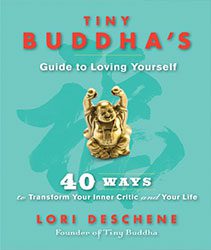 A new book from TinyBuddha.com founder Lori Deschene, The Tiny Buddha’s Guide to Loving Yourself, shares 40 unique perspectives and insights on topics related to loving yourself, such as realizing you’re not broken, accepting your flaws, releasing the need for approval, forgiving yourself, letting go of comparisons, and learning to be authentic. Featuring real stories selected from hundreds of TinyBuddha.com contributors, the book provides an honest look at what it means to overcome critical, self-judging thoughts to create a peaceful, empowered life.
As part of the Patheos Book Club, we invited Lori to answer some questions about her new book, the tinybuddha community she founded, and the big issue of loving yourself.
 Why did you start tinybuddha.com as a community blog?
Prior to starting tinybuddha.com, I’d visited a wide variety of personal development blogs, and each one hinged on one person’s growth and expertise. While I admired this approach, I realized that I didn’t want to create a site that revolved around my own story, but rather a site that encouraged people to share their own experiences and insights. In this way, it wouldn’t be about learning from me, but rather all of us learning together. I think this is the key to meaningful change and authentic connection: realizing we are all both students and teachers.
What inspired you to write this book?
Self-love is the foundation for everything we do in life. When we believe in our intrinsic value and take good care of ourselves, we’re better able to maintain healthy relationships, pursue our dreams, and make the difference we want to make in the world. Most of us know this intellectually, but it can still be so challenging to change the beliefs and habitual, dysfunctional thought patterns that keep us feeling stuck and unworthy. At least this has been my experience. I spent the majority of my life feeling mired in a deep sense of self-loathing. I’ve been working at it for years, and I’ve realized the journey to self-love and acceptance is a lifelong process. I hope this book helps readers feel less alone on that road, and better equipped to navigate it.
Why did you choose to include so many different stories and perspectives on self-love?
I believe that shame is the biggest barrier to self-acceptance, since it convinces us that there’s something wrong with us and that we should hide ourselves in fear of being fully seen and judged. We need to release our shame to truly love ourselves, and yet a lot of us carry shame around the fact that we struggle with being good to ourselves. Acknowledging our challenges can feel like admitting weakness or inferiority. I wanted to share a collection of vulnerable, insightful stories, including my own, to help readers acknowledge their own self-love journey, and realize there is nothing wrong with them for having room to grow. It’s only when we accept where we stand that we’re able to move forward.
How did you choose which stories to include?
All of these pieces come from the tinybuddha.com blog. I looked for stories that were both self-reflective and insightful, sharing personal experiences that I felt readers could relate to and lessons that might help them form their own epiphanies. I structured the book with 10 related chapters, and chose the relevant stories from the site that seemed to resonate most strongly with online readers.
You didn’t write nearly as much about yourself in this book as you did in your first one. Why is that?
In my first book, I included a personal story from my life at the start of every chapter. For this book, I only shared one in the beginning, mostly because I wanted the reader submissions to be the focus of the book.
Self-love seems to be a popular theme on tinybuddha.com. Why do you think that is?
I think this comes back to the first question—it’s something we all struggle with. Especially in a competitive culture that values monetary success, we can easily end up feeling inadequate and pressured to do and be more. Also, it’s somewhat of a taboo topic—admitting your own self-acceptance challenges—and yet it’s so cathartic to do it. Every time someone shares their own self-love story, countless people get inspired to do the same. Vulnerability is contagious, because people see how liberating it feels to acknowledge not only their former challenges, but also what they deal with right now. It takes the power away from it, and gives us permission to be beautifully, imperfectly human.
A lot of the writers in the book discussed the instinct to compare themselves unfavorably to other people. Why do you think this is such a common practice?
I suspect we’ve always compared ourselves to others, because this is how we measure our own progress; and it’s also part of our survival instinct, to ensure we’re not falling behind. But we face a new challenge now that social media is so pervasive: We have 24/7 access to everyone else’s experiences and accomplishments—and most of us are much less forthcoming in sharing the less joyful moments. We end up overestimating other people’s happiness—as if they don’t also deal with life’s ups and downs—and questioning ourselves, whether we’re doing enough, and if we’re somehow missing out.
Another theme in the book revolves around letting go of the need for approval. Why do you think this is so ingrained in us—and what’s one thing we can do move beyond it?
This goes back to our childhoods, when we looked for social approval and approval from our parents to form our sense of identity and self-worth. I think there’s also a link between how harshly we judge ourselves and how often we seek approval from others. When we have gaps in our sense of self that we feel unable to fill, we tend to look to others to do it for us.
One thing we can do to overcome this instinct is learn to self-soothe. So instead of looking to someone we trust to tell us we did a good job on something, we can slowly learn to tell ourselves these things in our heads. Of course, we first need to dispute the self-critical thoughts that tell us otherwise.
As an example, I recently felt self-judgmental after giving a quick, off-the-cuff toast at my sister’s wedding. I’d written something longer, but I’d forgotten it at home. My first instinct was to ask everyone if my toast was ok and if I’d let my sister down—and I did ask a couple of people I trust. But eventually I decided to tell myself, “You show you love her through actions all the time. You said something sweet and thoughtful. There’s no reason to get down on yourself. You didn’t do anything wrong.”
Once I fully believed this, I stopped asking other people what they thought. Their opinions no longer held the same weight when I approved of myself in this scenario.
Can readers who feel they have a strong self of self-love benefit from this book?
Absolutely! Not everyone will relate to every story, but the lessons and insights are universal, regardless of where you are on your individual journey.
What’s the main message you hope readers take away from this book?
No matter how we struggle, we don’t need to feel ashamed. We’ve all had our own unique experiences and challenges that have contributed to our learned behaviors. The important thing to remember is that we are not alone, and we can all learn to transform the voice inside our heads—and our lives—if we’re honest with each other and ourselves.
For more on The Tiny Buddha’s Guide to Loving Yourself, visit the Patheos Book Club here.
Previous Post

October 15, 2013
How Pope Francis Leads: A Q&A with Chris Lowney
Next Post
October 17, 2013 Good Power: A Book Review of Andy Crouch's "Playing God"
Recent Comments
2,316 Comments | Leave a Comment
Browse Our Archives
Select a Category Author Q&A Book Review Christian Living Church Leadership Stump a Scholar Theology Uncategorized
Select a Month June 2022 March 2021 October 2020 August 2020 February 2019 November 2017 July 2017 June 2017 May 2017 March 2017 February 2017 January 2017 November 2016 October 2016 August 2016 July 2016 June 2016 May 2016 April 2016 March 2016 February 2016 January 2016 November 2015 October 2015 September 2015 August 2015 July 2015 June 2015 May 2015 April 2015 March 2015 February 2015 January 2015 December 2014 November 2014 October 2014 September 2014 August 2014 July 2014 June 2014 May 2014 April 2014 March 2014 February 2014 January 2014 December 2013 November 2013 October 2013 September 2013 August 2013 July 2013 June 2013 May 2013 April 2013 March 2013 February 2013 January 2013 December 2012 November 2012 October 2012 September 2012 August 2012 July 2012 June 2012 May 2012 April 2012 March 2012 February 2012 January 2012 December 2011 November 2011 October 2011 September 2011 August 2011 July 2011 June 2011 May 2011 April 2011 March 2011 February 2011 January 2011 December 2010 November 2010 October 2010 September 2010 August 2010 July 2010 June 2010
Follow Us!
TAKE THE
Religious Wisdom Quiz
How many books does the Old Testament have?
Select your answer to see how you score.
39 51 50 41
Related posts from Take and Read

"The Slow March of Light" Highlights The Human...

"A Brilliant Night of Stars and Ice" Recounts...

How To Judge The Bible By Its Cover

Life is an Endless Invitation: Q&A With Rob...
TRENDING AT PATHEOS Religious Music & Entertainment

"Les Diabolique" and Transgression
Alongside something like Arrival, Vertigo, or Charade, Les Diaboliques is a...

"The Plague Dogs" and Mortality
So, flashback to the late 70s, early 80s. Walt Disney Studios is...

With the recent and highly successful release of Christopher Nolan’s epic film,...

"L'avventura" and Human Weakness
Today's piece is going to be a little different for a few...

I first want to apologize for not posting or writing anything. I'm...

I've engaged in the multi-year project of reading through the Church Fathers,...
view all Religious Music & Entertainment blogs
Ad-Free & Subscriber Log-In Subscription Support
- About Us
- 2026 Calendar
- Videos
- Podcasts
- Library of World Religions
- Faith In Media Tracker
- Advertise With Us
- Write for Us
- Privacy Policy
- Terms of Service
- Do Not Sell My Data
- Contact Us
- Radiant Digital
- Manage Newsletter Subscriptions
- Unsubscribe From Notifications
- Sitemap
Copyright 2008-2026, Patheos. All rights reserved.
Subscription Support Ad-Free & Subscriber Log-In
Follow Patheos