
BuddhistCatholicContemplativeEvangelicalGeneral ChristianHinduJewishLatter-day SaintMuslimNew VisionsProgressive Christian
Beliefs
- Buddhist
- Catholic
- Contemplative
- Evangelical
- General Christian
- Hindu
- Jewish
- Latter-day Saint
- More Voices
- Muslim
- New Visions
- Pagan
- Progressive Christian
Topics
- Religion News
- Food and Religion
- Sports and Religion
- Religious Art
- Religious Music and Entertainment
- Religious Events
- History and Religion
- Style and Religion
- Politics and Religion
- Women in Religion
- Recreation Outdoors and Religion
- Business Finance and Religion
- Careers Workplace and Religion
- Education and Religion
- Family Parenting and Religion
- Health Fitness and Religion
- Home and Religion
- Relationships and Religion
- Technology and Religion
- Travel and Religion
Columnists
- Buddhist Columnists
- Business Finance and Religion Columnists
- Careers Workplace and Religion Columnists
- Catholic Columnists
- Contemplative Columnists
- Education and Religion Columnists
- Evangelists Columnists
- Family Parenting and Religion Columnists
- General Christian Columnists
- Health Fitness and Religion Columnists
- Hindu Columnists
- History and Religion Columnists
- Home and Religion Columnists
- Jewish Columnists
- More Voices Columnists
- Latter Day Columnists
- Muslim Columnists
- New Visions Columnists
- Nonreligious Columnists
- Pagan Columnists
- Politics and Religion Columnists
- Progressive Columnists
- Recreation Outdoors and Religion Columnists
- Relationships and Religion Columnists
- Religion News Columnists
- Religious Art Columnists
- Religious Events Columnists
- Religious Music and Entertainment Columnists
- Sports and Religion Columnists
- Style and Religion Columnists
- Technology and Religion Columnists
- Travel and Religion Columnists
- Women in Religion Columnists
Resource Library
- 2026 Calendar
- Library of World Religions
- The 100 Most Holy Places on Earth
- Patheos Answers
- Podcasts
- Videos
- Faith Leaders Database
- Anglican Episcopalian
- Bahai
- Baptist
- Buddhism
- Christianity
- Confucianism
- Eastern Orthodoxy
- Hinduism
- Holiness and Pentecostal
- ISKCON
- Islam
- Judaism
- Lutheran
- Methodist
- The Church of Jesus Christ of Latter-day Saints
- New Age
- Paganism
- Presbytarian and Reformed
- Protestantism
- Religion Behind the Scenes
- Roman Catholic
- Scientology
- Shia Islam
- Sikhism
- Sufism
- Sunni Islam
- Taoism
- Zen
- See all religions
Research Tools
 Ad-Free & Subscriber Log-In Subscription Support
Ad-Free & Subscriber Log-In Subscription Support
Follow Patheos 

- Trending:
- Forgiveness
- |
- Marriage
- |
- Consciousness
- |
- Death Penalty
- |
- Election
- |
- Halloween

- Home
- Religious Music & Entertainment
- Rock-Bottom Blessings: A Q&A with Author Karen Beattie
Rock-Bottom Blessings: A Q&A with Author Karen Beattie
Last updated on: August 30, 2013 at 11:02 am by Deborah Arca
Rock-Bottom Blessings: A Q&A with Author Karen Beattie 2013-08-30T11:02:40-06:00 Deborah Arca
Patheos Explore the world's faith through different perspectives on religion and spirituality! Patheos has the views of the prevalent religions and spiritualities of the world.
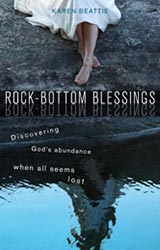 In the new book Rock-Bottom Blessings: Discovering God’s Abundance When All Seems Lost, Karen Beattie faces serious challenges: she loses her job, experiences a miscarriage, and encounters heart-wrenching difficulties in adopting a child. Her faith journey through her grief, loss and disappointment is at the heart of her book, now featured at the Patheos Book Club.
We had a chance to ask Beattie a few questions about her story, including what inspired her to write her book, her thoughts on “abundance,” and her conversion in her late 40s to Catholicism.
This is an honest and very personal book. What inspired you to share your story in Rock-Bottom Blessings?
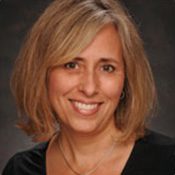 In 2009 I was laid off from my job, my husband was in school to change careers, and because of our lack of money, we had to put a long-awaited adoption on hold. I originally wrote the book to work out my own feelings and thoughts about what was going on. I was a good Christian – doing all of the right things. So why wasn’t God “blessing” me? I had picked up all of these ideas about God that were so wrong.
The author Parker Palmer once said “I write because I was born baffled.” I was born baffled, too. And writing helps me to understand. Another way to say it, and this I learned from a writing professor, is that “We write to find out what we know.” I was hoping that by working through all of these questions for myself, I would I some way help other people who were struggling with the same questions.
Much of your faith struggle in Rock-Bottom Blessings centers around money, or the lack there-of. How would you describe your particular journey with money — where it began and where it is now?
That’s a complicated question. I’m still trying to figure it out. In our society, money is not something like to talk about. Discussing our personal finances is a bit of a taboo. And one of the reasons I wrote this book was to bring the topic to the light and start a conversation about how our idea of abundance often has to do with our view of money.
Money affects every part of our lives – our relationships, our freedom, our security, whether we decide to have children or not. I grew up in a fairly upper middle class home, but there was a lot of anxiety about money. My father was a great provider, but I know he worried about supporting us. My mother used shopping as a way to cope with the stress of raising five children, which I totally understand. But there were a lot of mixed messages.
On top of that, our society tells us that if we just work hard enough and “pull ourselves up by out bootstraps,” we can be financially successful. And our churches – even if they are not prosperity gospel churches per se – imply that if we do all of the right things, God will “bless us” financially. I don’t think those things are true.
So all of these different messages have made me a little schizophrenic about money.
Writing this book was one way I was trying to unravel all of these messages. My vision, and I’m not sure I’m quite there yet, is to have a healthy, peaceful relationship with money. I want to be grateful for what I have, trust God to provide, and also try not to equate living an abundant life with having a lot of material wealth.
Yes, your book becomes more than anything a meditation on the word abundance. What was your starting description of that word, and what has it come to mean for you now?
I used to think abundance meant having a nice home, getting everything you wanted, having things go your way, enjoying financial security. Basically, being comfortable and happy and financially secure. Now I think of abundance as the transformation we experience in the midst of struggles. I think it’s about embracing the chaos and losses in life – because what happens in those difficult times is often miraculous in many ways. If you believe in the paschal mystery – the life, passion, and resurrection of Christ – then you can believe that resurrection can come even in the most difficult circumstance. I’ve also started seeing abundance in the minutia of life, like sitting with my daughter on the deck eating popsicles in the summer, or seeing the full moon shining across Lake Michigan. My view of abundance has both expanded, and become more focused.
You write of a “Ghost God” that helped you to see your past differently, and offered hope for your current challenges. What is the Ghost God for you?
There are times when you don’t think God is present in your life. He is silent, and he has “left the building.” During our financial crisis and my layoff, I couldn’t see God anywhere. I kept thinking – if I only saw a reason why all of this was happening, then I could endure it. If I could only catch a glimpse of God, I would have hope. But often, when you look back on events or the timeline of your life, you realize that God really was there, but he was lurking somewhere in the background, and you couldn’t see it at the time. In Flannery O’Connor’s novel Wise Blood, the character Hazel Motes says that Jesus is like “a ragged figure flitting from tree to tree at the back of his mind.” I can relate to that.
As part of your journey, you sought out a number of people of faith — a spiritual director, a financial planner at a mega-church, a Catholic priest — as well as explored a number of spiritual practices — the Spiritual Exercises of St. Ignatius, a Buddhist practice of praying for your “enemies.” Who and what’s been the most helpful to you in your own faith journey?
Going through the spiritual exercises of St. Ignatius had a huge part in transforming my faith, and was the turning point, I think, in my acceptance and peace about my situation. I learned that St. Ignatius, hundreds of years ago, was struggling with the exact same things that I was struggling with – being drawn to material wealth, wanting the riches of world and the world’s definition of success.
In the First Principle and Foundation of the spiritual exercises, St. Ignatius writes, “As far as we are concerned, we should not want health more than illness, wealth more than poverty, fame more than disgrace, a long life more than a short one, and similarly for all the rest, but we should desire and choose only what helps us more towards the end for which we are created.” I taped this to my bathroom mirror.
Part of your particular journey was converting to Catholicism in your 40s. What was it about the Catholic faith that drew you, especially during and throughout the challenges you recount in your book?
When my husband and I first walked into Old St. Pat’s in Chicago, we immediately felt like we were home. It was a bit like falling in love. I grew up in a Baptist church, which was very fundamentalist and interpreted scripture literally. Richard Rohr writes in his new book, Immortal Diamond, “Literalism is the lowest and least level of meaning.” I agree. And at some point it wasn’t enough for me. In my 20s and 30s, I spent a lot of time going to various non-denominational evangelical churches. After a while, I just felt like it wasn’t working any more. I needed a different language, and different rituals, to find God again.
There’s something to be said for beauty. When we entered Old St. Pat’s for the first time, we walked into a gorgeous sanctuary that had been built by Irish immigrants in the 1850s. The stained glass…the intricate Celtic-inspired designs on the walls and ceilings. I thought, “This beauty is worthy of my faith.” I needed tangible reminders of God – beauty, art, the Sacraments, the Sign of the Cross, the icons of the saints, signposts to point me to God until I could believe again. I was drawn to the fact that Catholics are much more comfortable with mystery and metaphor.
What was the hardest thing about writing this book? What was the easiest?
Writing has always been difficult for me. Trying to capture my feelings and thoughts on the page is excruciating. I never feel that it’s good enough. It was also hard just to get it done. I was sending chapters to my editor as I was writing. My goal was to send her a chapter a month. Having that accountability was great because there were so many times I wanted to quit. I would lose momentum, or feel that I had nothing more to say. I work full-time, so sitting in front of a computer all day, and then coming home and opening the computer again to work on the book was the last thing I wanted to do. But I also knew I needed to tell my story. I was compelled to get it out and on the page.
The easiest part, to be honest, was getting it published. I shopped the idea of the book around to a few people, but then I met with the wonderful folks at Loyola Press and they were so encouraging. I knew that Loyola Press was where this book belonged. It just seemed to fall into place. I know many other writers will hate me for saying that.
What do you most hope people take away from Rock-Bottom Blessings?
I think many people feel like they’re doing something wrong – that it’s their fault if their lives aren’t perfect, or they aren’t succeeding, or their dreams are unfulfilled. “What am I doing wrong?” “Is God punishing me?” “Does God love me?” I guess I want them to know that they are loved. That Ghost God is lurking behind the trees. And that resurrection can happen even in the most difficult circumstances.
Visit the Patheos Book Club to read an excerpt from Rock-Bottom Blessings.
Previous Post
August 27, 2013
Frank Schaeffer Reads From His Latest Novel: And God Said, "Billy!"
Next Post

August 30, 2013 A Land Without Sin: A Q&A with Author Paula Huston
Recent Comments
2,460 Comments | Leave a Comment
Browse Our Archives
Select a Category Author Q&A Book Review Christian Living Church Leadership Stump a Scholar Theology Uncategorized
Select a Month June 2022 March 2021 October 2020 August 2020 February 2019 November 2017 July 2017 June 2017 May 2017 March 2017 February 2017 January 2017 November 2016 October 2016 August 2016 July 2016 June 2016 May 2016 April 2016 March 2016 February 2016 January 2016 November 2015 October 2015 September 2015 August 2015 July 2015 June 2015 May 2015 April 2015 March 2015 February 2015 January 2015 December 2014 November 2014 October 2014 September 2014 August 2014 July 2014 June 2014 May 2014 April 2014 March 2014 February 2014 January 2014 December 2013 November 2013 October 2013 September 2013 August 2013 July 2013 June 2013 May 2013 April 2013 March 2013 February 2013 January 2013 December 2012 November 2012 October 2012 September 2012 August 2012 July 2012 June 2012 May 2012 April 2012 March 2012 February 2012 January 2012 December 2011 November 2011 October 2011 September 2011 August 2011 July 2011 June 2011 May 2011 April 2011 March 2011 February 2011 January 2011 December 2010 November 2010 October 2010 September 2010 August 2010 July 2010 June 2010
Follow Us!
TAKE THE
Religious Wisdom Quiz
I am the vine; you are the branches. If you remain in me and I in you, you will bear much ____; apart from me you can do nothing.
Select your answer to see how you score.
Peace Faith Joy Fruit
Related posts from Take and Read

Even the Faith Giants Didn’t Always Get it...

Author Lily Burana on Experiencing God's Grace and...

How the Church Can Heal the Race Divide

TRENDING AT PATHEOS Religious Music & Entertainment

"Les Diabolique" and Transgression
Alongside something like Arrival, Vertigo, or Charade, Les Diaboliques is a...

"The Plague Dogs" and Mortality
So, flashback to the late 70s, early 80s. Walt Disney Studios is...

With the recent and highly successful release of Christopher Nolan’s epic film,...

"L'avventura" and Human Weakness
Today's piece is going to be a little different for a few...

I first want to apologize for not posting or writing anything. I'm...

I've engaged in the multi-year project of reading through the Church Fathers,...
view all Religious Music & Entertainment blogs
Ad-Free & Subscriber Log-In Subscription Support
- About Us
- 2026 Calendar
- Videos
- Podcasts
- Library of World Religions
- Faith In Media Tracker
- Advertise With Us
- Write for Us
- Privacy Policy
- Terms of Service
- Do Not Sell My Data
- Contact Us
- Radiant Digital
- Manage Newsletter Subscriptions
- Unsubscribe From Notifications
- Sitemap
Copyright 2008-2026, Patheos. All rights reserved.
Subscription Support Ad-Free & Subscriber Log-In
Follow Patheos