
BuddhistCatholicContemplativeEvangelicalGeneral ChristianHinduJewishLatter-day SaintMuslimNew VisionsProgressive Christian
Beliefs
- Buddhist
- Catholic
- Contemplative
- Evangelical
- General Christian
- Hindu
- Jewish
- Latter-day Saint
- More Voices
- Muslim
- New Visions
- Pagan
- Progressive Christian
Topics
- Religion News
- Food and Religion
- Sports and Religion
- Religious Art
- Religious Music and Entertainment
- Religious Events
- History and Religion
- Style and Religion
- Politics and Religion
- Women in Religion
- Recreation Outdoors and Religion
- Business Finance and Religion
- Careers Workplace and Religion
- Education and Religion
- Family Parenting and Religion
- Health Fitness and Religion
- Home and Religion
- Relationships and Religion
- Technology and Religion
- Travel and Religion
Columnists
- Buddhist Columnists
- Business Finance and Religion Columnists
- Careers Workplace and Religion Columnists
- Catholic Columnists
- Contemplative Columnists
- Education and Religion Columnists
- Evangelists Columnists
- Family Parenting and Religion Columnists
- General Christian Columnists
- Health Fitness and Religion Columnists
- Hindu Columnists
- History and Religion Columnists
- Home and Religion Columnists
- Jewish Columnists
- More Voices Columnists
- Latter Day Columnists
- Muslim Columnists
- New Visions Columnists
- Nonreligious Columnists
- Pagan Columnists
- Politics and Religion Columnists
- Progressive Columnists
- Recreation Outdoors and Religion Columnists
- Relationships and Religion Columnists
- Religion News Columnists
- Religious Art Columnists
- Religious Events Columnists
- Religious Music and Entertainment Columnists
- Sports and Religion Columnists
- Style and Religion Columnists
- Technology and Religion Columnists
- Travel and Religion Columnists
- Women in Religion Columnists
Resource Library
- 2026 Calendar
- Library of World Religions
- The 100 Most Holy Places on Earth
- Patheos Answers
- Podcasts
- Videos
- Faith Leaders Database
- Anglican Episcopalian
- Bahai
- Baptist
- Buddhism
- Christianity
- Confucianism
- Eastern Orthodoxy
- Hinduism
- Holiness and Pentecostal
- ISKCON
- Islam
- Judaism
- Lutheran
- Methodist
- The Church of Jesus Christ of Latter-day Saints
- New Age
- Paganism
- Presbytarian and Reformed
- Protestantism
- Religion Behind the Scenes
- Roman Catholic
- Scientology
- Shia Islam
- Sikhism
- Sufism
- Sunni Islam
- Taoism
- Zen
- See all religions
Research Tools
 Ad-Free & Subscriber Log-In Subscription Support
Ad-Free & Subscriber Log-In Subscription Support
Follow Patheos 

- Trending:
- Forgiveness
- |
- Marriage
- |
- Consciousness
- |
- Death Penalty
- |
- Election
- |
- Halloween

- Home
- Religious Music & Entertainment
- C.S. Lewis, A Life: A Q&A with Author Alister McGrath
C.S. Lewis, A Life: A Q&A with Author Alister McGrath
Last updated on: February 28, 2013 at 11:26 am by Deborah Arca
C.S. Lewis, A Life: A Q&A with Author Alister McGrath 2013-02-28T11:26:00-07:00 Deborah Arca
Patheos Explore the world's faith through different perspectives on religion and spirituality! Patheos has the views of the prevalent religions and spiritualities of the world.
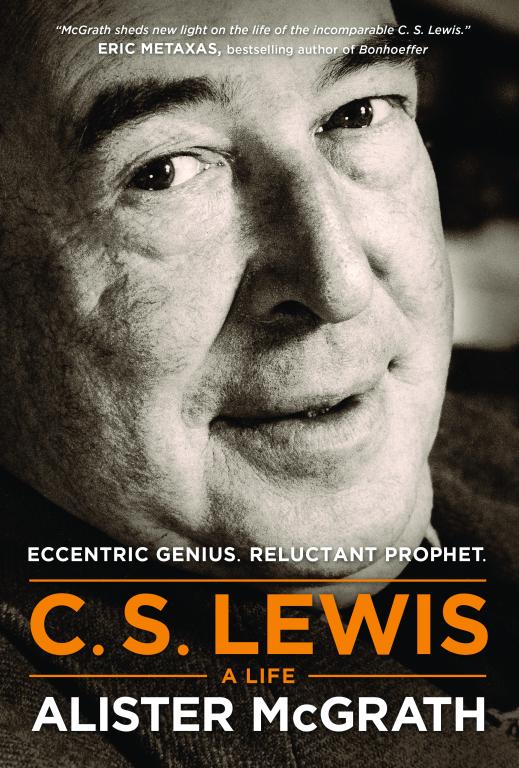 In C.S. Lewis — A Life, Alister McGrath, prolific author and respected professor at King’s College of London, paints a definitive portrait of the life of popular fiction writer and atheist-turned-Christian C. S. Lewis. After thoroughly examining recently published Lewis correspondence, Alister challenges some of the previously held beliefs about the exact timing of Lewis’s shift from atheism to theism and then to Christianity. He paints a portrait of an eccentric thinker who became an inspiring, though reluctant, prophet for our times.
Here, Dr. McGrath responds to a few questions about the book and the impact of Lewis’ life and legacy on this, the 50th anniversary of his death, for the Patheos Book Club.
 What stimulated your interest in writing a new biography of C. S. Lewis?
I started reading Lewis in the 1970s, when I was a student at Oxford University, and my admiration for him has grown over the years. 2013 marks the 50th anniversary of his death, and it seemed right to mark the occasion with a new biography.
Describe the parallels between your own spiritual journey and that of Lewis.
Lewis and I have many things in common. We were both born in Belfast and spent our childhoods there. We were both students and then dons at Oxford University. Both of us were atheists who discovered Christianity at Oxford. And we both try to defend Christianity against its critics. I think these parallels made it easier for me to understand Lewis.
You note that in the late 1940s, the famed “Kilns” where Lewis and his brother, Warnie, lived had become a dysfunctional household. What created the tension, and how did this affect Lewis’s writing?
Lewis shared The Kilns with his brother, Warnie, Mrs. Moore, and her daughter, Maureen. Maureen left home after her marriage in 1940. Shortly after this, it became obvious that Warnie had become an alcoholic, and Mrs. Moore began to develop dementia. By the late 1940s, Lewis found himself acting as a full-time nurse to Mrs. Moore (who could no longer look after herself) while trying to cope with his brother’s frequent absences on alcoholic binges in Ireland and their aftermath. It was unquestionably one of the darkest periods of his life.
Lewis was regarded by many of his academic colleagues at Oxford with suspicion or derision during that same period. Why did he experience such academic hostility?
There were two sources of concern to Lewis’s academic colleagues at Oxford in the 1940s. The first was Lewis’s explicit commitment to Christianity, which irritated the more dogmatic academic atheists of his day. Yet the evidence suggests that this was not the major concern. Academic hostility towards Lewis really began to develop in the early 1940s, and largely rested on the perception that he had become a populariser rather than a serious scholar. This impression arose primarily as a result of The Screwtape Letters. These were seen by many of his colleagues as academically frivolous and lightweight. Lewis would probably have got away with this, if he had produced some major academic works around this time. But it was not until 1954 that Lewis produced a really serious piece of scholarship, which restored his academic reputation and helped secure his appointment as Professor of English Literature at Cambridge University.
One of the most compelling aspects of your research involves the redating of Lewis’s conversion to theism. What led you to reexamine this chronology?
I did not expect to raise questions about the traditional dating of Lewis’s conversion to theism. Yet the method of research I used forced me to this conclusion. In preparation for this work, I read everything that Lewis wrote in chronological order. After I had read everything for 1929—the traditional date of his “conversion”—I was puzzled. Nothing fundamental seemed to have changed. Yet beginning in February 1930, his writings show obvious signs of some kind of reorientation. I then examined the evidence for the traditional date of his conversion in minute detail, and concluded— for reasons set out clearly in the biography—that his conversion must have taken place a year later than everyone had believed. I think this is the most significant finding reported in the biography.
In the course of your research, you conducted a complete, chronological analysis of the entire collection of Lewis’s letters and archives. How long did this take you?
This took me fifteen months and involved long periods of reading and note-taking. But it was fascinating, seeing how Lewis’s ideas and style developed and how his authorial “voice” emerged. I took the view that you simply could not write a biography of Lewis without reading his total output. One result of this is that I quote from Lewis more than many of his earlier biographers so that my readers can hear Lewis’s voice, and not simply my own. I also explored archives, mainly in Oxford, and was able to turn up some important material never used by Lewis’s biographers that casts new light on his life, especially during the 1910s.
Many readers are fascinated by the love relationship late in life between Lewis and Joy Davidman Gresham. You quote her son Douglas as stating that his mother originally went to England with one specific intention: “To seduce C. S. Lewis.” How did he come to assess the situation in that manner?
Douglas Gresham bases his judgment on his memories of his mother from that time. We don’t know quite what led him to that judgment, but the evidence now available confirms his suspicions. It is clear from some of Joy’s writings of the period—especially a collection of “Sonnets” that have only very recently come to light—that she actively set out to seduce Lewis. We can hope to have some fine new biographies of Joy from significant scholars in the near future which will explore this matter in much greater detail.
You write that Joy’s marriage to Jack was, in Lewis’s view, purely a marriage of convenience at first. At what point did Lewis’s feelings for her begin to change?
Lewis initially saw his clandestine civil marriage to Joy as a chivalrous act which would enable her to remain in England and develop her career as a journalist and writer. The evidence strongly suggests that Lewis’s feelings towards Joy began to change when he became conscious that she was seriously ill. The realization that he might soon lose her seems to have triggered a deep sense of compassion and care, resulting in a romantic love for Joy that doesn’t seem to have been present earlier. It’s hard to date this development, but it’s clearly reflected in a letter Lewis wrote to the novelist Dorothy L. Sayers in June 1957.
The friendship between Lewis and Tolkien cooled as the years progressed. Why did Tolkien’s views about Lewis darken?
The relationship between Lewis and Tolkien was of major importance to both throughout the 1930s and into the early 1940s. The cooling seems to have taken place mainly on Tolkien’s side, reflecting three issues. The first was what seems to have been jealousy on Tolkien’s part about the growing influence that the novelist Charles Williams had on Lewis in the early 1940s. This was alleviated somewhat with Williams’s death in 1945. The second emerged in the early 1950s, when Tolkien began to suspect that Lewis’s Chronicles of Narnia borrowed some of his own ideas without due acknowledgment. Third, Tolkien regarded Lewis’s views of marriage as inadequate and was dismayed by Lewis marrying a divorcée and hurt by the fact that Lewis failed to tell him about it. In any case, Tolkien cordially detested Joy personally. Yet Lewis always respected and admired Tolkien. One of my discoveries in researching this biography was a hitherto unknown letter in which Lewis proposed Tolkien for the 1961 Nobel Prize for Literature, which clearly reflects this high regard.
Lewis’s death on November 22, 1963, was overshadowed in the media by the assassination of John F. Kennedy. How are we to judge Lewis’s life and legacy fifty years after his death?
The most important thing is that more people read Lewis today than at any point in his lifetime. Although many—including Lewis himself—believed that his influence and reputation would quickly fade after his death, Lewis has bounced back. Partly this reflects the imaginative appeal of the Chronicles of Narnia, particularly now that some of the novels have been turned into major movies. But there is also substantial interest in Lewis’s literary and religious writings, some of which have established themselves as “classics.” My biography provides a solid base for future exploration of Lewis’s legacy, which I think is going to be significant for some considerable time to come.
For more on Alister McGrath’s new book C.S. Lewis — A Life, visit the Patheos Book Club here.
Previous Post
February 18, 2013
Abolitionist Mamas: A Q&A with Shayne Moore and Kim McOwen Yim
Next Post
February 28, 2013 Finding God in the Dark: A Q&A with Ted Kluck and Ronnie Martin
Recent Comments
Browse Our Archives
Select a Category Author Q&A Book Review Christian Living Church Leadership Stump a Scholar Theology Uncategorized
Select a Month June 2022 March 2021 October 2020 August 2020 February 2019 November 2017 July 2017 June 2017 May 2017 March 2017 February 2017 January 2017 November 2016 October 2016 August 2016 July 2016 June 2016 May 2016 April 2016 March 2016 February 2016 January 2016 November 2015 October 2015 September 2015 August 2015 July 2015 June 2015 May 2015 April 2015 March 2015 February 2015 January 2015 December 2014 November 2014 October 2014 September 2014 August 2014 July 2014 June 2014 May 2014 April 2014 March 2014 February 2014 January 2014 December 2013 November 2013 October 2013 September 2013 August 2013 July 2013 June 2013 May 2013 April 2013 March 2013 February 2013 January 2013 December 2012 November 2012 October 2012 September 2012 August 2012 July 2012 June 2012 May 2012 April 2012 March 2012 February 2012 January 2012 December 2011 November 2011 October 2011 September 2011 August 2011 July 2011 June 2011 May 2011 April 2011 March 2011 February 2011 January 2011 December 2010 November 2010 October 2010 September 2010 August 2010 July 2010 June 2010
Follow Us!
TAKE THE
Religious Wisdom Quiz
Who said: "You are a chosen people, a royal priesthood, a holy nation, God's special possession"?
Select your answer to see how you score.
Peter Moses James Paul
Related posts from Take and Read

"The Slow March of Light" Highlights The Human...

"A Brilliant Night of Stars and Ice" Recounts...

How To Judge The Bible By Its Cover

Life is an Endless Invitation: Q&A With Rob...
TRENDING AT PATHEOS Religious Music & Entertainment

"Les Diabolique" and Transgression
Alongside something like Arrival, Vertigo, or Charade, Les Diaboliques is a...

"The Plague Dogs" and Mortality
So, flashback to the late 70s, early 80s. Walt Disney Studios is...

With the recent and highly successful release of Christopher Nolan’s epic film,...

"L'avventura" and Human Weakness
Today's piece is going to be a little different for a few...

I first want to apologize for not posting or writing anything. I'm...

I've engaged in the multi-year project of reading through the Church Fathers,...
view all Religious Music & Entertainment blogs
Ad-Free & Subscriber Log-In Subscription Support
- About Us
- 2026 Calendar
- Videos
- Podcasts
- Library of World Religions
- Faith In Media Tracker
- Advertise With Us
- Write for Us
- Privacy Policy
- Terms of Service
- Do Not Sell My Data
- Contact Us
- Radiant Digital
- Manage Newsletter Subscriptions
- Unsubscribe From Notifications
- Sitemap
Copyright 2008-2026, Patheos. All rights reserved.
Subscription Support Ad-Free & Subscriber Log-In
Follow Patheos