
BuddhistCatholicContemplativeEvangelicalGeneral ChristianHinduJewishLatter-day SaintMuslimNew VisionsProgressive Christian
Beliefs
- Buddhist
- Catholic
- Contemplative
- Evangelical
- General Christian
- Hindu
- Jewish
- Latter-day Saint
- More Voices
- Muslim
- New Visions
- Pagan
- Progressive Christian
Topics
- Religion News
- Food and Religion
- Sports and Religion
- Religious Art
- Religious Music and Entertainment
- Religious Events
- History and Religion
- Style and Religion
- Politics and Religion
- Women in Religion
- Recreation Outdoors and Religion
- Business Finance and Religion
- Careers Workplace and Religion
- Education and Religion
- Family Parenting and Religion
- Health Fitness and Religion
- Home and Religion
- Relationships and Religion
- Technology and Religion
- Travel and Religion
Columnists
- Buddhist Columnists
- Business Finance and Religion Columnists
- Careers Workplace and Religion Columnists
- Catholic Columnists
- Contemplative Columnists
- Education and Religion Columnists
- Evangelists Columnists
- Family Parenting and Religion Columnists
- General Christian Columnists
- Health Fitness and Religion Columnists
- Hindu Columnists
- History and Religion Columnists
- Home and Religion Columnists
- Jewish Columnists
- More Voices Columnists
- Latter Day Columnists
- Muslim Columnists
- New Visions Columnists
- Nonreligious Columnists
- Pagan Columnists
- Politics and Religion Columnists
- Progressive Columnists
- Recreation Outdoors and Religion Columnists
- Relationships and Religion Columnists
- Religion News Columnists
- Religious Art Columnists
- Religious Events Columnists
- Religious Music and Entertainment Columnists
- Sports and Religion Columnists
- Style and Religion Columnists
- Technology and Religion Columnists
- Travel and Religion Columnists
- Women in Religion Columnists
Resource Library
- 2026 Calendar
- Library of World Religions
- The 100 Most Holy Places on Earth
- Patheos Answers
- Podcasts
- Videos
- Faith Leaders Database
- Anglican Episcopalian
- Bahai
- Baptist
- Buddhism
- Christianity
- Confucianism
- Eastern Orthodoxy
- Hinduism
- Holiness and Pentecostal
- ISKCON
- Islam
- Judaism
- Lutheran
- Methodist
- The Church of Jesus Christ of Latter-day Saints
- New Age
- Paganism
- Presbytarian and Reformed
- Protestantism
- Religion Behind the Scenes
- Roman Catholic
- Scientology
- Shia Islam
- Sikhism
- Sufism
- Sunni Islam
- Taoism
- Zen
- See all religions
Research Tools
 Ad-Free & Subscriber Log-In Subscription Support
Ad-Free & Subscriber Log-In Subscription Support
Follow Patheos 

- Trending:
- Forgiveness
- |
- Marriage
- |
- Consciousness
- |
- Death Penalty
- |
- Election
- |
- Halloween

- Home
- Religious Music & Entertainment
- Love & Salt: A Q&A with Amy Andrews and Jessica Mesman Griffith
Love & Salt: A Q&A with Amy Andrews and Jessica Mesman Griffith
Last updated on: February 1, 2013 at 2:29 pm by Deborah Arca
Love & Salt: A Q&A with Amy Andrews and Jessica Mesman Griffith 2013-02-01T14:29:50-07:00 Deborah Arca
Patheos Explore the world's faith through different perspectives on religion and spirituality! Patheos has the views of the prevalent religions and spiritualities of the world.
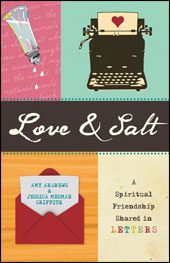 In our hyper-digital age of shorter and shorter missives communicated through fewer and fewer strokes, a friendship sustained and deepened through long, handwritten letters is an extraordinary act of love and faith. Love & Salt: A Spiritual Friendship in Letters, is an achingly beautiful new book chronicling the friendship between two young Catholic women over a five year span, as they make sense of their daily lives — marriage, career, Church, pregnancy, motherhood, and tragic loss — through the lens of faith. The resulting letters – each a deep soul dive that leaves you savoring, while yearning for the next – reveals an exquisite, honest, heart-breaking and ultimately hopeful portrait of two lives deeply lived, contemplated, shared, and redeemed in the context of the search for God.
We invited Jess and Amy to respond to some questions about the letters, their friendship, and the decision to share it all in a book.
What inspired your letter-writing to each other?
 Jess: We were just getting to know each other when we both moved away from Pittsburgh. Neither of us had a very good track record with long-distance relationships. Since we had initially bonded by reading each other’s writing about faith, it made sense to continue the friendship through writing. We loved the idea of it, writing these old-fashioned letters rather than emails or phone calls.
 Amy: I actually have a hard time remembering exactly how we cooked up the idea, I just know how thrilling it felt – like we were heading out on the road to Compostela. Very early on in our friendship we started devising mini-pilgrimages: a trip to see the relics at St. Anthony’s in Pittsburgh, a trek out to Flannery O’Connor’s farm in Georgia, or a weekend at a Trappist monastery. That’s how this letter-writing project felt, like we were at the start of a quest, and the romance of it – being wayfarers on the road to something sacred – enchanted us.
When you began your letters to each other, did you ever imagine it would last nearly five years? What was it about the process of writing to each other that kept it going so long after the initial commitment?
Jess: I don’t know that we would have seen it through if we hadn’t decided to make it a Lenten commitment—one letter for every day of that first Lent. I hear that it takes at least a month of daily repetition to form a new habit. We were definitely hooked before the end of that Lent. At that point, I couldn’t imagine life without them.
Amy: I once read in a review of the collected letters of William and Henry James that their letters were not only the form their intimacy took, but also the very medium of their thinking, being and spiritual experience. Somehow the abstract or the unseen never becomes real for me if I am left alone with my own thoughts. Writing to Jess returns me to life. So, of course, once I discovered this during our first Lent, I couldn’t let our letters go.
How is your friendship different from the other relationships in your lives, because of the letters?
Jess: Amy has written that it’s almost like we have two friendships—the one where we visit each other and talk on the phone about our kids and husbands and daily lives, like all friends do, and then, the friendship of our letters, where we try to understand our daily lives in relationship to God. I once handed her a letter in person, and we both realized that we felt a little shy about it. Amy described it as like meeting her secret correspondent for the first time. For me it was like seeing my confessor face to face after I’d poured out all my sins and doubt behind the screen.
What really makes our friendship different, though, is that it’s a spiritual friendship. We came together to seek God, and that search is really the foundation, the thing that our friendship is “about.” I want to add that “spiritual” here does not mean our friendship is always high or good or pure. We struggle with the same things – jealousy, competition, paranoia – that all friendships contend with. It’s just that what’s at the heart of our friendship – our search for God – has the power to redeem us. I think that’s one of the real satisfactions of our story.
Amy: I think letter writing made an ongoing intimacy between us more possible. Often the initial phase of friendship (either a romantic or platonic one) is so intense because you are trying to give yourself to the other person through storytelling. But eventually you’ve told most of your stories; you feel that you know each other. At this point it is often hard for intimacy to continue to deepen. If you open your heart anew or try to be something new, you worry this person who knows you so well will see through the attempt. But our letters offered a way of talking – almost like whispering in the dark – that kept our intimacy fresh, even when the going got rough.
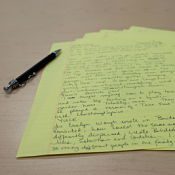 Mid-way through the book, Amy says: “The arrival of a letter is often the only sacramental thing in my day … We press God out in the pages of our letters, ironing and ironing, like two old-fashioned women. We mail him back and forth, and pile him up, like a basket of linen.” Can you say more about the sacramental nature of your letters?
Amy: When you love someone that love is largely invisible. Children are a physical manifestation of marital love, but not every friendship can have an obvious physical sign of its unity. When I get a letter from Jess, I feel like I’m holding a real artifact from that unseen bond. I remember Jess writing to me about receiving her Grandmother’s letters in a box. She poured over them, treasured them, held them gently. Goethe once said that letters are “the most immediate breath of life.” With a letter in hand, you have the sense that your friend is with you, present in her words. It’s not only the physicality of the letter itself, the unique quality of the handwriting, but the mysterious connection between word and person that creates that sacramental feel.
Your letters are deeply honest and expressive of a full range of emotion — joy, doubt, hope, boredom, despair, ecstasy. You write candidly about your husbands, parents, in-laws, children, co-workers and friends. How did you decide to allow these very personal letters to become a book to be shared with hundreds of readers? What was that discernment process like for each of you?
Jess: It was, and is, hard. But as a writer, especially a writer of personal essay and memoir, I’ve had to accept that it comes with the territory. Plus we felt that the honesty and the candidness, the authenticity, of the letters was one of their chief virtues.
Amy: I agree – it was very hard. In fact after we finished editing the letters into a book-length manuscript, we shelved the final draft for almost two years before sending it to Loyola Press. One of the things that helped us get over our trepidation was the book Looking Before and After by Alan Jacobs. He urges Christians to tell their stories in order to flesh out the various forms, or genres, the Christian life might take. By doing this, Jacobs thinks, we help each other avoid despair and resignation on the road to God, offering each other a vision of hope. This helped us move forward, for we were fairly confident that if nothing else our story succeeded in fleshing out a particular way to God – the way of friendship. And since so little these days is written about serious friendship between women, or serious friendship period, we thought it could be a real contribution.
A theme revisited often in your letters is summed up in this question from Jess: “Are we missing our lives by obsessing over our souls?” How would you answer that question now? Have you found the balance between living and contemplation?
Jess: Ultimately we realized that our letters had the opposite effect. They came to be the way that we savored experience—a way to suspend time, one of our common obsessions. Often it was only in writing and reflecting on my days, and many times my days long past, that I uncovered the deeper meaning that of course had been there all along.
Amy: I think about that tie between contemplation and living all the time. I keep coming across advice from psychologists to keep a gratitude journal, which is another way of contemplating life. They tell us this will lead to happiness. I’ve been trying to make sense of our letters in light of all this. I feel like our correspondence is the dark, brooding cousin of the gratitude journal. In a similar way our letters purposefully frame life on a daily basis, but they are certainly not a consistent record of happiness. Sometimes we do record happy moments, but those moments are never what I feel is most profound about our practice. What I see instead is the movement through periods of bleakness, doubt and grief that eventually reveals a retrospective vision of God’s grace, pervasive through all those times. In the end it was not so much happiness, but hope our letters gave us.
Another crucial theme that persists throughout your letters is the fear of death. What ultimately sustained you through the real and imagined experiences of death in your lives?
Jess: I almost said grace, but often we can’t perceive the workings of grace during those intense periods of grief that follow the death of someone we love. In the face of death, I, personally, felt totally abandoned, and that nothing was real but death. So, really, what sustained us was the cross, the belief that God became man and faced even this, and that even this did not end his love.
Amy: I’m so glad you brought this up. I definitely agree that an awareness of death was at the center of our letters and of our friendship. The question of how to believe in the face of mortality is really what focused our correspondence. And this focus is responsible more than anything else for our letters becoming a book. We never set out to write a story, and in fact most collections of letters are an assemblage and have no narrative drive. But because there was a single question at the heart of our correspondence and because in the middle of those years we encountered a real tragedy, our letters became a story. And I agree with Jess, the revelation of our story – and the thing that sustained us – was the cross, which includes the resurrection. In the end we discovered a hope beyond death, which was the answer our question traveled into.
You both are beautiful writers … how did the act of letter writing change, shape or grow you as a writer?
Jess: It’s just a different writing experience than any other form. It’s not public, but it’s not private either, like keeping a journal or a diary. You’re still accountable to an audience, only that audience is just one soul. You don’t have to worry about pleasing everyone (or as many as you can), as you inevitably do with any form of public writing. It’s that peculiar middle, not public, not totally private, that makes letters so fascinating to me. It was also pretty instructive and inspiring to be getting these beautiful, profound letters from Amy in the mail every day. I definitely grew as a writer and thinker just from being in conversation with her in this way.
Amy: When you write a letter, you imagine the presence of a receptive world beyond the self. It’s the same act of faith required to create any piece of writing or, for that matter, to pray. And it’s really a desire for response. When that response actually comes in an envelope in the handwriting of a friend, it shores you up for the hard work of writing, and of praying. I’ve learned so much about both writing and prayer from my correspondence with Jess. It actually seems I’m quite incapable of both when our letters have lapsed.
Were there periods of time that your letter writing slowed? How did you decide to eventually stop altogether?
Jess: We haven’t stopped! We keep telling each other that. This Lent we are committing again to a letter a day. Kids definitely slowed us down, though, I’m not gonna lie. I used to write with Charlotte asleep in my lap. She’s seven now, and she and her little brother want me to play Hobbits every waking hour. And they require much less sleep than I do.
There was one time when we really did stop writing, and that’s when Amy moved to Sweet Briar for nine months. We lived around the corner from each other on the college campus. For the first time in our friendship, I saw her every day. We tried to devise ways to keep up the letter writing—we even tried to give up seeing each other for Lent. But we just couldn’t make it work. That was the greatest consolation when she had to move away: we knew we’d get our letters back.
What was the hardest part of writing letters to each other? And what was the greatest gift to each of you in the exchange of your letters?
Jess: The hardest part of writing letters was carving out that bit of time every day to write them. It became even harder with small children around to find that space for contemplation, and it’s painful, because there’s so much that I want to recall and preserve and explore about life with children.
The greatest gift was friendship, and the discovery that friendship, as the 12th century monk Aelred of Rievaulx wrote, is where God abides.
Amy: I just want to add one thing. In his book Spiritual Friendship, which we discovered long after we began writing our letters, Aelred says that finding God in friendship gives us a foretaste of eternity. In this life, he says, we are called upon to love everyone, even our enemies, but only in friendship do charity and sweetness come together. It is this foretaste of eternity, I think, that is the real gift our letters gave us. We spend much of the book confronting mortality and seeking God’s providence, but in the end the revelation of eternal life – abiding, as Jess said, in our friendship – is the real presence we discover.
What’s next for each of you? What projects are you currently working on/inspired by?
Amy: We’re both working on other memoirs. And of course, we’re still writing letters!
For more conversation on Love & Salt – and to read an excerpt, watch a video Q&A, and hear the authors reading their letters aloud – visit the Patheos Book Club here.
Previous Post

January 31, 2013
A Contagious Christ: A Review of Follow Me
Next Post
February 1, 2013 Soul Friends: A Review of Love & Salt
Recent Comments
2,777 Comments | Leave a Comment
Browse Our Archives
Select a Category Author Q&A Book Review Christian Living Church Leadership Stump a Scholar Theology Uncategorized
Select a Month June 2022 March 2021 October 2020 August 2020 February 2019 November 2017 July 2017 June 2017 May 2017 March 2017 February 2017 January 2017 November 2016 October 2016 August 2016 July 2016 June 2016 May 2016 April 2016 March 2016 February 2016 January 2016 November 2015 October 2015 September 2015 August 2015 July 2015 June 2015 May 2015 April 2015 March 2015 February 2015 January 2015 December 2014 November 2014 October 2014 September 2014 August 2014 July 2014 June 2014 May 2014 April 2014 March 2014 February 2014 January 2014 December 2013 November 2013 October 2013 September 2013 August 2013 July 2013 June 2013 May 2013 April 2013 March 2013 February 2013 January 2013 December 2012 November 2012 October 2012 September 2012 August 2012 July 2012 June 2012 May 2012 April 2012 March 2012 February 2012 January 2012 December 2011 November 2011 October 2011 September 2011 August 2011 July 2011 June 2011 May 2011 April 2011 March 2011 February 2011 January 2011 December 2010 November 2010 October 2010 September 2010 August 2010 July 2010 June 2010
Follow Us!
TAKE THE
Religious Wisdom Quiz
Which king had dreams interpreted by Daniel?
Select your answer to see how you score.
Nebuchadnezzar Belshazzar Ahasuerus Darius
Related posts from Take and Read

"The Slow March of Light" Highlights The Human...

"A Brilliant Night of Stars and Ice" Recounts...

How To Judge The Bible By Its Cover

Life is an Endless Invitation: Q&A With Rob...
TRENDING AT PATHEOS Religious Music & Entertainment

"Les Diabolique" and Transgression
Alongside something like Arrival, Vertigo, or Charade, Les Diaboliques is a...

"The Plague Dogs" and Mortality
So, flashback to the late 70s, early 80s. Walt Disney Studios is...

With the recent and highly successful release of Christopher Nolan’s epic film,...

"L'avventura" and Human Weakness
Today's piece is going to be a little different for a few...

I first want to apologize for not posting or writing anything. I'm...

I've engaged in the multi-year project of reading through the Church Fathers,...
view all Religious Music & Entertainment blogs
Ad-Free & Subscriber Log-In Subscription Support
- About Us
- 2026 Calendar
- Videos
- Podcasts
- Library of World Religions
- Faith In Media Tracker
- Advertise With Us
- Write for Us
- Privacy Policy
- Terms of Service
- Do Not Sell My Data
- Contact Us
- Radiant Digital
- Manage Newsletter Subscriptions
- Unsubscribe From Notifications
- Sitemap
Copyright 2008-2026, Patheos. All rights reserved.
Subscription Support Ad-Free & Subscriber Log-In
Follow Patheos