
BuddhistCatholicContemplativeEvangelicalGeneral ChristianHinduJewishLatter-day SaintMuslimNew VisionsProgressive Christian
Beliefs
- Buddhist
- Catholic
- Contemplative
- Evangelical
- General Christian
- Hindu
- Jewish
- Latter-day Saint
- More Voices
- Muslim
- New Visions
- Pagan
- Progressive Christian
Topics
- Religion News
- Food and Religion
- Sports and Religion
- Religious Art
- Religious Music and Entertainment
- Religious Events
- History and Religion
- Style and Religion
- Politics and Religion
- Women in Religion
- Recreation Outdoors and Religion
- Business Finance and Religion
- Careers Workplace and Religion
- Education and Religion
- Family Parenting and Religion
- Health Fitness and Religion
- Home and Religion
- Relationships and Religion
- Technology and Religion
- Travel and Religion
Columnists
- Buddhist Columnists
- Business Finance and Religion Columnists
- Careers Workplace and Religion Columnists
- Catholic Columnists
- Contemplative Columnists
- Education and Religion Columnists
- Evangelists Columnists
- Family Parenting and Religion Columnists
- General Christian Columnists
- Health Fitness and Religion Columnists
- Hindu Columnists
- History and Religion Columnists
- Home and Religion Columnists
- Jewish Columnists
- More Voices Columnists
- Latter Day Columnists
- Muslim Columnists
- New Visions Columnists
- Nonreligious Columnists
- Pagan Columnists
- Politics and Religion Columnists
- Progressive Columnists
- Recreation Outdoors and Religion Columnists
- Relationships and Religion Columnists
- Religion News Columnists
- Religious Art Columnists
- Religious Events Columnists
- Religious Music and Entertainment Columnists
- Sports and Religion Columnists
- Style and Religion Columnists
- Technology and Religion Columnists
- Travel and Religion Columnists
- Women in Religion Columnists
Resource Library
- 2026 Calendar
- Library of World Religions
- The 100 Most Holy Places on Earth
- Patheos Answers
- Podcasts
- Videos
- Faith Leaders Database
- Anglican Episcopalian
- Bahai
- Baptist
- Buddhism
- Christianity
- Confucianism
- Eastern Orthodoxy
- Hinduism
- Holiness and Pentecostal
- ISKCON
- Islam
- Judaism
- Lutheran
- Methodist
- The Church of Jesus Christ of Latter-day Saints
- New Age
- Paganism
- Presbytarian and Reformed
- Protestantism
- Religion Behind the Scenes
- Roman Catholic
- Scientology
- Shia Islam
- Sikhism
- Sufism
- Sunni Islam
- Taoism
- Zen
- See all religions
Research Tools
 Ad-Free & Subscriber Log-In Subscription Support
Ad-Free & Subscriber Log-In Subscription Support
Follow Patheos 

- Trending:
- Forgiveness
- |
- Marriage
- |
- Consciousness
- |
- Death Penalty
- |
- Election
- |
- Halloween

- Home
- Religious Music & Entertainment
- Jews, Christians and Muslims? Do Any Two People Worship the Same God?
Jews, Christians and Muslims? Do Any Two People Worship the Same God?
Last updated on: December 5, 2012 at 10:47 am by Brad Hirschfield
Jews, Christians and Muslims? Do Any Two People Worship the Same God? 2012-12-05T10:47:39-07:00 Brad Hirschfield
Patheos Explore the world's faith through different perspectives on religion and spirituality! Patheos has the views of the prevalent religions and spiritualities of the world.
 By Rabbi Brad Hirschfield
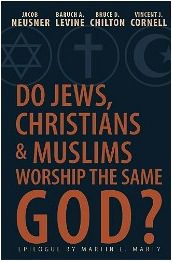
Don’t you love it when great minds think alike? I am not referring to the five contributors to Do Jews, Christians, & Muslims Worship The Same God?, though they are great minds, and in some regards they do think alike. I refer to Robert Hunt and to myself, in that we were both struck by a particular claim made in the book by Professor Jacob Neusner.
Yes, I realize that I am complimenting myself by jumping into the “great minds” category along with Hunt, but I hope that both he and you readers will forgive my humor and appreciate that my focus is on what it was that captured our attention. Neusner writes, and Hunt highlights the following words:
“Interfaith dialogue is made possible by monotheism, which defines the common ground on the foundations of which debate can take place. Polytheism defines dialogue out of existence, making provision, rather, for an exchange of opinions in a spirit of tolerance.”
I agree with Hunt about the importance of that claim, but disagree, both with him and with Professor Neusner that interfaith dialogue is only possible among monotheists, and that polytheism defines such conversation out of existence. While I think I know what they mean in making and supporting that claim, I think that the viability of any conversation about God or Gods is determined by the willingness of the participants, not the particular theology they hold.
Interfaith dialogue is not limited to conversation about God, and even if it were, the monotheist/polytheist divide does not render that conversation impossible as long as both sides believe that they can actually learn about “their” God from those who worship “another” God or Gods.
Intellectual suppleness and expansiveness, not the God or gods in whom one believes, are the only limiting factors in interfaith dialogue. If one chooses to invoke theology as the reason/excuse for not having such conversations, so be it, but it need not be so.
At the end of the day, I was struck by Bruce Chilton’s observation that we might find it more useful and meaningful to focus not on the issue of the sameness of God for Jews, Christians, and Muslims, but on the fact that all three affirm belief in the oneness of God. At the very least, recognizing the power of that claim to all three traditions invites conversations in ways which debates about sameness never will.
In fact, leaving aside Jews, Christians, Muslims, one could reasonably ask if any two people worship the same God. Theological deal-making and doctrine-solving by religious authorities aside, the fact is, that no two people could possibly have the same conception of God, even if they claim to – especially monotheists.
When people posit, as all three of the so-called “Abrahamic traditions” do, that the God in whom they believe is infinite, then all assertions about that God are no more than approximations, dependant on the one who makes them, and necessarily, filtered through their own perspective and experience. In other words, in the truest sense of the word, no two people worship the same God. The gap between people’s finitude and God’s infinity assures that.
To be sure, some people’s conceptions are closer than are others’, and when there is a sufficient number of such like-minded (not same-minded) folk, they call themselves a community. But even within the most cohesive and coherent communities, there is sufficient difference to preclude the use of worshipping the same God as anything other than a way to rally the faithful.
It is precisely that gap between human finitude, and an infinite divine, which can nurture serious interfaith dialogue, whether between the followers of different faiths, or even those who officially follow the same faith. The “inter-ness” is the willingness to appreciate both the relatedness of any two faith claims, the distinctiveness of each of those claims, and the possibility of genuine wisdom and insight arising from the shared conversation between them.
Follow the conversation on Do Jews, Christians and Muslims Worship the Same God? at the Patheos Book Club here.
 Listed three years in a row in Newsweek as one of America’s 50 Most Influential Rabbis, and recognized as one of our nation’s leading Preachers & Teachers by Beliefnet.com, think tank President, talk show host, interfaith activist, and diversity expert Brad Hirschfield is the author of You Don’t Have To Be Wrong For Me To Be Right: Finding Faith Without Fanaticism (Harmony, 2008).
Previous Post

December 4, 2012
Santa Claus Training, Part 3: St. Nicholas in a Violent World
Next Post

December 6, 2012 Walnut Boats and Fur-Ball Mice: The Real Gifts of Christmas
Browse Our Archives
Select a Category Author Q&A Book Review Christian Living Church Leadership Stump a Scholar Theology Uncategorized
Select a Month June 2022 March 2021 October 2020 August 2020 February 2019 November 2017 July 2017 June 2017 May 2017 March 2017 February 2017 January 2017 November 2016 October 2016 August 2016 July 2016 June 2016 May 2016 April 2016 March 2016 February 2016 January 2016 November 2015 October 2015 September 2015 August 2015 July 2015 June 2015 May 2015 April 2015 March 2015 February 2015 January 2015 December 2014 November 2014 October 2014 September 2014 August 2014 July 2014 June 2014 May 2014 April 2014 March 2014 February 2014 January 2014 December 2013 November 2013 October 2013 September 2013 August 2013 July 2013 June 2013 May 2013 April 2013 March 2013 February 2013 January 2013 December 2012 November 2012 October 2012 September 2012 August 2012 July 2012 June 2012 May 2012 April 2012 March 2012 February 2012 January 2012 December 2011 November 2011 October 2011 September 2011 August 2011 July 2011 June 2011 May 2011 April 2011 March 2011 February 2011 January 2011 December 2010 November 2010 October 2010 September 2010 August 2010 July 2010 June 2010
Follow Us!
TAKE THE
Religious Wisdom Quiz
What Christian celebration commemorates the resurrection of Jesus Christ?
Select your answer to see how you score.
Lent Christmas Epiphany Easter
Related posts from Take and Read

"The Slow March of Light" Highlights The Human...

"A Brilliant Night of Stars and Ice" Recounts...

How To Judge The Bible By Its Cover

Life is an Endless Invitation: Q&A With Rob...
TRENDING AT PATHEOS Religious Music & Entertainment

"Les Diabolique" and Transgression
Alongside something like Arrival, Vertigo, or Charade, Les Diaboliques is a...

"The Plague Dogs" and Mortality
So, flashback to the late 70s, early 80s. Walt Disney Studios is...

With the recent and highly successful release of Christopher Nolan’s epic film,...

"L'avventura" and Human Weakness
Today's piece is going to be a little different for a few...

I first want to apologize for not posting or writing anything. I'm...

I've engaged in the multi-year project of reading through the Church Fathers,...
view all Religious Music & Entertainment blogs
Ad-Free & Subscriber Log-In Subscription Support
- About Us
- 2026 Calendar
- Videos
- Podcasts
- Library of World Religions
- Faith In Media Tracker
- Advertise With Us
- Write for Us
- Privacy Policy
- Terms of Service
- Do Not Sell My Data
- Contact Us
- Radiant Digital
- Manage Newsletter Subscriptions
- Unsubscribe From Notifications
- Sitemap
Copyright 2008-2026, Patheos. All rights reserved.
Subscription Support Ad-Free & Subscriber Log-In
Follow Patheos