
BuddhistCatholicContemplativeEvangelicalGeneral ChristianHinduJewishLatter-day SaintMuslimNew VisionsProgressive Christian
Beliefs
- Buddhist
- Catholic
- Contemplative
- Evangelical
- General Christian
- Hindu
- Jewish
- Latter-day Saint
- More Voices
- Muslim
- New Visions
- Pagan
- Progressive Christian
Topics
- Religion News
- Food and Religion
- Sports and Religion
- Religious Art
- Religious Music and Entertainment
- Religious Events
- History and Religion
- Style and Religion
- Politics and Religion
- Women in Religion
- Recreation Outdoors and Religion
- Business Finance and Religion
- Careers Workplace and Religion
- Education and Religion
- Family Parenting and Religion
- Health Fitness and Religion
- Home and Religion
- Relationships and Religion
- Technology and Religion
- Travel and Religion
Columnists
- Buddhist Columnists
- Business Finance and Religion Columnists
- Careers Workplace and Religion Columnists
- Catholic Columnists
- Contemplative Columnists
- Education and Religion Columnists
- Evangelists Columnists
- Family Parenting and Religion Columnists
- General Christian Columnists
- Health Fitness and Religion Columnists
- Hindu Columnists
- History and Religion Columnists
- Home and Religion Columnists
- Jewish Columnists
- More Voices Columnists
- Latter Day Columnists
- Muslim Columnists
- New Visions Columnists
- Nonreligious Columnists
- Pagan Columnists
- Politics and Religion Columnists
- Progressive Columnists
- Recreation Outdoors and Religion Columnists
- Relationships and Religion Columnists
- Religion News Columnists
- Religious Art Columnists
- Religious Events Columnists
- Religious Music and Entertainment Columnists
- Sports and Religion Columnists
- Style and Religion Columnists
- Technology and Religion Columnists
- Travel and Religion Columnists
- Women in Religion Columnists
Resource Library
- 2026 Calendar
- Library of World Religions
- The 100 Most Holy Places on Earth
- Patheos Answers
- Podcasts
- Videos
- Faith Leaders Database
- Anglican Episcopalian
- Bahai
- Baptist
- Buddhism
- Christianity
- Confucianism
- Eastern Orthodoxy
- Hinduism
- Holiness and Pentecostal
- ISKCON
- Islam
- Judaism
- Lutheran
- Methodist
- The Church of Jesus Christ of Latter-day Saints
- New Age
- Paganism
- Presbytarian and Reformed
- Protestantism
- Religion Behind the Scenes
- Roman Catholic
- Scientology
- Shia Islam
- Sikhism
- Sufism
- Sunni Islam
- Taoism
- Zen
- See all religions
Research Tools
 Ad-Free & Subscriber Log-In Subscription Support
Ad-Free & Subscriber Log-In Subscription Support
Follow Patheos 

- Trending:
- Forgiveness
- |
- Marriage
- |
- Consciousness
- |
- Death Penalty
- |
- Election
- |
- Halloween

- Home
- Religious Music & Entertainment
- Santa Claus Training, Part 2
Santa Claus Training, Part 2
Last updated on: December 5, 2012 at 10:48 am by Guest Contributor
Santa Claus Training, Part 2 2012-12-05T10:48:47-07:00 Guest Contributor
Patheos Explore the world's faith through different perspectives on religion and spirituality! Patheos has the views of the prevalent religions and spiritualities of the world.
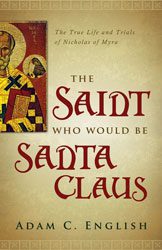 [This is the second in a series of posts on the real Santa Claus by Adam English, author of the new book The Saint Who Would Be Santa Claus*, now featured at the Patheos Book Club.]*
When I stepped off the plane for the first time in Bari, Italy, I was only vaguely aware of what I was doing.
I wanted to find out for myself whether Santa Claus really existed. His bones were said to be buried in the crypt of the Basilica di San Nicola, a Romanesque church situated within the walls of old-town Bari. Well, not the bones of Santa Claus of course, but of his historical predecessor, Saint Nicholas of Myra. Even so, I knew that the answers to my questions were not located in a tomb, but in the archival library adjacent to the basilica and maintained by Dominican friars.
At first the evidence did not seem to be in Nicholas’ favor. The three most important twentieth century scholars to study Saint Nicholas came to the conclusion that he quite possibly never existed, or if he did, it was unlikely that he did any of the things attributed to him.
The spirit of St. Nick must have been on my side, though, because I soon met Father Gerardo Cioffari, the bespectacled Dominican curator of the archive library. Father Cioffari pulled yellowed volumes of the shelves and flipped through them with quiet familiarity and confidence. He had, after all, spent the last thirty years gathering, sorting, and evaluating the evidence. His findings: Saint Nicholas most certainly lived. Here were the Greek and Latin texts of Michael the Archimandrite, Symeon Metaphrastes, and Andrew of Crete.
I faced another problem though. As I sifted through the material, I realized that for the past millennium, we have been telling the story not of one man named Nicholas, but of two men, both named Nicholas. Nicholas of Sion lived about 200 years after Nicholas of Myra, but sometime in the tenth century his story was merged with that of Nicholas of Myra. The two became one – so much so that even down to the present time the error has persisted.
My job in The Saint Who Would Be Santa Claus was to separate the two Nicholai and narrate, for the first time in a long time, the original life of St. Nicholas of Myra. Along the way I discovered not only Nicholas but myself.
Late one afternoon during my stay in Bari, I took a long and meandering walk through the city – of which the Romanesque basilica and cobbled old-town make up just one small part – to a Russian Saint Nicholas church dedicated to serving pilgrims who travel from far and wide to pray at the tomb. As I stepped off the big-city sidewalk into the candle-lit sanctuary, I was transported to another time and place. The sound of the prayers, the smell of the incense and the glimmer of gold-flecked icons – they were all so foreign and yet so palpably real. Here was the true reason I was obsessed with Saint Nicholas. It had nothing to do with Santa Claus; it was this man who, out of his deep and passionate faith, has inspired generations of believers.
I found the saint I was looking for – not only in the historical sources but also, and more importantly, in spirit. I have been asked more than once: “Has spending four years with Nicholas changed you in certain ways?” The answer is yes. Nicholas has changed me in deep and lasting ways, but I am still trying to put my finger on it. I am not yet being able to describe exactly how and in what ways Nicholas has affected me, even though I can feel in deep in my bones. There is more yet to be discovered.
 Adam C. English is Associate Professor of Religion at Campbell University where he teaches philosophy of religion, constructive theology, and the history of Christian thought. He lives near Raleigh, North Carolina.
Visit the Patheos Book Club for more on The Saint Who Would Be Santa Claus!
Previous Post

November 28, 2012
The Key to Christmas
Next Post

November 29, 2012 The Hindu-ness of Rob Bell
Browse Our Archives
Select a Category Author Q&A Book Review Christian Living Church Leadership Stump a Scholar Theology Uncategorized
Select a Month June 2022 March 2021 October 2020 August 2020 February 2019 November 2017 July 2017 June 2017 May 2017 March 2017 February 2017 January 2017 November 2016 October 2016 August 2016 July 2016 June 2016 May 2016 April 2016 March 2016 February 2016 January 2016 November 2015 October 2015 September 2015 August 2015 July 2015 June 2015 May 2015 April 2015 March 2015 February 2015 January 2015 December 2014 November 2014 October 2014 September 2014 August 2014 July 2014 June 2014 May 2014 April 2014 March 2014 February 2014 January 2014 December 2013 November 2013 October 2013 September 2013 August 2013 July 2013 June 2013 May 2013 April 2013 March 2013 February 2013 January 2013 December 2012 November 2012 October 2012 September 2012 August 2012 July 2012 June 2012 May 2012 April 2012 March 2012 February 2012 January 2012 December 2011 November 2011 October 2011 September 2011 August 2011 July 2011 June 2011 May 2011 April 2011 March 2011 February 2011 January 2011 December 2010 November 2010 October 2010 September 2010 August 2010 July 2010 June 2010
Follow Us!
TAKE THE
Religious Wisdom Quiz
What food did Elijah eat in the wilderness?
Select your answer to see how you score.
Bread and meat Figs and wine Manna Fish and honey
Related posts from Take and Read

"The Slow March of Light" Highlights The Human...

"A Brilliant Night of Stars and Ice" Recounts...

How To Judge The Bible By Its Cover

Life is an Endless Invitation: Q&A With Rob...
TRENDING AT PATHEOS Religious Music & Entertainment

"Les Diabolique" and Transgression
Alongside something like Arrival, Vertigo, or Charade, Les Diaboliques is a...

"The Plague Dogs" and Mortality
So, flashback to the late 70s, early 80s. Walt Disney Studios is...

With the recent and highly successful release of Christopher Nolan’s epic film,...

"L'avventura" and Human Weakness
Today's piece is going to be a little different for a few...

I first want to apologize for not posting or writing anything. I'm...

I've engaged in the multi-year project of reading through the Church Fathers,...
view all Religious Music & Entertainment blogs
Ad-Free & Subscriber Log-In Subscription Support
- About Us
- 2026 Calendar
- Videos
- Podcasts
- Library of World Religions
- Faith In Media Tracker
- Advertise With Us
- Write for Us
- Privacy Policy
- Terms of Service
- Do Not Sell My Data
- Contact Us
- Radiant Digital
- Manage Newsletter Subscriptions
- Unsubscribe From Notifications
- Sitemap
Copyright 2008-2026, Patheos. All rights reserved.
Subscription Support Ad-Free & Subscriber Log-In
Follow Patheos