
BuddhistCatholicContemplativeEvangelicalGeneral ChristianHinduJewishLatter-day SaintMuslimNew VisionsProgressive Christian
Beliefs
- Buddhist
- Catholic
- Contemplative
- Evangelical
- General Christian
- Hindu
- Jewish
- Latter-day Saint
- More Voices
- Muslim
- New Visions
- Pagan
- Progressive Christian
Topics
- Religion News
- Food and Religion
- Sports and Religion
- Religious Art
- Religious Music and Entertainment
- Religious Events
- History and Religion
- Style and Religion
- Politics and Religion
- Women in Religion
- Recreation Outdoors and Religion
- Business Finance and Religion
- Careers Workplace and Religion
- Education and Religion
- Family Parenting and Religion
- Health Fitness and Religion
- Home and Religion
- Relationships and Religion
- Technology and Religion
- Travel and Religion
Columnists
- Buddhist Columnists
- Business Finance and Religion Columnists
- Careers Workplace and Religion Columnists
- Catholic Columnists
- Contemplative Columnists
- Education and Religion Columnists
- Evangelists Columnists
- Family Parenting and Religion Columnists
- General Christian Columnists
- Health Fitness and Religion Columnists
- Hindu Columnists
- History and Religion Columnists
- Home and Religion Columnists
- Jewish Columnists
- More Voices Columnists
- Latter Day Columnists
- Muslim Columnists
- New Visions Columnists
- Nonreligious Columnists
- Pagan Columnists
- Politics and Religion Columnists
- Progressive Columnists
- Recreation Outdoors and Religion Columnists
- Relationships and Religion Columnists
- Religion News Columnists
- Religious Art Columnists
- Religious Events Columnists
- Religious Music and Entertainment Columnists
- Sports and Religion Columnists
- Style and Religion Columnists
- Technology and Religion Columnists
- Travel and Religion Columnists
- Women in Religion Columnists
Resource Library
- 2026 Calendar
- Library of World Religions
- The 100 Most Holy Places on Earth
- Patheos Answers
- Podcasts
- Videos
- Faith Leaders Database
- Anglican Episcopalian
- Bahai
- Baptist
- Buddhism
- Christianity
- Confucianism
- Eastern Orthodoxy
- Hinduism
- Holiness and Pentecostal
- ISKCON
- Islam
- Judaism
- Lutheran
- Methodist
- The Church of Jesus Christ of Latter-day Saints
- New Age
- Paganism
- Presbytarian and Reformed
- Protestantism
- Religion Behind the Scenes
- Roman Catholic
- Scientology
- Shia Islam
- Sikhism
- Sufism
- Sunni Islam
- Taoism
- Zen
- See all religions
Research Tools
 Ad-Free & Subscriber Log-In Subscription Support
Ad-Free & Subscriber Log-In Subscription Support
Follow Patheos 

- Trending:
- Forgiveness
- |
- Marriage
- |
- Consciousness
- |
- Death Penalty
- |
- Election
- |
- Halloween

- Home
- Religious Music & Entertainment
- Becoming Catholic, Again: A Q&A with Catherine Brunell
Becoming Catholic, Again: A Q&A with Catherine Brunell
Last updated on: November 15, 2012 at 5:11 pm by Deborah Arca
Becoming Catholic, Again: A Q&A with Catherine Brunell 2012-11-15T17:11:23-07:00 Deborah Arca
Patheos Explore the world's faith through different perspectives on religion and spirituality! Patheos has the views of the prevalent religions and spiritualities of the world.
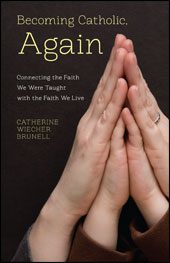 This month at the Patheos Book Club, we’re featuring the new book Becoming Catholic, Again: Connecting the Faith We Were Taught with the Faith We Live. Author Catherine Wiecher Brunell, a 30-something mother of four, wrote the book partly in response to her own growing tensions with her tradition as she grappled with the teachings of the church as they related to her own experience of God in the world. “Catholicism and I were not always a great fit,” she says, frankly, in her memoir.
Yet her journey into the tensions and the questions led her deeper into the truth of her spiritual life, and how she was meeting and responding to God in the real moments of her life. In the process, she came to reconcile her relationship with the Catholic Church and the authentic, lived experience of her faith as an adult woman called by God to minister in the world, right where she was.
We invited Catherine to share some further thoughts on her book, and her own faith journey, with us at Patheos. (You can also watch a video interview with Catherine here.)
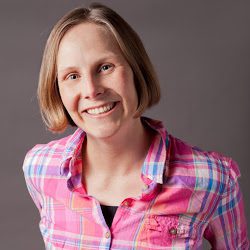 What was the impetus for writing this book at this time in your life?
Frankly, I was looking for something to supplement my long days of lego building and serving chicken nuggets. When I drafted the letter to the Loyola Press, I was at home with 3 kids under 5. One great gift of doing something you love is the passion that comes to do it more. This is how I feel about parenting, and I know that to do it I need stamina. Every parent needs a break to be his or her best and this book was mine.
While the need to work in a different way was the motivation that led me to write, the impetus to write this book has been with me for most of my adult faith. I knew that I was not alone in my longing for a God that is as real as my everyday experience. I was confident that there was an audience that was looking for the same permission to pursue this God.
The title of your book is Becoming Catholic, Again, and yet as a non-Catholic, I found myself in your story too. Who did you write this book for? And what makes it distinctly Catholic?
Well, that is a wonderful compliment. I can “Become Catholic, Again,” because I’ve realized that the point is actually not to be Catholic. The point is to get on with whatever deepens our life and as such leads us to what is ultimately true. For me, this means being Catholic. Realizing this was a huge shift in my faith because it gave me the permission to put down some of the things I thought I had to hold about faith and to pick up what matters. I didn’t have to apologize for or advocate about the Catholic faith as I was a consumer of it. Instead, seeing it as an important part of who I am, I focused on using it as a practice towards God, towards what is true and packed with love.
We are all becoming. But, are we careful enough to nurture the practices and the incremental steps that our becoming requires while still holding the bigger picture of God’s promises? Being in the mix and yet available to the vision is complicated. I can only attempt to do it when I am grounded in something in which I am fluent; Catholicism is my spiritual language.
Because of this, the book is as Catholic as I am because Catholicism is the language I learned as my spiritual practice. I have an accent and know a few words from other traditions, but I am Catholic. I can’t tell my story or the story of God with out it. I’m grateful that our stories intersect, even from distinct their places. This connection is what makes a story believable. It is how the cannon within the bible was chosen and why facebook goes viral.
I wrote the book for everyone who wants to believe and have a faith and needs a pick me up in pursuing it: For people who need a bridge between their experience and the institutional church, for parents who are discerning how and why to authentically engage their children in faith, for young adults who are wondering if faith will play a part in their adult life at all, for educators who have the great task of modeling humanity to their students and for ministers who hold the big questions that people ask. My hope is that this book will be a tool for all of you.
You have, shall we say, a rather difficult relationship with the Catholic Church. In one chapter, you compare your relationship with it to the conflict you and your mother sometimes experience. Can you say a bit more about that analogy, and how you’ve reconciled both?
Actually, I could have written this analogy with any of the key relationships in my life. Our important relationships naturally have an investment from both parties that sometimes leads us into conflict. The lesson I’ve learned is about what I can do when, not if, I reach this tension.
My resolution is that I go back to the relationship. For example, my mom is wonderful. She is passionate and steadfast and always giving. And I need to remember this precisely when we butt heads. It helps me give her the benefit of the doubt and to put down my assumptions. Then, I can actually be present to what is at hand rather than being pulled into the distraction of what I think all of it implies.
When I experience tension within the Church, I do the same thing. The alternative is to feel anger or even worse, apathy, and that simply gets in my way. Instead, I try to engage in the tension within a relational framework. It doesn’t mean that I let go of my experience, but that I give the Church the benefit of the doubt that it is trying to help and trying to bring the story of God to life in a particular way. The framework allows me to distill what is at hand and to consider it carefully.
You say the Catholic Church and you have not always been a good “fit.” What about the Church has been particularly hard for you, and did you every think about exploring other faith traditions during those times?
When my son was 2 years old, he entered the church one Sunday morning and said, “Look at all the mens mommy.” He was referring to the Priest, the deacon and the altar servers. It broke my heart. My faith is filled with instrumental women, I know that God is both feminine and masculine and I have found a way to add my particular voice. But, he was 2 and I felt as if I was actively participating in something that wasn’t telling to whole story. It was a painful time for me in the church because I felt angry and trapped. This is when “home church” started in our house. We gather, read the Gospel, share in it and celebrate Christ’s life around our kitchen table piled with art supplies, snacks, and the candles that just might burn down our house because children really shouldn’t play with matches. When I feel shut out, I open another way. The spiritual path is too important to be bumped off of it by the flaws that will always exist in humanity.
Along with doing home church, I also went to other Christian churches in the mile radius of our house. It was in a UCC ceremony that echoed everything that I believe but with a ritual where I felt clumsy and where I physically felt the longing for my faith. It is a toolbox that I do add too but that already has the basics. When I use it well, and when others help me, I feel a sense of belonging that I have never been able to match in another setting.
I will teach my children about the herstory of God, but the sense of belonging that I have will imprint far more about their own place in God’s love than any theology I espouse. For this reason, I’m banking on the community that I know to welcome them as much as it has me.
What ultimately kept you tethered to the tradition of your upbringing? Was it nostalgia, or theology, or liturgy … or something else?
All of those and fear. I’m joking of course, but not about the mixture of what keeps me engaged. I can’t take the formative memories from my k-12 Catholic school, the incredible connection that I feel with Christ or the fact that I have celebrated the same rituals thousands of times in my life out of the imprint my faith has on my life. They are what help me belong and what tug on me when I feel distant.
You talk about the assumptions – religious and spiritual – that actually get in the way of our faith. What do you mean by that, and how can we begin breaking down those roadblocks to a more authentic spiritual life?
When I worked at Boston College, I worked with a lot of students who were struggling with what we referred to as the hook-up culture: The pressure to forgo dating, flirting or being in a relationship and to instead just to “hook up” or have a one night stand. When we focused on why this was happening, with the help of authors like Donna Freitas and Kathleen Bogle, we saw that there was a script by which the students were influenced. Their actions were not based on reality or the whole picture, but instead their perception of what they thought their peers were doing and therefore what they thought should do… At the time, this rang true in the problem that I has having with living my faith in the suburbs.
For example, one day I was with one of my little ones and I let someone cut in front of me in a line of cars. The action made me want to scream because it felt like it was the only good deed that I had done that day. I loved being a mom but also I felt so limited in how I could fit having a preferential option for the poor in between naptime and the homemade baby food that I also thought I had to make. I actually asked my husband, “Does my life (a stay at home mom in the suburbs) make a mockery of the Gospels?”
I haven’t reached nirvana yet, but I have been able to expand my narrow definition, or assumption, of a lived faith. I stopped thinking that I could only live my faith in a developing nation as a community advocate and I started authentically trying to see how my life, and how it evolves, could live as radical of a faith in the 4 walls of my house. I also started asking what else, besides radical, do I want my faith to be?
We all have things that we think have to be true in order for us to … be holy, to be a good person, to be a loving partner etc… One way to get out from under our assumptions is to look at these scripts, wonder about their origins and discern what purpose having those thoughts serves. Jesus was a multifaceted person. We read different characterizations of him in each Gospel. To what emphasis are we naturally drawn? How does that emphasis serve us and what else do we need to see about the whole picture?
You maintain that one of the biggest roadblocks for you in your journey has been what you call a “theology of inadequacy.” I imagine a lot of us struggle with that. Where do you feel that comes from in the tradition; how does it hinder our adult faith; and how can we begin to deconstruct that?
Hah! Like I can explain thousands of years of this drudgery. Well, in my life it came from only emphasizing what one does with faith. I thought: “If our faith matters then we should serve.” I still think this but I know now that this service only works when it is born out of an understanding that we are already enough. We can’t serve because we want to be more.
When we know that we are enough and as such the very beloved of God, we have the energy to hold onto others the way true service requires. If we don’t do this, our feeling of inadequacy and the need to prove our faith, our hope, and our love through our service fails us, and ultimately those we serve.
These are the practices that I use to deconstruct the theology of inadequacy: Once a day, especially when I am having that horrible conversation in my head about how I are not cutting it, I tell myself that I am loved. Can I believe it? Also, I imagine that I am as loveable as those that I love. Finally, Anthony DeMello S.J. wrote, “Behold God beholding you and smiling.” I love that.
You have a beautiful chapter about the “no’s” and the “yes’s” we say to God – and others – at various points in our lives. What does saying “yes” mean for you in a spiritual sense?
Saying yes means responding to the grace in my life right now. Each of us has this opportunity on any given day – sometimes it is internal with how we see ourselves or others and other times it is something tangible like a reconciliation that could happen or an action of hospitality that we could give. Can we find these moments, these subtle yet sacred invitations, and share the gift that we are within the worlds that we live? This is our spiritual yes. Incrementally, they build into the purposes that drive our lives and the relationships that form who we are.
What was the hardest thing about writing this book? And where was the most joy?
The hardest thing was becoming an author. This is tied into overcoming the theology of inadequacy. I wrote for months as if it was as assignment that I was turning into to someone else. I also went to breakfast with another author, (Mary Johnson of An Unquenchable Thirst) and I literally had to talk myself through staying at the table. I could have listened to her talk about writing all day, but I felt my experience paled in comparison. But then, my book arrived on a UPS truck. While my kids jumped up and down hoping that the package was a gift from a distant relative, I opened something that had happened despite my doubts. It was the start of saying yes to the grace-filled invitation in a new chapter of what God is revealing to me.
The greatest joy is seeing my kids respond to this moment. My two year old asked me if I wrote the encyclopedia and my seven year old thinks that I am only 6 books away from being JK Rowling. Both do wonders for my ego! More, my 5 year-old daughter writes a new book almost everyday. When we create things in life, they spread. Then, what others create comes back to inspire us again.
I am also deeply touched when my words resonate with my readers. Before I pressed “send” on the email with the final draft of the manuscript – an unbelievably common action for such a formative moment – I said a prayer. “Help me to be what I have discovered in this book.” It is a prayer that I say now after I meet a reader, “Help this person to be who they found in the places where my words resonated.”
What do you hope people take away from you book? What one comment from a reader would make you most pleased?
I hope they find the same permission that I found in writing it; that is to be on the only spiritual path that we can be – our lives and what they reveal.
What would I like most to hear? “I bought this book for everyone I know and love.” I’ve got 4 kids and that is a lot of babysitting to write the next book. Truthfully, though, I’d love to hear that their faith feels lighter or pursing it feel easier after reading the book and engaging in the reflection that it offers. That would be enough for a very long time!
For more conversation on Becoming Catholic, Again, visit the Patheos Book Club here.
Previous Post

November 13, 2012
Five Lines to Watch For in The Hobbit
Next Post

November 16, 2012 Rob Bell and a New Christianity: A Q&A with Author James Wellman
Recent Comments
2,364 Comments | Leave a Comment
Browse Our Archives
Select a Category Author Q&A Book Review Christian Living Church Leadership Stump a Scholar Theology Uncategorized
Select a Month June 2022 March 2021 October 2020 August 2020 February 2019 November 2017 July 2017 June 2017 May 2017 March 2017 February 2017 January 2017 November 2016 October 2016 August 2016 July 2016 June 2016 May 2016 April 2016 March 2016 February 2016 January 2016 November 2015 October 2015 September 2015 August 2015 July 2015 June 2015 May 2015 April 2015 March 2015 February 2015 January 2015 December 2014 November 2014 October 2014 September 2014 August 2014 July 2014 June 2014 May 2014 April 2014 March 2014 February 2014 January 2014 December 2013 November 2013 October 2013 September 2013 August 2013 July 2013 June 2013 May 2013 April 2013 March 2013 February 2013 January 2013 December 2012 November 2012 October 2012 September 2012 August 2012 July 2012 June 2012 May 2012 April 2012 March 2012 February 2012 January 2012 December 2011 November 2011 October 2011 September 2011 August 2011 July 2011 June 2011 May 2011 April 2011 March 2011 February 2011 January 2011 December 2010 November 2010 October 2010 September 2010 August 2010 July 2010 June 2010
Follow Us!
TAKE THE
Religious Wisdom Quiz
What city was the Apostle Paul imprisoned in for two years?
Select your answer to see how you score.
Rome Corinth Jerusalem Ephesus
Related posts from Take and Read

"The Slow March of Light" Highlights The Human...

"A Brilliant Night of Stars and Ice" Recounts...

How To Judge The Bible By Its Cover

Life is an Endless Invitation: Q&A With Rob...
TRENDING AT PATHEOS Religious Music & Entertainment

"Les Diabolique" and Transgression
Alongside something like Arrival, Vertigo, or Charade, Les Diaboliques is a...

"The Plague Dogs" and Mortality
So, flashback to the late 70s, early 80s. Walt Disney Studios is...

With the recent and highly successful release of Christopher Nolan’s epic film,...

"L'avventura" and Human Weakness
Today's piece is going to be a little different for a few...

I first want to apologize for not posting or writing anything. I'm...

I've engaged in the multi-year project of reading through the Church Fathers,...
view all Religious Music & Entertainment blogs
Ad-Free & Subscriber Log-In Subscription Support
- About Us
- 2026 Calendar
- Videos
- Podcasts
- Library of World Religions
- Faith In Media Tracker
- Advertise With Us
- Write for Us
- Privacy Policy
- Terms of Service
- Do Not Sell My Data
- Contact Us
- Radiant Digital
- Manage Newsletter Subscriptions
- Unsubscribe From Notifications
- Sitemap
Copyright 2008-2026, Patheos. All rights reserved.
Subscription Support Ad-Free & Subscriber Log-In
Follow Patheos