
BuddhistCatholicContemplativeEvangelicalGeneral ChristianHinduJewishLatter-day SaintMuslimNew VisionsProgressive Christian
Beliefs
- Buddhist
- Catholic
- Contemplative
- Evangelical
- General Christian
- Hindu
- Jewish
- Latter-day Saint
- More Voices
- Muslim
- New Visions
- Pagan
- Progressive Christian
Topics
- Religion News
- Food and Religion
- Sports and Religion
- Religious Art
- Religious Music and Entertainment
- Religious Events
- History and Religion
- Style and Religion
- Politics and Religion
- Women in Religion
- Recreation Outdoors and Religion
- Business Finance and Religion
- Careers Workplace and Religion
- Education and Religion
- Family Parenting and Religion
- Health Fitness and Religion
- Home and Religion
- Relationships and Religion
- Technology and Religion
- Travel and Religion
Columnists
- Buddhist Columnists
- Business Finance and Religion Columnists
- Careers Workplace and Religion Columnists
- Catholic Columnists
- Contemplative Columnists
- Education and Religion Columnists
- Evangelists Columnists
- Family Parenting and Religion Columnists
- General Christian Columnists
- Health Fitness and Religion Columnists
- Hindu Columnists
- History and Religion Columnists
- Home and Religion Columnists
- Jewish Columnists
- More Voices Columnists
- Latter Day Columnists
- Muslim Columnists
- New Visions Columnists
- Nonreligious Columnists
- Pagan Columnists
- Politics and Religion Columnists
- Progressive Columnists
- Recreation Outdoors and Religion Columnists
- Relationships and Religion Columnists
- Religion News Columnists
- Religious Art Columnists
- Religious Events Columnists
- Religious Music and Entertainment Columnists
- Sports and Religion Columnists
- Style and Religion Columnists
- Technology and Religion Columnists
- Travel and Religion Columnists
- Women in Religion Columnists
Resource Library
- 2026 Calendar
- Library of World Religions
- The 100 Most Holy Places on Earth
- Patheos Answers
- Podcasts
- Videos
- Faith Leaders Database
- Anglican Episcopalian
- Bahai
- Baptist
- Buddhism
- Christianity
- Confucianism
- Eastern Orthodoxy
- Hinduism
- Holiness and Pentecostal
- ISKCON
- Islam
- Judaism
- Lutheran
- Methodist
- The Church of Jesus Christ of Latter-day Saints
- New Age
- Paganism
- Presbytarian and Reformed
- Protestantism
- Religion Behind the Scenes
- Roman Catholic
- Scientology
- Shia Islam
- Sikhism
- Sufism
- Sunni Islam
- Taoism
- Zen
- See all religions
Research Tools
 Ad-Free & Subscriber Log-In Subscription Support
Ad-Free & Subscriber Log-In Subscription Support
Follow Patheos 

- Trending:
- Forgiveness
- |
- Marriage
- |
- Consciousness
- |
- Death Penalty
- |
- Election
- |
- Halloween

- Home
- Religious Music & Entertainment
- How To Live Like the First Christians
How To Live Like the First Christians
Last updated on: October 15, 2012 at 1:58 pm by Chuck Gutenson
How To Live Like the First Christians 2012-10-15T13:58:09-06:00 Chuck Gutenson
Patheos Explore the world's faith through different perspectives on religion and spirituality! Patheos has the views of the prevalent religions and spiritualities of the world.
 [This month at the Patheos Book Club, we’re featuring the new book The Right Church: Live Like the First Christians, by Charles E. Gutenson. Below is the first in a series of posts by Gutenson related to the book.]
From the Introduction
At one level, then, this book is about church renewal. In a sense, it is about going forward by looking back, a desire to awaken the church of today by appealing to the church of yesterday, and not just any yesterday, but all the way back to the earliest church period –the period closest to the life of Jesus. The question that lies beneath all of my inquiry is this: how did the early Church understand the nature of faithful discipleship? And, then, how should that impact and influence how we live today?
There’s a good deal of mythology and romanticism about the earliest period of the church. Some perhaps believe the prescription for the contemporary church’s ailments is found in a recovery of the supposed purity of the “early church.” This book is not a romantic inquiry into the “golden days” of the church, but rather an attempt to crack open a window into the early church for the explicit purpose of examining how differently they saw the world. My hope is not that the reader will walk away agreeing with everything one might find in that early period. I do hope, though, that it might inspire some lively debate and that the Spirit might use that debate to sow seeds of renewal in the church. A renewal that will change us so that when the world looks at the church, it sees a genuine and distinct alternative “way of being”—one more consistent with the life lived by our Lord.
We as Christians are heirs to a remarkably rich tradition dating back at least 2000 years, much longer when you include the prior Jewish tradition from which Christianity sprang. Within that history, we find different understandings of what it means to be faithful to God’s call upon our lives, and more specifically, how following Jesus is supposed to be lived out. Perhaps some of those ways of following Jesus stand in a degree of tension with others, but part of the wisdom of the church has been its willingness to allow those tensions to stand side-by-side. In this way, the differences challenge us more carefully to think through the implications rather than giving the tensions an easy resolution. Origen once observed something similar about the Scriptures themselves, convinced that God allowed tensions to stand within the text because he knew that a key part of our formation was intimately connected with our sorting those tensions within communities of faith. It seems Origen believed that God was not so much interested in “blind obedience” as he was in folks who could “think theologically.” Not every possible circumstance we might face in life is directly addressed in Scripture. So, if we will but let them, Scripture and the tradition can stand as dual mentors in developing our ability to move beyond following the “letter of the law” to being able to resolve the tensions in a careful and nuanced way that allows us ultimately to be better followers of our Lord.
Unfortunately, for the vast majority of Christians, this deep and rich heritage, for all practical purposes does not exist. Why? Well, the short answer is: ignorance or perhaps more simply, unawareness. If it is the case that we, as a group, are becoming increasingly ignorant of the biblical narratives themselves (and it almost certainly is the case), it is even more the case that we are ignorant of the broader resources within the tradition available to us in working out how best to be faithful followers of Jesus in our contemporary context. Most Christians today would consider themselves well read if they have managed to stay plugged into the contemporary Christian scene—reading relatively contemporary books and listening to sermons and Scriptural commentary from the last, oh, say, fifty years. I expect someone in my own United Methodist tradition would consider themselves remarkably well read if they had actually worked their way through some of John Wesley’s 52 standard sermons. Yet, as old and as rich as those sermons are, they reach back not even 300 years—a very short time when compared to the multi-millennium history of the church.
A rallying cry during the middle ages was “ad fontes,” which means “back to the fountain” or “back to the origins.” The idea was that Christians needed to get back to the early church period to recapture the vibrant faith exhibited during that period. It is time again to cry out “Ad Fontes!” and to turn our attention more intentionally to the wisdom of the early church, its preachers and its bishops. Not necessarily because we will always agree with them, not because we buy into that myth of a pure, early church, but because it is vitally important to us today to consider how Christians of different time periods have sought to be faithful. We need to look beyond the mythology of the early church and discover what the early church wrote and, more importantly, how they lived.
 Dr. Charles (Chuck) Gutenson is a church consultant and former chief operating officer ofSojourners. He previously served 10 years at Asbury Seminary in Kentucky, most recently as the professor of Theology and Philosophy. He received his Masters of Divinity from Asbury in 1995 and a PhD in Philosophical Theology from Southern Methodist University in 2000. A member of the International Society of Theta Phi, an honor society for theological students, scholars in the field of religion and outstanding religious leaders, Chuck is the author of three books (one forthcoming) and numerous articles on a variety of theological and philosophical subjects.
Visit the Patheos Book Club for more on The Right Church!
Previous Post

September 17, 2012
The Gift of Broken Leaders: A Review of "Ashamed No More"
Next Post
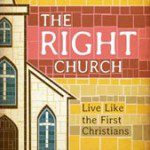
September 20, 2012 The Right Church: A Book Review
Browse Our Archives
Select a Category Author Q&A Book Review Christian Living Church Leadership Stump a Scholar Theology Uncategorized
Select a Month June 2022 March 2021 October 2020 August 2020 February 2019 November 2017 July 2017 June 2017 May 2017 March 2017 February 2017 January 2017 November 2016 October 2016 August 2016 July 2016 June 2016 May 2016 April 2016 March 2016 February 2016 January 2016 November 2015 October 2015 September 2015 August 2015 July 2015 June 2015 May 2015 April 2015 March 2015 February 2015 January 2015 December 2014 November 2014 October 2014 September 2014 August 2014 July 2014 June 2014 May 2014 April 2014 March 2014 February 2014 January 2014 December 2013 November 2013 October 2013 September 2013 August 2013 July 2013 June 2013 May 2013 April 2013 March 2013 February 2013 January 2013 December 2012 November 2012 October 2012 September 2012 August 2012 July 2012 June 2012 May 2012 April 2012 March 2012 February 2012 January 2012 December 2011 November 2011 October 2011 September 2011 August 2011 July 2011 June 2011 May 2011 April 2011 March 2011 February 2011 January 2011 December 2010 November 2010 October 2010 September 2010 August 2010 July 2010 June 2010
Follow Us!
TAKE THE
Religious Wisdom Quiz
What did the Israelites build while Moses was on Mount Sinai?
Select your answer to see how you score.
A temple An altar A tower A golden calf
Related posts from Take and Read

"The Slow March of Light" Highlights The Human...

"A Brilliant Night of Stars and Ice" Recounts...

How To Judge The Bible By Its Cover

Life is an Endless Invitation: Q&A With Rob...
TRENDING AT PATHEOS Religious Music & Entertainment

"Les Diabolique" and Transgression
Alongside something like Arrival, Vertigo, or Charade, Les Diaboliques is a...

"The Plague Dogs" and Mortality
So, flashback to the late 70s, early 80s. Walt Disney Studios is...

With the recent and highly successful release of Christopher Nolan’s epic film,...

"L'avventura" and Human Weakness
Today's piece is going to be a little different for a few...

I first want to apologize for not posting or writing anything. I'm...

I've engaged in the multi-year project of reading through the Church Fathers,...
view all Religious Music & Entertainment blogs
Ad-Free & Subscriber Log-In Subscription Support
- About Us
- 2026 Calendar
- Videos
- Podcasts
- Library of World Religions
- Faith In Media Tracker
- Advertise With Us
- Write for Us
- Privacy Policy
- Terms of Service
- Do Not Sell My Data
- Contact Us
- Radiant Digital
- Manage Newsletter Subscriptions
- Unsubscribe From Notifications
- Sitemap
Copyright 2008-2026, Patheos. All rights reserved.
Subscription Support Ad-Free & Subscriber Log-In
Follow Patheos