
BuddhistCatholicContemplativeEvangelicalGeneral ChristianHinduJewishLatter-day SaintMuslimNew VisionsProgressive Christian
Beliefs
- Buddhist
- Catholic
- Contemplative
- Evangelical
- General Christian
- Hindu
- Jewish
- Latter-day Saint
- More Voices
- Muslim
- New Visions
- Pagan
- Progressive Christian
Topics
- Religion News
- Food and Religion
- Sports and Religion
- Religious Art
- Religious Music and Entertainment
- Religious Events
- History and Religion
- Style and Religion
- Politics and Religion
- Women in Religion
- Recreation Outdoors and Religion
- Business Finance and Religion
- Careers Workplace and Religion
- Education and Religion
- Family Parenting and Religion
- Health Fitness and Religion
- Home and Religion
- Relationships and Religion
- Technology and Religion
- Travel and Religion
Columnists
- Buddhist Columnists
- Business Finance and Religion Columnists
- Careers Workplace and Religion Columnists
- Catholic Columnists
- Contemplative Columnists
- Education and Religion Columnists
- Evangelists Columnists
- Family Parenting and Religion Columnists
- General Christian Columnists
- Health Fitness and Religion Columnists
- Hindu Columnists
- History and Religion Columnists
- Home and Religion Columnists
- Jewish Columnists
- More Voices Columnists
- Latter Day Columnists
- Muslim Columnists
- New Visions Columnists
- Nonreligious Columnists
- Pagan Columnists
- Politics and Religion Columnists
- Progressive Columnists
- Recreation Outdoors and Religion Columnists
- Relationships and Religion Columnists
- Religion News Columnists
- Religious Art Columnists
- Religious Events Columnists
- Religious Music and Entertainment Columnists
- Sports and Religion Columnists
- Style and Religion Columnists
- Technology and Religion Columnists
- Travel and Religion Columnists
- Women in Religion Columnists
Resource Library
- 2026 Calendar
- Library of World Religions
- The 100 Most Holy Places on Earth
- Patheos Answers
- Podcasts
- Videos
- Faith Leaders Database
- Anglican Episcopalian
- Bahai
- Baptist
- Buddhism
- Christianity
- Confucianism
- Eastern Orthodoxy
- Hinduism
- Holiness and Pentecostal
- ISKCON
- Islam
- Judaism
- Lutheran
- Methodist
- The Church of Jesus Christ of Latter-day Saints
- New Age
- Paganism
- Presbytarian and Reformed
- Protestantism
- Religion Behind the Scenes
- Roman Catholic
- Scientology
- Shia Islam
- Sikhism
- Sufism
- Sunni Islam
- Taoism
- Zen
- See all religions
Research Tools
 Ad-Free & Subscriber Log-In Subscription Support
Ad-Free & Subscriber Log-In Subscription Support
Follow Patheos 

- Trending:
- Forgiveness
- |
- Marriage
- |
- Consciousness
- |
- Death Penalty
- |
- Election
- |
- Halloween

- Home
- Religious Music & Entertainment
- The Difference that Matters
The Difference that Matters
Last updated on: February 29, 2012 at 3:24 pm by Rita Sherma
The Difference that Matters 2012-02-29T12:02:49-07:00 Rita Sherma
Patheos Explore the world's faith through different perspectives on religion and spirituality! Patheos has the views of the prevalent religions and spiritualities of the world.
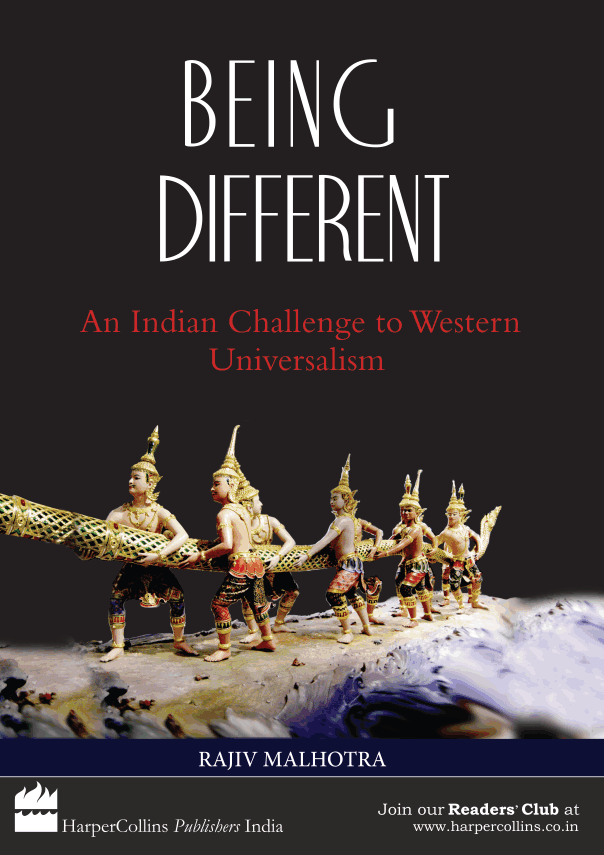 [This post by Dr. Rita Sherma is part of a roundtable discussion on the new book Being Different: An Indian Challenge to Western Universalism by Rajiv Malhotra, now featured at the Patheos Book Club.]
There is difference that matters and difference that really does not. In Being Different: An Indian Challenge to Western Universalism, the author makes a case for the importance of not falling prey to the belief that the obliteration of all difference will lead to greater harmony for humanity. Being Different uses Indian civilization and its interaction with the West as a case study for the problem of the erasure of differences that matter.
In a recent interview in Tricycle, the Brazilian-born founder of the reformist Juniper school of the Gelug denomination of Tibetan Buddhism, Segyu Rinpoche explained why he had created a reformist school in the lineage into which he was inducted, which attempts to do away with differences arising from the Tibetan culture but not Buddhist insights:
“I am within the tradition….But I did not blindly follow it. I was able to distinguish between the Tibetan culture and the essence of the teachings….Eventually, I had a fair number of exceptional students, but many felt there were barriers to comprehending the Tibetan tradition….they [asked me] questions like ”Why do we have to follow forms that are foreign to us? Is this a condition for inner growth, or would it be better to find ways more culturally appropriate?”….So we began a process of challenging assumptions, discussing the teachings, their relevance to Westerners, and the cultural barriers….Our main task was to make sure we did not throw out the baby with the bathwater—to keep the essence and potency intact.”
At first glance, the thoughts of this teacher, who views himself as a Westerner, seem innocuous, even laudatory. If Buddhism is to become at home in the West, should it not become “Westernized”? The answer is that it definitely should and, indeed, would over time in any case, as it has in every new culture it has entered. Buddhism, a Dharma Tradition (a termed I coined to describe those spiritual traditions that originally emerged in ancient India), was the first “world religion” meaning that it had spread widely from it source of origin to distant corners at a time when Christianity had not been broadly disseminated, and Islam was yet unborn. Buddhism spread, as Rajiv Malhotra notes in Being Different, without bloodshed or conquest; without clergy following their soldiers to convert vanquished peoples to a better way. This is difference that matters.
Returning now to the application of the premise of Being Different, in terms of difference that matters, to the reform efforts of Western Buddhists such as Segyu Rinpoche, quoted above, the question one must ask is: Who decides how to distinguish between the baby and the bathwater and how do we know whether they will always be right in discerning the distinction between the essential and the cultural? Is culture simply “baggage” that can be dispensed with, difference that does not matter? As David R. Loy has written recently: “Good critical studies undermine the assumption that culture is merely a kind of baggage that can be discarded at will. The problem for [Western] Buddhist modernists…is that we tend to view our own beliefs as culture-free….those of us who try [to the extract essential from cultural] are embedded in culture too.” Segyu Rinpoche, for example, has done away with prostrations as a sign of respect to tradition and teacher. But what is rather remarkable for someone who cares very much about not “throwing the baby out with the bathwater” is that he views the doctrine of rebirth as a cultural vestige as well. This however, not part of Tibetan culture; it has been intrinsic to the integrity of the Dharma Traditions for millennia. In other words it is a difference that matters. The principle of rebirth is not an arbitrary doctrine formulated by monastics huddling in a conclave, but by yogis and sages who experienced these insights through an empirical methodology. Malhotra emphasizes this point, that the focus on “embodied knowing” (for Dharma Traditions) on one hand, and what he calls “history-centrism” in general (on the part of the West), on the other, are key factors in creating the differences in approaches to the self, world, and reality. This is not a matter of making judgments of the validity of either position, but on noting that they cannot be confused with each other.
In Being Different, Malhotra offers a view on differences that matter, through the prism of what he refers to as “four areas of difference between dharmic and Judeo-Christian traditions” which are “embodied knowing versus history-centrism; integral unity versus synthetic unity; anxiety over chaos versus comfort with complexity; and cultural digestion versus non-translatable elements in Sanskrit.” Within these categories, he offers a plethora of elements that, when torn from their rootedness in a certain culture, lose the fullness of meaning and effectiveness in terms of being able to initiate positive change. And change is something we are in dire need of, not only as a global society but as a species facing an existential threat due to the spread of a consumer monoculture which seeks to erase—difference.
Rita Sherma holds an M.A. in Women’s Studies in Religion, and Ph.D. in Religious Studies (2002). Since 2007, Dr. Sherma has served as Executive Director of the School of Philosophy and Religious Studies at Taksha University, and is the President of the Confluence Institute initiative which partners with US and Indian institutions of higher learning to preserve and apply indigenous knowledge systems for contemporary needs. She is the Co-founder and Vice-President of DANAM (Dharma Academy of North America), the first scholarly association in North America to offer a dedicated forum for the interdisciplinary academic study of the Dharma Traditions (Hindu, Jain, Buddhist, and Sikh Dharma). She is the Co-founder and former President of Foundation for Indic Philosophy and Culture (FIPC) at the School of Religion at Claremont Graduate University, and is a Chief Co-Editor of the Journal of Dharma Studies. Previous books include of five co-edited volumes, including Dying, Death, and Afterlife in Dharma Traditions and Western Religions (2007); Hermeneutics and Hindu Thought (2008), and Woman and Goddess in Hinduism: Reinterpretations and Re-envisionings (2011); Prayer and Worship in Dharma Traditions (forthcoming).
Previous Post

February 29, 2012
Towards an Honest Pluralism: Responding to "Being Different"
Next Post
February 29, 2012 Moving Beyond Binaries
Recent Comments
2,826 Comments | Leave a Comment
Browse Our Archives
Select a Category Author Q&A Book Review Christian Living Church Leadership Stump a Scholar Theology Uncategorized
Select a Month June 2022 March 2021 October 2020 August 2020 February 2019 November 2017 July 2017 June 2017 May 2017 March 2017 February 2017 January 2017 November 2016 October 2016 August 2016 July 2016 June 2016 May 2016 April 2016 March 2016 February 2016 January 2016 November 2015 October 2015 September 2015 August 2015 July 2015 June 2015 May 2015 April 2015 March 2015 February 2015 January 2015 December 2014 November 2014 October 2014 September 2014 August 2014 July 2014 June 2014 May 2014 April 2014 March 2014 February 2014 January 2014 December 2013 November 2013 October 2013 September 2013 August 2013 July 2013 June 2013 May 2013 April 2013 March 2013 February 2013 January 2013 December 2012 November 2012 October 2012 September 2012 August 2012 July 2012 June 2012 May 2012 April 2012 March 2012 February 2012 January 2012 December 2011 November 2011 October 2011 September 2011 August 2011 July 2011 June 2011 May 2011 April 2011 March 2011 February 2011 January 2011 December 2010 November 2010 October 2010 September 2010 August 2010 July 2010 June 2010
Follow Us!
TAKE THE
Religious Wisdom Quiz
What does Hebrews say is living and active?
Select your answer to see how you score.
The word of God Prayer Faith The church
Related posts from Take and Read

"The Slow March of Light" Highlights The Human...

"A Brilliant Night of Stars and Ice" Recounts...

How To Judge The Bible By Its Cover

Life is an Endless Invitation: Q&A With Rob...
TRENDING AT PATHEOS Religious Music & Entertainment

"Les Diabolique" and Transgression
Alongside something like Arrival, Vertigo, or Charade, Les Diaboliques is a...

"The Plague Dogs" and Mortality
So, flashback to the late 70s, early 80s. Walt Disney Studios is...

With the recent and highly successful release of Christopher Nolan’s epic film,...

"L'avventura" and Human Weakness
Today's piece is going to be a little different for a few...

I first want to apologize for not posting or writing anything. I'm...

I've engaged in the multi-year project of reading through the Church Fathers,...
view all Religious Music & Entertainment blogs
Ad-Free & Subscriber Log-In Subscription Support
- About Us
- 2026 Calendar
- Videos
- Podcasts
- Library of World Religions
- Faith In Media Tracker
- Advertise With Us
- Write for Us
- Privacy Policy
- Terms of Service
- Do Not Sell My Data
- Contact Us
- Radiant Digital
- Manage Newsletter Subscriptions
- Unsubscribe From Notifications
- Sitemap
Copyright 2008-2026, Patheos. All rights reserved.
Subscription Support Ad-Free & Subscriber Log-In
Follow Patheos