
BuddhistCatholicContemplativeEvangelicalGeneral ChristianHinduJewishLatter-day SaintMuslimNew VisionsProgressive Christian
Beliefs
- Buddhist
- Catholic
- Contemplative
- Evangelical
- General Christian
- Hindu
- Jewish
- Latter-day Saint
- More Voices
- Muslim
- New Visions
- Pagan
- Progressive Christian
Topics
- Religion News
- Food and Religion
- Sports and Religion
- Religious Art
- Religious Music and Entertainment
- Religious Events
- History and Religion
- Style and Religion
- Politics and Religion
- Women in Religion
- Recreation Outdoors and Religion
- Business Finance and Religion
- Careers Workplace and Religion
- Education and Religion
- Family Parenting and Religion
- Health Fitness and Religion
- Home and Religion
- Relationships and Religion
- Technology and Religion
- Travel and Religion
Columnists
- Buddhist Columnists
- Business Finance and Religion Columnists
- Careers Workplace and Religion Columnists
- Catholic Columnists
- Contemplative Columnists
- Education and Religion Columnists
- Evangelists Columnists
- Family Parenting and Religion Columnists
- General Christian Columnists
- Health Fitness and Religion Columnists
- Hindu Columnists
- History and Religion Columnists
- Home and Religion Columnists
- Jewish Columnists
- More Voices Columnists
- Latter Day Columnists
- Muslim Columnists
- New Visions Columnists
- Nonreligious Columnists
- Pagan Columnists
- Politics and Religion Columnists
- Progressive Columnists
- Recreation Outdoors and Religion Columnists
- Relationships and Religion Columnists
- Religion News Columnists
- Religious Art Columnists
- Religious Events Columnists
- Religious Music and Entertainment Columnists
- Sports and Religion Columnists
- Style and Religion Columnists
- Technology and Religion Columnists
- Travel and Religion Columnists
- Women in Religion Columnists
Resource Library
- 2026 Calendar
- Library of World Religions
- The 100 Most Holy Places on Earth
- Patheos Answers
- Podcasts
- Videos
- Faith Leaders Database
- Anglican Episcopalian
- Bahai
- Baptist
- Buddhism
- Christianity
- Confucianism
- Eastern Orthodoxy
- Hinduism
- Holiness and Pentecostal
- ISKCON
- Islam
- Judaism
- Lutheran
- Methodist
- The Church of Jesus Christ of Latter-day Saints
- New Age
- Paganism
- Presbytarian and Reformed
- Protestantism
- Religion Behind the Scenes
- Roman Catholic
- Scientology
- Shia Islam
- Sikhism
- Sufism
- Sunni Islam
- Taoism
- Zen
- See all religions
Research Tools
 Ad-Free & Subscriber Log-In Subscription Support
Ad-Free & Subscriber Log-In Subscription Support
Follow Patheos 

- Trending:
- Forgiveness
- |
- Marriage
- |
- Consciousness
- |
- Death Penalty
- |
- Election
- |
- Halloween
 Synapses of the Soul
- Home
- Catholic
- Your Life Should Cause Cognitive Dissonance
Your Life Should Cause Cognitive Dissonance
Last updated on: March 5, 2021 at 7:02 am by Synapses of the Soul
Your Life Should Cause Cognitive Dissonance 2021-03-05T07:02:02-06:00 Synapses of the Soul
Patheos Explore the world's faith through different perspectives on religion and spirituality! Patheos has the views of the prevalent religions and spiritualities of the world.
“You will know the truth, and the truth will make you odd.” This quip – which is often attributed to Flannery O’Connor but not actually found in any of her works – captures an essential element of being a Christian: absurdity. The encounter with Christ, who is Truth, will make you absurd.
I don’t mean that Christians are irrational. On the contrary, the reason of a Christian is more expansive, for she engages every facet of reality rather than only a portion of it. Nor is the Christian living in another world beyond this one. She lives the truth of human life, the same reality as others, only with a greater depth and intensity.
But it is precisely the reasonableness of the Christian that makes her absurd in the eyes of those who have not encountered Truth. To explain, I will turn to St. Benedict and neuropsychology.
Saint Benedict on the absurdity of love
As I shared in an essay for the Church Life Journal, I am translating an Italian biography of Saint Benedict into English. A passage I recently worked on captures the absurdity of the love of Christ:
One day, Benedict heard that Martin, a hermit famous in the area for the exceptional sanctity of his life, had decided to imprison himself in the cave that he had chosen as his dwelling. By tying one end of a chain to his foot and the other end to a rock, Martin had made himself a rough – if voluntary – jail cell.
Between the Saints there is, at times, a daring intimacy. The abbot of Monte Cassino sent one of his disciples to the hermit of Mount Marsico, with a singular exhortation:
“If you are the slave of God, Martin, it is not a chain of iron that binds you but the chain of Christ.”
These revealing words contain all of Benedict’s soul, the radical spirit of his life and the Rule he wrote for his children. Benedict understands them to be “seekers of God,” men who… are dominated by a great love. The intensity of their love reveals the depth and seriousness of their search, and it alone ensures the monks’ fidelity to the means that will lead them to their end. Without love, if we choose to evaluate it with our banal units of measurement, the life that Benedict proposed to his children – and that he himself lived – is absurd…
The ultimate reason for [the monk’s] absolute obedience, even in the face of something that could seem impossible, is only one: the love of God. The same love will teach the monk to pray for his enemies, to generously embrace, nay, to “guard” the Rule, and to humbly respect his abbot, not for his human qualities but for “amore Christi.” The love of Christ! … How could others, those who do not love, understand the value of this holocaust, which is the highest gift a creature could offer God?1
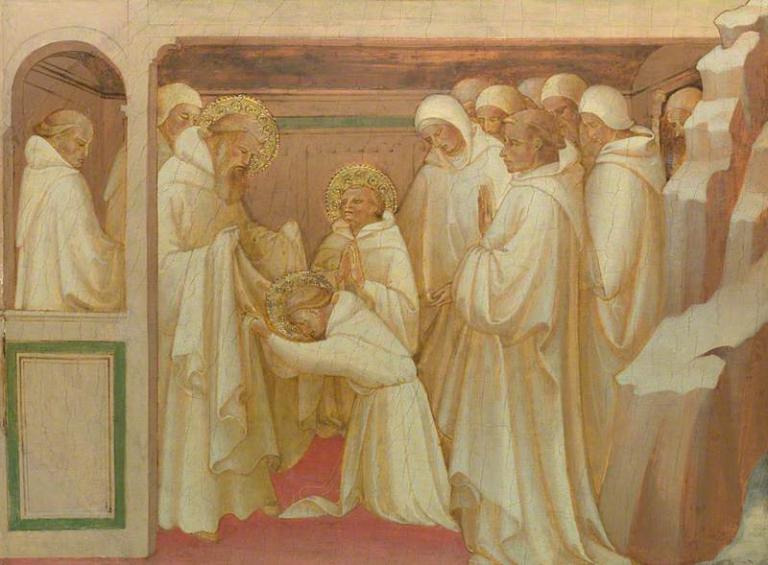
Lorenzo Monaco (c.1370-1425); The National Gallery, London
From the outside, the life of a monk or nun is not only absurd, but downright inhuman. The monastic renounces marriage and family, the most natural expressions of her human affectivity. She renounces every possession and pleasure, even those that would appear good. But above all, she renounces her own will, perhaps that which is most precious to the human person. Why? For love of Christ, who asks these sacrifices of her so that she might live, now, what we will all live in Heaven.
Cognitive dissonance and Christian witness
For many, such a life gives rise to cognitive dissonance. In psychology, this refers to the discomfort that arises when a person holds conflicting attitudes, behaviours, or beliefs, or receives new information that conflict them. The psychological discomfort drives the person to resolve the tension by altering a behaviour or belief, or by denying or trivialising the new information. In the brain, this takes place through activity of the medial and dorsolateral prefrontal cortex, as well as the insula. These regions are involved in processing emotion, avoiding discomfort, and maintaining a sense of self.
Face-to-face with a joyful monastic, or indeed any Christian who radiantly lives the Gospel, any atheist would experience a bit of cognitive dissonance. On the one hand, he may be firmly committed to the belief that Christ does not exist. But on the other, he sees that one who gives her whole life to Christ is more alive than he. It is absurd!
This is witness.
Of course, true witness never overwhelms the freedom of the other. Indeed, the atheist can always choose to resolve his cognitive dissonance by denying or trivialising the transfigured life of the Christian. But wouldn’t this be unreasonable, a narrowing of the scope of reality that he is willing to look at? Would it not, therefore, diminish his very humanity? Yet such is our freedom.
Let Christ make you absurd
Christ was quite aware of the absurdity of His own life. Son of a virgin mother, Christ the King entered the world as a helpless infant in a bleak cave. Son of God, He freely offered His life to save the weak and rebellious humanity that He loved. It’s “horrifying,” as Nietzsche succinctly proclaims in AntiChrist.
So, too, does Christ proclaim an absurd Gospel. How could the kingdom of heaven belong to the poor and the persecuted? Is it possible to love one’s enemies? How would those who renounce everything for the sake of the name of Jesus receive a hundredfold in return? What is the resurrection, and how can we have hope in something – Someone – we have never seen?
Even Christians feel the absurdity of their beliefs at times. It is a reminder that our faith is not something we generate; revelation is a mystery that is only partially unveiled. But whenever we catch an additional glimpse of the dizzying strangeness of our faith, it is the opportunity to say “yes,” once more, to the calling of Christ who is Truth. And He gives us His strength to live a life that would be absurd if not for His existence, absurd if not for His love.
During stay-at-home orders this spring, I enjoyed listening to “Let Love,” a podcast created by the Sisters of Life. Each episode, they explore another way that each of us can allow the love of God to enter and transfigure our lives. Adopting the pattern of their litany of invitations, I invite you to let love make you absurd. Let Christ so transform your life that others cannot understand it except in light of the Gospel.
You can send me your podcast recommendations, questions about St. Benedict, or ideas about witness at [email protected]. I’ve also got a quarterly newsletter that you can subscribe to here.
[1] Please do not reproduce any of this text without written permission.

About Synapses of the Soul
You can contact Sofia at [email protected]. You can read more about the author here.
Previous Post

September 25, 2020
The End of Education
Next Post

November 8, 2020 My Latest Heavenly Patron
Browse Our Archives
Select a Category Monthly Roundup Series: Habits Uncategorized
Select a Month November 2020 October 2020 September 2020 August 2020 July 2020 June 2020 May 2020 April 2020 January 2020 December 2019 November 2019 October 2019 September 2019 August 2019 March 2019 February 2019 January 2019 December 2018 November 2018 October 2018 September 2018 August 2018
TAKE THE
Religious Wisdom Quiz
Who was thrown into a den of lions?
Select your answer to see how you score.
Joseph Daniel Jonah David
Related posts from Synapses of the Soul



Does Your Mind Extend Into the World?

The Dizzying Smallness of Life
TRENDING AT PATHEOS Catholic

The Parable Of The Sower And The Word...
One of Christ’s most famous parables is that of the sower who...

Rejecting Doom: Christian Hope And Human Action
Christianity is a religion of hope. We are to have hope and...

Why I Choose the Eucharist Over the Sermon
Choose the Eucharist, Not the Sermon What are we supposed to get...

5 Design Elements Found in Spiritually Rooted Homes
Putting Spirituality Into Home Decor Our homes are more than our living...

Credo: A Story of God Told with the...
About 10 years ago, I began to imagine a personal "Credo" that...

The Anatomy of Divine Revelation in Catholic Thought
The claim that God has made Himself known to human beings is...
view all Catholic blogs
Ad-Free & Subscriber Log-In Subscription Support
- About Us
- 2026 Calendar
- Videos
- Podcasts
- Library of World Religions
- Faith In Media Tracker
- Advertise With Us
- Write for Us
- Privacy Policy
- Terms of Service
- Do Not Sell My Data
- Contact Us
- Radiant Digital
- Manage Newsletter Subscriptions
- Unsubscribe From Notifications
- Sitemap
Copyright 2008-2026, Patheos. All rights reserved.
Subscription Support Ad-Free & Subscriber Log-In
Follow Patheos