
BuddhistCatholicContemplativeEvangelicalGeneral ChristianHinduJewishLatter-day SaintMuslimNew VisionsProgressive Christian
Beliefs
- Buddhist
- Catholic
- Contemplative
- Evangelical
- General Christian
- Hindu
- Jewish
- Latter-day Saint
- More Voices
- Muslim
- New Visions
- Pagan
- Progressive Christian
Topics
- Religion News
- Food and Religion
- Sports and Religion
- Religious Art
- Religious Music and Entertainment
- Religious Events
- History and Religion
- Style and Religion
- Politics and Religion
- Women in Religion
- Recreation Outdoors and Religion
- Business Finance and Religion
- Careers Workplace and Religion
- Education and Religion
- Family Parenting and Religion
- Health Fitness and Religion
- Home and Religion
- Relationships and Religion
- Technology and Religion
- Travel and Religion
Columnists
- Buddhist Columnists
- Business Finance and Religion Columnists
- Careers Workplace and Religion Columnists
- Catholic Columnists
- Contemplative Columnists
- Education and Religion Columnists
- Evangelists Columnists
- Family Parenting and Religion Columnists
- General Christian Columnists
- Health Fitness and Religion Columnists
- Hindu Columnists
- History and Religion Columnists
- Home and Religion Columnists
- Jewish Columnists
- More Voices Columnists
- Latter Day Columnists
- Muslim Columnists
- New Visions Columnists
- Nonreligious Columnists
- Pagan Columnists
- Politics and Religion Columnists
- Progressive Columnists
- Recreation Outdoors and Religion Columnists
- Relationships and Religion Columnists
- Religion News Columnists
- Religious Art Columnists
- Religious Events Columnists
- Religious Music and Entertainment Columnists
- Sports and Religion Columnists
- Style and Religion Columnists
- Technology and Religion Columnists
- Travel and Religion Columnists
- Women in Religion Columnists
Resource Library
- 2026 Calendar
- Library of World Religions
- The 100 Most Holy Places on Earth
- Patheos Answers
- Podcasts
- Videos
- Faith Leaders Database
- Anglican Episcopalian
- Bahai
- Baptist
- Buddhism
- Christianity
- Confucianism
- Eastern Orthodoxy
- Hinduism
- Holiness and Pentecostal
- ISKCON
- Islam
- Judaism
- Lutheran
- Methodist
- The Church of Jesus Christ of Latter-day Saints
- New Age
- Paganism
- Presbytarian and Reformed
- Protestantism
- Religion Behind the Scenes
- Roman Catholic
- Scientology
- Shia Islam
- Sikhism
- Sufism
- Sunni Islam
- Taoism
- Zen
- See all religions
Research Tools
 Ad-Free & Subscriber Log-In Subscription Support
Ad-Free & Subscriber Log-In Subscription Support
Follow Patheos 

- Trending:
- Forgiveness
- |
- Marriage
- |
- Consciousness
- |
- Death Penalty
- |
- Election
- |
- Halloween
 Synapses of the Soul
- Home
- Catholic
- The Science of the Sacred Heart: Tender yet Metal
The Science of the Sacred Heart: Tender yet Metal
Last updated on: March 5, 2021 at 7:02 am by Synapses of the Soul
The Science of the Sacred Heart: Tender yet Metal 2021-03-05T07:02:05-06:00 Synapses of the Soul
Patheos Explore the world's faith through different perspectives on religion and spirituality! Patheos has the views of the prevalent religions and spiritualities of the world.
Today’s feast is simultaneously the most tender and the most metal of Catholicism: The Solemnity of the Sacred Heart of Jesus. We celebrate the mystery of the love of God, who stooped down to take on our human flesh, and endured His Passion while remaining an inexhaustible source of compassion. His human Heart — pierced, wounded, and bleeding — is our refuge and our source of strength.
The Sacred Heart is a personal devotion of mine, because “Jesus, make my heart like Yours” pretty much summarises my spirituality. Over the years, my devotion has been fed by two stunning scientific insights: the science of fetal heart development, and the analysis of consecrated hosts in cases of Eucharistic miracles.
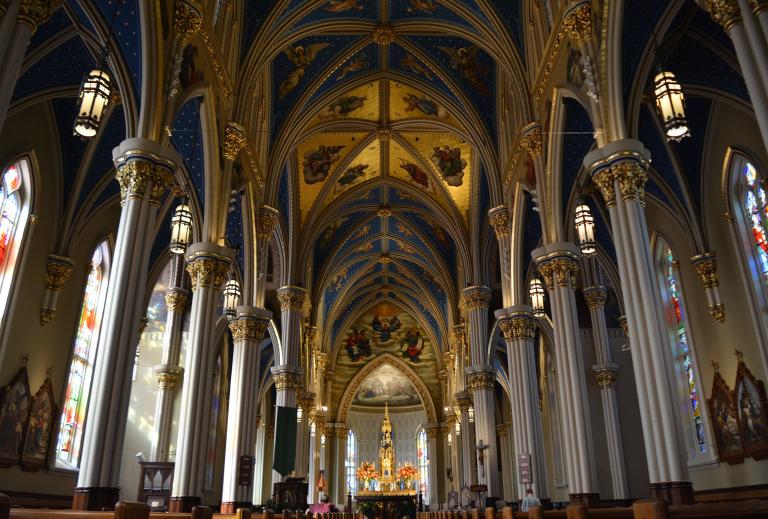
The Basilica of the Sacred Heart at Notre Dame (go Irish)
1. The Sacred Heart in the womb of Mary
The science of a baby’s heart development shows the fragility of the Heart of our Savior.
In the womb, the fetal heart begins beating rapidly by about the third week of life, and it is strong enough to be detected by the sixth week. But throughout pregnancy, the heart cannot actually perform its function. The fetal heart cannot pump oxygenated blood through the circulatory system, because the lungs cannot breathe.
Instead, the mother’s body ‘breathes’ for the baby through the placenta, an organ formed by the child and mother together. Nutrients and oxygen move across a thin layer of cells in the placenta, from the blood of the mother to that of the fetus. At the same time, waste products move from the fetus to the mother. Then, oxygen-rich blood traverses the umbilical cord to the child’s liver, and from there, to the rest of the body.
A baby’s umbilical cord is clamped at birth, ending this intimate connection between child and mother. As the infant’s lungs begin to inflate and deflate, fluid clears from the alveoli and blood pressure rises. As a result, the anatomy of the child’s heart actually changes. Two shunts, which had enabled blood to bypass the heart and liver, close so that the beating of the heart might pump blood throughout the body.
For nine long months, the Immaculate Heart of Mary beat for the Sacred Heart of Jesus, and her lungs breathed for His. What a mystery to ponder. The Savior of the world not only chose to take on our flesh, but entered the world in a condition of total dependence. Mary, the glory of our race, enabled the Heart of God to beat for us.
As Mary and Joseph brought the Child Jesus to the temple for the first time, Simeon prophesied that the heart of Mary would be pierced (Luke 2:35). And indeed, when His side was pierced on the Cross thirty-three years later, so too was her heart pierced with sorrow. How could it not be, after her heart had beat for His, her heart had formed His, her heart had suffered with His!
Heart of Jesus, formed by the Holy Spirit in the womb of the Virgin Mother, have mercy on us.
2. The Sacred Heart present in the Eucharist
The scientific study of Eucharistic miracles reminds us, tangibly, the presence of the Sacred Heart in the consecrated Host.
Eucharistic miracles are the most badass of all, in my humble opinion. Over the centuries, hundreds have occurred in Catholic Churches throughout the world. Perhaps the most famous is the Miracle of Bolsena, in 1263. Blood began to trickle from a consecrated Host during Mass, and falling onto an altar cloth, it formed an image of the visage of Christ. In celebration of this event, and upon the encouragement of St. Thomas Aquinas, Pope Urban IV instituted the Feast of Corpus Christi.
In the modern era, Eucharistic miracles have been subject to intense scientific scrutiny, often with astonishing results. Take, for instance, the Eucharistic miracle of Solkolka, which occurred in 2008. After a Host fell from the hands of a priest during distribution of Communion, it grew red as if stained with blood. Upon examination by independent scientific experts, the piece of altered host was identified as myocardial or heart tissue, closely intertwined with the structure of bread. Not only that, but the cells displayed histological characteristics typical of dying tissue. Similarly, a few decades ago, a miracle occurred in Argentina in which the consecrated Host developed reddish stains. Genetic testing revealed the red spots to be human blood; further analyses identified intact myocardial cells and active white blood cells. The Host contained the physical presence of distressed heart tissue.
Eucharistic miracles are not given to prove doctrine through science — especially not before they receive confirmation from the Vatican. Rather, our belief in the Eucharist should come from our trust in Christ’s words in Scripture (see John 6:48-58 and 1 Corinthians 10:16). But these miracles do invite us to a deeper devotion to His Sacred Heart, present in the Eucharist. These mysteries are a powerful invitation to reverence the one who suffered for our sake, to adore the one who died of love for us. In the words of the 16th century hymn Cristo al morir tendea, “As He gives heart and soul to take you to Heaven, / will you leave Him for another love?”
Heart of Jesus, of whose fullness we have all received, have mercy on us.
To celebrate the Solemnity, I made a Sacred Heart playlist on Spotify. Enjoy!
If you enjoy the blog, click here to join my mailing list.

About Synapses of the Soul
You can contact Sofia at [email protected]. You can read more about the author here.
Previous Post
June 15, 2020
Love and Longing in the Time of Coronavirus
Next Post

July 6, 2020 The Dizzying Smallness of Life
Browse Our Archives
Select a Category Monthly Roundup Series: Habits Uncategorized
Select a Month November 2020 October 2020 September 2020 August 2020 July 2020 June 2020 May 2020 April 2020 January 2020 December 2019 November 2019 October 2019 September 2019 August 2019 March 2019 February 2019 January 2019 December 2018 November 2018 October 2018 September 2018 August 2018
TAKE THE
Religious Wisdom Quiz
What did God use to speak to Moses in the wilderness?
Select your answer to see how you score.
A mighty wind A burning bush A pillar of fire A thunderstorm
Related posts from Synapses of the Soul


Your Life Should Cause Cognitive Dissonance


Does Your Mind Extend Into the World?
TRENDING AT PATHEOS Catholic

The Parable Of The Sower And The Word...
One of Christ’s most famous parables is that of the sower who...

Rejecting Doom: Christian Hope And Human Action
Christianity is a religion of hope. We are to have hope and...

Why I Choose the Eucharist Over the Sermon
Choose the Eucharist, Not the Sermon What are we supposed to get...

5 Design Elements Found in Spiritually Rooted Homes
Putting Spirituality Into Home Decor Our homes are more than our living...

Credo: A Story of God Told with the...
About 10 years ago, I began to imagine a personal "Credo" that...

The Anatomy of Divine Revelation in Catholic Thought
The claim that God has made Himself known to human beings is...
view all Catholic blogs
Ad-Free & Subscriber Log-In Subscription Support
- About Us
- 2026 Calendar
- Videos
- Podcasts
- Library of World Religions
- Faith In Media Tracker
- Advertise With Us
- Write for Us
- Privacy Policy
- Terms of Service
- Do Not Sell My Data
- Contact Us
- Radiant Digital
- Manage Newsletter Subscriptions
- Unsubscribe From Notifications
- Sitemap
Copyright 2008-2026, Patheos. All rights reserved.
Subscription Support Ad-Free & Subscriber Log-In
Follow Patheos