
BuddhistCatholicContemplativeEvangelicalGeneral ChristianHinduJewishLatter-day SaintMuslimNew VisionsProgressive Christian
Beliefs
- Buddhist
- Catholic
- Contemplative
- Evangelical
- General Christian
- Hindu
- Jewish
- Latter-day Saint
- More Voices
- Muslim
- New Visions
- Pagan
- Progressive Christian
Topics
- Religion News
- Food and Religion
- Sports and Religion
- Religious Art
- Religious Music and Entertainment
- Religious Events
- History and Religion
- Style and Religion
- Politics and Religion
- Women in Religion
- Recreation Outdoors and Religion
- Business Finance and Religion
- Careers Workplace and Religion
- Education and Religion
- Family Parenting and Religion
- Health Fitness and Religion
- Home and Religion
- Relationships and Religion
- Technology and Religion
- Travel and Religion
Columnists
- Buddhist Columnists
- Business Finance and Religion Columnists
- Careers Workplace and Religion Columnists
- Catholic Columnists
- Contemplative Columnists
- Education and Religion Columnists
- Evangelists Columnists
- Family Parenting and Religion Columnists
- General Christian Columnists
- Health Fitness and Religion Columnists
- Hindu Columnists
- History and Religion Columnists
- Home and Religion Columnists
- Jewish Columnists
- More Voices Columnists
- Latter Day Columnists
- Muslim Columnists
- New Visions Columnists
- Nonreligious Columnists
- Pagan Columnists
- Politics and Religion Columnists
- Progressive Columnists
- Recreation Outdoors and Religion Columnists
- Relationships and Religion Columnists
- Religion News Columnists
- Religious Art Columnists
- Religious Events Columnists
- Religious Music and Entertainment Columnists
- Sports and Religion Columnists
- Style and Religion Columnists
- Technology and Religion Columnists
- Travel and Religion Columnists
- Women in Religion Columnists
Resource Library
- 2026 Calendar
- Library of World Religions
- The 100 Most Holy Places on Earth
- Patheos Answers
- Podcasts
- Videos
- Faith Leaders Database
- Anglican Episcopalian
- Bahai
- Baptist
- Buddhism
- Christianity
- Confucianism
- Eastern Orthodoxy
- Hinduism
- Holiness and Pentecostal
- ISKCON
- Islam
- Judaism
- Lutheran
- Methodist
- The Church of Jesus Christ of Latter-day Saints
- New Age
- Paganism
- Presbytarian and Reformed
- Protestantism
- Religion Behind the Scenes
- Roman Catholic
- Scientology
- Shia Islam
- Sikhism
- Sufism
- Sunni Islam
- Taoism
- Zen
- See all religions
Research Tools
 Ad-Free & Subscriber Log-In Subscription Support
Ad-Free & Subscriber Log-In Subscription Support
Follow Patheos 

- Trending:
- Forgiveness
- |
- Marriage
- |
- Consciousness
- |
- Death Penalty
- |
- Election
- |
- Halloween
 Synapses of the Soul
- Home
- Catholic
- You Could Die Anytime (When Breath Becomes Air)
You Could Die Anytime (When Breath Becomes Air)
Last updated on: March 5, 2021 at 7:03 am by Synapses of the Soul
You Could Die Anytime (When Breath Becomes Air) 2021-03-05T07:03:45-06:00 Synapses of the Soul
Patheos Explore the world's faith through different perspectives on religion and spirituality! Patheos has the views of the prevalent religions and spiritualities of the world.
Our culture fears anything related to death. We fear ageing, not merely out of distaste for the accompanying wrinkles and back pain. We fear illness, and not only because of the pain and high medical bills that it brings. No, we fear ageing and illness as harbingers of death. So we work to keep them at bay, studiously avoiding any reminder of our mortality.
Perhaps we shouldn’t. Fear of death does not generate life. No matter how studiously we avoid reminders of our mortality, we could die anytime.
As I’ve mentioned before, I believe we should all think about death more: it’s an opportunity for vulnerability, wisdom, and encounter. A fear of death can suppress the heart’s search for ultimate meaning. What is the purpose of my life? Does my suffering have value? What truly fulfils me? Many people stifle these questions, afraid to open them up because of the inevitable abyss of the unknown that looms under them.
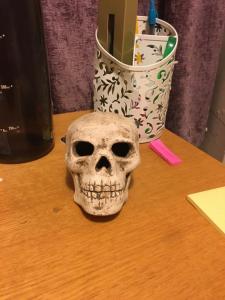
Sofia.
It doesn’t have to be this way. We can learn to embrace reminders of our mortality. Our engagement with death can in fact become a source of life, a provocation to live authentically and courageously. I actively choose to do this by keeping a skull on my desk which I (a bit egotistically) named “Sofia.”
Some don’t have this choice to begin with. We are forced to confront death when faced with the loss of a loved one, a serious injury, or a terminal diagnosis.
When Breath Becomes Air
This was the case with Paul Kalanathi, author of the memoir When Breath Becomes Air. At age 36, Kalanthi was a brilliant neurosurgery resident at a top medical school. He had years of gruelling training behind him and cutting-edge research experience under his belt. After his completion of residency, he would begin his prestigious career as a neurosurgeon neuroscientist, in which he would pioneer novel technologies in the treatment of brain disorders. To Kalanathi, it seemed that he was finally nearing the life he had planned to lead; he was one hurdle away from the finish line.
But then, Paul received earth-shattering news: he had stage IV lung cancer. Though Paul had been experiencing back pain and fatigue for weeks, the diagnosis understandably shocked him, as this advanced cancer is extremely rare in men of his age. Perhaps more than anything else, the uncertainty of his prognosis disturbed Paul. How could he decide how he to live if he didn’t know how much time he had left?
In the end, it was less than two years. Only 22 months elapsed between Paul’s diagnosis and his death. Those months, as he recorded them in his memoir, were enormously fruitful. Paul responded to his illness with courage and determination, with his wife Lucy by his side. With his death on the horizon, Paul had no more room for delays, for complacency or ambiguity. Paul had to make choices, and not just about his treatment plan. Would he continue working in medicine, or return to his earlier passion for literature? Would he devote himself to research projects that would outlive him, or patients whose illnesses he could heal? Should he spend more time with his family and friends, or with his wife? Should the two of them seek to bring a child into the world?
Beyond these practical questions lurked more existential ones. As is the case with many of us, Paul’s decisions and behaviors — both personal and professional — were grounded on the assumption that he had half a decade left to live. The elimination of that future called his identity into question. But Paul didn’t avoid these doubts, questions, and fears. He grappled with them in search of a real answer. And even as he was steeped in this inner turmoil, he lived. He acted, he worked, and he made choices. He sought to leave behind a legacy through his memoir. Most beautifully, he and his wife welcomed a daughter, who filled his final days with joy.
Lessons from the memoir
Paul’s memoir is filled with valuable and vulnerable reflections on life and death. In particular, though, three themes emerge.
First, what does it mean to practice medicine? For Paul, medicine was not just problem-solving. It was a vocation. Paul’s work demanded that he take his patient’s suffering on himself. Paul’s decisions determined their life expectancy and his skill their quality of life. These high stakes were not an objection to Paul’s calling, but a part of it. In the same way, neither could the gruelling years of training and long hours of work be an objection. (Though I do think that medical education should be reformed). Through embracing his calling as a surgeon, Paul reminds us that true fulfillment is not separate from the cross. In fact, it demands that we sacrifice our own self-interest in the service of others.
Second, what is hope? Paul struggles to identify where and how he can have hope. Many patients pin their hopes on their odds of survival, no matter how narrow. This doesn’t satisfy Paul. Nor does he place his hope on his legacy, either in neurosurgery or in his personal life. I think that, in his heart, Paul intuited the truth about hope. Hope cannot rest on my circumstances, depend on some abstract future possibility*.* Hope can only be grounded of a present reality. Luigi Giussani explains true hope this way:
“It’s a hope in me and in you, in you and in me; it’s a hope in our person, or something inside of our person. It’s not a hope in something outside us, a hope in a word, a circumstance, a situation or opportunity.”
Third, what is our relationship with death? Paul’s relationship with his mortality changed over the course of his diagnosis. Eventually, he made peace with it, concluding that “The fact of death is unsettling. Yet there is no other way to live.” By his life, Paul demonstrated that engaging death can be an opportunity to love and to bear fruit that will remain. He did not indulge in platitudes, or even explicitly exhort his readers to make the most of their time. But he embodied the value of keeping death in mind — what I would call an ‘eternal perspective.’ We need not receive a diagnosis like his to reflect on our own lives, and make changes accordingly.
These themes are, of course, a simplification of Paul’s experience. I encourage you to read the book for yourself – and perhaps think about your own death a little more in the process.
If you’d like updates on this project, please click here to join my mailing list.

About Synapses of the Soul
You can contact Sofia at [email protected]. You can read more about the author here.
Previous Post

October 31, 2019
You're Not Made for the City
Next Post
November 27, 2019 Four British Gifts for Thanksgiving
Browse Our Archives
Select a Category Monthly Roundup Series: Habits Uncategorized
Select a Month November 2020 October 2020 September 2020 August 2020 July 2020 June 2020 May 2020 April 2020 January 2020 December 2019 November 2019 October 2019 September 2019 August 2019 March 2019 February 2019 January 2019 December 2018 November 2018 October 2018 September 2018 August 2018
TAKE THE
Religious Wisdom Quiz
Who prayed in the lions' den every day?
Select your answer to see how you score.
David Daniel Solomon Paul
Related posts from Synapses of the Soul


Your Life Should Cause Cognitive Dissonance


Does Your Mind Extend Into the World?
TRENDING AT PATHEOS Catholic

The Parable Of The Sower And The Word...
One of Christ’s most famous parables is that of the sower who...

Rejecting Doom: Christian Hope And Human Action
Christianity is a religion of hope. We are to have hope and...

Why I Choose the Eucharist Over the Sermon
Choose the Eucharist, Not the Sermon What are we supposed to get...

5 Design Elements Found in Spiritually Rooted Homes
Putting Spirituality Into Home Decor Our homes are more than our living...

Credo: A Story of God Told with the...
About 10 years ago, I began to imagine a personal "Credo" that...

The Anatomy of Divine Revelation in Catholic Thought
The claim that God has made Himself known to human beings is...
view all Catholic blogs
Ad-Free & Subscriber Log-In Subscription Support
- About Us
- 2026 Calendar
- Videos
- Podcasts
- Library of World Religions
- Faith In Media Tracker
- Advertise With Us
- Write for Us
- Privacy Policy
- Terms of Service
- Do Not Sell My Data
- Contact Us
- Radiant Digital
- Manage Newsletter Subscriptions
- Unsubscribe From Notifications
- Sitemap
Copyright 2008-2026, Patheos. All rights reserved.
Subscription Support Ad-Free & Subscriber Log-In
Follow Patheos