
BuddhistCatholicContemplativeEvangelicalGeneral ChristianHinduJewishLatter-day SaintMuslimNew VisionsProgressive Christian
Beliefs
- Buddhist
- Catholic
- Contemplative
- Evangelical
- General Christian
- Hindu
- Jewish
- Latter-day Saint
- More Voices
- Muslim
- New Visions
- Pagan
- Progressive Christian
Topics
- Religion News
- Food and Religion
- Sports and Religion
- Religious Art
- Religious Music and Entertainment
- Religious Events
- History and Religion
- Style and Religion
- Politics and Religion
- Women in Religion
- Recreation Outdoors and Religion
- Business Finance and Religion
- Careers Workplace and Religion
- Education and Religion
- Family Parenting and Religion
- Health Fitness and Religion
- Home and Religion
- Relationships and Religion
- Technology and Religion
- Travel and Religion
Columnists
- Buddhist Columnists
- Business Finance and Religion Columnists
- Careers Workplace and Religion Columnists
- Catholic Columnists
- Contemplative Columnists
- Education and Religion Columnists
- Evangelists Columnists
- Family Parenting and Religion Columnists
- General Christian Columnists
- Health Fitness and Religion Columnists
- Hindu Columnists
- History and Religion Columnists
- Home and Religion Columnists
- Jewish Columnists
- More Voices Columnists
- Latter Day Columnists
- Muslim Columnists
- New Visions Columnists
- Nonreligious Columnists
- Pagan Columnists
- Politics and Religion Columnists
- Progressive Columnists
- Recreation Outdoors and Religion Columnists
- Relationships and Religion Columnists
- Religion News Columnists
- Religious Art Columnists
- Religious Events Columnists
- Religious Music and Entertainment Columnists
- Sports and Religion Columnists
- Style and Religion Columnists
- Technology and Religion Columnists
- Travel and Religion Columnists
- Women in Religion Columnists
Resource Library
- 2026 Calendar
- Library of World Religions
- The 100 Most Holy Places on Earth
- Patheos Answers
- Podcasts
- Videos
- Faith Leaders Database
- Anglican Episcopalian
- Bahai
- Baptist
- Buddhism
- Christianity
- Confucianism
- Eastern Orthodoxy
- Hinduism
- Holiness and Pentecostal
- ISKCON
- Islam
- Judaism
- Lutheran
- Methodist
- The Church of Jesus Christ of Latter-day Saints
- New Age
- Paganism
- Presbytarian and Reformed
- Protestantism
- Religion Behind the Scenes
- Roman Catholic
- Scientology
- Shia Islam
- Sikhism
- Sufism
- Sunni Islam
- Taoism
- Zen
- See all religions
Research Tools
 Ad-Free & Subscriber Log-In Subscription Support
Ad-Free & Subscriber Log-In Subscription Support
Follow Patheos 

- Trending:
- Forgiveness
- |
- Marriage
- |
- Consciousness
- |
- Death Penalty
- |
- Election
- |
- Halloween
 Synapses of the Soul
- Home
- Catholic
- On The Modern Prometheus
On The Modern Prometheus
Last updated on: March 5, 2021 at 7:03 am by Synapses of the Soul
On The Modern Prometheus 2021-03-05T07:03:56-06:00 Synapses of the Soul
Patheos Explore the world's faith through different perspectives on religion and spirituality! Patheos has the views of the prevalent religions and spiritualities of the world.
I recently re-read Frankenstein, or The Modern Prometheus for the first time in many years. And what I discovered in the pages of Mary Shelley’s 1818 work surprised me.
First of all, the text barely resembles the modern-day myth. “Frankenstein” is the creator rather than the Creature. And more importantly, the Creature isn’t a dumb brute, but an articulate, deeply aware, and morally complex character.
Secondly, the philosophical implications of the narrative are provocative and arguably ambiguous. The modern interpretation of Shelley’s work – as a mere warning against overreach of scientific progress – is simplistic. That element is certainly present, as the subtitle of the work suggests. However, the Creature is not merely a symbol of technological advancements, and Frankenstein is not only a representative of humanity’s hubris.
As a work of speculative fiction, Frankenstein offers nearly endless points of reflection on political rights and duties, scientific progress and exploration, human nature and society, morality and sin.
Here are three of its overlooked lessons. Through these lessons, Frankenstein invites us to reflect and act on the truth of who we are as human beings.
-
The human person longs for the transcendent
In Walton, Frankenstein, and even the Creature, we see clearly that the human heart is oriented toward the infinite, and longs for experiences of the transcendent. As Rabbi Abraham Joshua Heschel writes in Who is Man: “Transcendence is not an article of faith. It is what we come upon immediately when standing face to face with reality.”
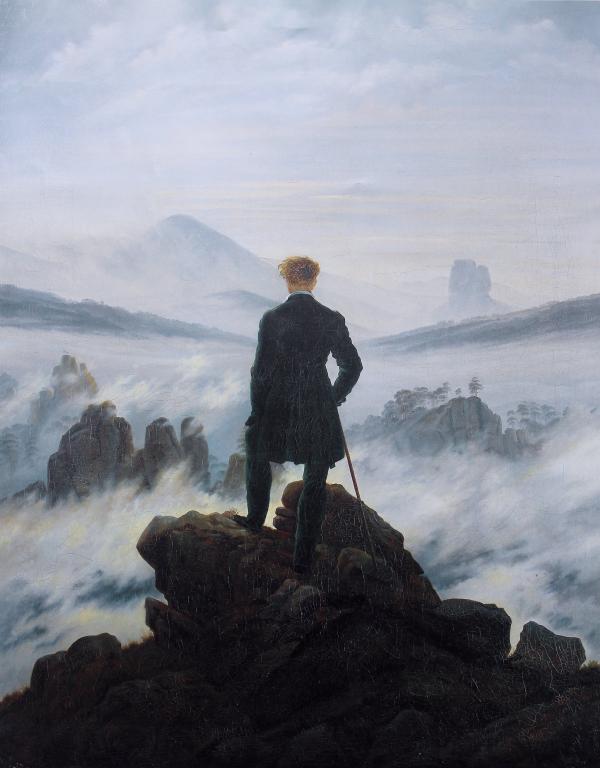
Caspar David Friedrich, Wanderer Above the Sea of Fog, 1818. Image in the public domain.
Our lived experience, if we take it seriously, elicits ultimate questions about meaning, and a powerful longing for something more. Heschel believes we must rediscover these questions, and take seriously this longing, if we are ever going to find an answer. On his terms, the vocation of the human person as to a relationship with the transcendent meaning that corresponds to her ultimate questions.
This vocation takes work: “The sense of meaning is not born in ease and sloth. It comes after bitter trials, disappointments in the glitters, foundering, strandings. It is the marrow from the bone. There is no manna in our wilderness.”
But we do not desire this work. Instead, it is easier to forget our questions. And so, we strive to fulfill them with earthly things. In the novel, Captain Walton places all his hope on his voyage of exploration across the Arctic. Similarly, Victor’s longing is manifest in the all-consuming passion that drives him to produce the Creature. In and of themselves, adventure, growth in knowledge, and art are good. But alone, they are not enough to satisfy us; they are not proportional to our desires. Frankenstein masterfully presents the structural mismatch between our heart’s longings and the ways we strive to answer them.
-
We are fundamentally constituted and fulfilled by relationship
Frankenstein’s Creature, at the beginning of its life, is not evil. Rather, the Creature’s rage is the fruit of broken relationality. First, he is rejected by his Creator – Frankenstein. Then, he is abused and attached by villagers and the de Lacey family. These experiences of trauma drive his murderous rage, and lead to the novel’s horrors.
Furthermore, when the Creature and Frankenstein first enter into dialogue with one another, the Creature’s one request is for a companion. He desires to share life with someone, to enter into “the interchange of those sympathies necessary for my being.”

Frankenstein and Creature meet in the 1931 “Frankenstein.” Moviepix/Getty Images.
Evidently, the human person is made for relationship. In order to become more fully human, more truly ourselves, we must give ourselves in love of another. We are created in the image and likeness of a Trinitarian God, and the persons of His being are constituted by self-giving love. We, too, depend on relationship to be whole and holy. This truth is resisted by Frankenstein but embraced by the Creature, making him almost more human than his creator.
-
We must respond creatively and fearlessly to the needs of others
The Creature’s only moment of positive relationships is with de Lacey, the blind head of household of the Creature’s family of “protectors.” Because of his blindness, the old man is able to recognize the humanity and sincerity of the Creature, and respond with empathy. All other characters – and the reader, too – are blind because of their prejudice at his ugliness.
Are we limited by our assumptions and prejudice? Do we resist dialogue with those who may appear “monstrous” or “other”? Why do we assume that others do not belong in our community?
Frankenstein fails to reflect on these questions. When the Creature asks for companionship, Frankenstein cannot recognize that needs as valid, nor think creatively about how to meet it. And so, he forces himself into the false binary between creating another “monster” and ignoring the need of his Creature. Thus, Frankenstein’s prejudice prevents him from responding to the demands of justice.
Thus, Frankenstein invites us to reflect on how we practice justice and compassion in our society. Just as the Creature could have found loving relationship in a community of blind people, who could not see his ugliness, so too can the vulnerable and marginalized in our midst find loving companionship in unexpected places. We cannot let fear limit our responses, but must expand our imagination.
Further reading recommendations
Read Frankenstein.
Find Heschel’s works here – I would start with God in Search of Man.
Finally, my mentor and professor Eileen Hunt Botting recently released a thought-provoking monograph on ethical implications of Frankenstein for children’s rights: Mary Shelley and the Rights of the Child.
Previous Post

January 31, 2019
The Healing Power of Touch
Next Post

February 7, 2019 California Bishops on Healing Mental Illness
Browse Our Archives
Select a Category Monthly Roundup Series: Habits Uncategorized
Select a Month November 2020 October 2020 September 2020 August 2020 July 2020 June 2020 May 2020 April 2020 January 2020 December 2019 November 2019 October 2019 September 2019 August 2019 March 2019 February 2019 January 2019 December 2018 November 2018 October 2018 September 2018 August 2018
TAKE THE
Religious Wisdom Quiz
How many times does the book of Genesis mention "God created"?
Select your answer to see how you score.
11 5 9 7
Related posts from Synapses of the Soul


Your Life Should Cause Cognitive Dissonance


Does Your Mind Extend Into the World?
TRENDING AT PATHEOS Catholic

Rejecting Doom: Christian Hope And Human Action
Christianity is a religion of hope. We are to have hope and...

It’s What Comes From Within Which Matters
One of the most difficult things for us to understand is why...

Why I Choose the Eucharist Over the Sermon
Choose the Eucharist, Not the Sermon What are we supposed to get...

5 Design Elements Found in Spiritually Rooted Homes
Putting Spirituality Into Home Decor Our homes are more than our living...

Credo: A Story of God Told with the...
About 10 years ago, I began to imagine a personal "Credo" that...

The Anatomy of Divine Revelation in Catholic Thought
The claim that God has made Himself known to human beings is...
view all Catholic blogs
Ad-Free & Subscriber Log-In Subscription Support
- About Us
- 2026 Calendar
- Videos
- Podcasts
- Library of World Religions
- Faith In Media Tracker
- Advertise With Us
- Write for Us
- Privacy Policy
- Terms of Service
- Do Not Sell My Data
- Contact Us
- Radiant Digital
- Manage Newsletter Subscriptions
- Unsubscribe From Notifications
- Sitemap
Copyright 2008-2026, Patheos. All rights reserved.
Subscription Support Ad-Free & Subscriber Log-In
Follow Patheos