
BuddhistCatholicContemplativeEvangelicalGeneral ChristianHinduJewishLatter-day SaintMuslimNew VisionsProgressive Christian
Beliefs
- Buddhist
- Catholic
- Contemplative
- Evangelical
- General Christian
- Hindu
- Jewish
- Latter-day Saint
- More Voices
- Muslim
- New Visions
- Pagan
- Progressive Christian
Topics
- Religion News
- Food and Religion
- Sports and Religion
- Religious Art
- Religious Music and Entertainment
- Religious Events
- History and Religion
- Style and Religion
- Politics and Religion
- Women in Religion
- Recreation Outdoors and Religion
- Business Finance and Religion
- Careers Workplace and Religion
- Education and Religion
- Family Parenting and Religion
- Health Fitness and Religion
- Home and Religion
- Relationships and Religion
- Technology and Religion
- Travel and Religion
Columnists
- Buddhist Columnists
- Business Finance and Religion Columnists
- Careers Workplace and Religion Columnists
- Catholic Columnists
- Contemplative Columnists
- Education and Religion Columnists
- Evangelists Columnists
- Family Parenting and Religion Columnists
- General Christian Columnists
- Health Fitness and Religion Columnists
- Hindu Columnists
- History and Religion Columnists
- Home and Religion Columnists
- Jewish Columnists
- More Voices Columnists
- Latter Day Columnists
- Muslim Columnists
- New Visions Columnists
- Nonreligious Columnists
- Pagan Columnists
- Politics and Religion Columnists
- Progressive Columnists
- Recreation Outdoors and Religion Columnists
- Relationships and Religion Columnists
- Religion News Columnists
- Religious Art Columnists
- Religious Events Columnists
- Religious Music and Entertainment Columnists
- Sports and Religion Columnists
- Style and Religion Columnists
- Technology and Religion Columnists
- Travel and Religion Columnists
- Women in Religion Columnists
Resource Library
- 2026 Calendar
- Library of World Religions
- The 100 Most Holy Places on Earth
- Patheos Answers
- Podcasts
- Videos
- Faith Leaders Database
- Anglican Episcopalian
- Bahai
- Baptist
- Buddhism
- Christianity
- Confucianism
- Eastern Orthodoxy
- Hinduism
- Holiness and Pentecostal
- ISKCON
- Islam
- Judaism
- Lutheran
- Methodist
- The Church of Jesus Christ of Latter-day Saints
- New Age
- Paganism
- Presbytarian and Reformed
- Protestantism
- Religion Behind the Scenes
- Roman Catholic
- Scientology
- Shia Islam
- Sikhism
- Sufism
- Sunni Islam
- Taoism
- Zen
- See all religions
Research Tools
 Ad-Free & Subscriber Log-In Subscription Support
Ad-Free & Subscriber Log-In Subscription Support
Follow Patheos 

- Trending:
- Forgiveness
- |
- Marriage
- |
- Consciousness
- |
- Death Penalty
- |
- Election
- |
- Halloween
 Synapses of the Soul
- Home
- Catholic
- Sam Harris’s Lazy Argument against the Self
Sam Harris’s Lazy Argument against the Self
Last updated on: March 5, 2021 at 7:03 am by Synapses of the Soul
Sam Harris’s Lazy Argument against the Self 2021-03-05T07:03:53-06:00 Synapses of the Soul
Patheos Explore the world's faith through different perspectives on religion and spirituality! Patheos has the views of the prevalent religions and spiritualities of the world.
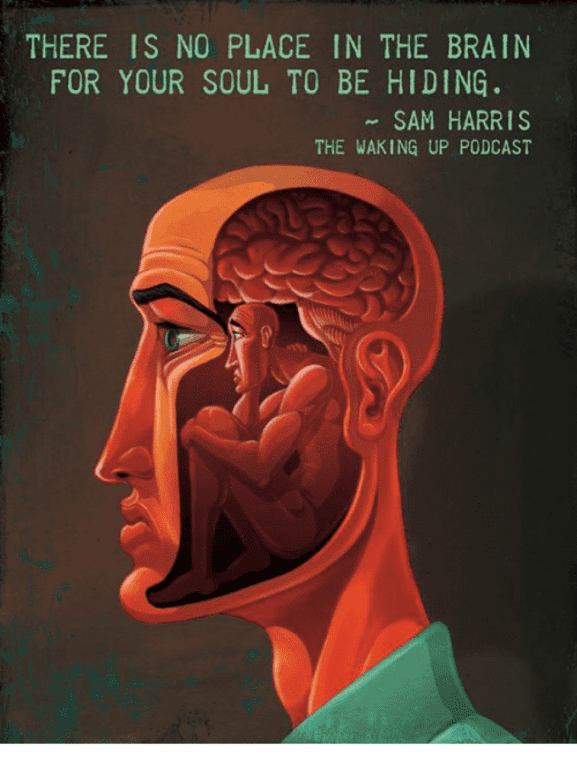
“There is no place in the brain for a soul to be hiding.”
I recently heard this phrase on a podcast by Sam Harris, who is an American cognitive neuroscientist and philosopher. Harris, one of the Four Horsemen of Atheism, believes that the self is an illusion that will disappear upon close examination. For Harris, this is a profound liberation, a “relief” akin to waking from sleep.
Harris’ argument for this view, though, is based in error. Allow me to explain.
The self as illusion
Sam Harris believes that each person has the experience of being a “self.” This is characterized by a sense of a coherent identity, as well as the impression of free will. However, this sense of self does not exist apart from the person’s subjective consciousness. There is no evidence, in the brain or elsewhere in the body, for the existence of a real “self.” And as such, Harris concludes that the sense of self is an illusion.
Why, then, does this sense of self exist? Harris claims this illusion is a useful tool that the brain uses in order to integrate thoughts and behaviors into a coherent framework. In other words, the brain generates a narrative to make sense of, and unite, its various experiences. This subjective narrative is the illusory “self.”
Wait a second… even if the brain produces the sense of self, mustn’t there be an “I” to perceive this illusion? Harris believes that this is a conceptual problem, a mere accident of our language because of which we cannot discuss the self without a referent.
In sum, his argument is this: there is no physical evidence for an objective self. A “sense of self,” therefore, is merely a subjective, illusory experience generated by brain processes. As a result, there is no soul.
Harris’ error
There is a basic problem with this line of reasoning. Namely, Harris begins from a certain set of assumptions, and, finding that dualism fails their test, embraces his premises as conclusions.
He believes that a “self” would necessarily reside in a physical location in the brain or body. Such a location could be identified as the “seat” of the self, and therefore would provide physical correlates for the sense of self. Thus Harris assumes that, if such a physical location cannot be found, there cannot be a self.
Then, Harris uses these assumptions to evaluate a dualistic understanding of the soul. Most forms of dualism claim that the mental and the physical are radically different kinds of things. Such theories understand the mind/soul and the brain/body to be separate; the soul does not reside in the body, and its existence is not reducible to or derived from a set of physical processes.
So of course “There is no place in the brain for your soul to be hiding.” Of course dualism fails Harris’ test. Harris’ test is rooted in a physicalist understanding of the person, which dualism explicitly rejects.
In this disagreement, there is a fundamental mismatch in assumptions about the nature of the human person, the mind and the body. But Harris does not argue for his view of the soul, nor does he argue against those of dualism. All he does is use his own assumptions to evaluate dualism, and finding that dualism fails, interprets his premises as conclusions.
Thus, he begs the question of the illusory existence of the self.
The negative and positive against Sam Harris
Please don’t mistake me: I am not arguing for dualism. Dualism has its own set of flaws and failings. All I am arguing is that Sam Harris does not prove what he thinks he does.
On the one hand, I can’t really blame him. Our modern life is characterized by implicit assumptions of both dualism and physicalism. And often, people don’t acknowledge the inherently contradictions in their own thought. So I understand why Sam Harris is tempted to take an easy shot at blasting dualism out of the water.
But on the other, I can totally blame him. Harris makes a very basic logical error by interpreting his premises as conclusions. And so, his argument falls to the ground upon close scrutiny.
My argument against Harris thus does not depend on my own vision of the soul. That said, what positive agenda can I advance?
As science progresses, we are increasingly able to characterize the human person in a way that does not fall into dualism on the one hand and materialism on the other. This characterization is one of fundamental embodiment, of unity of mind and brain, soul and body. I hope to engage and further this promising field throughout my career. In the mean time, I will continue to expose Sam Harris as a lazy philosopher.
Further reading recommendations
Jaegwon Kim’s “Philosophy of Mind” presents a great overview of essential ideas in philosophy of mind. On dualism, read Gilbert Ryle’s foundational work, “The Concept of Mind.“

About Synapses of the Soul
You can contact Sofia at [email protected]. You can read more about the author here.
Previous Post

February 10, 2019
Lessons from a Juvenile Prison
Next Post

February 19, 2019 Women's Voices at the Vatican Summit
Recent Comments
Browse Our Archives
Select a Category Monthly Roundup Series: Habits Uncategorized
Select a Month November 2020 October 2020 September 2020 August 2020 July 2020 June 2020 May 2020 April 2020 January 2020 December 2019 November 2019 October 2019 September 2019 August 2019 March 2019 February 2019 January 2019 December 2018 November 2018 October 2018 September 2018 August 2018
TAKE THE
Religious Wisdom Quiz
How many times does the book of Genesis mention "God created"?
Select your answer to see how you score.
11 5 9 7
Related posts from Synapses of the Soul


Your Life Should Cause Cognitive Dissonance


Does Your Mind Extend Into the World?
TRENDING AT PATHEOS Catholic

Rejecting Doom: Christian Hope And Human Action
Christianity is a religion of hope. We are to have hope and...

It’s What Comes From Within Which Matters
One of the most difficult things for us to understand is why...

Why I Choose the Eucharist Over the Sermon
Choose the Eucharist, Not the Sermon What are we supposed to get...

5 Design Elements Found in Spiritually Rooted Homes
Putting Spirituality Into Home Decor Our homes are more than our living...

Credo: A Story of God Told with the...
About 10 years ago, I began to imagine a personal "Credo" that...

The Anatomy of Divine Revelation in Catholic Thought
The claim that God has made Himself known to human beings is...
view all Catholic blogs
Ad-Free & Subscriber Log-In Subscription Support
- About Us
- 2026 Calendar
- Videos
- Podcasts
- Library of World Religions
- Faith In Media Tracker
- Advertise With Us
- Write for Us
- Privacy Policy
- Terms of Service
- Do Not Sell My Data
- Contact Us
- Radiant Digital
- Manage Newsletter Subscriptions
- Unsubscribe From Notifications
- Sitemap
Copyright 2008-2026, Patheos. All rights reserved.
Subscription Support Ad-Free & Subscriber Log-In
Follow Patheos