
BuddhistCatholicContemplativeEvangelicalGeneral ChristianHinduJewishLatter-day SaintMuslimNew VisionsProgressive Christian
Beliefs
- Buddhist
- Catholic
- Contemplative
- Evangelical
- General Christian
- Hindu
- Jewish
- Latter-day Saint
- More Voices
- Muslim
- New Visions
- Pagan
- Progressive Christian
Topics
- Religion News
- Food and Religion
- Sports and Religion
- Religious Art
- Religious Music and Entertainment
- Religious Events
- History and Religion
- Style and Religion
- Politics and Religion
- Women in Religion
- Recreation Outdoors and Religion
- Business Finance and Religion
- Careers Workplace and Religion
- Education and Religion
- Family Parenting and Religion
- Health Fitness and Religion
- Home and Religion
- Relationships and Religion
- Technology and Religion
- Travel and Religion
Columnists
- Buddhist Columnists
- Business Finance and Religion Columnists
- Careers Workplace and Religion Columnists
- Catholic Columnists
- Contemplative Columnists
- Education and Religion Columnists
- Evangelists Columnists
- Family Parenting and Religion Columnists
- General Christian Columnists
- Health Fitness and Religion Columnists
- Hindu Columnists
- History and Religion Columnists
- Home and Religion Columnists
- Jewish Columnists
- More Voices Columnists
- Latter Day Columnists
- Muslim Columnists
- New Visions Columnists
- Nonreligious Columnists
- Pagan Columnists
- Politics and Religion Columnists
- Progressive Columnists
- Recreation Outdoors and Religion Columnists
- Relationships and Religion Columnists
- Religion News Columnists
- Religious Art Columnists
- Religious Events Columnists
- Religious Music and Entertainment Columnists
- Sports and Religion Columnists
- Style and Religion Columnists
- Technology and Religion Columnists
- Travel and Religion Columnists
- Women in Religion Columnists
Resource Library
- 2026 Calendar
- Library of World Religions
- The 100 Most Holy Places on Earth
- Patheos Answers
- Podcasts
- Videos
- Faith Leaders Database
- Anglican Episcopalian
- Bahai
- Baptist
- Buddhism
- Christianity
- Confucianism
- Eastern Orthodoxy
- Hinduism
- Holiness and Pentecostal
- ISKCON
- Islam
- Judaism
- Lutheran
- Methodist
- The Church of Jesus Christ of Latter-day Saints
- New Age
- Paganism
- Presbytarian and Reformed
- Protestantism
- Religion Behind the Scenes
- Roman Catholic
- Scientology
- Shia Islam
- Sikhism
- Sufism
- Sunni Islam
- Taoism
- Zen
- See all religions
Research Tools
 Ad-Free & Subscriber Log-In Subscription Support
Ad-Free & Subscriber Log-In Subscription Support
Follow Patheos 

- Trending:
- Forgiveness
- |
- Marriage
- |
- Consciousness
- |
- Death Penalty
- |
- Election
- |
- Halloween
 Synapses of the Soul
- Home
- Catholic
- Habits #3: Find a Friend
Habits #3: Find a Friend
Last updated on: March 5, 2021 at 7:26 am by Synapses of the Soul
Habits #3: Find a Friend 2021-03-05T07:26:13-06:00 Synapses of the Soul
Patheos Explore the world's faith through different perspectives on religion and spirituality! Patheos has the views of the prevalent religions and spiritualities of the world.
If you’ve been following this series, you know not to set New Year’s Resolutions. Instead, you know to form strong habits, which demands that you start small and be consistent. You also know that, for this to be effective, you should rely on cues and rewards rather than motivation and willpower.
So what’s missing? From a neuroscience perspective, what’s the final key to habit formation?
The role of relationship
The third and final key to habit formation is this: personal change happens in relationship with others. It matters that we strive to form virtuous habits together with our loved ones.
If you follow my blogging, you’ve heard me go on and on about the importance of relationships. Our bonds with friends and family are essential to our flourishing, both during development and throughout our lives.
Habit formation is no exception. We know this intuitively; think of your study group, your workout buddy, or your co-workers. Without them, what would your daily habits look like?
Research confirms this idea. A recent study found that when someone initiates a new health habit, it is extremely likely that this habit will also positively affect his or her partner’s health. Some of this is due to accountability: the American Society of Training and Development (ASTD) found that your chances of successfully reaching a goal increase 30% when you explicitly commit to an accountability partner.
But it’s not just accountability. As inherently relational creatures, we look to others to provide cues for our behavior, to celebrate our successes and discipline our failures. We rely on the example of others to inspire us, the feedback of others to inform us, and the accompaniment of others to bring us strength and joy. We are made for relationships of love, and growth in virtue takes place in the context of these relationships.
Wired for relationship
Why is this the case? Because our species is wired for relationship. Through most of our evolutionary history, we lived in close-knit families embedded in tribal or clan settings.
As a result, our brain was selected to develop, function, and thrive in the context of such bonds. Our reward circuits are wired to respond to interpersonal feedback, and our striatum (the region that initiates habit formation) responds to social cues. When this goes wrong, we call it “peer pressure.” But when it goes well, it gives us the strength to adhere to what we know to be good, despite our weakness. It permits an otherwise-unattainable growth and flourishing.
So to act according to our evolutionary biology, we must lean into our friendships and relationships. Don’t hide your goals, struggles, and desires from your loved ones. Share them. Ask for assistance and accountability. Yes, it requires vulnerability, but the accompaniment of your friends and family is essential in your journey toward your best self.
Now let’s theologize
Again, this is exactly what the Church teaches us. Throughout Sacred Scripture are innumerable stories that reveal this truth: that we are made for relationships of love.
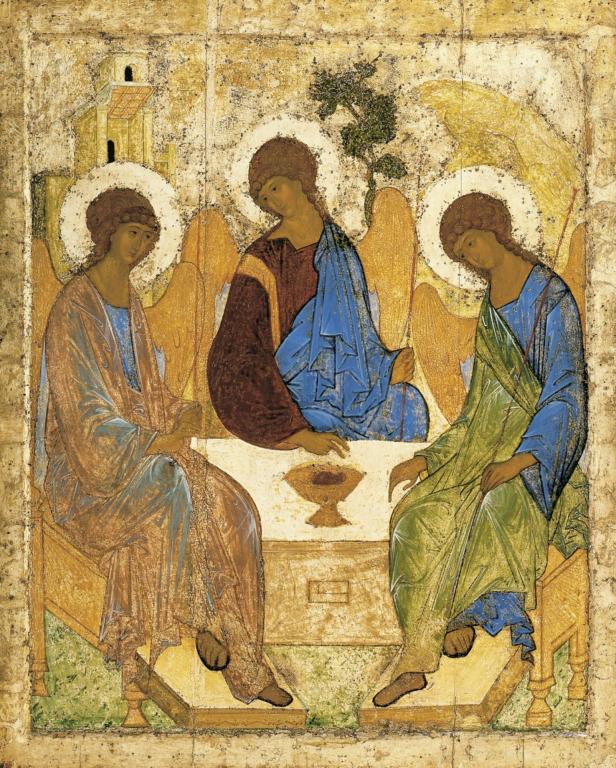
The Trinity, Andrei Rublev, 15th century Russian icon. Image from Wikimedia Commons.
On a doctrinal level, think of the theology of the Trinity. God exists as a communion of three divine Persons giving themselves completely to one another. And He created us to participate in that very communion. Think of Christ’s outpouring of love on the Cross. He invites us to love each other in that same self-sacrificial way, to find our identity and fulfillment as members of His Body.
Find the rest of this series here.
Further reading recommendations
Though the research is constantly evolving, Louis Cozolino’s The Neuroscience of Human Relationships is a thorough and rigorous introduction to the field.

About Synapses of the Soul
You can contact Sofia at [email protected]. You can read more about the author here.
Previous Post

January 10, 2019
Habits #2: Use Cues and Rewards
Next Post

January 20, 2019 Your Habits Will Save You
Browse Our Archives
Select a Category Monthly Roundup Series: Habits Uncategorized
Select a Month November 2020 October 2020 September 2020 August 2020 July 2020 June 2020 May 2020 April 2020 January 2020 December 2019 November 2019 October 2019 September 2019 August 2019 March 2019 February 2019 January 2019 December 2018 November 2018 October 2018 September 2018 August 2018
TAKE THE
Religious Wisdom Quiz
Who tried to seduce Joseph in Egypt?
Select your answer to see how you score.
Potiphar's wife Tamar Midianite woman Pharaoh's daughter
Related posts from Synapses of the Soul

Your Life Should Cause Cognitive Dissonance


Does Your Mind Extend Into the World?

The Dizzying Smallness of Life
TRENDING AT PATHEOS Catholic

Rejecting Doom: Christian Hope And Human Action
Christianity is a religion of hope. We are to have hope and...

It’s What Comes From Within Which Matters
One of the most difficult things for us to understand is why...

Why I Choose the Eucharist Over the Sermon
Choose the Eucharist, Not the Sermon What are we supposed to get...

5 Design Elements Found in Spiritually Rooted Homes
Putting Spirituality Into Home Decor Our homes are more than our living...

Credo: A Story of God Told with the...
About 10 years ago, I began to imagine a personal "Credo" that...

The Anatomy of Divine Revelation in Catholic Thought
The claim that God has made Himself known to human beings is...
view all Catholic blogs
Ad-Free & Subscriber Log-In Subscription Support
- About Us
- 2026 Calendar
- Videos
- Podcasts
- Library of World Religions
- Faith In Media Tracker
- Advertise With Us
- Write for Us
- Privacy Policy
- Terms of Service
- Do Not Sell My Data
- Contact Us
- Radiant Digital
- Manage Newsletter Subscriptions
- Unsubscribe From Notifications
- Sitemap
Copyright 2008-2026, Patheos. All rights reserved.
Subscription Support Ad-Free & Subscriber Log-In
Follow Patheos