
BuddhistCatholicContemplativeEvangelicalGeneral ChristianHinduJewishLatter-day SaintMuslimNew VisionsProgressive Christian
Beliefs
- Buddhist
- Catholic
- Contemplative
- Evangelical
- General Christian
- Hindu
- Jewish
- Latter-day Saint
- More Voices
- Muslim
- New Visions
- Pagan
- Progressive Christian
Topics
- Religion News
- Food and Religion
- Sports and Religion
- Religious Art
- Religious Music and Entertainment
- Religious Events
- History and Religion
- Style and Religion
- Politics and Religion
- Women in Religion
- Recreation Outdoors and Religion
- Business Finance and Religion
- Careers Workplace and Religion
- Education and Religion
- Family Parenting and Religion
- Health Fitness and Religion
- Home and Religion
- Relationships and Religion
- Technology and Religion
- Travel and Religion
Columnists
- Buddhist Columnists
- Business Finance and Religion Columnists
- Careers Workplace and Religion Columnists
- Catholic Columnists
- Contemplative Columnists
- Education and Religion Columnists
- Evangelists Columnists
- Family Parenting and Religion Columnists
- General Christian Columnists
- Health Fitness and Religion Columnists
- Hindu Columnists
- History and Religion Columnists
- Home and Religion Columnists
- Jewish Columnists
- More Voices Columnists
- Latter Day Columnists
- Muslim Columnists
- New Visions Columnists
- Nonreligious Columnists
- Pagan Columnists
- Politics and Religion Columnists
- Progressive Columnists
- Recreation Outdoors and Religion Columnists
- Relationships and Religion Columnists
- Religion News Columnists
- Religious Art Columnists
- Religious Events Columnists
- Religious Music and Entertainment Columnists
- Sports and Religion Columnists
- Style and Religion Columnists
- Technology and Religion Columnists
- Travel and Religion Columnists
- Women in Religion Columnists
Resource Library
- 2026 Calendar
- Library of World Religions
- The 100 Most Holy Places on Earth
- Patheos Answers
- Podcasts
- Videos
- Faith Leaders Database
- Anglican Episcopalian
- Bahai
- Baptist
- Buddhism
- Christianity
- Confucianism
- Eastern Orthodoxy
- Hinduism
- Holiness and Pentecostal
- ISKCON
- Islam
- Judaism
- Lutheran
- Methodist
- The Church of Jesus Christ of Latter-day Saints
- New Age
- Paganism
- Presbytarian and Reformed
- Protestantism
- Religion Behind the Scenes
- Roman Catholic
- Scientology
- Shia Islam
- Sikhism
- Sufism
- Sunni Islam
- Taoism
- Zen
- See all religions
Research Tools
 Ad-Free & Subscriber Log-In Subscription Support
Ad-Free & Subscriber Log-In Subscription Support
Follow Patheos 

- Trending:
- Forgiveness
- |
- Marriage
- |
- Consciousness
- |
- Death Penalty
- |
- Election
- |
- Halloween
 Synapses of the Soul
- Home
- Catholic
- Why you should pray the Liturgy of the Hours
Why you should pray the Liturgy of the Hours
Last updated on: March 5, 2021 at 7:04 am by Synapses of the Soul
Why you should pray the Liturgy of the Hours 2021-03-05T07:04:13-06:00 Synapses of the Soul
Patheos Explore the world's faith through different perspectives on religion and spirituality! Patheos has the views of the prevalent religions and spiritualities of the world.
What if I told you that there was a prayer perfectly suited to your biology? There is: The Liturgy of the Hours. This prayer of the Catholic Church is a powerful way to lean into how you are wired.
But to understand this, you first need some science.
What is a circadian rhythm?
The circadian rhythm is your body’s inner biological clock. It’s regulated by genes located in cell throughout your body, but the master biological clock is a cluster of 20,000 cells in the hypothalamus. This group of cells is called the suprachiasmatic nucleus. It sends proteins to the rest of the body to signal the time of day.
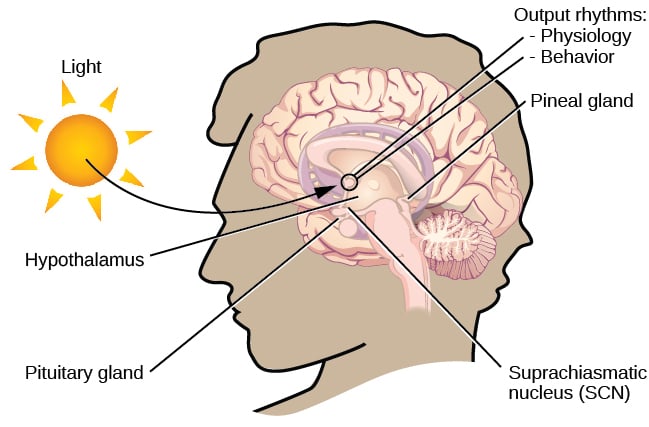
Image from Lumen Learning.
The purpose of the circadian rhythm is to make sure that your body’s functions all run on the same schedule. All by itself, it’s not exactly 24-hours long; there is a small mismatch. Therefore, your internal clock uses the light-dark cycle of the sun to resets itself daily.
This cycle is essential for regulating your hunger and metabolic rate. It’s also known to regulate your sleep and wakefulness patterns. But the effects of the circadian rhythm extend to important functions such as heart rate and blood pressure, temperature regulation, and even hormone levels.
Respect your circadian rhythm
Disrupting your circadian rhythm is a bad idea. This typically happens with business travelers and in night shift workers. But it can even occur through getting up unusually early, having meals at odd times, or through using blue-light technology late at night.
Since the circadian rhythm is involved in so many essential functions, the effects of a disrupted rhythm are broad. Your digestion and metabolic rate can get thrown off, giving you cravings or abnormal hunger. It’s harder to stay awake in class, and harder to fall asleep at your usual time at night. With a disrupted rhythm, you’re more likely to be impulsive and aggressive, and slower at processing and thinking. And with chronic disruption of circadian rhythms, you are more likely to develop diabetes, cancer, obesity and depression.
A daily rhythm awareness of God
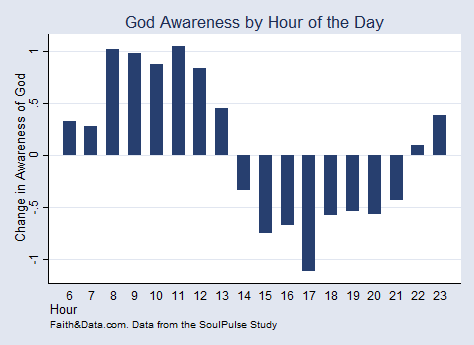
The daily rhythmicity of human life extends to our spirituality. A fascinating study published last year by Kucinskas et al examined how experiences of meaning vary over the course of the day. Researchers used a smartphone app to ask study participants, at random times, what they were doing and feeling. They found that people experience most meaning while engaging in religious and spiritual practices, and in general over the course of the workday. Interestingly, they also found that awareness of God deepens and prolongs experiences of meaning. This “sacred awareness” follows a daily pattern: it peaks in the late morning, declines through the afternoon, and rises again by nighttime.
Live into your biology
Our spirituality follows a daily rhythm. This makes sense, because we are fundamentally embodied creatures who come to experience and love God in and through our corporeality.
And this suggests that, in order to grow in our experience of meaning and awareness of God, we should lean into our biology. Rather than fighting the daily patterns of our brains, bodies, and spirits, we should try to live “in tune” with our natural rhythm. By following our circadian rhythm, we will have more energy and self-control, enhanced mental and physical health, and an improved ability to be present in the moment.
What does it look like to live into your biology?
Form habits that punctuate your day, from beginning to end. Form a morning routine that helps you start the day with energy and intentionality. Get daily exercise. Work hard during the day, but take breaks to purposefully step away to rest and reflect. Eat regular meals at regular times. And at the end of the day, form a night routine that prepares you for sleep.
A circadian prayer
And when it comes to your spirituality, the Church has the best way to live into your daily rhythm: the Divine Office. Also known as the Liturgy of Hours, this is the official prayer of the Catholic Church. The Church developed this prayer in obedience to the Lord’s command to pray without ceasing. It is a rich collection of prayers, hymns, psalms, and readings. They change each day and throughout the seasons.
The Divine Office is beautifully composed in a daily rhythm: the Office of Readings, Morning Prayer (Lauds), Daytime Prayer (Terce, Sext, or Non), Evening Prayer (Vespers), and Night Prayer (Compline). Whether you choose to pray one or all of these, the prayers punctuate your day in a cyclic pattern, interweaving and orienting your circadian rhythm to the praise of God.
Prayer is an incredibly powerful way to reshape your brain, settle your mind and heart, and bring you into dialogue with the Lord. When the prayer is regularly interspersed throughout the day, it increases your awareness of God and consecrates all that you do to Him. In the words of Canticum Laudis, “The purpose of the Divine Office is to sanctify the day and all human activity.”
Don’t let this prayer turn into a mechanical exercise: let it elevate your awareness of God and reawaken you to the constancy of His love!
Further reading recommendations
Charles Peguy’s poem The Portal and the Mystery of Hope contains a beautiful passage on the sacredness of sleep, of obeying your limits, of trusting in God and hoping in the new morning. Find it here.
He whose heart is pure, sleeps. And he who sleeps has a pure heart.
This is the great secret to being as indefatigable as a child.
To have that strength in your legs that a child has.
Those new legs, those new souls
And to start over every morning, always new,
Like the young, like the new
Hope.

About Synapses of the Soul
You can contact Sofia at [email protected]. You can read more about the author here.
Previous Post
November 11, 2018
Your brain on prayer
Next Post

November 18, 2018 On spiritual friendship
Recent Comments
Browse Our Archives
Select a Category Monthly Roundup Series: Habits Uncategorized
Select a Month November 2020 October 2020 September 2020 August 2020 July 2020 June 2020 May 2020 April 2020 January 2020 December 2019 November 2019 October 2019 September 2019 August 2019 March 2019 February 2019 January 2019 December 2018 November 2018 October 2018 September 2018 August 2018
TAKE THE
Religious Wisdom Quiz
I killed 600 Philistines with nothing but an oxgoad. Who am I?
Select your answer to see how you score.
Gideon Ehud Shamgar Samson
Related posts from Synapses of the Soul


Your Life Should Cause Cognitive Dissonance


Does Your Mind Extend Into the World?
TRENDING AT PATHEOS Catholic

Creation, Preservation, and Teleology in Catholic Theology
As I write this, it is very early Monday morning. Like millions...

The Parable Of The Sower And The Word...
One of Christ’s most famous parables is that of the sower who...

Rejecting Doom: Christian Hope And Human Action
Christianity is a religion of hope. We are to have hope and...

Why I Choose the Eucharist Over the Sermon
Choose the Eucharist, Not the Sermon What are we supposed to get...

5 Design Elements Found in Spiritually Rooted Homes
Putting Spirituality Into Home Decor Our homes are more than our living...

Credo: A Story of God Told with the...
About 10 years ago, I began to imagine a personal "Credo" that...
view all Catholic blogs
Ad-Free & Subscriber Log-In Subscription Support
- About Us
- 2026 Calendar
- Videos
- Podcasts
- Library of World Religions
- Faith In Media Tracker
- Advertise With Us
- Write for Us
- Privacy Policy
- Terms of Service
- Do Not Sell My Data
- Contact Us
- Radiant Digital
- Manage Newsletter Subscriptions
- Unsubscribe From Notifications
- Sitemap
Copyright 2008-2026, Patheos. All rights reserved.
Subscription Support Ad-Free & Subscriber Log-In
Follow Patheos