
BuddhistCatholicContemplativeEvangelicalGeneral ChristianHinduJewishLatter-day SaintMuslimNew VisionsProgressive Christian
Beliefs
- Buddhist
- Catholic
- Contemplative
- Evangelical
- General Christian
- Hindu
- Jewish
- Latter-day Saint
- More Voices
- Muslim
- New Visions
- Pagan
- Progressive Christian
Topics
- Religion News
- Food and Religion
- Sports and Religion
- Religious Art
- Religious Music and Entertainment
- Religious Events
- History and Religion
- Style and Religion
- Politics and Religion
- Women in Religion
- Recreation Outdoors and Religion
- Business Finance and Religion
- Careers Workplace and Religion
- Education and Religion
- Family Parenting and Religion
- Health Fitness and Religion
- Home and Religion
- Relationships and Religion
- Technology and Religion
- Travel and Religion
Columnists
- Buddhist Columnists
- Business Finance and Religion Columnists
- Careers Workplace and Religion Columnists
- Catholic Columnists
- Contemplative Columnists
- Education and Religion Columnists
- Evangelists Columnists
- Family Parenting and Religion Columnists
- General Christian Columnists
- Health Fitness and Religion Columnists
- Hindu Columnists
- History and Religion Columnists
- Home and Religion Columnists
- Jewish Columnists
- More Voices Columnists
- Latter Day Columnists
- Muslim Columnists
- New Visions Columnists
- Nonreligious Columnists
- Pagan Columnists
- Politics and Religion Columnists
- Progressive Columnists
- Recreation Outdoors and Religion Columnists
- Relationships and Religion Columnists
- Religion News Columnists
- Religious Art Columnists
- Religious Events Columnists
- Religious Music and Entertainment Columnists
- Sports and Religion Columnists
- Style and Religion Columnists
- Technology and Religion Columnists
- Travel and Religion Columnists
- Women in Religion Columnists
Resource Library
- 2026 Calendar
- Library of World Religions
- The 100 Most Holy Places on Earth
- Patheos Answers
- Podcasts
- Videos
- Faith Leaders Database
- Anglican Episcopalian
- Bahai
- Baptist
- Buddhism
- Christianity
- Confucianism
- Eastern Orthodoxy
- Hinduism
- Holiness and Pentecostal
- ISKCON
- Islam
- Judaism
- Lutheran
- Methodist
- The Church of Jesus Christ of Latter-day Saints
- New Age
- Paganism
- Presbytarian and Reformed
- Protestantism
- Religion Behind the Scenes
- Roman Catholic
- Scientology
- Shia Islam
- Sikhism
- Sufism
- Sunni Islam
- Taoism
- Zen
- See all religions
Research Tools
 Ad-Free & Subscriber Log-In Subscription Support
Ad-Free & Subscriber Log-In Subscription Support
Follow Patheos 

- Trending:
- Forgiveness
- |
- Marriage
- |
- Consciousness
- |
- Death Penalty
- |
- Election
- |
- Halloween
 Synapses of the Soul
- Home
- Catholic
- Therapy, truth, and freedom
Therapy, truth, and freedom
Last updated on: March 5, 2021 at 7:04 am by Synapses of the Soul
Therapy, truth, and freedom 2021-03-05T07:04:15-06:00 Synapses of the Soul
Patheos Explore the world's faith through different perspectives on religion and spirituality! Patheos has the views of the prevalent religions and spiritualities of the world.
I’ve done in a lot of Cognitive Behavioral Therapy (CBT). For a while, I received it myself, and now, I provide CBT to kids who have experienced trauma. And it’s taught me this: the human person was made for truth.
That’s not just a metaphysical platitude. Mental illness is rooted in distortions of the truth. Therapy –CBT in particular – helps the client eliminate those distortions. Some people call it “fighting your brain,” but that’s too Cartesian for my comfort. I call it “building circuits for truth.”
The spiral of disordered thinking
Let’s start with a crash course in psychology.
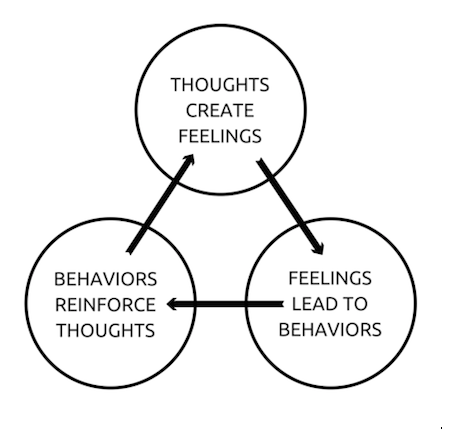
Thoughts, feelings, and behaviors are intertwined. Thoughts affect how we act and feel. Feelings affect how we think and act. Behaviors affect how we think and feel.
Events trigger cycles of thoughts, feelings, and behaviors. As an example, let’s say you failed an Organic Chemistry exam.
Thought: “I am not doing well in Orgo”
Feeling: worry, determination, some fear
Behavior: getting a tutor, studying hard
This cycle is helpful.
But the cycle can also be destructive.
Thought: “I am stupid and will fail out of school”
Feeling: despair, self-hatred, shame, paralyzing fear
Behavior: inability to study, self-destructive coping mechanisms, crying in the library
What makes the difference? The helpful cycle is rooted in truth, while the self-destructive one is based in falsehood. Furthermore, the destructive cycle is self-reinforcing. Maladaptive behaviors aggravate negative feelings and reinforce the underlying disordered belief. This can spiral out control, and can sometimes develop into mental illnesses like depression and anxiety.
The basis of disordered thinking
People who struggle with self-destructive cycles of feelings and behavior usually have a set of dysfunctional core beliefs about reality. In other words, disordered thinking comes from a distorted relationship with reality.
Biological causes underlie these dysfunctional core beliefs. Examples of potential causes include underdeveloped neural circuits, disorganized communication, or imbalances in the brain structures of the cognitive system. For instance, an improper relationship between the amygdala (the fear center of the brain) and the prefrontal cortex (the locus of rational thoughts) can underlie an irrational fear.
Through the thought-feeling-behavior cycle, these maladaptive neural circuits get stronger. In other words, they become consolidated and are hard to change.
How CBT breaks the cycle
CBT starves the monster of disordered thinking. It takes advantage of neuroplasticity, the brain’s ability to change, to replace maladaptive neural circuits with new ones. In other words, CBT “builds circuits for truth.”
The first step is to help the client recognize false thoughts. The client is trained to be a scientist, putting her thoughts under the microscope to examine the evidence for and against the thoughts, instead of assuming that they are true. For instance, if a patient believes he is unworthy of love because he is imperfect, he might be challenge that thought by observing that he loves his friends, though they themselves are flawed.
Then, the therapist works to align the client’s core beliefs with reality through cognitive restructuring. Behavioral experiments are one particularly effective strategy. Again, the client is like a scientist. First, she makes predictions based on her core beliefs. Then, when a client acts, she observes the outcomes, and reflects on how the results should change her core beliefs.
Truth and human flourishing
The goal of CBT is to orient the client toward truth. When this happens, we can truly begin to flourish again. In my experience, CBT changed the whole triangle:
- Thoughts. I learned to align my thoughts with the truth of the reality beyond me.
- Feelings. The landscape of my interior life was transformed. Dark clouds of continual rumination were scattered. This made room for boundless joy, and built resilience in front of life’s difficulties.
- Behavior. I gradually stopped engaging in self-destructive behavior, bringing new life to my friendships, work, and – especially – my relationship with God.
As Jeffrey M. Schwartz writes, “We spend a considerable amount of our time engrossed in following deceptive brain messages until we begin to see them for what they are and value our true emotions and needs.” And when this change happens, we start to chase after the good. We have time and energy to truly come alive. We can pour ourselves into study, romance, faith, beauty, community, and simple joy.
Don’t get me wrong: getting rid of dysfunctional core beliefs is hard. It’s a long and slow battle to correct your neural circuits. But as Aquinas wrote:
“Augustine says… ‘It is better to limp along the way than to walk briskly off the way.’ For one who limps along the way, even though he makes just a little progress, is approaching his destination; but if one walks off the way, the faster he goes the further he gets from his destination.”
Progress can by pitifully slow. But recovery is worth it.
Christ, the origin and end of flourishing
Ultimately, we don’t recover through willpower alone. Recovery is always a grace, is always bestowed as a gift. Christ is the way, the truth and the life: He is the one to set us free. So your task is to remain open to receiving this gift. Open yourself to recovery. Open yourself to encountering the healing truth of Christ’s loving presence.
Part of that healing can be therapy. There is no shame in asking for professional help along your journey; God often heals us through doctors and therapists. Whatever it takes, seek to “build circuits for truth,” and this will set you free from disordered thinking.
Further reading recommendations
Here is an interesting review of the neural circuits underlying stress disorders.
Dr. Jeffrey M. Schwartz’s book “You Are Not Your Brain” uses excellent science, and is particularly useful for anyone struggling with unhealthy thinking.

About Synapses of the Soul
You can contact Sofia at [email protected]. You can read more about the author here.
Previous Post

November 1, 2018
What matters in the end?
Next Post
November 11, 2018 Your brain on prayer
Browse Our Archives
Select a Category Monthly Roundup Series: Habits Uncategorized
Select a Month November 2020 October 2020 September 2020 August 2020 July 2020 June 2020 May 2020 April 2020 January 2020 December 2019 November 2019 October 2019 September 2019 August 2019 March 2019 February 2019 January 2019 December 2018 November 2018 October 2018 September 2018 August 2018
TAKE THE
Religious Wisdom Quiz
Who interpreted the "writing on the wall" for King Belshazzar?
Select your answer to see how you score.
Jeremiah Ezekiel Isaiah Daniel
Related posts from Synapses of the Soul


Your Life Should Cause Cognitive Dissonance


Does Your Mind Extend Into the World?
TRENDING AT PATHEOS Catholic

The Parable Of The Sower And The Word...
One of Christ’s most famous parables is that of the sower who...

Rejecting Doom: Christian Hope And Human Action
Christianity is a religion of hope. We are to have hope and...

Why I Choose the Eucharist Over the Sermon
Choose the Eucharist, Not the Sermon What are we supposed to get...

5 Design Elements Found in Spiritually Rooted Homes
Putting Spirituality Into Home Decor Our homes are more than our living...

Credo: A Story of God Told with the...
About 10 years ago, I began to imagine a personal "Credo" that...

The Anatomy of Divine Revelation in Catholic Thought
The claim that God has made Himself known to human beings is...
view all Catholic blogs
Ad-Free & Subscriber Log-In Subscription Support
- About Us
- 2026 Calendar
- Videos
- Podcasts
- Library of World Religions
- Faith In Media Tracker
- Advertise With Us
- Write for Us
- Privacy Policy
- Terms of Service
- Do Not Sell My Data
- Contact Us
- Radiant Digital
- Manage Newsletter Subscriptions
- Unsubscribe From Notifications
- Sitemap
Copyright 2008-2026, Patheos. All rights reserved.
Subscription Support Ad-Free & Subscriber Log-In
Follow Patheos